Lost by Gregory Maguire, published in 2001, is a psychological ghost story that blends literary homage, psychological introspection, and gothic horror. Known for his imaginative reworkings of classic tales (notably Wicked), Maguire this time crafts an eerie, metafictional journey that draws on the legacy of Charles Dickens, especially A Christmas Carol, and classic English ghost stories. The novel follows American author Winifred Rudge as she travels to London for inspiration and becomes ensnared in unsettling events involving spectral disturbances, family history, and buried traumas.
Plot Summary
Winifred Rudge returned from Cape Cod beneath a gray sky slit with wind, late for her appointment and distracted enough to miss her exit. The highway pooled with stormwater, and she, ever the rule-breaker, slipped illegally into the carpool lane. Her reward was front-row witness to calamity – a white pine shearing in the wind, cartwheeling into a Subaru, the scream of twisted metal and sleet. Winifred was the first to step into the rain and search for signs of life. In the back seat, shrouded in pine branches, she found a child – or rather, a life-size Raggedy Ann, absurdly strapped into a booster seat, a decoy where a real life should have been.
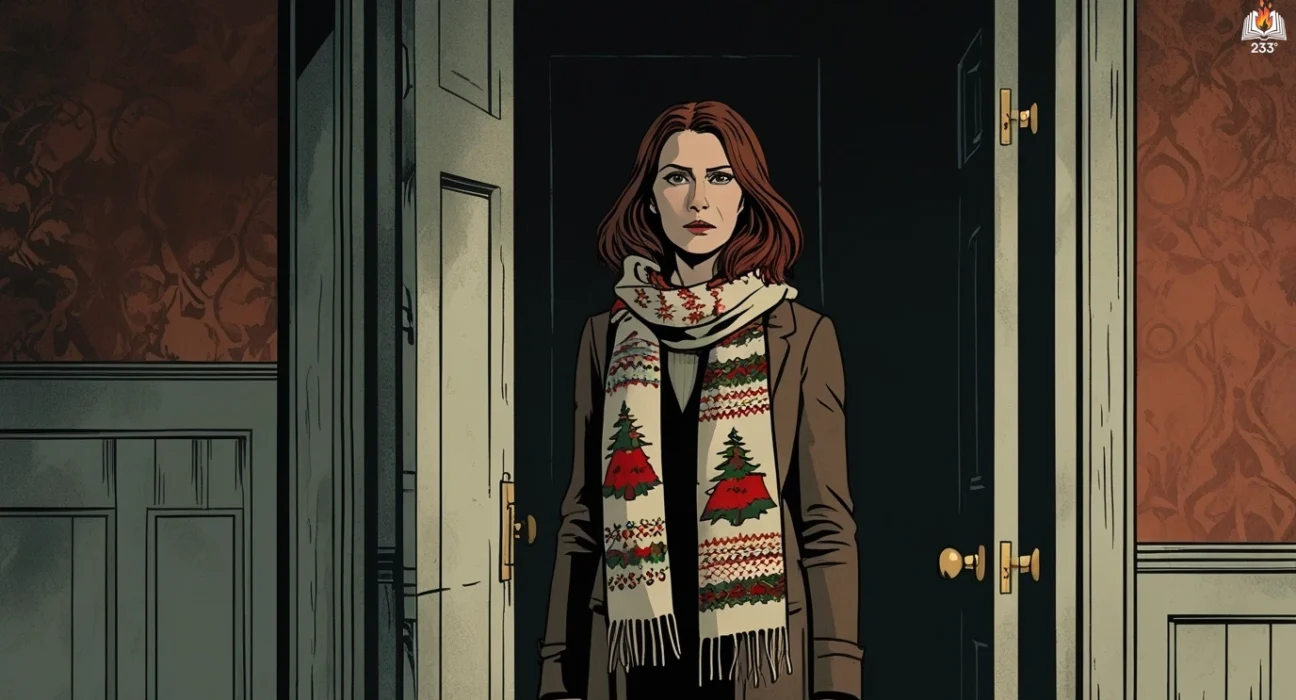
Though no heroics were required, the moment left her unsettled, steeped in gasoline and adrenaline, reluctant to meet her appointment but compelled nonetheless. She arrived at the community center for a seminar hosted by Forever Families, a group that matched children to the childless. Around her, couples clung together, grateful for each other, expectant of something beyond themselves. Winifred, alone, was the outlier, shrouded in a holiday scarf patterned with Fezziwigs and evasions. She had come not to adopt, but to observe. Her latest project – a book, perhaps – demanded detail, and detail she would harvest, quietly and uninvited.
Among the registrants were those desperate to fill holes in their lives: the Boudreaus, who had lost their children to a house fire; the Schimels, navigating the void left by a hysterectomy; Adrian and Geoff, a gay couple seeking their place in a world slow to recognize it. Each story bled into the next, a roomful of strangers revealing their wounds in exchange for the promise of a child.
The seminar’s leader, Mabel Quackenbush, ran the show with weary compassion and corporate efficiency. She called for introductions and role-playing, passing out photocopies and slogans. Winifred, resisting the performance, kept to herself until Adrian Moscou, part fourth-grade teacher and part provocateur, exposed her real purpose. She was a writer, not a hopeful parent. The room chilled around her. Mabel excused herself to consult the head office. When she returned, she asked Winifred to leave. The paperwork hadn’t matched. Her pseudonym had triggered alarms. The childless assembly, momentarily sympathetic, watched her exile in silence.
Outside, Winifred cast off her scarf – her bit of Dickensian camouflage – and let it flutter like a vanishing banner into the storm. Her car skated home through sleet, her house on Huxtable Street waiting with locked doors and flickering lights. Inside, her alarm screamed the wrong code. Something had triggered it, something unseen. She tried calling the security company, but no one answered. When she finally received a call, it was Adrian, apologizing for what he’d done. But the silence on the line before that had not been his voice.
That night, she packed for London. She was due to visit her stepcousin, John Comestor, and use the trip as both an escape and a continuation. Her real project – or perhaps the one haunting her from the margins – was Wendy Pritzke, a fictional character not yet shaped, who might adopt a child in Romania or trace spectral footsteps through Whitechapel. Winifred was uncertain where Wendy began and she ended. The writing had not yet told her.
Her flight to London was nearly empty, the seats sparsely filled, the stewardess yawning through safety protocols. As the plane cut through clouds and de-icer streaked her window like diluted blood, Winifred dozed in and out, cataloging sensations, harvesting them for later. London awaited – literary London, the one she’d built from childhood books. Not Bloomsbury’s intellectual salons but Cherry Tree Lane, Kensington Gardens, the alleys where Peter Pan still flitted in oak leaves. Yet this England felt hostile, stripped of its charm, a backdrop for something more twisted.
At Rudge House in Hampstead, something was amiss. John was gone. His flat was upended by renovations, drop cloths draped like shrouds, and a smell of sewage clinging to the air. There was no note, no forwarding contact, only the unsettling silence of abandonment. She phoned Malcolm Rice, John’s friend and adviser. He offered no information. The phrase I couldn’t say hung between them, thick with implication.
Winifred, hungry and uneasy, dined alone in Hampstead Village, trying to conjure Wendy Pritzke. Wendy was stronger than she was, lustier, braver. Wendy would not eat vinaigrette and sadness. Wendy would devour sausages and secrets. But the boundary between them blurred, and as the night stretched on, Winifred’s own story seemed to tilt toward something gothic, something shadowed.
She filled her notebook with fragments. Children with ghost eyes waiting at her door. Clocks blinking 00:00. The sense that she had not come to London but had been summoned. And always, the question that Adrian had posed lingered: Who would she want to be haunted by? It was not a matter of choice. The haunting had already begun.
Strange disruptions mounted. The phone line hissed, alarms misfired, lights dimmed. In the flat, a presence thickened – not John, not memory, something older. Winifred began exploring the idea that her ancestor, the long-dead Rudge of Rudge House, might still linger in brick and dust. She dove into archives, finding tangents – Dickens, ghost stories, Jack the Ripper – all weaving into the growing sense that her visit was less research and more invocation.
The line between imagination and intrusion thinned. In one room, a child’s voice whispered. In another, a curtain moved without breeze. Winifred, ever the rationalist, documented each incident like footnotes, yet the pages accumulated like evidence against her disbelief.
She found herself drawn to Thrawl Street, a place tied not to her cousin or her writing but to a primal fear, a need to uncover some obscured history. The ghost was not a metaphor. The past she was uncovering was not thematic. It was personal. Rudge House was not merely haunted – it was claiming her, testing her, forcing her into a story older and more brutal than she’d intended to write.
Her nights became dense with dreams and visitations. Each object in the house began to echo. She stumbled on letters that weren’t hers, found doors that opened into old air. And always, the presence thickened – that of Marley, perhaps, or Wendy, or someone unnamed. Someone watching through the glass, someone who had never truly left.
Still, she stayed. She let the haunting unfold, not resisting it but listening. This was not the book she meant to write. But it was the only one that would write itself.
Main Characters
Winifred Rudge (Winnie): A sharp, self-critical American novelist in her 40s, Winnie is haunted by both literal and metaphorical ghosts. Disillusioned and struggling creatively, she travels to London to visit her stepcousin and seek inspiration for her next book. She is sardonic, intelligent, and psychologically complex, gradually unraveling both a mystery and parts of herself.
John Comestor: Winnie’s stepcousin and the current resident of Rudge House in Hampstead. His sudden disappearance upon Winnie’s arrival becomes a central mystery. A cosmopolitan and enigmatic man, John symbolizes familial detachment and unresolved histories.
Adrian Moscou: A fellow registrant at the Forever Families seminar, Adrian is sharp, socially observant, and a bit provocative. His casual revelation of Winnie’s true identity as a writer forces a confrontation that escalates her alienation. Adrian’s role introduces the motif of observation and exposure.
Mabel Quackenbush: The overly perky and controlling Forever Families facilitator. Her pseudo-compassionate speech and rigid administrative demeanor offer a satirical commentary on bureaucratic empathy. She serves as a foil to Winnie’s sarcasm and internalized loss.
Wendy Pritzke: A fictional character within Winnie’s in-progress novel, Wendy is an alter ego – a device that allows the narrative to explore layers of identity, reality, and creation. Her imagined journey mirrors and refracts Winnie’s own psychological voyage.
Theme
Haunting and the Ghosts of the Past: Central to the novel is the idea of being haunted – not just by spirits, but by family legacy, lost ambitions, and memories. This is manifested both literally (with ghostly presences in Rudge House) and metaphorically, particularly through the character of Marley and references to A Christmas Carol.
Creative Paralysis and Identity: Winnie’s status as a blocked writer becomes a rich field for exploring how personal trauma and fear can stifle creativity. The creation of Wendy Pritzke symbolizes an internal struggle with identity, authorship, and the fear of irrelevance.
Loss and Displacement: The narrative delves into various forms of loss – infertility, death, missed connections, and the erosion of personal relationships. It critiques the commodification of grief, especially in settings like Forever Families, while also sympathizing with the real pain behind each character’s story.
Metafiction and Literary Echoes: Maguire weaves in homages to Dickens, Barrie, and other literary figures to blur the lines between fiction and reality. This intertextuality amplifies the sense of dislocation and invites the reader to question the authenticity of memory and narrative.
Isolation and Belonging: Winnie’s outsider status, both as a solo woman in a family adoption seminar and an American in England, underscores a broader meditation on belonging. The novel questions whether roots are something one finds, creates, or escapes from.
Writing Style and Tone
Gregory Maguire’s prose in Lost is intricate, layered, and often deeply introspective. He frequently employs long, rhythmically varied sentences that mimic the wandering quality of memory and thought. His diction is elevated, sometimes arch, reflecting Winnie’s literary bent and internalized commentary on the world around her. This style supports the psychological depth of the novel, allowing readers to inhabit Winnie’s fragmented mental and emotional states.
The tone of the novel oscillates between sardonic and melancholic, with flashes of gothic horror and dark comedy. Maguire deftly merges the banal with the uncanny: mundane social rituals are tinged with eerie discomfort, and spectral moments are rendered with almost journalistic precision. The result is a tone that feels both intimate and disquieting, like a ghost story whispered over a cup of coffee in a rain-lashed London flat.
Maguire’s mastery lies in his ability to create discomfort not through overt terror but through creeping unease. He places the reader in a liminal space – between belief and skepticism, between reality and invention. Much like his protagonist, the reader is left to sift through fragmented truths and ghostly suggestions, questioning the very nature of story and self.
Quotes
Lost – Gregory Maguire (2001) Quotes
“How easily Neverland is corrupted into the deserted island of Lord of the Flies . How quickly Tinkerbell regresses to being one of the flies pestering the gouged eye sockets of the pig that the lost boys butcher.”
“It was mild monsters like these that made Jack the Ripper go after young women, she decided: who could tolerate yielding the world to someone who behaved as if she had given birth to the very world herself?”
“How she wanted to put away adult things and go back to seeing through a looking-glass, darkly.”
“The sun is the biggest metaphor. The sun is the first candle. She can get there by its light.”
“No wonder Wonderland isn't funny to read anymore: We live there full time. We need a break from it.”
“If you have an ancestor who is a Benedictine monk, we would rather not know it.”
“The division of one day from the next must be one of the most profound peculiarities of life on this planet. It is, on the whole, a merciful arrangement. We are not condemned to sustained flights of being, but are constantly refreshed by little holidays from ourselves. . . .”
“The chronic fun of writing, the distraction of it, was not knowing.”
We hope this summary has sparked your interest and would appreciate you following Celsius 233 on social media:
There’s a treasure trove of other fascinating book summaries waiting for you. Check out our collection of stories that inspire, thrill, and provoke thought, just like this one by checking out the Book Shelf or the Library
Remember, while our summaries capture the essence, they can never replace the full experience of reading the book. If this summary intrigued you, consider diving into the complete story – buy the book and immerse yourself in the author’s original work.
If you want to request a book summary, click here.
When Saurabh is not working/watching football/reading books/traveling, you can reach him via Twitter/X, LinkedIn, or Threads
Restart reading!