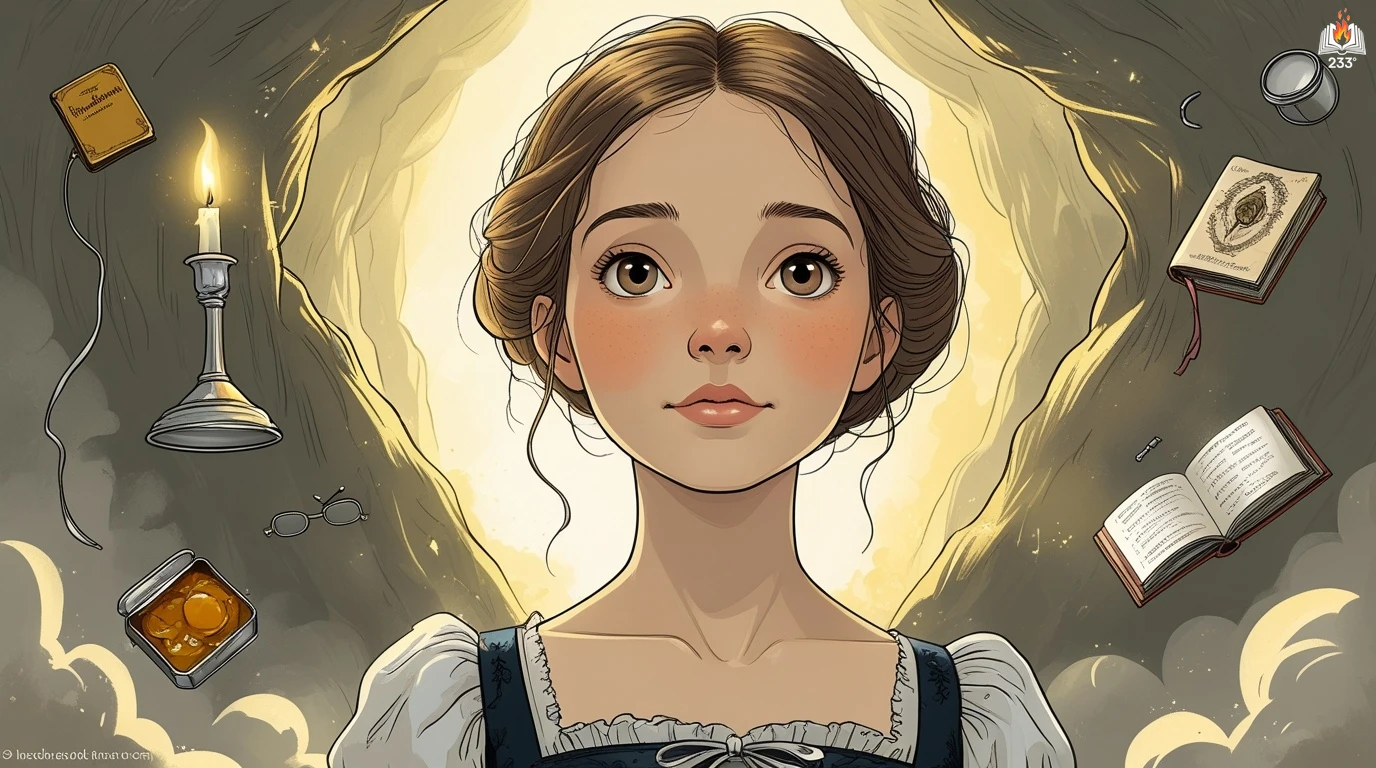
Mirror Mirror by Gregory Maguire, published in 2003, is a richly woven reimagining of the Snow White fairy tale set against the turbulent backdrop of early 16th-century Italy. Infused with Renaissance intrigue, political manipulation, and religious intensity, the story unfolds in the time of Cesare and Lucrezia Borgia. Maguire blends historical fiction and fantasy to explore power, innocence, and corruption, turning the mirror not only upon its characters but also upon the reader.
Plot Summary
In the hills of Montefiore, tucked between the folds of Tuscany and Umbria, a child named Bianca de Nevada lived in the care of her father, Don Vicente, a scholarly and soft-spoken man. Their villa, remote and lifted above the chaos of the world, seemed a safe cradle from which the child viewed existence. The red-tiled roofs, the winding poplar-flanked roads, the crofts and kitchen fires below – all whispered of routine and quiet devotion. Bianca’s world was filled with minor wonders: the warmth of Primavera Vecchia’s raucous affection, the priest Fra Ludovico’s half-true sermons, the drone of farm work, and the memory of a mother she had never known.
Bianca’s birth, tangled in the tragedy of her mother’s death, was shrouded in tales. Primavera called her a snow-borne babe; Fra Ludovico claimed her mother had ascended directly to heaven. Her father said little, only that the past was past and what lived was what mattered. For Bianca, the world was her father’s gaze, the fields of Montefiore, and the glimmering mirror they had fished from the lake – a piece of impossible craftsmanship whose smooth face seemed to hum with secrets.
Into this quiet stepped danger, garbed in silk and steel. Cesare Borgia and his sister Lucrezia arrived under a bloodred moon, trailing retinues and ambitions. Don Vicente, once tied to the courts of Rome, could not refuse their sudden need for refuge. Cesare – a man with a predator’s grace and a soldier’s thirst – busied himself with affairs of state. Lucrezia – calculating, luminous, and terrifyingly poised – turned her gaze elsewhere.
Montefiore, briefly, became a stage. Cesare spoke of alliances, of Ottoman hostages, of princely pawns. Lucrezia wandered the grounds like a flame uncorked, her curiosity sharpened by boredom and desire. She discovered the mirror. The glass, framed with elegance, offered her not just a reflection but a promise. In it, she saw not herself but the power of gazing, the authority of beauty. She touched its surface and began to ask it questions not with her lips, but with her intentions.
In time, Don Vicente was summoned to Rome by Cesare, entrusted with a mission to deliver the imprisoned Prince Dschem to the Pope. His journey was reluctant, his parting from Bianca sorrowful and cold, as if shadowed by things left unsaid. He gave strict orders – Bianca was not to leave Montefiore, no matter what. Her safety, he said, depended on silence and stillness.
But safety was a fiction. Once Vicente departed, Lucrezia laid her plans. Bianca’s beauty, ripening into the kind that turned heads and twisted hearts, ignited Lucrezia’s envy. She contrived to have the girl sent away – not merely removed but erased. She ordered a huntsman to take Bianca into the woods and kill her, bringing back proof in the form of her heart. The act, clean and final, would solve Lucrezia’s problem.
Yet the heart returned belonged not to Bianca, but to a wild boar. The huntsman, unable to perform the act, had let her flee into the forest. There, in the wilderness beyond the bridge she was never allowed to cross, Bianca found refuge with seven dwarves – ancient, strange beings who moved through the world unnoticed and forgotten. They were not of the mortal rhythm. They lived slowly, deliberately, like stone made sentient.
These dwarves, more elemental than human, took Bianca into their home under the hills, not for pity, but because the world outside had lost its balance and needed bearing. They taught her silence and shadow, the patience of earth and the memory of trees. Time passed differently underground. Bianca shed her childhood like a skin.
Meanwhile, Don Vicente, betrayed by Cesare, was imprisoned in Rome, a prisoner more symbolic than strategic. Cesare had no further need of him – his usefulness had ended the moment he had delivered the prince. Rumors spread: of poisoning, of deaths arranged like pieces on a chessboard. Bianca’s name was not spoken, for in Lucrezia’s mind, she had already vanished.
But the mirror remembered.
Lucrezia, believing herself triumphant, continued to gaze into the glass. She sought reassurance, but found herself haunted by a face she had thought erased. Bianca’s image lingered on the edge of the reflection – not in the center, not bold, but in the corners, like a thought she could not suppress. The glass, though unvoiced, began to betray its new mistress. Her beauty waned in her eyes, her power looked borrowed. She aged not in face, but in certainty.
The dwarves, sensing the world’s tilt, agreed that it was time. Bianca returned, walking the slope to Montefiore with the quiet surety of someone who has passed through fire. Her presence was spectral. No one announced her. No trumpet or drum called attention. She simply appeared.
The confrontation between her and Lucrezia held no swords, no curses. It was a still moment, like the second before lightning. Bianca stood before the mirror, and Lucrezia looked again, and this time saw not just beauty, but judgment. She saw herself as she truly was – vain, brittle, hollow.
It was the mirror that chose.
Lucrezia, broken by the image it gave back to her, fell not by poison or blade but by despair. Whether she was driven mad or died of her own illusions was never clear. Cesare vanished into the noise of politics and war, and Don Vicente, long presumed dead, returned thin and quiet, to find his daughter alive and changed.
Montefiore once again stood silent and remote, the mirror hanging heavy on its wall, reflecting no magic, no illusions, only the light of passing days. Bianca remained, not a princess nor a ghost, but a woman who had crossed beyond childhood into something older, something wiser. She watched the seasons turn. She stood where the hills opened to the south and let the wind play through her hair, not waiting, not hoping – simply present.
The mirror never spoke again.
Main Characters
Bianca de Nevada: The heart of the narrative, Bianca is a young girl of ethereal beauty and quiet intelligence. Sheltered in the remote villa of Montefiore, she grows up under the protection of her father, unaware of the political machinations that will soon entrap her. Her journey from innocence to awakening is both poignant and perilous.
Don Vicente de Nevada: Bianca’s father, a scholar and former advisor to the Papal legates, is a quiet man driven by a deep sense of duty and love. His attempts to protect his daughter lead him into peril when he becomes entangled in a scheme involving the Borgias and a mysterious mirror.
Lucrezia Borgia: The infamous historical figure is reimagined here as both seductress and villain, her ambition, vanity, and cunning driving much of the novel’s conflict. Her interactions with Bianca are charged with malice masked by politeness.
Cesare Borgia: Lucrezia’s brother, a ruthless military leader with charm and cruelty in equal measure. His presence underscores the danger of political gamesmanship in a world where alliances shift with the wind.
Primavera Vecchia: Bianca’s coarse, wise, and comically blunt nursemaid, she grounds the story with her earthy humor and raw emotional insight. Despite her abrasive ways, she serves as a protective maternal figure.
Fra Ludovico: A local priest with a sardonic wit, his philosophical musings and dry commentary add moral ambiguity to the tale. His dynamic with Primavera provides comic relief and occasional wisdom.
Theme
Innocence and Corruption: At the novel’s core is the contrast between Bianca’s purity and the debauchery of the world around her, especially embodied by the Borgias. Maguire uses this tension to question whether innocence can survive in a world defined by manipulation and sin.
Power and Gender: The novel scrutinizes how power is wielded, especially by women like Lucrezia who must navigate a patriarchal society through sexuality, cunning, and calculated performance. Bianca’s transformation mirrors the trials of girlhood in a world that commodifies beauty.
Mirrors and Self-Perception: The enchanted mirror is more than a magical object; it symbolizes the dangers of vanity and the distortions of self-understanding. Characters see themselves and others through layers of illusion and desire.
History and Myth: Maguire masterfully merges fairy tale tropes with historical realism, challenging the boundaries of truth and storytelling. The Borgia siblings are not mere caricatures of evil but deeply complex players shaped by their era.
Writing Style and Tone
Gregory Maguire’s prose in Mirror Mirror is lyrical, ornate, and laced with irony. He draws heavily on Renaissance imagery and language, blending archaic diction with sensual detail to evoke the lushness and decay of the period. His use of metaphoric language, vivid description, and philosophical asides gives the text a dreamlike, almost operatic quality. The storytelling voice often shifts perspective – from third-person narration to first-person reflections – giving readers intimate access to various inner worlds while maintaining a tone of omniscient awareness.
The tone of the novel is both whimsical and foreboding. Humor surfaces through characters like Primavera and Fra Ludovico, yet beneath the banter lies a dark meditation on mortality, beauty, and betrayal. Maguire doesn’t shy from grotesque or unsettling imagery, and the atmosphere often oscillates between the magical and the macabre. This tonal complexity allows Mirror Mirror to move beyond retelling into something richer – a gothic fable grounded in human desire and historical consequence.
Quotes
Mirror Mirror – Gregory Maguire (2003) Quotes
“The eye is always caught by light, but shadows have more to say.”
“If you're ever in doubt, throw a pepper in the air. If it fails to come down, you have gone mad, so don't trust in anything.”
“Even God used silence as a strategy.”
“She dreamed of leaving, but she had too little exposure to the world to imagine where to go.”
“I believe in the floor. I put it in place and I walk on it. Faith is a floor. If you don't work at making it for yourself, you have nothing to walk on.”
“Happiness now sometimes meant turning away from what one remembered of earlier, better happiness.”
“Speaking uses us up, speeds us up. Without prayer, that act of confession for merely existing, one might live forever and not know it.”
“But there was the mirror in which I would glimpse his handsome form, because mirrors don't lie about men, only women.”
“What more does one ask of life, really, but to stagger from moment to moment with a reason to wake and wait for the next reason to wake?”
“He had forgotten how convincing the world could look, how sure of itself: its outlines and edges; it's gradations, recessions, protrusions; it's startling and vulgar colors.”
“The years peeled slowly off, one by one, or perhaps dozens at a time.”
“I’m a priest, I know better than most when a lie is permitted.”
“Before catechisms can instill a proper humility, small children know the truth that their own existence has caused the world to bloom into being.”
“Please, I know nothing of the world, except my father is lost in it.”
“No one survives in times of war unless they make war their home. How did I get so old and wise, but for welcoming war into my house and making friends with him? Better to befriend the enemy and hang on. Something worse might come along, which might be amusing or might not.”
“Lucrezia Borgia couldn't be moved by the sentiment, nor could she forgive the insult. Old woman. Old.”
“I am a woman who slept with my father the Pope. They say I did, at least, and so does he. And who am I to make the Pope a liar, And who is he to make a liar of me?”
“She wasn't Zeus, to cause Phaëthon to stop driving the chariot of bright Helios: she couldn't halt the daily chariot of crushing light and rushing time.”
“We are never enough to ourselves because we can never be enough to another. Any one of us walks into any room and reminds its occupants that we are not the one they most want to see. We are never the one. We are never enough.”
“What did it say about the movement of time, about what was about to happen, that I could understand the hummingbird spin of human voices?”
“The question ocasionally invents the answer. (142)”
“Hello, this is I, and these are my arms and legs, which are useful, and this inconvenient hump is my sorrow, which is less than useful, but I've learned how to hump it around, so pay it no mind.”
We hope this summary has sparked your interest and would appreciate you following Celsius 233 on social media:
There’s a treasure trove of other fascinating book summaries waiting for you. Check out our collection of stories that inspire, thrill, and provoke thought, just like this one by checking out the Book Shelf or the Library
Remember, while our summaries capture the essence, they can never replace the full experience of reading the book. If this summary intrigued you, consider diving into the complete story – buy the book and immerse yourself in the author’s original work.
If you want to request a book summary, click here.
When Saurabh is not working/watching football/reading books/traveling, you can reach him via Twitter/X, LinkedIn, or Threads
Restart reading!