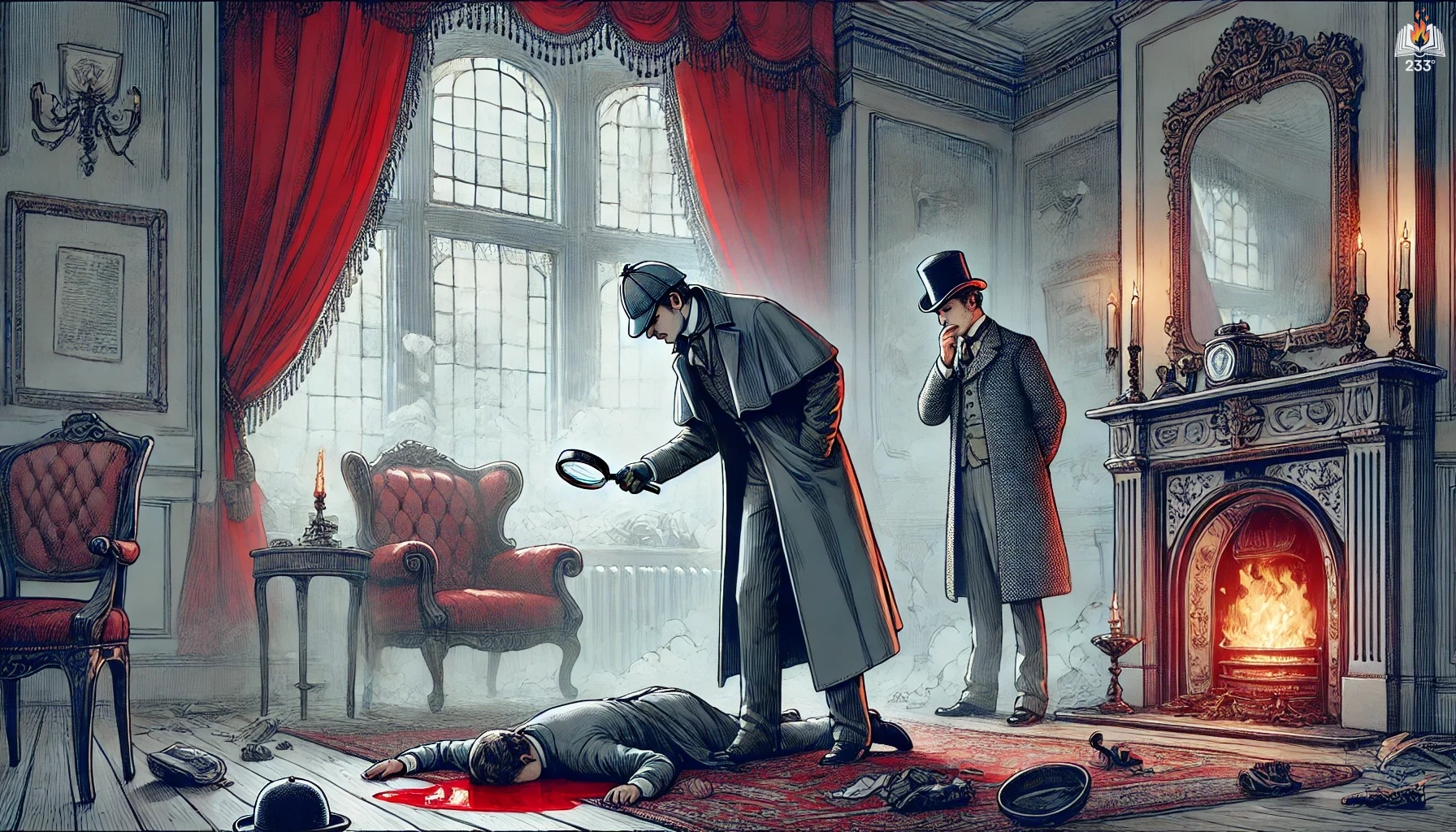
The Murder on the Links, published in 1923, is Agatha Christie’s second novel featuring the brilliant Belgian detective Hercule Poirot, part of her renowned Poirot series. Set in northern France, the novel weaves a suspenseful murder mystery around the death of a wealthy man, Paul Renauld, blending international intrigue, buried secrets, and Poirot’s unmatched investigative prowess.
Plot Summary
On a train bound for Calais, a chance encounter takes place between a reserved Englishman and a spirited young woman, her red hat askew and her manner as brash as it is charming. The gentleman is Captain Hastings, traveling with little to occupy his mind, and the girl, brimming with life, calls herself Cinderella before vanishing into the crowd. Soon after, Hastings finds himself drawn back into the world of investigation alongside his fastidious friend, Hercule Poirot, summoned by an urgent letter from a wealthy French resident, Paul Renauld.
Renauld’s letter, tinged with fear, speaks of danger, of a secret that threatens his life. But when Poirot and Hastings arrive at the Villa Geneviève in the quiet seaside town of Merlinville-sur-Mer, they are too late. The household is in turmoil – Renauld has been found dead, stabbed in the back, his body buried hastily in an open grave by the golf course he was developing. His elegant wife, Eloise, lies upstairs, recovering from her ordeal, having been bound and gagged by two masked men.
Poirot’s keen eyes miss nothing. While the French police leap to conclusions, Poirot focuses on the subtle details: a crooked hearthrug, a woman’s long black hair, and a scrap of a check marked with the name Duveen. The official investigators, led by the arrogant Inspector Giraud, focus on physical clues and footprints, while Poirot turns inward, examining motives, gestures, and the complexity of the human heart.
Eloise Renauld describes the harrowing night. Two masked intruders, speaking a rough Spanish, forced Paul from their bedroom at knifepoint. The safe in his dressing room had been emptied, and the men seemed desperate for something beyond mere money. Before leaving, Paul tried to calm his wife, whispering that he would return before morning. But he never came back. Instead, his life was taken, and his body buried like a discarded secret.
The Renauld household is full of tensions. Jack Renauld, the handsome, impulsive son, is away in South America, sent there suddenly by his father on mysterious business. Meanwhile, the local townspeople murmur about Madame Daubreuil, a beautiful woman with a shadowy past living nearby with her daughter, Marthe. Gossip hints at late-night visits, whispered affairs, and financial entanglements between Paul and Madame Daubreuil.
Poirot uncovers a passionate undercurrent in Jack’s life as well. He has been in love with Marthe Daubreuil, much to his father’s disapproval. Yet, complicating matters further, a letter emerges from a woman named Bella, written with the fury of a lover scorned. Bella Duveen, it turns out, is the sister of the fiery young actress Hastings met on the train – and she has been romantically involved with Jack. Jealousy, betrayal, and desperate love swirl through the investigation.
A second shock rattles the investigation: another body is discovered in the grave, that of a tramp who had been killed earlier. Poirot’s mind spins through the possibilities, weighing identities and timelines. Jack returns unexpectedly, only to be accused of his father’s murder when his fingerprints are found on the murder weapon. But Poirot’s faith in the young man’s innocence remains firm. He sifts through the lies and half-truths, the betrayals and loyalties.
The deeper Poirot digs, the darker Paul Renauld’s past appears. Years before, he was involved in a scandalous case in South America, under the name Paul Bernadotte, connected to a notorious affair involving a man named Georges Conneau and Madame Daubreuil, then known as Madame Beroldy. A blackmailer’s noose had tightened, and Renauld, desperate to bury his past, had been tormented by threats. Poirot realizes the masked men were no strangers but figures from Renauld’s own history.
Madame Daubreuil, once a woman of ambition and ruthlessness, emerges at the center of the web. Her daughter, Marthe, innocent in love, stands in painful contrast to her mother’s calculated schemes. Bella Duveen’s love, wild and vengeful, collides with Jack’s divided heart. Even Eloise Renauld, outwardly the grieving widow, harbors quiet secrets of her own.
Poirot’s patient unraveling of the case leads him to reconstruct the fateful night. Paul Renauld, fearing exposure, devised a plan to stage his own death, swapping clothes with a tramp and faking his disappearance. Yet his plan went awry, and his past caught up with him in the most brutal way. The masked men were not strangers but accomplices in his scheme turned enemies, and one among them, desperate and betrayed, turned the blade upon him.
The confrontation comes quietly, as Poirot gathers the household and lays bare the truth with his usual blend of delicacy and precision. Marthe and Jack, their love tested, are reunited. Bella’s rage fades into sorrow, and Madame Daubreuil’s cold schemes crumble. Inspector Giraud, forced to swallow his pride, departs in silence, while Poirot, triumphant yet modest, gently tidies the disorder left behind.
As the days pass, the villa slowly returns to peace. Hastings, ever the romantic, finds his thoughts drifting to Cinderella, the lively girl from the train, whose wit and warmth linger in his mind. Poirot, meanwhile, turns to his next case, his sharp eyes already seeking the next puzzle to challenge his mind.
The murder on the links has been solved, but its echoes remain – in the hearts broken and healed, in the truths uncovered and the lies laid bare, and in the quiet triumph of a little man with a great mind, who once again reminded the world that order, method, and the understanding of human nature can conquer even the deepest of crimes.
Main Characters
Hercule Poirot: The meticulous, methodical Belgian detective whose “little grey cells” guide him to the heart of the mystery. Poirot is dignified, fussy, and brilliant, known for his precision, charm, and deep understanding of human nature.
Captain Arthur Hastings: Poirot’s loyal friend and the story’s narrator, Hastings is a well-meaning but often naïve companion. His romantic inclinations and traditional views contrast sharply with Poirot’s rational mind, adding humor and humanity to the narrative.
Paul Renauld: The wealthy South American businessman whose murder sparks the investigation. Renauld is portrayed as secretive, anxious, and caught between a troubled past and a precarious present.
Eloise Renauld: Paul’s elegant and strong-willed wife, deeply affected by her husband’s murder. Eloise’s calm exterior masks her pain, and her unwavering devotion becomes a poignant element in the case.
Jack Renauld: The Renaulds’ impulsive and hot-tempered son. His complicated romantic life and strained relationship with his father make him both a suspect and a sympathetic figure in the investigation.
Bella Duveen: A fiery, passionate young woman linked romantically to Jack, Bella’s jealousy, devotion, and vulnerability cast her as both a threat and a victim within the tangled web of motives.
Madame Daubreuil and Marthe Daubreuil: Mysterious neighbors with a hidden connection to Renauld’s past. Madame Daubreuil’s calculated maneuvers and Marthe’s love for Jack introduce layers of tension and suspicion.
Inspector Giraud: The arrogant detective from the French Sûreté, whose reliance on physical clues clashes with Poirot’s psychological approach, creating a rivalry laced with humor and intellectual competition.
Theme
Order vs. Chaos: Poirot’s obsession with order reflects the struggle to impose reason on the chaos of human emotions, lies, and violence. The contrast between his approach and the messy reality of crime underscores the central tension of the novel.
Jealousy and Betrayal: Romantic jealousy drives several characters, leading to betrayal, violence, and despair. Bella’s fierce love and Madame Daubreuil’s ambition show how passion can twist into destruction.
The Mask of Respectability: Many characters hide behind façades — wealthy homes, polite manners, or societal roles — while harboring secrets and desires. Christie explores how these masks crumble under scrutiny.
Justice and Truth: The novel raises questions about legal justice versus moral justice. Poirot often seeks the deeper truth, navigating around official procedures to uncover what the heart knows but the law might miss.
Writing Style and Tone
Agatha Christie’s writing in The Murder on the Links is brisk, witty, and elegantly plotted, marked by sharp dialogue and vivid descriptions. Through Hastings’ narration, Christie strikes a conversational tone, blending the warmth of friendship with the chill of murder. Hastings’ dry humor and romantic idealism balance Poirot’s cerebral investigations, creating a rhythm that feels both intimate and suspenseful.
Christie masterfully constructs the mystery with multiple red herrings, shifting perspectives, and timed revelations. Her prose is deceptively simple, allowing character nuances and plot intricacies to emerge organically. The tone oscillates between lighthearted banter — particularly in the Hastings-Poirot dynamic — and the darker undercurrents of crime and human weakness, producing a tapestry that is both entertaining and psychologically rich.
Quotes
The Murder on the Links – Agatha Christie (1923) Quotes
“Two people rarely see the same thing.”
“Now I am old-fashioned. A woman, I consider, should be womanly. I have no patience with the modern neurotic girl who jazzes from morning to night, smokes like a chimney, and uses language which would make a billingsgate fishwoman blush!”
“The heart of a woman who loves will forgive many blows.”
“When will a woman lie? Sometimes for herself. Usually for the man she loves. Always for her children.”
“My friend, in working upon a case, one does not take into account only the things that are "mentioned". There is no reason to mention many things which may be important. Equally, there is often an excellent reason for not mentioning them.”
“Man is an unoriginal animal. Unoriginal within the law in his daily respectable life, equally unoriginal outside the law. If a man commits a crime, any other crime he commits will resemble it closely.”
“It would mean a good film, the story that you have recounted to me there - but it bears no sort of resemblance to everyday life.' 'I admit that I haven't gone into all the details, but-' 'You have gone farther - you have ignored them magnificently.”
“The little grey cells, my friend, the little grey cells! They told me.”
“There! Now we're friends!" declared the minx. "Say you're sorry about my sister -" "I am desolated!" "That's a good boy!”
“Some of the greatest criminals I have known had the faces of angels.”
“For whom will a woman lie? Sometimes for herself, usually for the man she loves, always for her children.”
“Arrange your ideas. Be methodical. Be orderly. There is the secret of success.”
“Your idea of a woman is some one who gets on a chair and shrieks if she sees a mouse. That’s all prehistoric.”
“A malformation of the grey cells may coincide quite easily with the face of a Madonna.”
“The sons of rich men are proverbially wild.”
“A rich man and his money are not so easily parted. Me, I have seen a well-known millionaire turn out a tramful of people to seek for a dropped halfpenny.”
“I had learned, with Poirot, that the less dangerous he looked, the more dangerous he was.”
“It is love that has come
“I neither see nor comprehend. You make all these confounded mysteries, and it’s useless asking you to explain. You always like keeping something up your sleeve to the last minute.”
“You speak of my manner to you being insulting. Well, once or twice, your manner has annoyed me " "I am enchanted to hear it," said Poirot.”
“If it is necessary for a criminal to be a consummate actress, then by all means assume her to be one.”
“[...] She is not for you, that one! Take it from Papa Poirot!”
“Pardon, monsieur, for interrupting, but was that a common practice of his?” “No, it was not, but old Françoise has the common idea as regards the English—that they are mad, and liable to do the most unaccountable things at any moment!”
“Height, five feet four inches, egg-shaped head carried a little to one side, eyes that shone green when he was excited, stiff military moustache, air of dignity immense!”
“We established ourselves on the grassy knoll as Poirot had suggested,”
“Poirot’s incurable habit of making a mystery out of nothing never failed to irritate me.”
“This hunting of the fox, you need the dogs, no?' 'Hounds,' I corrected gently. 'Yes, of course.' 'But yet,' Poirot wagged his finger at me. 'You did not descend from your horse and run along the ground smelling with your nose and uttering loud Ow Ows?”
“I believe that a well-known anecdote exists to the effect that a young writer, determined to make the commencement of his story forcible and original enough to catch and rivet the attention of the most blasé of editors, penned the following sentence: “‘Hell!’ said the Duchess.”
“Now I am old-fashioned. A woman, I consider, should be womanly. I have no patience with the modern neurotic girl who jazzes from morning to night, smokes like a chimney, and uses language which would make a Billingsgate fishwoman blush! I”
We hope this summary has sparked your interest and would appreciate you following Celsius 233 on social media:
There’s a treasure trove of other fascinating book summaries waiting for you. Check out our collection of stories that inspire, thrill, and provoke thought, just like this one by checking out the Book Shelf or the Library
Remember, while our summaries capture the essence, they can never replace the full experience of reading the book. If this summary intrigued you, consider diving into the complete story – buy the book and immerse yourself in the author’s original work.
If you want to request a book summary, click here.
When Saurabh is not working/watching football/reading books/traveling, you can reach him via Twitter/X, LinkedIn, or Threads
Restart reading!