

“Anne of Green Gables,” written by Lucy Maud Montgomery and published in 1908, is a beloved classic of children’s literature. Set in the rural community of Avonlea on Prince Edward Island, the story follows the adventures of Anne Shirley, an imaginative, talkative, and fiery-haired orphan mistakenly sent to live with Marilla and Matthew Cuthbert, a brother and sister who had initially planned to adopt a boy to help with farm work. Montgomery’s novel captures the beauty of nature, the joy of imagination, and the trials of growing up, while also exploring deeper themes of belonging, identity, and self-acceptance.
Plot Summary
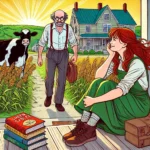
When Matthew Cuthbert set out from Green Gables in his buggy that June afternoon, he had no idea that the simple errand of picking up an orphan boy would turn into the most unexpected and life-changing event of his quiet life. Matthew, a shy and silent man who rarely ventured far from the farm he shared with his stern sister, Marilla, was surprised when he arrived at the station to find not a boy, but a thin, freckled girl with bright red hair, waiting for him with wide, eager eyes. This was Anne Shirley, a talkative, imaginative orphan who had spent her short life bouncing from one caretaker to another, never knowing the warmth of a true home.
Anne’s arrival at Green Gables was a mistake. Marilla had requested a boy, one strong enough to help Matthew with the farm work. When she discovered Anne instead of a boy, Marilla was ready to send her back to the orphanage at once. But Anne’s expressive face, her fierce longing for a place to belong, and her boundless imagination began to work their way into Matthew’s heart. While Marilla remained firm in her resolve, Matthew quietly advocated for Anne to stay, feeling that sending her back would be too cruel. After some hesitation, Marilla agreed to keep Anne, at least for the time being.
From the start, Anne brought both joy and chaos to Green Gables. Her wild imagination and tendency to get lost in daydreams led to a series of humorous mishaps. On her very first day of school, she broke a slate over the head of Gilbert Blythe, a classmate who dared to tease her about her red hair. This act of defiance sparked a rivalry between Anne and Gilbert, though Gilbert quickly regretted his teasing and tried to make amends. Anne, however, held a stubborn grudge, refusing to forgive him for many years.
Life in Avonlea was not always easy for Anne. She had to adjust to Marilla’s strict rules and the quiet routine of farm life, and she often struggled with feelings of insecurity, especially regarding her appearance. Anne was deeply self-conscious about her red hair, which she saw as a curse, and she longed to be beautiful like her best friend, Diana Barry, who lived nearby. Diana, with her dark hair and kind heart, became Anne’s “bosom friend,” and the two girls shared countless adventures. Anne’s vivid imagination made even the most ordinary days feel like grand stories, and Diana eagerly joined in.
One of Anne’s greatest embarrassments occurred when she accidentally got Diana drunk. Marilla had left Anne in charge of serving tea to Diana, but instead of the cordial Anne thought she was offering, she poured Diana generous helpings of homemade currant wine. Diana, who had never tasted alcohol before, became tipsy, and her horrified mother forbade her from seeing Anne again. Anne was devastated by the separation from her dearest friend, but her earnest apology and a bit of luck—when Anne saved Diana’s younger sister, Minnie May, from a deadly illness—helped restore their friendship.
As Anne grew older, her academic talents began to shine. Though she often got into trouble for speaking out of turn or letting her imagination run wild, Anne was a bright student. Her rivalry with Gilbert Blythe, who was also a top student, pushed her to excel. Eventually, both were awarded scholarships to the prestigious Queen’s Academy. Anne was overjoyed at the prospect of continuing her education and achieving her dream of becoming a teacher.
However, life took an unexpected turn. After Matthew suffered a fatal heart attack, Anne was faced with a difficult decision. Her beloved Green Gables was in danger of being lost, and Marilla, who was beginning to lose her eyesight, could not run the farm alone. In that moment, Anne chose to give up her scholarship and return to Avonlea to help Marilla. The dream of becoming a teacher was still within reach, as Anne secured a local teaching position, but her decision to stay at Green Gables was a sign of her deep love and loyalty to the home she had finally found.
In the end, Anne’s relationship with Gilbert Blythe also transformed. After years of bitterness and rivalry, Anne came to see Gilbert in a new light. When Gilbert gave up his position at the Avonlea school so that Anne could be closer to home and care for Marilla, Anne’s heart softened, and she forgave him at last. The rivalry that had defined much of their school years melted away, replaced by a friendship that hinted at something deeper in the future.
Through all of Anne’s misadventures—whether dyeing her hair green by accident, falling off rooftops, or fantasizing about life as a princess—she never lost her sense of wonder and her ability to find beauty in the smallest things. Green Gables, once a quiet and ordinary farm, had become a place of laughter, love, and endless stories, all thanks to Anne’s irrepressible spirit. Though she faced sorrow and loss, Anne never let go of her imagination or her belief that the world was a place full of magic and possibility. In Avonlea, with Marilla, Matthew, Diana, and eventually Gilbert, Anne had finally found the home she had longed for her entire life.
Main Characters
Anne Shirley: The spirited and imaginative protagonist of the story, Anne is an orphan with a boundless imagination and a talent for turning everyday moments into grand adventures. Throughout the novel, she grows from a lonely child longing for acceptance into a confident young woman. Her vivid imagination, frequent daydreams, and passionate emotions are both her greatest strengths and her biggest challenges.
Marilla Cuthbert: A strict, no-nonsense woman who initially only wants Anne to help with farm chores, Marilla is deeply practical and struggles to understand Anne’s flights of fancy. However, over time, she develops a deep affection for Anne, despite her initial reservations about raising an orphan girl.
Matthew Cuthbert: Marilla’s shy, kind-hearted brother who immediately takes a liking to Anne. Though he is quiet and reserved, Matthew’s gentle nature and quiet support play a crucial role in helping Anne feel at home at Green Gables. His soft heart contrasts with Marilla’s sternness, and he forms a close bond with Anne from the start.
Diana Barry: Anne’s “bosom friend” and closest confidante, Diana lives near Green Gables and quickly becomes Anne’s closest companion. Although less imaginative than Anne, Diana is loyal and kind, and the two share many adventures and misadventures.
Gilbert Blythe: A classmate of Anne’s who initially teases her about her red hair, calling her “Carrots.” This sets off a long-standing rivalry between them, but Gilbert eventually becomes an important figure in Anne’s life, especially as they grow older and their relationship deepens.
Theme
Imagination and Reality: One of the central themes in “Anne of Green Gables” is the power of imagination. Anne’s vivid daydreams and fantasies are an essential part of her character and serve as a coping mechanism for the difficulties she faces. Her imaginative outlook often clashes with the more practical views of the adults around her, especially Marilla. This theme explores the balance between creativity and realism.
Belonging and Family: Anne’s journey is deeply rooted in her search for a place to belong. As an orphan, she has spent much of her life feeling unwanted and unloved. At Green Gables, she finally finds a home and a sense of family with Marilla and Matthew. The novel emphasizes the importance of love, community, and family in shaping one’s identity and self-worth.
Growth and Self-Acceptance: Over the course of the novel, Anne matures from a dreamy, impulsive child into a more thoughtful and grounded young woman. Her struggles with her appearance, especially her red hair, represent her broader struggles with self-acceptance. By the end of the novel, Anne learns to embrace who she is and finds strength in her unique qualities.
The Beauty of Nature: Prince Edward Island, with its lush landscapes and beautiful natural surroundings, is almost a character in itself. The novel is filled with rich descriptions of the environment, reflecting Anne’s deep appreciation for the beauty of the world around her. Nature serves as both a source of comfort and inspiration for Anne throughout the story.
Writing Style and Tone
Lucy Maud Montgomery’s writing style in “Anne of Green Gables” is poetic, descriptive, and imbued with a sense of wonder. Her lush descriptions of the natural world vividly paint the scenery of Prince Edward Island, making readers feel as though they are experiencing the seasons and landscapes alongside Anne. Montgomery’s use of dialogue is equally lively, capturing Anne’s verbose and imaginative speech in contrast to the more restrained language of characters like Marilla. The rhythm of the novel is leisurely, allowing readers to savor the small moments of Anne’s life, from her schooldays to her quiet reflections on the world.
The tone of the novel shifts between light-hearted humor and deep emotional sincerity. While much of the story is infused with Anne’s quirky charm and humorous escapades, it also touches on more serious themes such as loss, loneliness, and the desire for love and acceptance. Montgomery strikes a balance between whimsicality and poignancy, creating a story that appeals to both children and adults with its timeless exploration of human nature and personal growth.
Quotes
Anne of Green Gables – Lucy Maud Montgomery (1908) Quotes
“I'm so glad I live in a world where there are Octobers.”
“It's been my experience that you can nearly always enjoy things if you make up your mind firmly that you will.”
“Kindred spirits are not so scarce as I used to think. It's splendid to find out there are so many of them in the world.”
“True friends are always together in spirit.”
“My life is a perfect graveyard of buried hopes.”
“Life is worth living as long as there's a laugh in it.”
“Dear old world', she murmured, 'you are very lovely, and I am glad to be alive in you.”
“People laugh at me because I use big words. But if you have big ideas, you have to use big words to express them, haven't you?”
“There's such a lot of different Annes in me. I sometimes think that is why I'm such a troublesome person. If I was just the one Anne it would be ever so much more comfortable, but then it wouldn't be half so interesting.”
“Because when you are imagining, you might as well imagine something worth while.”
“Oh, it's delightful to have ambitions. I'm so glad I have such a lot. And there never seems to be any end to them-- that's the best of it. Just as soon as you attain to one ambition you see another one glittering higher up still. It does make life so interesting.”
“It was November--the month of crimson sunsets, parting birds, deep, sad hymns of the sea, passionate wind-songs in the pines. Anne roamed through the pineland alleys in the park and, as she said, let that great sweeping wind blow the fogs out of her soul.”
“Tomorrow is a new day with no mistakes in it... yet.”
“Look at that sea, girls--all silver and shadow and vision of things not seen. We couldn't enjoy its loveliness any more if we had millions of dollars and ropes of diamonds.”
“I read in a book once that a rose by any other name would smell as sweet, but I've never been able to believe it. I don't believe a rose WOULD be as nice if it was called a thistle or a skunk cabbage.”
“That's the worst of growing up, and I'm beginning to realize it. The things you wanted so much when you were a child don't seem half so wonderful to you when you get them.”
“It is ever so much easier to be good if your clothes are fashionable.”
“We pay a price for everything we get or take in this world; and although ambitions are well worth having, they are not to be cheaply won, but exact their dues of work and self denial, anxiety and discouragement.”
“It's delightful when your imaginations come true, isn't it?”
“Next to trying and winning, the best thing is trying and failing.”
“The world calls them its singers and poets and artists and storytellers; but they are just people who have never forgotten the way to fairyland.”
“I don't know, I don't want to talk as much. (...) It's nicer to think dear, pretty thoughts and keep them in one's heart, like treasures. I don't like to have them laughed at or wondered over.”
“It's all very well to read about sorrows and imagine yourself living through them heroically, but it's not so nice when you really come to have them, is it?”
“When I left Queen's my future seemed to stretch out before me like a straight road. I thought I could see along it for many a milestone. Now there is a bend in it. I don't know what lies around the bend, but I'm going to believe that the best does.”
“I'm not a bit changed--not really. I'm only just pruned down and branched out. The real ME--back here--is just the same.”
“But if you call me Anne, please call me Anne with an 'e'.”
“Anne always remembered the silvery, peaceful beauty and fragrant calm of that night. It was the last night before sorrow touched her life; and no life is ever quite the same again when once that cold, sanctifying touch has been laid upon it.”
“Miss Barry was a kindred spirit after all," Anne confided to Marilla, "You wouldn't think so to look at her, but she is. . . Kindred spirits are not so scarce as I used to think. It's splendid to find out there are so many of them in the world.”
We hope this summary has sparked your interest and would appreciate you following Celsius 233 on social media:
There’s a treasure trove of other fascinating book summaries waiting for you. Check out our collection of stories that inspire, thrill, and provoke thought, just like this one by checking out the Book Shelf or the Library
Remember, while our summaries capture the essence, they can never replace the full experience of reading the book. If this summary intrigued you, consider diving into the complete story – buy the book and immerse yourself in the author’s original work.
If you want to request a book summary, click here.
When Saurabh is not working/watching football/reading books/traveling, you can reach him via Twitter/X, LinkedIn, or Threads
Restart reading!