Ender’s Game, written by Orson Scott Card and published in 1985, is the first book in the celebrated Ender Saga, a landmark science fiction series. Set in a future where Earth faces annihilation by an alien species known as the Formics (or “Buggers”), the novel follows the journey of a brilliant child, Andrew “Ender” Wiggin, who is selected and trained at Battle School to become humanity’s potential savior. Combining military strategy, psychological tension, and moral complexity, the novel has become a touchstone in both science fiction literature and discussions of leadership, childhood, and ethics.
Plot Summary
Ender Wiggin was six when the monitor was removed from his neck, the small device that let the government watch his every move, his every thought. With its absence came freedom – and danger. His brother Peter’s cruelty, once kept in check, was now unrestrained. Peter was brilliant, but where Ender had empathy, Peter had only ambition and fury. Ender’s sister, Valentine, was the only gentle presence in his life, offering the comfort of love and understanding. But Ender’s world was not built for comfort.
The world watched the stars with dread. The Formics, insect-like aliens humanity called Buggers, had attacked before. Twice, they were repelled. Now, the International Fleet prepared for a third encounter, one they feared might be the last. So they searched for a commander – not among generals or politicians, but among children.
Colonel Graff came for Ender. He had seen what Ender did when cornered by the schoolyard bully, Stilson. Ender fought not only to win, but to prevent the fight from ever returning. Graff saw a mind that understood the cost of victory. And so, Ender left his family, the only home he knew, and boarded the shuttle bound for Battle School.
Up in the Belt, Battle School was no playground. Children were soldiers. They were trained with lessons in tactics and simulations in the Battle Room – a vast, zero-gravity arena where formations and maneuvers unfolded like deadly dances. Ender was a natural, grasping the freedom of movement in null gravity, seeing the battlefield not as walls and floors but as a fluid space where the enemy’s gate was always down.
Yet Graff’s strategy was isolation. He made Ender a leader by making him alone. His brilliance separated him from the other boys. In the Launch group, Ender earned respect quickly, but friendships were fleeting. When transferred to Salamander Army under Bonzo Madrid, he faced resentment. Bonzo was proud, territorial, threatened by the boy’s skill. Ender learned patience and subtlety, taking what lessons he could while biding his time.
Ender rose through the ranks, moving to Rat Army under the sharp-tongued Dink Meeker, and then eventually into command of his own force – Dragon Army. His soldiers were young, barely trained, but under Ender’s relentless drills and revolutionary strategies, they transformed. He turned disadvantages into victories, mastering chaos. With Bean, a boy as sharp as Ender himself, he found an unexpected ally, one who pushed his thinking even further.
The games grew harsher. The rules bent, then shattered. Ender’s Dragon Army was outnumbered, outmatched on paper, and yet they won, again and again. But victories carved scars. The loneliness deepened. Bonzo, humiliated by defeat, sought revenge. In a dark corner of the school, he confronted Ender. What began as confrontation ended in tragedy, Bonzo crumpled on the bathroom tiles. Another life broken under the weight of competition.
Back on Earth, Peter and Valentine wove their own web. Behind anonymous screens, they became Locke and Demosthenes, voices that stirred the world’s political tides. Peter’s hunger for power reached into governments, while Valentine, ever the conscience, tried to shape the discourse toward peace. Their influence grew as Ender’s battles raged light-years away.
Graff saw that Ender was nearing his limit. The boy’s spirit cracked under the constant pressure, so he gave him respite – but it was a fragile gift. Valentine was brought to Ender, her words a balm, but also a tether. She convinced him to continue, to rise one last time. And so Ender left Earth behind, this time for Command School.
There, under the tutelage of Mazer Rackham, the hero of the last Bugger war, Ender faced his final test. The simulations were brutal, the enemy relentless. Ender’s squad, made of the best from Battle School – Bean, Petra, Alai, and others – fought endless skirmishes in the simulator. Ender commanded with exhausted genius, barely sleeping, each victory more pyrrhic than the last.
The final simulation was set over a Bugger planet, a fortress guarded by thousands of ships. Ender, drained and desperate, made the impossible decision – to sacrifice everything, to launch the Molecular Detachment Device, the Little Doctor, at the planet itself. The planet disintegrated under the force, and with it, the enemy fleet. Ender had won.
But the game was no game. Graff and the commanders revealed the truth. The simulations had been real. The fleet, the battles, the annihilation of the Bugger homeworld – all real. Ender, the boy who hated hurting even his enemies, had become the destroyer of an entire species. His triumph was ashes.
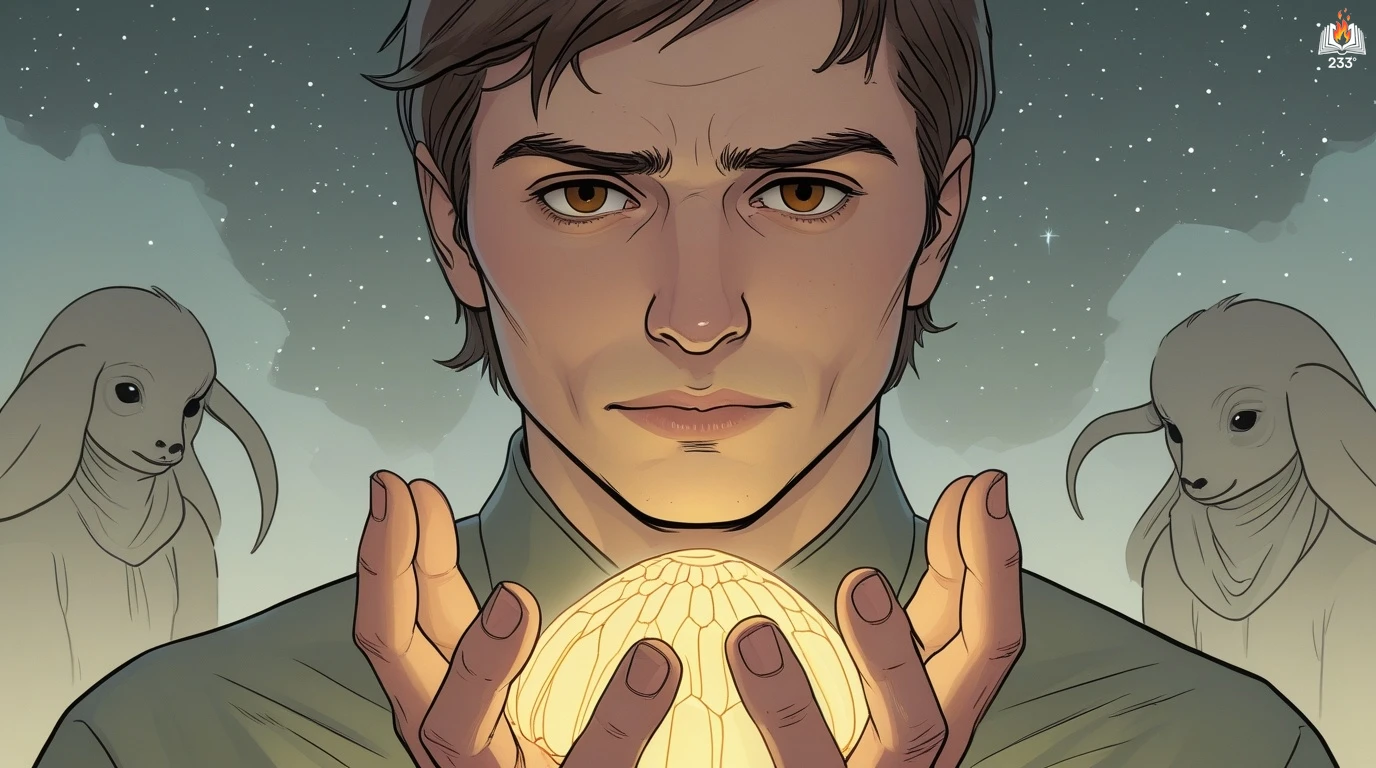
Haunted, Ender retreated from the adulation, from the title of savior. On the desolate colonies established on former Bugger worlds, Ender wandered, searching for peace. In the hollowed chambers of a Bugger hive, he discovered something unexpected: an egg, the last Bugger queen, waiting for a chance to rebuild. Through a strange communication across memory and dreams, Ender learned the truth – the Buggers had not meant war, only misunderstanding. They had reached out, too late, in regret.
With the egg cradled in his hands, Ender became something new – a speaker for the dead, a carrier of memory and atonement. He left behind the name of commander and killer and set out across the stars, seeking a home for the last remnant of the race he had destroyed, hoping to write a different ending.
Main Characters
Andrew “Ender” Wiggin: Ender is a six-year-old genius, sensitive yet fiercely intelligent, chosen for Battle School because of his unmatched tactical mind and emotional complexity. Constantly torn between his capacity for empathy and his ruthless brilliance, Ender grapples with isolation, manipulation, and the burden of leadership as he evolves from a child into a military commander.
Peter Wiggin: Ender’s older brother, Peter, is brilliant but cruel, displaying a manipulative and violent nature. His deep-seated jealousy and hunger for power drive him to political scheming, ultimately rising to global influence, even as his personal relationship with Ender remains fractured and dangerous.
Valentine Wiggin: Ender’s sister and emotional anchor, Valentine is compassionate, nurturing, and highly intelligent. She serves as Ender’s moral compass and remains one of the few people he truly trusts. Even while she and Peter collaborate to influence Earth’s politics, her love for Ender never wavers.
Colonel Hyrum Graff: Graff is the Battle School commander who orchestrates Ender’s training. His pragmatic, often harsh methods shape Ender’s journey, balancing manipulation with a genuine belief in Ender’s potential to save humanity, though at great personal cost to the boy.
Bean: A younger prodigy and one of Ender’s closest allies at Battle School, Bean is sharp, resourceful, and shares Ender’s gift for strategy. Their relationship is one of mutual respect, and Bean ultimately becomes crucial in the climactic battles.
Bonzo Madrid: Ender’s Spanish commander in Salamander Army, Bonzo is proud, authoritarian, and threatened by Ender’s abilities. His insecurity leads to violent confrontation, making him one of the most dangerous human antagonists in Ender’s life.
Theme
The Cost of Leadership: Ender’s journey highlights the emotional and psychological toll leadership can exact, especially on children. Ender is burdened by loneliness, guilt, and moral conflict, showing that victory often comes at profound personal expense.
The Manipulation of Innocence: The adults in the novel, especially Graff, manipulate Ender and the other children, shaping them into weapons under the guise of games. This motif explores the ethics of using children as tools in war, questioning where responsibility lies.
Violence and Empathy: A central paradox in Ender’s character is his ability to love and understand those he defeats. The novel wrestles with the coexistence of compassion and brutality, asking whether empathy can survive in a world of conflict.
Isolation and Identity: Throughout the story, Ender is deliberately isolated to cultivate his independence. His journey becomes one of self-discovery, as he questions who he is—child, killer, savior—and what it means to have a personal identity shaped by external expectations.
The Game vs. Reality: The blurred line between simulation and real warfare drives the novel’s climax. What starts as a “game” reveals itself to have deadly, irreversible consequences, underscoring the theme of deception and moral awakening.
Writing Style and Tone
Orson Scott Card’s writing style in Ender’s Game is clear, accessible, and emotionally precise. He avoids ornate prose in favor of direct language, making the psychological depth of the characters stand out. The novel’s child protagonists are portrayed with intellectual and emotional sophistication, giving their thoughts a gravity that resonates with adult readers while remaining believable for younger characters. Card uses brisk pacing and sharp dialogue, which keeps the tension high even in introspective moments.
The tone of the novel is both intimate and somber. While there are moments of warmth—often in Ender’s interactions with Valentine or his trusted friends—the overall mood is tense, isolating, and morally complex. Card balances the excitement of space battles and military games with an undercurrent of tragedy and philosophical questioning. By maintaining a measured, sometimes clinical tone during moments of violence or manipulation, Card amplifies the emotional weight, leaving readers unsettled and reflective about the nature of war, innocence, and power.
Quotes
Ender’s Game – Orson Scott Card (1985) Quotes
“Perhaps it's impossible to wear an identity without becoming what you pretend to be.”
“If you try and lose then it isn't your fault. But if you don't try and we lose, then it's all your fault.”
“I don't care if I pass your test, I don't care if I follow your rules. If you can cheat, so can I. I won't let you beat me unfairly - I'll beat you unfairly first. - Ender ”
“I think it's impossible to really understand somebody, what they want, what they believe, and not love them the way they love themselves.”
“Remember, the enemy's gate is down.”
“Because never in my entire childhood did I feel like a child. I felt like a person all along_the same person that I am today.”
“Sometimes lies were more dependable than the truth.”
“Humanity does not ask us to be happy. It merely asks us to be brilliant on its behalf.”
“I've lived too long with pain. I won't know who I am without it.”
“There are times when the world is rearranging itself, and at times like that, the right words can change the world.”
“Early to bed and early to rise," Mazer intoned, "makes a man stupid and blind in the eyes.”
“So the whole war is because we can't talk to each other.”
“Ender Wiggin isn't a killer. He just wins—thoroughly.”
“I also remembered that you were beautiful." "Memory does play tricks on us." "No. Your face is the same, but I don't remember what beautiful means anymore.”
“You're a monster. Thanks. Does this mean I get a raise? No, just a medal. The budget isn't inexhaustable.”
“Peter, you're twelve years old. I'm ten. They have a word for people our age. They call us children and they treat us like mice.”
“I need you to be clever, Bean. I need you to think of solutions to problems we haven't seen yet. I want you to try things that no one has ever tried because they're absolutely stupid.”
“Human beings are free except when humanity needs them. Maybe humanity needs you. To do something. Maybe humanity needs me—to find out what you're good for. We might both do despicable things, Ender, but if humankind survives, then we were good tools.”
“He could see Bonzo's anger growing hot. Hot anger was bad. Ender's anger was cold, and he could use it. Bonzo's was hot, and so it used him. ”
“I will remember this, thought Ender, when I am defeated. To keep dignity, and give honor where it's due, so that defeat is not disgrace. And I hope I don't have to do it often.”
“Fiction, because it is not about somebody who actually lived in the real world, always has the possibility of being about oneself.”
“Human beings may be miserable specimens, in the main, but we can learn, and, through learning, become decent people.”
“We have to go. I'm almost happy here.”
“The story itself, the true story, is the one that the audience members create in their minds, guided and shaped by my text, but then transformed, elucidated, expanded, edited, and clarified by their own experience, their own desires, their own hopes and fears.”
“I've watched through his eyes, I've listened through his ears, and I tell you he's the one.”
“We're all trying to decide whether your scores up there are a miracle or a mistake." "A habit. ”
“The story is one that you and I will construct together in your memory. If the story means anything to you at all, then when you remember it afterward, think of it, not as something I created, but rather as something that we made together. ”
We hope this summary has sparked your interest and would appreciate you following Celsius 233 on social media:
There’s a treasure trove of other fascinating book summaries waiting for you. Check out our collection of stories that inspire, thrill, and provoke thought, just like this one by checking out the Book Shelf or the Library
Remember, while our summaries capture the essence, they can never replace the full experience of reading the book. If this summary intrigued you, consider diving into the complete story – buy the book and immerse yourself in the author’s original work.
If you want to request a book summary, click here.
When Saurabh is not working/watching football/reading books/traveling, you can reach him via Twitter/X, LinkedIn, or Threads
Restart reading!