A Study in Scarlet, written by Sir Arthur Conan Doyle and first published in 1887, introduces the world to Sherlock Holmes, the iconic detective, and his loyal companion, Dr. John Watson. This novella is the first in the Sherlock Holmes series and presents the duo’s initial meeting, followed by their collaborative effort in solving a complex murder case. Blending mystery, adventure, and detective work, it also explores the use of Holmes’s keen deductive skills, which have become the hallmark of Doyle’s writing and influence on crime fiction.
Plot Summary
Dr. John Watson, freshly returned to London after his service as an army surgeon in Afghanistan, finds himself physically weakened and financially strained. Seeking more affordable living arrangements, he meets an old acquaintance, Stamford, who introduces him to Sherlock Holmes, an eccentric man with whom Watson might share lodgings. Holmes is engaged in scientific experiments and possesses an unusual knack for deduction, but Watson knows little else about him. After a brief meeting, Holmes and Watson agree to share a flat at 221B Baker Street, setting the stage for an extraordinary partnership.
From the outset, Watson is intrigued and somewhat perplexed by Holmes. His habits are peculiar: at times, he is engrossed in chemical experiments or locked in intense mental focus, while at others, he remains silent for hours, seemingly lost in his thoughts. Watson learns of Holmes’s unique profession through a chance encounter with a visitor—a consulting detective. Holmes is not merely interested in crime; he actively helps both private citizens and the police solve cases that baffle them. Though Watson is skeptical at first, he soon witnesses the full extent of Holmes’s remarkable abilities.
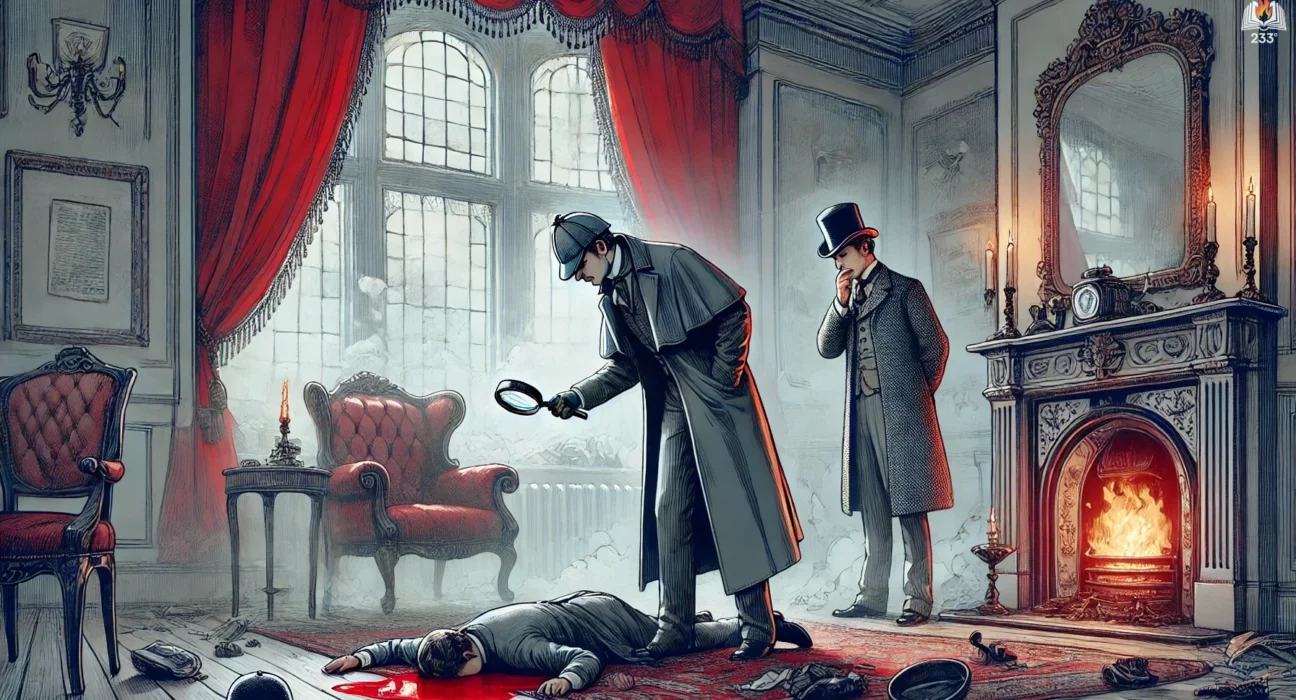
One foggy morning, a note arrives for Holmes from Inspector Gregson of Scotland Yard. A man has been found dead under mysterious circumstances at 3 Lauriston Gardens, and the police are at a loss. Holmes invites Watson to join him in investigating the case. When they arrive at the scene, Holmes immediately begins to observe details that the police have missed. The victim, Enoch J. Drebber, is found in an empty house, with no visible wounds on his body. There are bloodstains around the room, but none on Drebber. Even more mysterious is the word “RACHE” scrawled in blood on the wall. While the police flounder, speculating that it could be the unfinished word “Rachel,” Holmes dismisses the idea and starts building his own theory.
Holmes quickly identifies that the blood does not belong to the victim, but to the perpetrator. His keen observation reveals that the murderer was not alone, but was likely accompanied by another person, someone connected to Drebber. He also deduces that Drebber had been poisoned. The investigation takes a turn when a second name, Joseph Stangerson, is linked to the case. Stangerson, Drebber’s secretary, is also found dead, having been stabbed in a hotel room. With both men murdered, the pressure on Scotland Yard intensifies, but it is Holmes who continues to piece together the puzzle with his deductive genius.
As Holmes narrows in on the killer, he sends out a mysterious telegram and prepares a trap, seemingly confident in the outcome. Meanwhile, he explains to Watson how he deduced so much from seemingly trivial clues. He noted the condition of the man’s boots, the trace of a particular cigar ash, and even the length of the murderer’s stride. These insights lead Holmes to the conclusion that the killer is a tall man who arrived in a cab.
Holmes’s trap is sprung when a cab driver, Jefferson Hope, arrives at Baker Street. To Watson’s surprise, Hope is the murderer. In a calm, almost detached manner, Hope begins to explain his reasons. His story takes them back many years, to the American West, where a tragedy unfolded. Hope had been deeply in love with a young woman named Lucy Ferrier. She and her father had been persecuted by a powerful and corrupt Mormon leader. When Lucy was forcibly married to Enoch Drebber against her will, Hope was powerless to stop it. After Lucy died heartbroken, Hope swore vengeance on those responsible: Drebber and Stangerson.
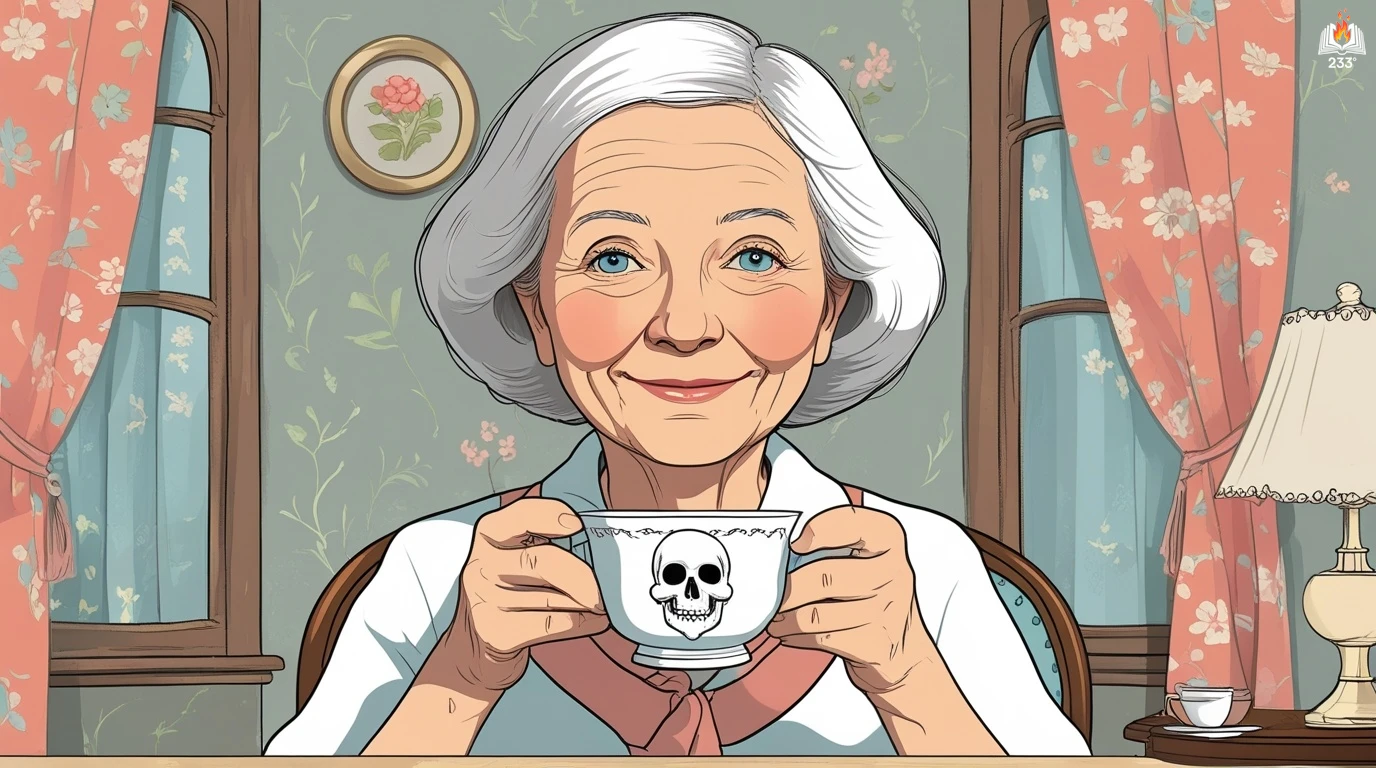
For years, Hope tracked them across continents, finally catching up to them in London. His murders were not driven by malice, but by a sense of justice. He had given both men a chance to live by offering them a choice—two pills, one harmless, one poisoned. Both men had chosen wrongly and died. Hope’s story casts him less as a villain and more as a man consumed by grief and a relentless need for retribution.
Despite his own satisfaction in having avenged Lucy, Hope is not a free man for long. His health, weakened by years of stress and ailing lungs, rapidly deteriorates. Before he can be brought to trial, he dies in prison from a ruptured aneurysm, a somewhat ironic twist of fate given his methodical pursuit of vengeance.
With the case closed, Holmes receives little credit for solving the mystery. The official accolades go to Inspector Gregson and Lestrade, despite their limited contribution to the investigation. Watson, now thoroughly impressed by Holmes’s abilities, decides to chronicle the case. His admiration for Holmes grows, though he remains puzzled by the detective’s emotional detachment. For Holmes, the case was merely an intellectual puzzle, one that he solved with cool precision and without any desire for fame.
Holmes’s brilliance shines through not just in his ability to solve crimes, but in the way he sees the world, noting the tiniest details that others overlook. Watson realizes that he has found a fascinating companion in Holmes, a man who views crime-solving as both a science and an art. Together, they will face more mysteries, but this first case cements their partnership as one of the greatest in the annals of detection.
Main Characters
Sherlock Holmes: The brilliant and eccentric detective, Holmes is characterized by his remarkable powers of observation and deduction. He is highly analytical, logical, and often aloof, preferring to solve problems with his intellect. Holmes’s enthusiasm for solving crimes is matched by his disdain for the limitations of conventional police work. In this story, his character is introduced as deeply knowledgeable in certain areas, though strangely ignorant in others, which piques Watson’s curiosity.
Dr. John Watson: A former army surgeon, Watson serves as the narrator of the story. After returning from military service in Afghanistan, Watson finds himself physically weakened and mentally adrift. He becomes Holmes’s roommate and chronicler, gradually growing fascinated by Holmes’s methods and becoming his trusted companion in solving cases.
Inspector Lestrade: A Scotland Yard detective who seeks Holmes’s assistance. Though competent in his own way, Lestrade represents the traditional methods of police investigation, which Holmes frequently outshines. His interactions with Holmes often illustrate the contrast between conventional police work and Holmes’s unique methods.
Jefferson Hope: The antagonist of the story, Hope is a man driven by revenge. His motivations are deeply tied to a personal tragedy involving his love, Lucy Ferrier, and her father, which leads him to commit the murders that Holmes investigates. His character adds emotional depth to the mystery, showing the lengths one will go for justice and retribution.
Theme
Justice and Revenge: One of the central themes in A Study in Scarlet is the fine line between justice and revenge. Jefferson Hope’s pursuit of the murder victims is driven by a deep sense of personal justice after the tragic loss of his loved ones. The novel asks whether his actions, though illegal, might be seen as morally justified.
Scientific Method and Reason: Holmes’s approach to solving crimes is a showcase of the scientific method. His reliance on evidence, logical deduction, and methodical reasoning contrasts with the more traditional, sometimes haphazard, methods of the police force, highlighting a motif of rationalism versus intuition or chance.
Duality of Human Nature: The story explores the duality of human nature, especially through Holmes’s character. While he appears cold and calculating, his passion for justice reveals a deeper moral compass. Similarly, Jefferson Hope’s vengeful acts stem from love and loss, adding complexity to his character.
Urban Isolation: Set against the backdrop of Victorian London, the novel explores the theme of isolation in a bustling city. Both Watson and Holmes experience a sense of detachment from society—Watson due to his war experiences and Holmes through his intellectual superiority and lack of emotional ties.
Writing Style and Tone
Conan Doyle’s writing in A Study in Scarlet is notable for its clear and precise language, making the complex plot easy to follow. He employs a straightforward, almost journalistic style, particularly through Watson’s narrative voice. The descriptive passages of both characters and scenes are vivid yet economical, contributing to a fast-paced narrative that keeps readers engaged. Dialogue is sharp and often laced with wit, particularly in Holmes’s exchanges, which are reflective of his sharp intellect and unique worldview.
The tone of the novella shifts between detached and analytical during Holmes’s investigation and more emotional and intense when Jefferson Hope’s backstory is revealed. Conan Doyle masterfully balances the cold logic of detective work with the passion of human drama, allowing readers to engage both intellectually and emotionally with the narrative.
Quotes
A Study in Scarlet – Sir Arthur Conan Doyle (1887) Quotes
“What you do in this world is a matter of no consequence. The question is what can you make people believe you have done.”
“To a great mind, nothing is little,' remarked Holmes, sententiously.”
“Populus me sibilat, at mihi plaudo Ipse domi stimul ac nummos contemplar in arca. (The public hiss at me, but I cheer myself when in my own house I contemplate the coins in my strong-box.)”
“It's quite exciting," said Sherlock Holmes, with a yawn.”
“Where there is no imagination, there is no horror.”
“No man burdens his mind with small matters unless he has some very good reason for doing so.”
“What the deuce is it to me?" he interrupted impatiently: "you say that we go round the sun. If we went round the moon it would not make a pennyworth of difference to me or to my work.”
“It was easier to know it than to explain why I know it. If you were asked to prove that two and two made four, you might find some difficulty, and yet you are quite sure of the fact. ~ Sherlock Holmes”
“I get in the dumps at times, and don't open my mouth for days on end. You must not think I am sulky when I do that. Just let me alone, and I'll soon be right.”
“They say that genius is an infinite capacity for taking pains," he remarked with a smile. "It's a very bad definition, but it does apply to detective work.”
“His Ignorance was as remarkable as his knowledge.”
“So all life is a great chain, the nature of which is known whenever we are shown a link of it.”
“One's ideas must be as broad as Nature if they are to interpret Nature”
“By a man's finger-nails, by his coat-sleeve, by his boots, by his trouser-knees, by the callosities of his forefinger and thumb, by his expression, by his shirt-cuff
“Let me see. What are my other shortcomings?”
“There is a mystery about this which stimulates the imagination; where there is no imagination there is no horror.”
“There is no satisfaction in vengeance unless the offender has time to realize who it is that strikes him, and why retribution has come upon him.”
“To begin at the beginning.”
“When a man writes on a wall, his instinct leads him to write above the level of his own eyes.”
“Desultory readers are seldom remarkable for the exactness of their learning.”
We hope this summary has sparked your interest and would appreciate you following Celsius 233 on social media:
There’s a treasure trove of other fascinating book summaries waiting for you. Check out our collection of stories that inspire, thrill, and provoke thought, just like this one by checking out the Book Shelf or the Library
Remember, while our summaries capture the essence, they can never replace the full experience of reading the book. If this summary intrigued you, consider diving into the complete story – buy the book and immerse yourself in the author’s original work.
If you want to request a book summary, click here.
When Saurabh is not working/watching football/reading books/traveling, you can reach him via Twitter/X, LinkedIn, or Threads
Restart reading!