The Lost World by Sir Arthur Conan Doyle, published in 1912, is a thrilling science fiction adventure that follows an intrepid group of explorers on a perilous journey to a remote plateau in the Amazon, where prehistoric creatures still roam. The novel introduces readers to a fantastical world filled with danger, excitement, and intellectual challenges, blending Conan Doyle’s mastery of storytelling with themes of scientific discovery and human perseverance.
Plot Summary
On a foggy November evening in London, Edward Malone, a young journalist for the Daily Gazette, finds himself in a peculiar dilemma. He is desperately in love with Gladys Hungerton, but she refuses to consider him as a suitor unless he accomplishes something heroic and grand. Determined to win her favor, Malone sets off to find an adventure that will prove his worth.
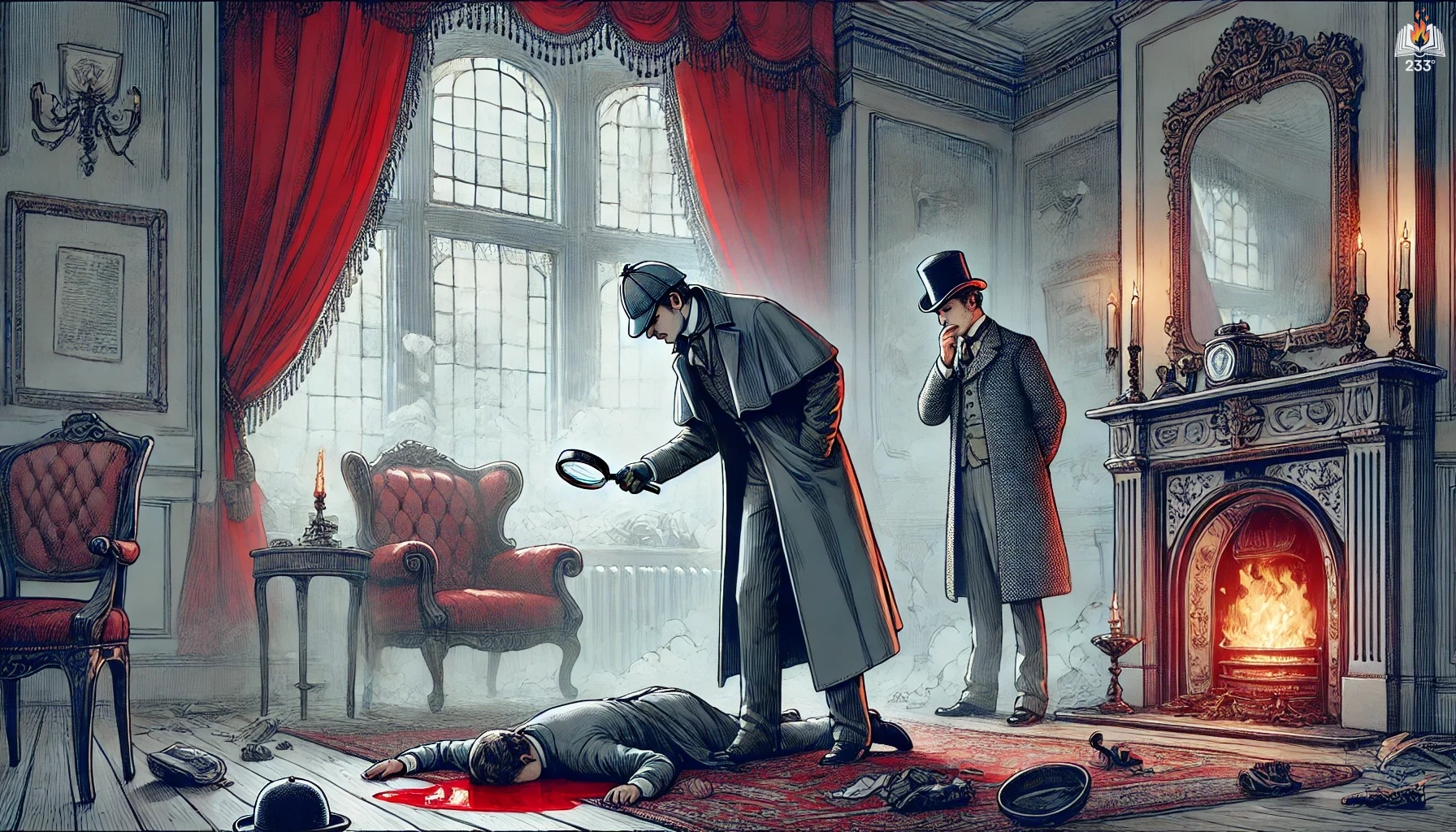
At the newspaper office, Malone speaks with McArdle, the news editor, hoping to be sent on a daring assignment. McArdle suggests that he interview Professor George Edward Challenger, a brilliant but notoriously combative zoologist, whose recent claims about prehistoric life in South America have caused a scandal in scientific circles. Although Malone knows that Challenger has physically thrown out other journalists, he eagerly accepts the challenge.
Malone visits Professor Challenger’s home, and after an aggressive and chaotic introduction, he manages to gain the professor’s trust. Challenger shares an astonishing revelation: during an expedition to the Amazon Basin, he discovered a remote plateau where dinosaurs and other prehistoric creatures still roam. Though initially skeptical, Malone becomes convinced when Challenger shows him a sketchbook filled with strange drawings and a pterodactyl’s wing fragment. Challenger, vindicated by Malone’s interest, proposes a new expedition to confirm his discovery and invites Malone to join him.
The expedition is soon organized, consisting of four key members: Challenger, Malone, the skeptical Professor Summerlee, and Lord John Roxton, a brave adventurer who seeks excitement and redemption after a life of high-society boredom. The group sets sail for South America, where they embark on a journey deep into the uncharted Amazon jungle.
After weeks of grueling travel, guided by native helpers, the explorers finally reach the mysterious plateau that Challenger had described. They find it surrounded by towering cliffs, accessible only by a single, precarious path. With a mix of ingenuity and courage, the group crosses a makeshift bridge to the top of the plateau. However, their bridge is destroyed by treachery, leaving them stranded in this strange and hostile land.
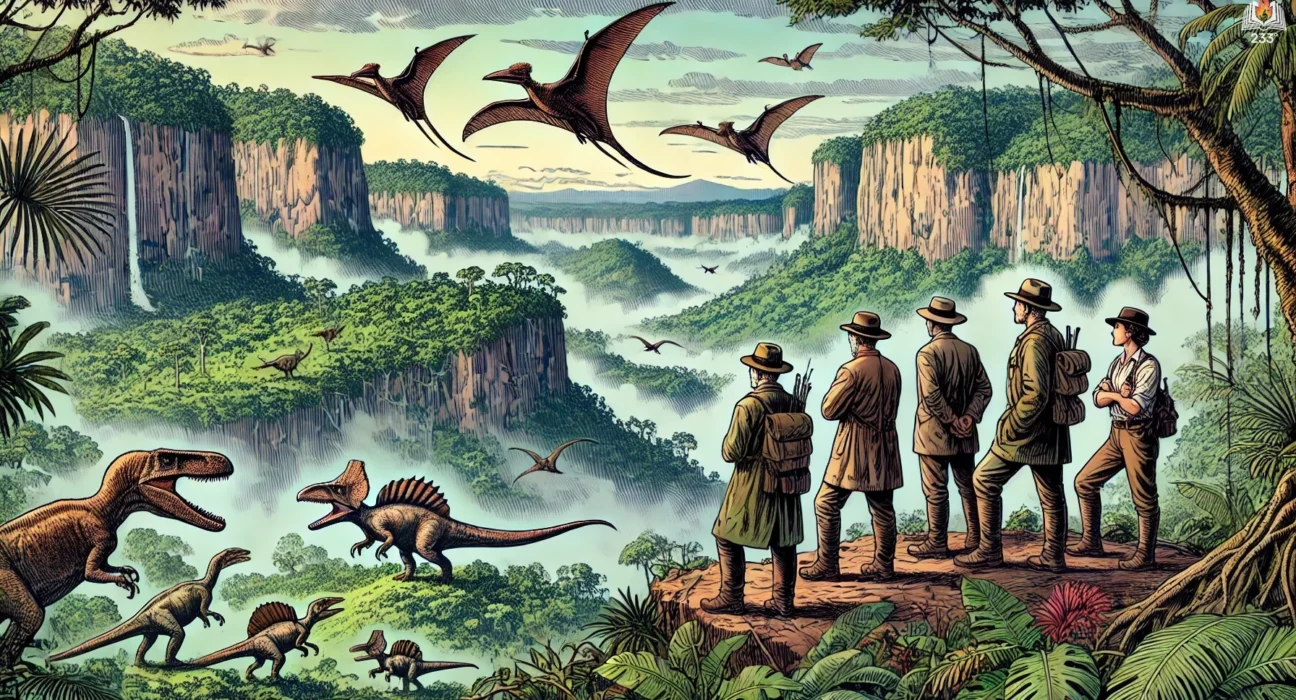
As they explore, the plateau reveals itself as a lost world untouched by time. The group encounters astonishing creatures: great flying pterodactyls soar overhead, and herds of iguanodons graze in the distance. Predatory dinosaurs, too, roam the land, and the men narrowly escape several deadly encounters with these ancient beasts. The harsh realities of survival become clear as they must now rely on their wits and skills to find a way back home.
Despite the dangers, the group’s scientific curiosity grows. Challenger is vindicated, though Summerlee, still cautious, requires more proof. Lord Roxton remains ever watchful, his hunting instincts honed for the perils they face. Malone, though initially awestruck, becomes more seasoned as he faces down the terrors of the plateau. The natural wonders are counterbalanced by the constant threat of death, as the men encounter more than just prehistoric animals; they also discover that the plateau is inhabited by primitive humans and a race of brutish, apelike creatures who live in caves.
Tensions rise when the group becomes involved in a war between the primitive humans and the apelike creatures. The humans, smaller and weaker, are oppressed by their monstrous enemies. The explorers, though initially hesitant to intervene, are drawn into the conflict after Roxton and Malone rescue a human prisoner from the ape-men. This act of bravery earns them the humans’ trust, and the group is taken to their village, where they are treated as honored guests. In return, the explorers help the humans overthrow the ape-men, engaging in a fierce battle that ends with the extermination of the monstrous creatures.
As the explorers contemplate their next move, they discover a hidden path that offers a potential escape from the plateau. Before leaving, Roxton stumbles upon a treasure trove of diamonds in a remote cave, which he secretly collects. Armed with this newfound wealth and the knowledge of their extraordinary discoveries, the group prepares to return to the world they once knew.
After a harrowing descent, the group finally reaches the jungle floor and retraces their steps back to civilization. In London, Challenger organizes a grand public meeting to reveal the truth of the expedition. Despite widespread skepticism, the evidence presented — including the pterodactyl wing fragment and various sketches — begins to sway the audience. However, when a live pterodactyl that the group had captured is released into the hall, chaos erupts as the creature flies out into the night, leaving no doubt of the group’s incredible tale.
With his reputation restored, Challenger basks in the glory of his discovery, while Summerlee, though humbled, acknowledges the truth of the lost world. Roxton, now a wealthy man thanks to the diamonds, is content to return to his adventurous life. Malone, however, finds no satisfaction upon his return to London. He rushes to see Gladys, hoping his newfound fame will win her heart, only to learn that she has married another man, someone unremarkable but practical. Disillusioned, Malone decides to follow a different path, resolving to seek out more adventures with Lord Roxton, leaving behind his once-cherished dreams of love.
The explorers’ journey to the lost world has changed them irrevocably. They have glimpsed the primal forces of life, both terrifying and awe-inspiring, and they leave behind the comforts of their previous existence, bound for new horizons where discovery, danger, and glory await.
Main Characters
Professor George Edward Challenger: A brilliant yet bombastic scientist, Challenger is the driving force behind the expedition to the lost world. His stubbornness, immense intellect, and larger-than-life personality dominate the novel. He is determined to prove the existence of the prehistoric creatures despite skepticism from the scientific community.
Edward Malone: A journalist for the Daily Gazette, Malone volunteers for the expedition to impress a woman he loves. Throughout the novel, he transforms from a lovesick reporter into a courageous and capable explorer, documenting the group’s adventures.
Professor Summerlee: The cautious, skeptical scientist who joins the expedition primarily to disprove Challenger’s wild claims. Summerlee represents the voice of reason and scientific rigor, but his character softens as he encounters the realities of the lost world.
Lord John Roxton: A seasoned adventurer and hunter, Roxton brings both experience and bravery to the team. He’s unflinchingly courageous, providing much-needed support during the group’s encounters with prehistoric beasts and hostile natives.
Theme
The Clash of Science and Skepticism: The tension between scientific discovery and skepticism forms the backbone of the narrative. Professor Challenger’s claims are met with doubt by his peers, including Summerlee, highlighting the struggles faced by pioneers in any field when presenting revolutionary ideas.
Man vs. Nature: A recurring theme in adventure literature, the explorers in The Lost World face the untamed forces of nature. From hostile dinosaurs to the treacherous jungle terrain, Conan Doyle emphasizes mankind’s frailty when confronted with the raw power of nature.
Colonialism and Exploration: The novel reflects the Edwardian era’s fascination with imperialism and the idea of the “unknown” lands ripe for exploration and conquest. The plateau, untouched by time, symbolizes both the allure and dangers of imperialistic exploration.
Heroism and Courage: Personal bravery is a key theme, embodied particularly by Lord John Roxton and Edward Malone, who risk their lives multiple times. Heroism is portrayed as a natural response to adversity, especially when facing the unknown or protecting one’s comrades.
Writing Style and Tone
Arthur Conan Doyle’s writing in The Lost World is immersive and descriptive, combining a formal, Edwardian tone with dynamic action sequences that heighten the sense of adventure. His meticulous attention to detail, especially in the depiction of the prehistoric world, adds a layer of realism to the fantastical elements. The language is sometimes grand and dramatic, reflective of Challenger’s outsized personality, while Malone’s narration balances it with a more grounded, human perspective.
The tone is one of excitement and discovery, tinged with a sense of wonder at the possibilities that lie beyond the familiar. Conan Doyle also injects humor, particularly through the larger-than-life character of Professor Challenger, whose arrogance and bluster often provide comic relief amidst the more serious and thrilling moments of the story.
Quotes
The Lost World – Sir Arthur Conan Doyle (1912) Quotes
“There are times, young fellah, when every one of us must make a stand for human right and justice, or you never feel clean again.”
“So tomorrow we disappear into the unknown. This account I am transmitting down the river by canoe, and it may be our last word to those who are interested in our fate.”
“One must wait till it comes.”
“I have wrought my simple plan If I give one hour of joy To the boy who’s half a man, Or the man who’s half a boy.”
“Brain, character, soul—only as one sees more of life does one understand how distinct is each.”
“There's many a man who never tells his adventures, for he can't hope to be believed.”
“He was too absurd to make me angry. Indeed, it was a waste of energy, for if you were going to be angry with this man you would be angry all the time.”
“There are strange red depths in the soul of the most commonplace man.”
“He has a gentle voice and a quiet manner, but behind his twinkling blue eyes there lurks a capacity for furious wrath and implacable resolution, the more dangerous because they are held in leash.”
“better to be a repulsed lover than an accepted brother”
“The bent head, the averted eye, the faltering voice, the wincing figure- these, and not the unshrinking gaze and frank reply, are the true signals of passion.”
“My instincts are all against a woman being too frank and at her ease with me. It is no compliment to a man.”
“It is decreed by a merciful Nature that the human brain cannot think of two things simultaneously, so that if it be steeped in curiosity as to science it has no room for merely personal considerations.”
“Why on earth people who have something to say which is worth hearing should not take the slight trouble to learn how to make it heard is one of the strange mysteries of modern life.”
“Well, I'm a bacteriologist, you know. I live in a nine-hundred-diameter microscope. I can hardly claim to take serious notice of anything that I can see with my naked eye.”
“I am an Irishman, sir." "Irish Irish?" "Yes, sir.”
“The individual must not monopolize what is meant for the world.”
“really was the most tactless person upon earth,—a fluffy, feathery, untidy cockatoo of a man, perfectly good-natured, but absolutely centered upon his own silly self.”
“Now, how did you know that I was going to propose?" I asked in genuine wonder. "Don't women always know? Do you suppose any woman in the world was ever taken unawares?”
“Was it hardness, was it selfishness, that she should ask me to risk my life for her own glorification? Such thoughts may come to middle age; but never to ardent three-and-twenty in the fever of his first love.”
“Apparently the age of romance was not dead, and there was common ground upon which the wildest imaginings of the novelist could meet the actual scientific investigations of the searcher for truth.”
We hope this summary has sparked your interest and would appreciate you following Celsius 233 on social media:
There’s a treasure trove of other fascinating book summaries waiting for you. Check out our collection of stories that inspire, thrill, and provoke thought, just like this one by checking out the Book Shelf or the Library
Remember, while our summaries capture the essence, they can never replace the full experience of reading the book. If this summary intrigued you, consider diving into the complete story – buy the book and immerse yourself in the author’s original work.
If you want to request a book summary, click here.
When Saurabh is not working/watching football/reading books/traveling, you can reach him via Twitter/X, LinkedIn, or Threads
Restart reading!