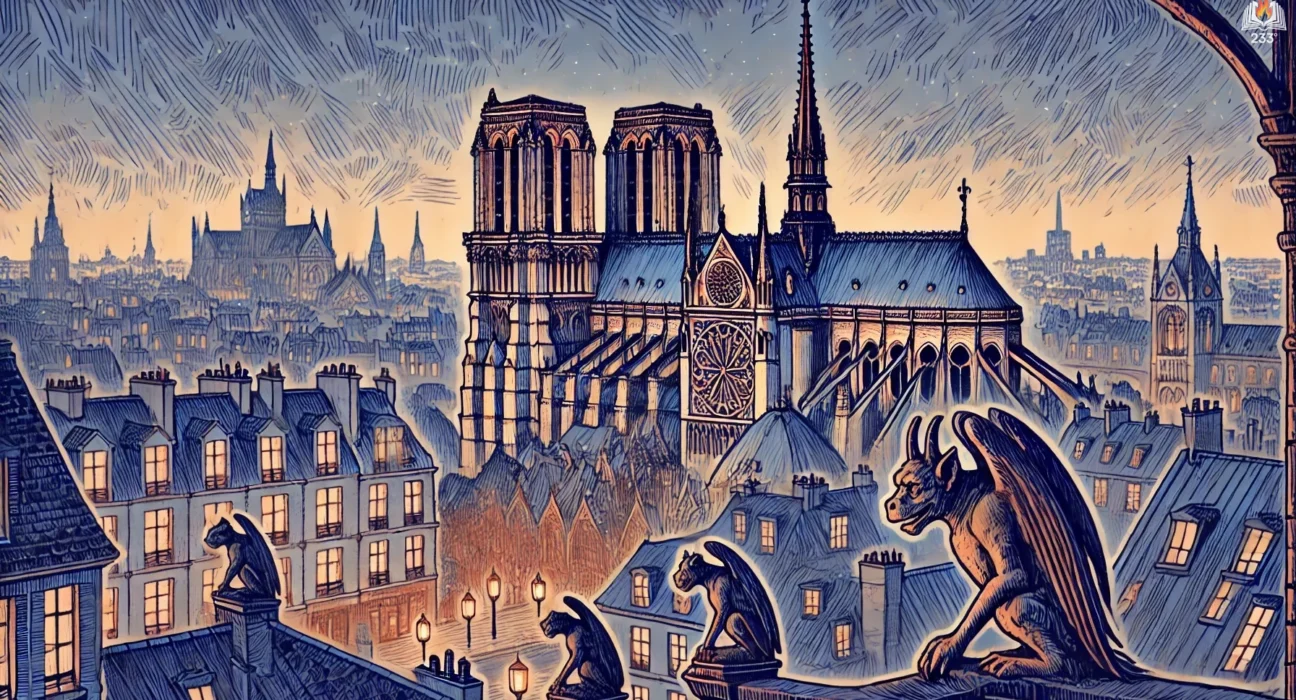
The Hunchback of Notre-Dame by Victor Hugo, published in 1831, is a monumental work of Romantic literature. Set in Paris during the late 15th century, it intertwines the lives of several complex characters around the looming presence of the Notre-Dame Cathedral. The novel not only depicts the architectural grandeur of the cathedral but also delves into themes of love, fate, and the cruelty of society, with particular emphasis on the tensions between beauty and deformity, virtue and sin.
Plot Summary
On the sixth of January, 1482, Paris buzzes with excitement. The city is preparing for two grand events: the Festival of Fools and a mystery play to be performed in the grand hall of the Palais de Justice. At the heart of the festivities, Quasimodo, the deformed bell-ringer of Notre-Dame Cathedral, is crowned Pope of Fools for his grotesque appearance. Unloved and shunned by society, he revels momentarily in this strange honor. Among the crowd is Claude Frollo, the Archdeacon of Notre-Dame, who has raised Quasimodo from infancy after finding him abandoned at the cathedral’s doorstep.
In the midst of the celebration, a beautiful Romani girl named Esmeralda dances in the square, captivating everyone with her grace. Her beauty, however, is a curse, as it catches the obsessive attention of Frollo. The Archdeacon, a man torn between his devout religious duties and forbidden desires, becomes consumed with lust for Esmeralda. Despite his lifelong commitment to celibacy and piety, Frollo’s passion for the young dancer slowly drives him toward madness.
Meanwhile, Esmeralda’s beauty also enchants Captain Phoebus de Châteaupers, a handsome but shallow soldier. Esmeralda falls in love with him, unaware of his selfish nature and the fleeting nature of his affection. When they meet in secret, Frollo, driven mad by jealousy, follows them and attacks Phoebus, leaving him for dead. Esmeralda is wrongly accused of the crime and sentenced to death for attempted murder. She remains unaware that it was Frollo, the man who claims to be her protector, who orchestrated her downfall.
Imprisoned and awaiting execution, Esmeralda is devastated by the betrayal and loss of her freedom. Just as her fate seems sealed, Quasimodo comes to her rescue. Despite his monstrous appearance and her initial fear of him, he is deeply devoted to her after she showed him kindness once before. With unparalleled strength, Quasimodo sweeps her away from the execution platform and hides her in the sanctuary of Notre-Dame, invoking the ancient right of asylum. Within the cathedral’s stone walls, Esmeralda finds temporary refuge under the care of the hunchback, who, though unloved by others, loves her with pure devotion.
As Esmeralda hides in Notre-Dame, her protectors are locked in a moral and emotional struggle. Frollo, who has raised Quasimodo and who is a powerful figure within the Church, wrestles with his own inner demons. His obsessive love for Esmeralda becomes a source of torment, making him vacillate between wanting to possess her and destroy her. Quasimodo, in contrast, loves her selflessly, knowing that she does not and could never love him in return. His devotion is to her safety and happiness, even if it means losing her.
Outside the cathedral, the wheels of fate continue to turn against Esmeralda. Frollo’s influence over the church and the law threatens her sanctuary, while her fellow Romani are suspected of involvement in her escape. Meanwhile, a group of beggars, led by Clopin, a charismatic leader of the Paris underworld, learns of her plight and plans a rescue attempt. In a daring and chaotic assault on Notre-Dame, the beggars storm the cathedral, believing they can save her from further persecution.
Quasimodo, however, misinterprets the assault as an attack on Esmeralda and the sanctuary itself. In a desperate frenzy, he defends the cathedral, using his immense strength to drive away the attackers. His actions only deepen the tragedy, as his efforts to protect Esmeralda result in her continued imprisonment rather than her escape.
Amid the chaos, Frollo reveals his twisted desires to Esmeralda. He offers her a terrible choice: she can either submit to him and become his, or face her execution. True to her spirit, Esmeralda chooses death rather than surrender to the man who betrayed her. In a final act of cruelty, Frollo hands her over to the authorities, sealing her fate. Esmeralda is led to the gallows, where she meets her end with quiet dignity, still believing in the purity of love despite the betrayals and horrors she has endured.
As Esmeralda’s life fades, Quasimodo watches from the cathedral. His heart, already scarred by a life of rejection and cruelty, breaks at the sight of her death. In his grief, he turns on Frollo, realizing at last the full extent of his master’s treachery. In a climactic moment atop the towers of Notre-Dame, Quasimodo throws Frollo from the cathedral’s heights, sending the Archdeacon plummeting to his death.
The novel closes on a somber note. After Frollo’s fall and Esmeralda’s death, Quasimodo vanishes from Notre-Dame. Years later, in a mass grave for those executed as criminals, two skeletons are found intertwined: one belonging to a woman, the other to a deformed man. In death, Quasimodo finally finds the closeness he yearned for in life, lying beside the woman he loved with all his heart.
Main Characters
Quasimodo: The titular hunchback, Quasimodo is a deformed bell-ringer of Notre-Dame. Deaf from the constant tolling of the bells, he is feared and ostracized by society but harbors deep feelings of loyalty, compassion, and love, especially for Esmeralda.
Esmeralda: A beautiful and kind-hearted Romani dancer, Esmeralda becomes the object of desire for multiple men, including Quasimodo and Frollo. Her innocence and purity contrast with the darker forces at play around her, yet she is relentlessly persecuted by the society of Paris.
Claude Frollo: The Archdeacon of Notre-Dame, Frollo is a highly educated but morally conflicted man. He harbors obsessive and destructive lust for Esmeralda, leading him to commit heinous acts. His internal conflict between piety and desire is central to the novel’s themes.
Phoebus de Châteaupers: A dashing but shallow soldier, Phoebus is desired by Esmeralda, but his interest in her is purely superficial. His involvement with her leads to disastrous consequences, exacerbating the tragedy of the story.
Pierre Gringoire: A struggling playwright and philosopher, Gringoire becomes entangled in the lives of the other characters, providing moments of levity and reflecting on the injustices of the world around him.
Theme
The Injustice of Society: The novel explores how society marginalizes and mistreats those who are different, be it through Quasimodo’s physical deformity or Esmeralda’s status as an outsider. Hugo critiques the cruelty of social structures and their propensity to destroy lives.
Beauty vs. Deformity: Physical appearance plays a central role in the novel. Quasimodo’s deformity contrasts sharply with Esmeralda’s beauty, yet it is Quasimodo who possesses a kind heart, while many of the outwardly beautiful characters are morally corrupt. This juxtaposition emphasizes Hugo’s message about the superficiality of society’s values.
Fate and Free Will: Characters in the novel often seem to be at the mercy of forces beyond their control, whether it’s Frollo’s obsessive desires or Esmeralda’s unfortunate destiny. The theme of fate reflects Hugo’s Romantic belief in the power of larger-than-life forces, but it is also a commentary on how individuals are trapped by societal expectations.
The Power and Presence of Notre-Dame: The cathedral is not just a backdrop but a living, breathing entity in the novel. It represents the grandeur and permanence of history, art, and architecture, contrasting with the fleeting lives and emotions of the characters.
Writing Style and Tone
Victor Hugo’s writing style in The Hunchback of Notre-Dame is rich, descriptive, and layered with symbolism. His prose often reflects the Gothic grandeur of the cathedral, with long, intricate sentences and vivid descriptions that breathe life into both characters and settings. Hugo uses the cathedral as a symbol of time, history, and human suffering, and his language often mirrors the complexity and weight of these themes.
The tone of the novel is melancholic, filled with an underlying sense of tragedy. Hugo imbues the narrative with a sense of foreboding, suggesting that the characters are bound by forces—whether it be fate, passion, or societal structures—that they cannot escape. There is also a strong Romantic sensibility, as Hugo explores the intense emotions of love, lust, and despair, often elevating them to epic proportions.
Quotes
The Hunchback of Notre-Dame – Victor Hugo (1831) Quotes
“Love is like a tree: it grows by itself, roots itself deeply in our being and continues to flourish over a heart in ruin. The inexplicable fact is that the blinder it is, the more tenacious it is. It is never stronger than when it is completely unreasonable.”
“Nothing makes a man so adventurous as an empty pocket.”
“I wanted to see you again, touch you, know who you were, see if I would find you identical with the ideal image of you which had remained with me and perhaps shatter my dream with the aid of reality. -Claude Frollo ”
“When you get an idea into your head you find it in everything.”
“Spira, spera. (breathe, hope)”
“A one-eyed man is much more incomplete than a blind man, for he knows what it is that's lacking.”
“mothers are often fondest of the child which has caused them the greatest pain.”
“He reached for his pocket, and found there, only reality”
“One drop of wine is enough to redden a whole glass of water.”
“Dost thou understand? I love thee!" he cried again. "What love!" said the unhappy girl with a shudder. He resumed,--"The love of a damned soul. a”
“The saints were his friends, and blessed him; the monsters were his friends, and guarded him.”
“You would have imagined her at one moment a maniac, at another a queen.”
“He left her. She was dissatisfied with him. He had preferred to incur her anger rather than cause her pain. He had kept all the pain for himself.”
“At the moment when her eyes closed, when all feeling vanished in her, she thought that she felt a touch of fire imprinted on her lips, a kiss more burning than the red-hot iron of the executioner.”
“by making himself a priest made himself a demon.”
“The greatest products of architecture are less the works of individuals than of society; rather the offspring of a nation's effort, than the inspired flash of a man of genius...”
“But alas, if I have not maintained my victory, it is God's fault for not making man and the devil of equal strength.”
“To a gargoyle on the ramparts of Notre Dame as Esmeralda rides off with Gringoire Quasimodo says. "Why was I not made of stone like thee?”
“His judgement demonstrates that one can be a genius and understand nothing of an art that is not one's own.”
“If he had had all Peru in his pocket, he would certainly have given it to this dancer; but Gringoire had not Peru in his pocket; and besides, America was not yet discovered. (p. 66)”
“He found that man needs affection, that life without a warming love is but a dry wheel, creaking and grating as it turns.”
“The owl goes not into the nest of the lark.”
“Large, heavy, ragged black clouds hung like crape hammocks beneath the starry cope of the night. You would have said that they were the cobwebs of the firmament.”
“When a man understands the art of seeing, he can trace the spirit of an age and the features of a king even in the knocker on a door.”
“I bear the dungeon within me; within me is winter, ice, and despair; I have darkness in my soul.”
We hope this summary has sparked your interest and would appreciate you following Celsius 233 on social media:
There’s a treasure trove of other fascinating book summaries waiting for you. Check out our collection of stories that inspire, thrill, and provoke thought, just like this one by checking out the Book Shelf or the Library
Remember, while our summaries capture the essence, they can never replace the full experience of reading the book. If this summary intrigued you, consider diving into the complete story – buy the book and immerse yourself in the author’s original work.
If you want to request a book summary, click here.
When Saurabh is not working/watching football/reading books/traveling, you can reach him via Twitter/X, LinkedIn, or Threads
Restart reading!