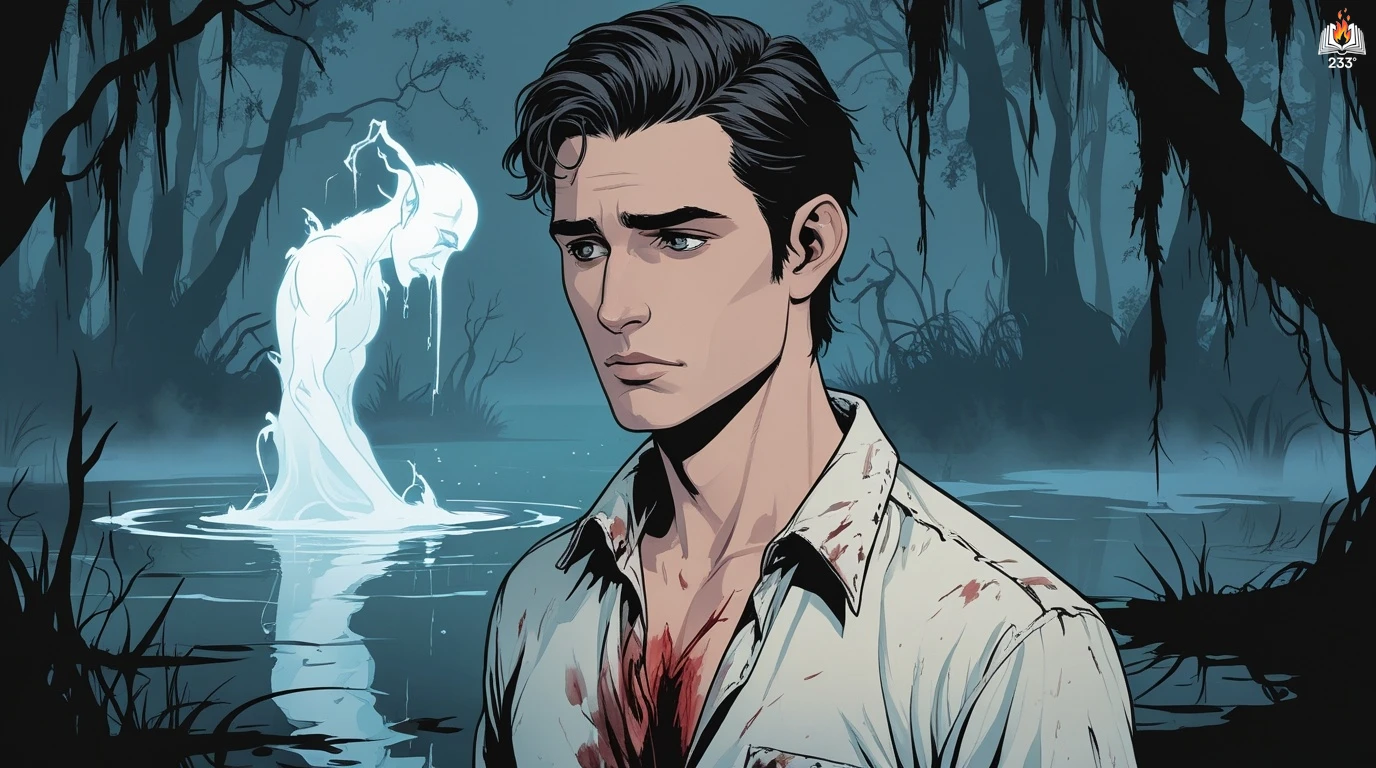
The Wolf Gift by Anne Rice, published in 2012, marks her foray into werewolf mythology, shifting focus from the vampires and witches of her acclaimed Vampire Chronicles and Mayfair Witches series. Set along the hauntingly beautiful Northern California coast, the novel follows the spiritual and physical transformation of a young man who inherits a mysterious power. With lush gothic prose and philosophical inquiry, Rice reinvents the werewolf legend, blending it with theological and moral dilemmas that echo through the pages of this modern gothic narrative.
Plot Summary
The mist curled low around the cliffs of the Northern California coast, where the great stone house of Nideck Point stood watch over the gray, heaving sea. It was there Reuben Golding arrived, a young reporter with shining blue eyes and tousled curls, sent to write a simple real estate piece. But the house stirred something deeper within him – something primal and magnetic – and its steward, the graceful and melancholic Marchent Nideck, only deepened that feeling. She walked him through the grand halls and shadowed libraries of her inheritance, sharing the history of her missing uncle Felix, an explorer and scholar lost for decades. The place breathed secrets. Reuben found himself bewitched by its memory-stained walls, by the faded grandeur, by Marchent herself.
Their connection warmed like firelight. They shared wine and stories, the glow of torches and the ache of memory. He thought of abandoning everything – his skeptical girlfriend, his practical mother, the city – just to live and write at Nideck Point. And then, one cold night, the dream fractured. Strangers broke into the house. Marchent was murdered before his eyes. Reuben, in a frantic effort to save her, was attacked. Amid the agony and blood, something ancient entered his body – something wild and immense. And when he awoke, he was not the same.
The change came with speed. Strength surged in his limbs. His senses sharpened until the world itself seemed reborn. His body responded to danger, to injustice, with a force he couldn’t control. By night, he became something more than human – the Man Wolf. At first, he fled from it, from the horror of what he had done to the attackers. But the creature inside him was no mindless beast. It hunted evil. It defended the innocent. It made judgments swift and final.
Whispers of a savage vigilante filled the news. Reuben struggled with guilt and wonder. He returned to the city, trying to mask the transformation, but his family noticed. His mother, the brilliant surgeon, saw the changes in his body and pressed with questions he couldn’t answer. Celeste, distant and logical, recoiled from his secrets. Only his father, the quiet poet, seemed to understand – not the details, but the poetry of it, the ache of being something other.
Nideck Point called to him still. Reuben inherited it after Marchent’s death, and there, in the solitude of redwoods and wind, he began to unravel the legacy he had been given. He explored the sealed rooms of Felix Nideck, the scrolls and tablets left behind, the indecipherable symbols etched in ink and stone. Slowly, threads of a hidden world revealed themselves. There were others. Morphenkinder, they were called – ancient shape-shifters, guardians, witnesses to humanity’s shadowed history.
One night, they came to him. Not monsters, but men and women draped in knowledge and power. Felix was among them, not dead, but alive and transformed, just like Reuben. He had vanished to protect the secret and protect himself, but he watched over his family from afar. With him were others – Sergei, Margon, Frank – wise, enigmatic beings who had walked the earth for centuries. They welcomed Reuben into their fold, not with ritual or dogma, but with fierce compassion. The gift he bore was rare and sacred. It bound him to a life of judgment, not vengeance, of solitude tempered by purpose.
But even as Reuben learned to master his transformations, the world around him darkened. His actions as the Man Wolf had not gone unnoticed. The media swarmed. Scientists and opportunists hunted for answers. One zealous doctor sought to expose him, to carve out his truth. Reuben, torn between revelation and concealment, found himself increasingly estranged from the life he once knew. He longed for love, for understanding, but the gift had marked him.
Into this tangle of need and secrecy came Laura. He saved her from death – a kidnapping gone wrong – and from that moment, a bond grew between them. She saw him for what he was, not the horror or the miracle, but the man beneath both. She did not flee from the beast, nor from the pain that clung to his soul. Her presence soothed the hunger in him, gave his rage and sorrow a quiet harbor. They spoke not just with words, but with silence and closeness. She believed in him.
Yet the gift would not let him rest. Another threat emerged, a creature twisted and unclaimed – a rogue like Reuben, but driven by madness. The killings were brutal, senseless. Reuben hunted the beast through forest and fog, through screams and scent. In a final confrontation, far from civilization, he faced the rogue down, not just with power but with mercy. It was not triumph but release.
Back at Nideck Point, the Morphenkinder came again. They stood beneath the redwoods, guardians of old truths, and embraced Reuben not as a novice but as a brother. He had crossed the thresholds of rage and restraint, of terror and tenderness. The beast and the man had become one.
With Laura at his side, Reuben looked out across the cliff, the wind tugging at his coat, the sea roaring its ancient hymn. The sky was deep with stars. The house behind him was no longer just a place of mystery, but of belonging. He knew now what it meant to be chosen, to carry the burden and the beauty of the wolf gift. He had found his voice, his purpose, and a love that saw through fur and fang into the soul beneath.
Main Characters
- Reuben Golding – A 23-year-old journalist dubbed “Sunshine Boy” for his youthful charm and good looks, Reuben is intelligent yet unsure of his place in the world. Initially sent to cover a real estate story, his encounter with a mysterious house and its alluring owner changes his life forever. His transformation into a werewolf (or Man Wolf) forces him to confront deep moral questions, experience the intoxication of power, and discover a primal side of himself he never imagined.
- Marchent Nideck – Elegant, enigmatic, and worldly, Marchent is the caretaker of the grand Nideck estate and heir to the secrets of her missing uncle. Her bond with Reuben is tender and complicated, as she represents both maternal warmth and romantic intrigue. Her fate acts as the first catalyst in Reuben’s journey of supernatural inheritance and awakening.
- Felix Nideck – A legendary figure whose disappearance haunts the estate, Felix is a polymath explorer, collector, and philosopher. Though initially absent, his legacy permeates the novel. As truths unfold, Felix’s presence becomes central to Reuben’s transformation and the unveiling of the hidden order of the Morphenkinder.
- Celeste – Reuben’s sharp, ambitious girlfriend and a rising district attorney, Celeste embodies the pragmatic, skeptical world Reuben begins to drift away from. Their relationship reveals the dissonance between Reuben’s old life and the profound changes he’s undergoing.
- Phil and Grace Golding – Reuben’s father and mother represent opposing worldviews. Phil, the aging poet, embraces beauty and wonder, while Grace, a trauma surgeon, is rooted in harsh realism and professional rigor. Their perspectives frame Reuben’s inner conflict between wonder and duty, instinct and intellect.
Theme
- Transformation and Identity: At the heart of The Wolf Gift lies the theme of transformation, both physical and spiritual. Reuben’s metamorphosis into the Man Wolf becomes a symbol for the discovery of one’s deeper, often hidden self. His dual nature reflects the eternal struggle between the civilized and the primal, and raises questions about identity, morality, and belonging.
- The Ethics of Power: Reuben’s supernatural abilities grant him strength and speed, but also the burden of moral judgment. He grapples with whether it’s righteous to use his power to exact justice on evildoers, effectively playing God. Rice explores the weight of such divine agency, contrasting human law with natural retribution.
- Heritage and Legacy: The mystery of the Nideck estate and the enigmatic Felix speak to the theme of inheritance – not merely of wealth or property, but of knowledge, mystery, and responsibility. Reuben inherits a physical gift, but also a spiritual lineage that binds him to an ancient brotherhood and a larger metaphysical destiny.
- Isolation and Community: As Reuben’s transformation distances him from family and friends, he finds solace and identity in the secretive society of the Morphenkinder. The novel reflects on the loneliness of being “other,” and the human need for connection – not merely with people, but with purpose and history.
- The Natural World vs. Civilization: The wild beauty of Mendocino’s forests and the looming redwoods symbolize untamed nature and ancient forces, juxtaposed against the structured, rational world of San Francisco. Nature here is not only a backdrop but an active force in the narrative – evocative, majestic, and deeply entwined with the werewolf mythos.
Writing Style and Tone
Anne Rice’s writing in The Wolf Gift is rich, lyrical, and steeped in atmospheric detail. Her prose flows with a romanticism reminiscent of 19th-century gothic fiction, yet it’s tempered with modern sensibilities and introspective clarity. The descriptions of the natural environment – mist-shrouded forests, ocean cliffs, and the grand estate – evoke a brooding beauty that situates the novel in a timeless space. Her narrative voice oscillates between intimate interiority and mythic grandeur, seamlessly melding the psychological with the supernatural.
Rice’s tone is reflective and philosophical. She uses Reuben’s transformation as a springboard for deeper exploration of theological questions and moral ambiguity. Dialogue often carries an elevated quality, bordering on the poetic, especially in moments of revelation or personal confession. Yet there is also warmth and humanity that grounds the story, with characters experiencing ordinary joys and doubts even amidst the extraordinary.
Anne Rice maintains her signature blend of sensuality, gothic romanticism, and spiritual inquiry. The tone is never rushed; instead, it invites the reader to linger – to dwell within the mysteries, to question along with the characters, and to surrender to the dark and luminous world she so meticulously constructs.
Quotes
The Wolf Gift – Anne Rice (2012) Quotes
“Time can tick when there is no clock.”
“Truth is a risky proposition. It's the nature of mediocre human beings to believe that lies are necessary, that they serve a purpose, that truth is subversive, that candor is dangerous, that the very scaffold of communal life is supported by lies.”
“Dear God, help me. Do not forget me on this tiny cinder lost in a galaxy that is lost–a heart no bigger than a speck of dust beating, beating against death, against meaninglessness, against guilt, against sorrow.”
“I will write things, he was thinking. I will write something meaningful and wonderful someday. I can do that. And I'll dedicate it to you because you're the first person who ever made me think I could.”
“I'm hoping what all sentient beings hope ... that somehow I'm part of something larger than myself, in which I play a role, an actual role that is somehow intended and meaningful.”
“Oh, if the moon only had a secret, if the moon only held a truth. But the moon was just the moon.”
“Pride is the parent of destruction; pride eats the mind and the heart and the soul alive.”
“Say what you will to the force that governs the universe. Perhaps we'll call it into being, and it will yet love us as we love it.”
“The highest truths a person could discover were rooted in the natural world.”
“Some mysteries are simply irresistible,” she said. “They have components that alter a life.”
“Who has a right to tell me I have no gift, no talent, no passion ...' he murmured. 'Why do people say those things to you when youre young? Doesn't seem fair, does it?' 'No, darling, it's not fair,'she said. 'But the mystery is why you listen.”
“Phil was mumbling that Reuben might become a writer after all and writers had a way of "redeeming everything that ever happens to them.”
“...what was the good of being a movie werewolf? You howled at the moon; you couldn't remember what you did, and then somebody shot you.”
“But all morality is of necessity shaped by context. I'm not talking relativism, no. To ignore the context of a decision is in fact immoral.”
“God, what is it like to be You and hear all those people all the time everywhere, begging, imploring, calling out for anything and anyone?”
“You are alone when something like this happens. Doesn't matter how many people love you and want to help you. You are alone. When Marchent died, she was alone.”
“He was so excited by this little bit of intelligence that he might have gone off, perplexed, pondering for a long time. It was like reading a wonderful sentence in a book, and not being able to continue because so many possibilities were crowding his mind.”
“Get thee behind me, tragedy.”
“Thank God he killed the guy. Oh, now, wait a minute. What kind of a prayer was that!”
“He had never expected death to be this quiet, this secretive, this easy.”
“Wasn't it his right to listen to opera, read poetry and adventure novels, go to Europe every couple of months for some reason or another, and drive his Porsche over the speed limit until he found out who he was?”
“I think all of us ordinary mortals tend to mythologize people as good-looking as you.”
“There's a virtue,' Felix said, 'to listening to a reluctant storyteller. You know that he is in fact diving deep for the salvageable truth.”
“When we talk about our lives, long or short, brief and tragic or enduring beyond comprehension, we impose a continuity on them, and that continuity is a lie.”
“Garden of Pain, I need you. What were the songs of beasts to the cries of sentient souls?”
“But even those people, cops, lawyers, doctors, learned what they learned from the aftermath. They weren't there when the killer tore at his victim; they didn't smell the scent of evil; they didn't hear the cries to heaven for something, someone, to intervene.”
“If drugs really numb your consciousness, they'd be a good thing. As it was, they slowed you down, confused you, kept you vulnerable to violent flashes of recall, and then agitated you and made you unsure of what you knew and didn't know.”
“Hoping for something is not the same as expecting it.”
“Laura remarked that science was dependent upon poetry, that all scientific description was metaphoric.”
We hope this summary has sparked your interest and would appreciate you following Celsius 233 on social media:
There’s a treasure trove of other fascinating book summaries waiting for you. Check out our collection of stories that inspire, thrill, and provoke thought, just like this one by checking out the Book Shelf or the Library
Remember, while our summaries capture the essence, they can never replace the full experience of reading the book. If this summary intrigued you, consider diving into the complete story – buy the book and immerse yourself in the author’s original work.
If you want to request a book summary, click here.
When Saurabh is not working/watching football/reading books/traveling, you can reach him via Twitter/X, LinkedIn, or Threads
Restart reading!