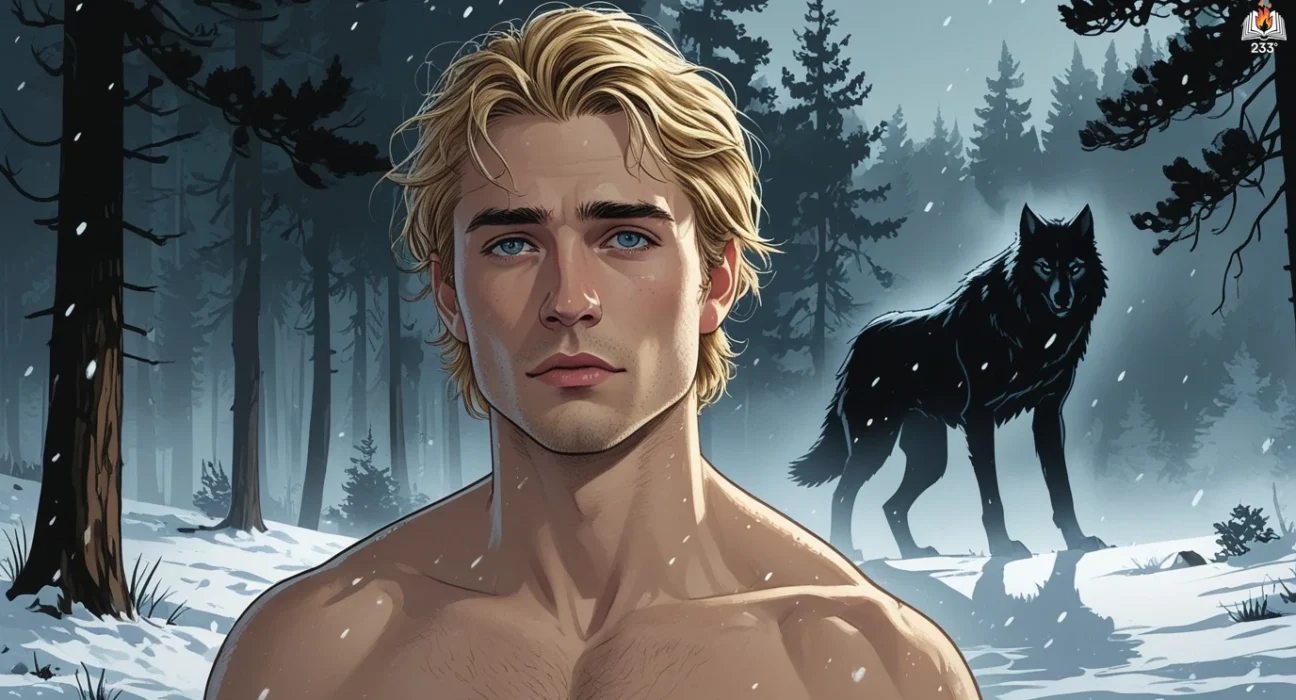
The Wolves of Midwinter by Anne Rice, published in 2013, is the second novel in The Wolf Gift Chronicles series. Set in the fog-drenched forests of Northern California, this gothic fantasy continues the tale of Reuben Golding, a young man who has embraced the gift – or curse – of becoming a Morphenkind, a sentient werewolf. As the Yuletide season approaches, the story weaves together ancient rituals, supernatural secrets, and the human longing for love, family, and belonging. Blending the mysticism of folklore with modern themes, Rice delves deeper into the mythical world she began in The Wolf Gift.
Plot Summary
In the deep of December, with the northern California rains draping the coast in mist and gray, the great mansion of Nideck Point burned with oak fires and secrets. It stood like a fortress against the encroaching darkness of the forest, home to the Morphenkinder – beings who lived with the weight and wonder of transformation, of immortality, of a dual nature both human and beast. Among them now was Reuben Golding, a young man newly gifted, still caught between the pull of his old life and the wild blood of his new one.
Yuletide approached, and the old ones – Felix Nideck, Margon, Thibault – stirred with ancient excitement. Plans for a grand festival were laid with meticulous joy. Reuben wandered through the preparations, watching as garlands were strung, fires stoked, and laughter spilled through halls that once echoed only with silence. Yet inside him, a quiet unease grew. Laura, the woman he loved, the anchor of his changing soul, had taken the Chrism. She had chosen immortality. And he had not known until he saw it in her eyes, the way her hair gleamed like burnished gold, the way her voice echoed with new resonance. Her transformation had begun.
He sought her out through the rain, to the house at the edge of Muir Woods, where the forest pressed against the windows like a dream. She welcomed him with warmth and touch and silence, her body still soft and familiar, but her spirit altered in ways he could not define. Her acceptance of the gift unnerved him – not for its danger, but for the way it slipped beyond his control. He had loved her as something fragile, someone to protect. Now she stood beside him, not beneath him, changed and unbreakable. And he feared he would no longer know how to love her.
Laura confessed it had not been a decision born of reason, but of need. Her past was filled with death – her children, her sister, her family, all gone. Nothing had ever broken the veil between life and death for her, until Reuben came from the trees, a myth made flesh. In him, she had seen a reason to believe again. In him, she had found the miracle that made her want to live. She wanted not to fade but to remain, and the Chrism was the only path. Reuben listened, torn between awe and mourning, knowing that something had passed between them that would never return – the unequal magic of a mortal and her beast.
She told him of the changes – the heightened senses, the voices of deer in the woods, the shimmer of stars beyond the clouds. But she had not yet transformed. Thibault waited near her home each night, should the full change overtake her. Reuben asked her to return with him, to come back to Nideck Point. But Laura chose to remain, to pass through this metamorphosis alone, wrapped in silence and snow, beneath the dripping branches. And so he left her, walking into the night with the weight of unspoken love pressing into his bones.
Back at Nideck, the preparations for the festival grew feverish. Felix moved with renewed purpose, restoring ancient traditions long buried. Statues for a crèche were unearthed from the cellar – marble saints and kings with eyes of eternity. The town was to be reborn as a place of light and gathering, its storefronts trimmed with holly and joy. Yet beneath the cheer, the Morphenkinder prepared for their own sacred rite. On the eve of Christmas, they would retreat to a hidden glade in the forest, a circle of stones where they would gather to drink, to remember the lost, and to welcome the new. There, Reuben, Laura, and Stuart would be formally embraced by the old blood.
Stuart, young and wild, mocked ceremony with the recklessness of one not yet hardened by years. He taunted the elders, jabbing at their rituals, but his bravado was thinly veiled wonder. He, too, longed to belong. Margon, the ancient one with eyes like deep time, growled and laughed in equal measure, keeping the boy close even as he scolded. Together with Reuben, they formed a strange triumvirate – the noble, the skeptic, and the innocent, each carrying the burden of power in different ways.
Felix, ever the architect of belonging, shared his vision with Reuben in the dim cellar beneath Nideck. Surrounded by statues, beneath the weight of carved lambs and marble halos, he reminded the younger man that immortality was not in the blood alone, but in the living – in love, in suffering, in the cycles of grief and renewal. He spoke of his own past, of homes long lost, of the sorrow that eroded even the strongest spirit. What kept them alive, truly alive, was treasuring the pain, not denying it. Reuben, listening, began to understand. That this fear of losing Laura was part of the love itself. That loving her now, as she became something more, was the only path forward.
Night fell, and Sergei returned from the forest, streaked with rain and leaves, his silence speaking of blood. The others gave him space, recognizing the raw pulse of the hunt. Reuben, stirred by the scent, felt the old hunger rise but turned inward instead, choosing thought over transformation. He began to write, pouring his restless heart into words. He wrote of Christmas – not as the world knew it, but as he had come to see it. A season not just of birth, but of return, of recognition, of renewal. A season of the eternal.
The house quieted, and Reuben curled into a window seat, a book forgotten in his lap, listening to the wind that moved through the eaves like a song. The fire burned low. He felt the ache of waiting, but also the grace of it. Laura would come. He did not know when. But the love between them was a living thing now, not bound by form or time. It would survive this change.
Outside, the forest watched. And within, in the hush of the deep hours, the wolves of Midwinter dreamed.
Main Characters
Reuben Golding – A once-ordinary journalist turned Morphenkind, Reuben is still learning how to live with his dual nature. Struggling with guilt, desire, and a growing sense of detachment from his human past, he seeks solace in love and community. Reuben’s evolution is marked by his fierce loyalty, vulnerability, and a deepening moral conscience that compels him to protect rather than destroy.
Laura – Reuben’s lover and emotional anchor, Laura is a woman marked by profound loss and spiritual isolation. Her decision to become Morphenkind symbolizes a reclaiming of agency and a desire for immortality and connection. As she undergoes the early stages of transformation, she becomes both a mirror and a challenge to Reuben’s ideals of love and identity.
Felix Nideck – A patriarchal figure among the Morphenkinder and the former guardian of the estate, Felix is wise, cultured, and driven by a deep commitment to preserving the traditions and secrecy of his kind. His mentorship of Reuben reveals his vision for a harmonious coexistence between human values and supernatural existence.
Stuart McIntyre – A teenager accidentally turned into a Morphenkind, Stuart brings a chaotic, irreverent energy to the narrative. His wit masks deeper insecurities and a yearning for acceptance. His banter, especially with the elders, highlights generational tensions within the Morphenkinder.
Margon – One of the elder Morphenkinder, Margon embodies ancient wisdom with a biting sense of humor. His relationship with Stuart and Reuben is layered with mentorship, provocation, and quiet affection. He is both guardian and provocateur.
Thibault – A refined and mysterious member of the Morphenkinder, Thibault serves as Laura’s guide during her transformation. His presence challenges Reuben’s notions of trust and masculinity, especially in how Laura seems to gravitate to him in her time of vulnerability.
Theme
Transformation and Identity – The central theme of metamorphosis explores not just the physical shift into werewolf form, but the profound psychological and emotional transformation that accompanies power and immortality. Characters struggle with the duality of their nature, balancing human emotion with animal instinct.
The Fear and Sanctity of Death – Immortality is portrayed not as a blessing but a burden, haunted by the grief of losing loved ones and the knowledge that time will eventually erase every attachment. Laura’s monologue on her family’s death crystallizes the desire to cheat death, not out of hubris, but longing.
Love and Possession – The love between Reuben and Laura is deeply felt yet clouded by fear and control. The narrative scrutinizes the difference between loving someone and trying to own them, especially as both undergo irreversible changes that threaten to redefine their bond.
Belonging and Family – At its heart, The Wolves of Midwinter is about finding family – whether chosen or inherited. Nideck Point becomes a sanctuary where lost souls and supernatural beings forge a new tribe. This theme plays out not only in the relationships among the Morphenkinder but also in Reuben’s conflicted ties to his biological family.
Ritual and Myth – The Midwinter festivities, steeped in ancient traditions and symbolism, reflect Rice’s fascination with the ritualistic aspects of both pagan and Christian heritage. The blending of Yuletide with the Morphenkinder’s secret rites underscores a broader meditation on faith, memory, and continuity.
Writing Style and Tone
Anne Rice’s prose in The Wolves of Midwinter is opulent, poetic, and richly atmospheric. Her sentences often drift into introspection, capturing the emotional and sensory world of her characters with lyrical precision. She infuses everyday occurrences—tea by the fire, a walk in the woods—with mysticism and depth, blurring the line between the mundane and the divine. Rice’s language is heavily adorned, favoring evocative detail over economy, which adds a dreamy, almost enchanted quality to the narrative.
The tone of the novel is both melancholic and reverent. It mourns the transience of life while celebrating the beauty of connection, memory, and myth. Though elements of horror exist, they are subdued, rendered instead through spiritual unease and existential dread. There’s a quiet reverence for nature, tradition, and the sensual world, making the book as much a philosophical reflection as a supernatural tale. Rice’s style invites the reader to slow down and dwell in the emotional nuances of her characters, emphasizing introspection over action.
Quotes
The Wolves of Midwinter – Anne Rice (2012) Quotes
“There is no normal life. There is only life.”
“Traditions are seldom lies; traditions reflect people’s deepest beliefs and customs. They have their own truth,”
“There is nothing under the sun...nor under the moon, no entity of intellect, that does not have to believe something about itself, something about its purpose, the reason for its suffering, its destiny.”
“There are ways to live this life, and my way has always been one of inclusion—of our own kind, of all humankind, of all spirits, of all things under the sun. It’s not a virtue with me. I don’t know any other way to move through the world.”
“Treasure the pain; treasure what you have with her, including the fear. Treasure what you may have, including the failure. Treasure it because if we don’t live this life, if we don’t live it to the fullest year after year and century after century, well, then, we die.”
“An accidental chaos blindly serving up the unaccountable beauty he now saw”
“The blowing mist, filled with the light of the moon, was seeking to swallow the lamps of the heavens.”
“as she pulled away the shirt and jacket like so much wrapping paper on a gift.”
“Why don’t people do what they really want to do, Reuben?” he asked. “Why do we so often settle for what makes us devoutly unhappy! Why do we accept that happiness just isn’t possible?”
“Christmas celebrations in the early colonies to the condemnations today of the commercial nature of the feast.”
“He was shaking his head, biting into his lower lip, fighting the sheer misery of the anticipation, when he realized that another figure was standing directly opposite, on the other side of the fire, quite visible above the leaping flames, gazing at him.”
“You are living in a blessed time now, Reuben, and you will be until all those you love here are gone, until your generation is in the earth. Then immortality will begin for you.”
“in the workaday world such relics were enshrined in museums, untouchable, and out of context,”
“Hellfire believers seem to delight in the idea that most of the human race would end up in just such a horrible place.”
“God triumphs on the ruins of our plans.”
“Jim, remember the movie Tombstone? Remember what Doc Holliday says to Wyatt Earp when Doc is dying. You and I saw that movie together, remember? Doc says to Wyatt: ‘There’s no such thing as normal life, Wyatt. There’s just life.”
“year and century after century, well, then, we die.”
“Geliebten Lakaien are once again here with us. Lisa, Heddy, Henrietta, Peter, and Jean Pierre,”
We hope this summary has sparked your interest and would appreciate you following Celsius 233 on social media:
There’s a treasure trove of other fascinating book summaries waiting for you. Check out our collection of stories that inspire, thrill, and provoke thought, just like this one by checking out the Book Shelf or the Library
Remember, while our summaries capture the essence, they can never replace the full experience of reading the book. If this summary intrigued you, consider diving into the complete story – buy the book and immerse yourself in the author’s original work.
If you want to request a book summary, click here.
When Saurabh is not working/watching football/reading books/traveling, you can reach him via Twitter/X, LinkedIn, or Threads
Restart reading!