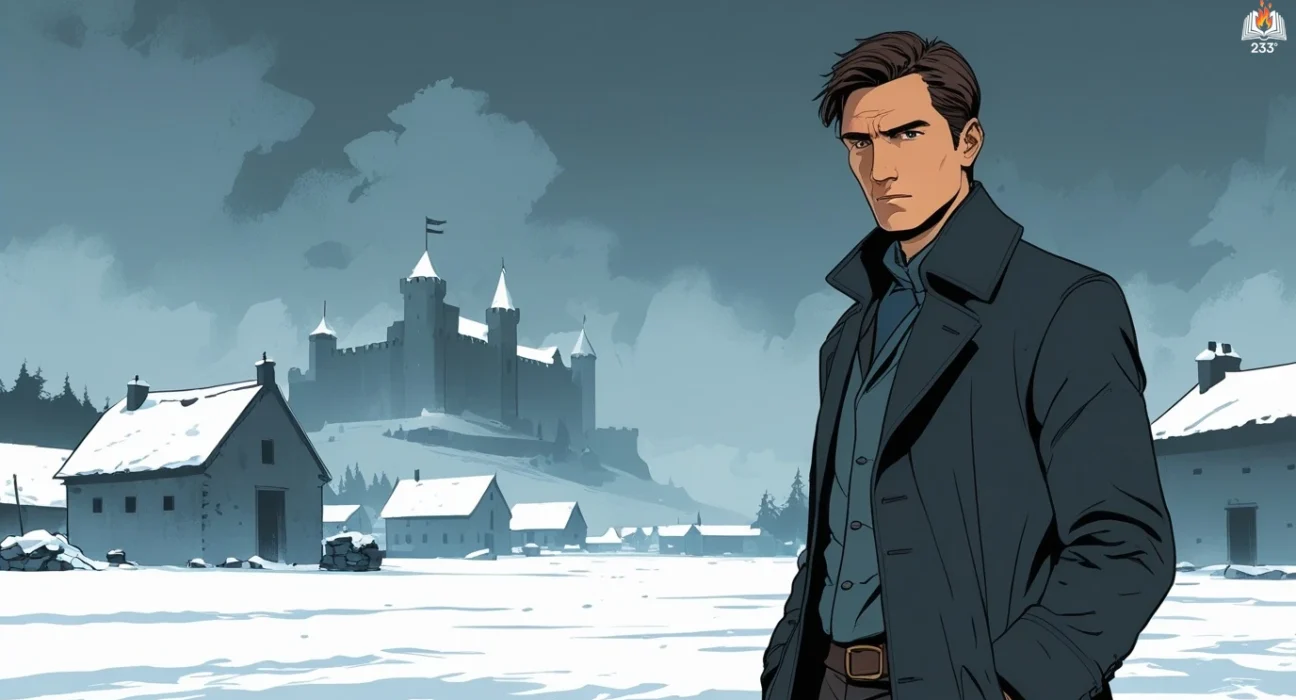
The Castle by Franz Kafka, first published posthumously in 1926, stands as one of the most enigmatic and profound works of modernist literature. Unfinished at the time of Kafka’s death, the novel was edited and published by his friend Max Brod, who defied Kafka’s wishes to have his manuscripts destroyed. The story follows a protagonist known only as K., a land surveyor who arrives in a snow-covered village governed by a mysterious and impenetrable bureaucracy headquartered in the elusive Castle. Despite being one of Kafka’s three major novels, The Castle is not part of a series but exists alongside The Trial and Amerika as a thematic sibling, each examining the alienation and absurdities of modern existence.
Plot Summary
It was late evening when K. arrived in the village, snow-buried and hushed beneath a heavy sky. The Castle, his destination, remained hidden in the mist, cloaked in darkness. The bridge that led from the road to the village stood empty, and the innkeeper, startled by the unexpected guest, offered him a makeshift bed on a straw pallet in the lounge. As K. slept, a young man claiming to be the son of the castle’s steward awoke him, demanding to know his purpose. When K. claimed to be the land surveyor summoned by the Castle, suspicion and confusion followed. A telephone call was made – to the Castle itself – and an uncertain affirmation returned. He was permitted to stay.
K.’s arrival did not bring clarity. The Castle, a looming presence on the hill, proved elusive. From a distance it seemed promising – dignified, perhaps even grand – but as he approached, its impression faltered. The buildings were squat, uninspiring, neither palace nor fortress, more a scattered town of crumbling stone. His purpose – to serve as a land surveyor – found no clear direction. Instead, there was a maze of messengers, assistants, and unnamed officials, each reflecting the opaque machinery of the Castle.
Two men were assigned to him as assistants – Arthur and Jeremiah – who moved like shadows, inseparable and indistinguishable, their obedience mechanical, their understanding shallow. They offered neither insight nor aid, yet they trailed him loyally, like specters tied to his fate. In the inn, he met Frieda, a barmaid entangled with Klamm, one of the elusive Castle officials. In Frieda, K. found a tenuous link to the power he sought. Their affair ignited quickly, their intimacy unfolding not in warmth, but in desperation, in a puddle of beer-soaked floorboards behind the bar. She left her position and followed him, choosing uncertainty over familiarity.
The innkeeper, the schoolmaster, and the villagers viewed K. with a blend of suspicion and passive indifference. The mayor confirmed that his services were no longer needed. Some bureaucratic error, it seemed – the Castle had summoned a land surveyor, but it had no work for one. Yet this decision was never fixed. Messages contradicted each other. Officials were unreachable. Letters arrived only through intermediaries, if at all, and often confused more than clarified. The Castle existed behind layers of silence, unreachable by roads or reason.
Through Barnabas, a young messenger, K. gained another thread to the Castle. Barnabas belonged to a family living in disgrace. Years ago, his sister Amalia had rejected the indecent summons of a Castle official named Sortini. The family had been marked ever since. They lived under a cloud of unspoken condemnation, abandoned by neighbors, tolerated only at the edges. Olga, the other sister, revealed their history to K., recounting the desperate efforts she had made to restore their name. She believed that her family’s punishment could be undone. K. listened, not out of sympathy, but because their story mirrored his own slow descent – their estrangement from the Castle echoed his own exclusion.
Frieda, increasingly embittered by K.’s futile pursuits and cold detachment, drifted away. Their bond, forged in rebellion against the Castle, unraveled when she saw in him the same obsession, the same blindness, she had tried to escape. Her return to Klamm’s circle was both a resignation and a survival.
K. made inquiries. He pursued audiences. He wandered to offices and sat in antechambers, questioned villagers and traced rumors. Every step toward the Castle was swallowed by deeper snow and thicker silence. Even the physical path seemed to deceive – the road to the Castle curved endlessly, pulling away just as it seemed to draw near. At times, the Castle loomed close, yet never permitted entry. K.’s efforts were not denied outright. They were misdirected, delayed, muffled by polite indifference or sudden absences.
His assistants added confusion. They mimicked his words, anticipated his gestures, yet understood nothing. One moment they would vanish, the next they would appear, arms linked with Frieda or laughing with strangers. Their presence reminded K. that he was never truly in control of his own mission.
When K. finally reached the Castle’s offices, the experience offered no clarity. A clerk ushered him into dimly lit corridors, but no audience followed. Files lay in disarray, functionaries moved like sleepwalkers, and even the simplest requests collapsed under endless procedures. The Castle was not a structure but a condition – an atmosphere of indecision and distance. To serve it, to be accepted by it, required not skill or purpose, but submission to its rhythmless breath.
He attempted to work through Barnabas’s connections. He drafted petitions, discussed strategies with Olga, weighed every rumor. But every plan returned him to the same uncertainty. Even his identity seemed to lose weight. Was he still the land surveyor? Or simply a man who claimed to be? The Castle never confirmed or denied his position. He remained suspended between inclusion and exile.
The village changed around him. Seasons did not pass, but time moved – not forward, not backward, but in circles. The snow never melted. People grew familiar with him, but never warm. His presence became accepted without being understood. The Castle remained as it had always been – visible yet unreachable, near but never present.
K. continued his efforts. He wrote letters, questioned functionaries, tried again to reach Klamm, to reclaim Frieda, to make sense of his errand. He found lodging with Barnabas’s family, sharing their outcast condition. He talked with Olga, listened to her exhausted dreams, admired Amalia’s silence.
The Castle did not move against him. It did not send him away. It did not crush him. It simply remained itself – vast, indifferent, inscrutable. And K., buried in snow and silence, pressed on with fading strength, his purpose obscured, his path without end.
Main Characters
- K. – The protagonist, a land surveyor whose efforts to gain recognition and establish his purpose in the village are met with relentless obstruction. He is persistent and skeptical, embodying the modern man’s struggle against opaque and indifferent systems. His journey is marked by isolation, self-doubt, and a futile yearning for acceptance by the Castle authorities.
- Frieda – A barmaid at the inn and K.’s initial love interest, Frieda is complex and emotionally volatile. She provides K. with a semblance of connection to the Castle through her past relationship with Klamm, a Castle official. Their relationship deteriorates as Frieda becomes disillusioned with K.’s obsession and failure to make meaningful progress.
- Klamm – A powerful and elusive Castle official, Klamm is at the center of K.’s attempts to gain legitimacy. He never fully appears in the narrative, which heightens his symbolic role as the inaccessible face of authority and bureaucracy. Klamm’s influence shapes much of the villagers’ lives and fuels K.’s frustration.
- Barnabas – A young village messenger whose family has been socially ostracized due to an unclear offense against the Castle. He serves as K.’s tentative link to the bureaucracy, though his messages often deepen the confusion rather than resolve it.
- Amalia and Olga – Barnabas’s sisters, with Amalia being defiant and principled, refusing an inappropriate summons from a Castle official, thereby bringing disgrace upon her family. Olga, more compliant, tries to rehabilitate the family’s status. Their contrasting responses to authority highlight the novel’s moral complexity.
- The Assistants (Arthur and Jeremiah) – Sent by the Castle to assist K., the twin-like figures are nearly indistinguishable and embody chaos and ambiguity. They are loyal in a baffling, almost comical way, and serve more as symbols of confusion than as reliable aides.
Theme
- The Absurdity of Bureaucracy: Kafka’s Castle is a towering metaphor for the labyrinthine, indifferent bureaucratic systems that govern modern life. The endless delays, contradictory messages, and faceless officials reflect a world where logic and order give way to confusion and alienation. K.’s efforts to be acknowledged are met with Kafkaesque paradoxes that reveal the futility of seeking clarity within such systems.
- Alienation and Isolation: K. is a quintessential outsider, cut off from both the villagers and the Castle. His status as a stranger underscores the existential loneliness that permeates the novel. Even those he becomes close to – Frieda, the assistants, Barnabas – remain ultimately separate from him, reinforcing his isolation in an uncaring universe.
- The Illusion of Authority: Authority in The Castle is both omnipresent and unreachable. Figures like Klamm wield immense influence, yet they remain unseen and unaccountable. This disconnection creates a system where authority exists more as a psychological force than a tangible presence, and the pursuit of validation becomes a self-defeating quest.
- Guilt and Punishment: Though K. has committed no identifiable crime, he is treated with suspicion and disdain. This motif of undefined guilt echoes Kafka’s broader philosophical exploration of sin and the Fall of Man, suggesting a metaphysical state of culpability inherent in human existence.
- Faith and Hope in the Face of the Incomprehensible: Amid the hopeless navigation of red tape and indifference, K. persists. His perseverance, though irrational, speaks to a deeper human need for purpose and understanding. Even in the most impenetrable systems, Kafka shows the glimmer of a spiritual or existential yearning.
Writing Style and Tone
Kafka’s prose in The Castle is deceptively simple, marked by clear sentence construction, restrained vocabulary, and an unadorned narrative voice. Yet within this clarity lies a surreal, dreamlike quality that disorients the reader. The narrative unfolds in long, often convoluted passages where dialogue and thought intermingle seamlessly. Kafka’s technique of presenting absurdities with sober precision lends the novel a nightmarish realism that reflects the protagonist’s mental and emotional disintegration.
The tone throughout is detached yet claustrophobic. There is a persistent sense of oppression and quiet despair, heightened by the cold, snow-bound setting. Kafka rarely indulges in dramatic outbursts; instead, the horror of the novel lies in its muted, suffocating atmosphere. The reader is made to feel K.’s confusion and desperation not through overt dramatization, but through the relentless, procedural breakdown of logic and communication.
Quotes
The Castle – Franz Kafka (1926) Quotes
“I dream of a grave, deep and narrow, where we could clasp each other in our arms as with clamps, and I would hide my face in you and you would hide your face in me, and nobody would ever see us any more”
“You misinterpret everything, even the silence.”
“If a man has his eyes bound, you can encourage him as much as you like to stare through the bandage, but he'll never see anything.”
“There's no quiet place here on earth for our love, not in the village and not anywhere else, so I picture a grave, deep and narrow, in which we embrace as if clamped together, I bury my face against you, you yours against me, and no one will ever see us.”
“Since I met you, I've felt abandoned without your nearness; your nearness is all I ever dream of, the only thing.”
“One must fight to get to the top, especially if one starts at the bottom.”
“Illusions are more common than changes in fortune”
“Deceptions are more frequent than changes”
“It isn’t easy to understand exactly what she is saying, for one doesn’t know whether she is speaking ironically or seriously, it’s mostly serious, but sounds ironic. - “Stop interpreting everything!” said K.”
“and i would hide my face in you and you would hide your face in me, and nobody would ever see us any more”
“all [the authorities] did was to guard the distant and invisible interests of distant and invisible masters”
“those who are ignorant naturally consider everything possible.”
“Other opportunities arise from time to time that almost don't accord with the overall situation, opportunities whereby a word, a glance, a sigh of trust may achieve more than a lifetime of exhausting endeavour.”
“Of course I'm ignorant, that remains true at all events and is extremely distressing for me, but it does have the advantage that the ignorant man dares more, so I shall gladly put up with ignorance and its undoubtedly dire consequences for a while, as long as my strength lasts.”
“Oh, if only you knew how hard I try to find a kernel of good for myself in all you do and say, even if it torments me.”
“to be sure, all that pointless standing about and waiting day after day always starting all over again without any prospect of change, will wear a man down and make him doubtful, and ultimately incapable of anything but that despairing standing about.”
“How suicidal happiness can be!”
“He certainly goes into the offices, but are the offices really the castle? And even if the castle does have offices, are they the offices which Barnabas is allowed to enter?”
“Official decisions are as elusive as young girls.”
“He is a land surveyor, well, perhaps that is something, he has trained at something, but if there's nothing you can do with that training then it means nothing.”
We hope this summary has sparked your interest and would appreciate you following Celsius 233 on social media:
There’s a treasure trove of other fascinating book summaries waiting for you. Check out our collection of stories that inspire, thrill, and provoke thought, just like this one by checking out the Book Shelf or the Library
Remember, while our summaries capture the essence, they can never replace the full experience of reading the book. If this summary intrigued you, consider diving into the complete story – buy the book and immerse yourself in the author’s original work.
If you want to request a book summary, click here.
When Saurabh is not working/watching football/reading books/traveling, you can reach him via Twitter/X, LinkedIn, or Threads
Restart reading!