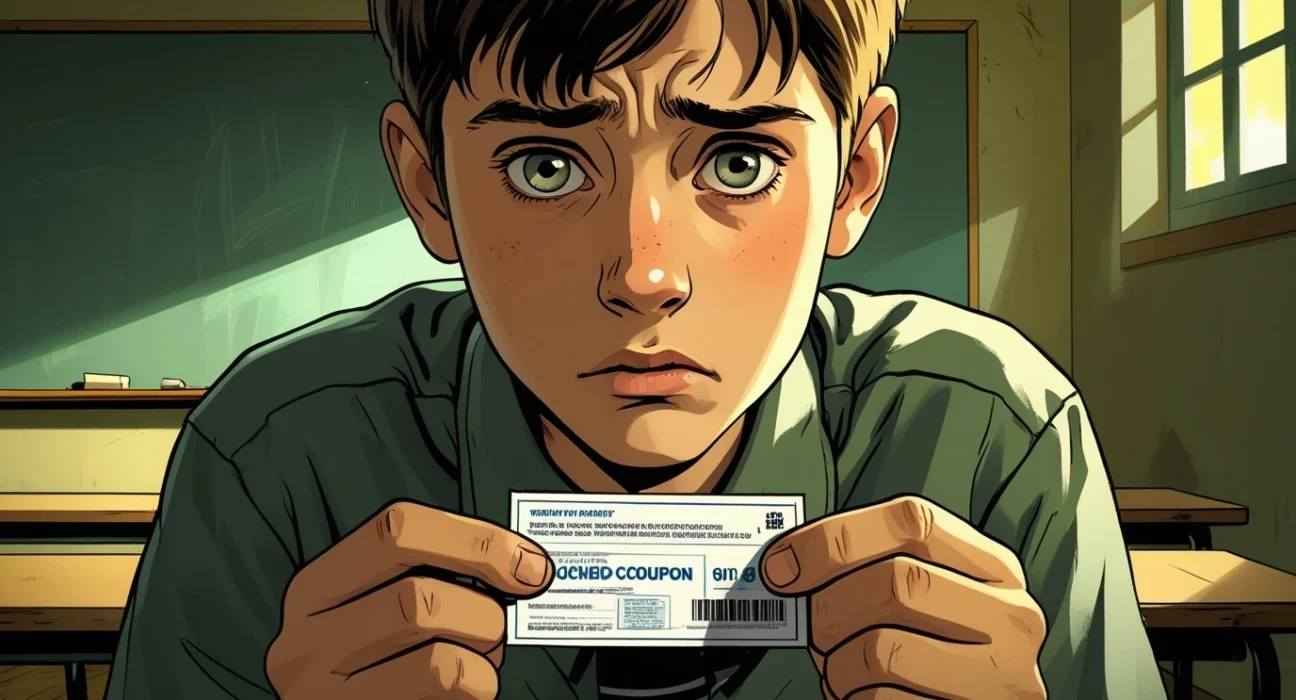
The Forged Coupon, written by Leo Tolstoy and published posthumously in 1911, is a compelling novella that explores the ripple effects of a single wrongful act. Divided into two parts, the story traces the consequences of a boy’s decision to forge a bank coupon and the widespread moral decay that results, before shifting toward redemption and spiritual renewal. Known for his powerful critiques of social institutions and moral philosophy, Tolstoy uses this story to illuminate the interconnectedness of human actions and the transformative power of goodness.
Plot Summary
In a modest Russian town, the life of young Mitya, a schoolboy of tender pride and restless ambition, turns upon a single act. Denied an advance on his modest allowance by his stern father, Fedor Mihailovich, Mitya burns with indignation. His father’s reproaches, sharp and cold, pierce through the boy’s pride. Humiliated and desperate to preserve his honor among his wealthier peers, Mitya seizes upon a reckless thought. He takes a two-and-a-half rouble coupon and, with careful deceit, alters it to show a sum of twelve and a half. Thus begins a quiet chain of events that stretches far beyond his imagination.
The forged coupon passes first into the hands of Mitya’s schoolmate, who presents it without knowledge of its falsity. It travels from student to merchant, merchant to moneylender, and moneylender to tradesman, leaving behind it a faint trail of confusion and resentment. Each link in the chain reacts not with concern or curiosity, but with self-interest, passing the fraud forward, washing their hands clean in silence. The forged note, unmarked by its origin, stirs a ripple that swells steadily outward.
As the coupon finds its way into the purse of a peasant named Pelagayushkin, it becomes a burden he cannot bear. Unaware of its fraudulent origin, he tries to use it and is promptly accused of passing counterfeit currency. The court, blind to nuance and justice, sentences him with chilling efficiency. The law’s weight falls heaviest on those least able to resist it.
The town turns indifferent once more. The governor focuses on reports, the merchants on profits, the clergy on ceremony. But beneath this surface, invisible wounds fester. The merchant who loses money grows bitter, and in that bitterness beats his wife. She, in turn, directs her pain at their maid. A clerk, driven to drink over the loss, finds himself dismissed. Each wrong feeds the next, each bruise deepening another. In these quiet turns of suffering, one sees the invisible cords that bind lives together, unseen until tugged too sharply.
Among those touched by this slow unravelling is a man named Makhin, a broker consumed by wealth and cunning. The forged coupon, passed through his hands, sparks a chain of swindles and betrayals in his world. He loans at exorbitant rates, exploits his debtors, and evades justice through bribes. His callousness, once a means of survival, begins to erode his soul. The people he ruins spiral into despair – one becomes a thief, another turns to drink, a third ends his own life in desperation. The evil of a small lie has matured into full-grown tragedy.
One of the fallen is a young man named Stepan, once upright, now twisted by misfortune and rage. Imprisoned unfairly and dismissed from honest labor, he becomes a thief, and then a murderer. His heart, once pliant, hardens against the world that discarded him so casually. But fate, ever turning, leads him to cross paths with Ivan Mironov, a man transformed by suffering.
Ivan had once been much like Stepan – embittered, furious, ruled by desire for revenge. But years earlier, amidst the despair of his own lost family, he had discovered something unexpected: peace through forgiveness. Choosing a life of humility, he walked among the poor, aiding where he could, asking nothing in return. His serenity was not born of ignorance, but of clarity. It drew others like moths to a steady flame.
Stepan meets Ivan after another brush with violence. He expects to find scorn or condemnation. Instead, he receives bread, warmth, and a place to sleep. No questions, no sermons – only quiet kindness. That night, as Stepan lies awake, the weight of his years begins to press differently upon his chest. In Ivan’s presence, vengeance feels heavy and cold. Something softer stirs.
In the days that follow, Stepan remains with Ivan, watching him live with simple dignity. He listens to the Gospels read without ornament or pretense. He helps chop wood for the widow nearby. He sees children, their hands small and uncalloused, laugh as they carry water. No doctrine is preached, but a different way of being reveals itself. Slowly, the anger drains from his limbs. His thoughts, once crowded with imagined insults and retributions, quiet into questions. One evening, he weeps without knowing why.
Mitya, now grown, returns to this same town in the company of a friend seeking religious truth. Years have passed since the forged coupon; his life has followed the quiet tracks of a privileged education and restrained success. He no longer remembers the exact shape of that moment, only that it once mattered. But in conversation with Ivan, he learns the full arc of what had followed – the false charge, the jailings, the deaths. Mitya’s face turns pale as he listens. When Ivan tells of Stepan’s repentance and quiet life, Mitya does not speak for a long time.
He leaves that day changed. The truth of his childhood misdeed – distant, small, foolish – now casts a long shadow. He had set in motion pain he could not have imagined, yet he sees now that good had been born from the ashes. Still, he cannot escape the truth of his part. In the silence of the road home, he begins to wonder what he might do next, not to erase the past, but to walk differently in its wake.
As for Ivan, his days continue in the same humble rhythm – work, prayer, kindness. He asks nothing, expects nothing. When people speak of salvation, he smiles quietly. What he believes is simple: that every hand extended in cruelty can, through patience and love, become a hand that heals. The world does not shift beneath his feet. But in those who meet him, something begins to stir – a stillness, a sorrow, a seed of change.
And so, the forgery that once stained a boy’s conscience blooms, through fire and ruin, into compassion. From falsity came truth, from wrong, redemption. And the chain of evil, long and cold, is met at last by a chain of mercy.
Main Characters
Mitya (Dmitri Smokovnikov): A schoolboy whose request for money is denied by his father, prompting him to forge a coupon. Mitya’s character sets the narrative in motion; his naive desperation and eventual remorse embody the moral struggle at the heart of the story.
Fedor Mihailovich Smokovnikov: Mitya’s stern and self-righteous father, a government official. His cold demeanor and refusal to empathize with his son’s situation indirectly catalyze the forgery, exposing the consequences of rigid moralism devoid of compassion.
Makeyev: A schoolmate of Mitya, who receives the forged coupon. Though a minor character in appearance, his role initiates the spread of the forged document into the broader community.
Makhin: A moneylender who unwittingly accepts the forged coupon and then ruthlessly passes the loss onto others. His character exemplifies the moral rot in society where greed and self-interest eclipse fairness.
Stepan Pelagayushkin: A peasant wrongfully accused and punished due to the forgery’s chain of consequences. His unjust suffering highlights the systemic failures of the legal and economic systems.
Ivan Mironov: A once-violent man transformed by religious conviction, who plays a pivotal role in the second part of the novella. His arc from vengeance to peace exemplifies Tolstoy’s ideal of Christian redemption and love.
Theme
Moral Causality: Central to the novella is the theme that even a minor wrongdoing can have vast, unintended consequences. Tolstoy meticulously tracks the forged coupon as it passes from hand to hand, showing how moral corruption spreads like a contagion.
Justice and Injustice: The story highlights the failures of institutional justice. The courts punish the innocent and protect the powerful, reflecting Tolstoy’s deep skepticism of state and legal systems as inherently flawed.
Redemption and Forgiveness: In contrast to the first part’s moral decay, the second part offers a redemptive arc where characters undergo profound spiritual awakenings, suggesting that sincere repentance and moral choice can break cycles of harm.
Christian Ethics vs. Organized Religion: Tolstoy contrasts true Christian virtues – humility, compassion, forgiveness – with the hollow rituals of institutional religion. His spiritual characters often exist outside or in opposition to the Church.
Interconnectedness of Human Actions: A dominant motif is the idea that all human actions are deeply interconnected. One small sin sets off a cascade of effects, illustrating how deeply we influence each other’s lives.
Writing Style and Tone
Tolstoy employs a clear, unembellished prose style that is deceptively simple but rich in psychological and moral insight. His narrative voice is omniscient yet restrained, offering judgments not through direct condemnation but through the consequences of characters’ actions. The story’s language avoids ornate flourishes, focusing instead on the stark realities of life and ethical struggle. This directness enhances the novella’s moral clarity and its forceful critique of societal norms.
The tone of The Forged Coupon shifts between cold moral realism and compassionate idealism. In the first part, Tolstoy’s tone is austere and unrelenting, as he depicts a society plagued by greed, deceit, and callousness. In the second part, the tone becomes contemplative and hopeful, filled with the quiet strength of spiritual awakening. This tonal transformation mirrors the thematic journey from corruption to redemption, making the novella not only a moral tale but a spiritual meditation.
Quotes
The Forged Coupon – Leo Tolstoy (1911) Quotes
“Chuyev was brought before the court for false witness and blasphemy, and was sentenced to deportation. Father Misail, on the other hand, received an award and was made an archimandrite.”
“and had only just recovered from the corrupting influence, the ignorance and narrow-mindedness in which she had been brought up
“felt as much as you do when you reach the top of the stairs in the dark and lift your foot onto a step that isn't there.”
We hope this summary has sparked your interest and would appreciate you following Celsius 233 on social media:
There’s a treasure trove of other fascinating book summaries waiting for you. Check out our collection of stories that inspire, thrill, and provoke thought, just like this one by checking out the Book Shelf or the Library
Remember, while our summaries capture the essence, they can never replace the full experience of reading the book. If this summary intrigued you, consider diving into the complete story – buy the book and immerse yourself in the author’s original work.
If you want to request a book summary, click here.
When Saurabh is not working/watching football/reading books/traveling, you can reach him via Twitter/X, LinkedIn, or Threads
Restart reading!