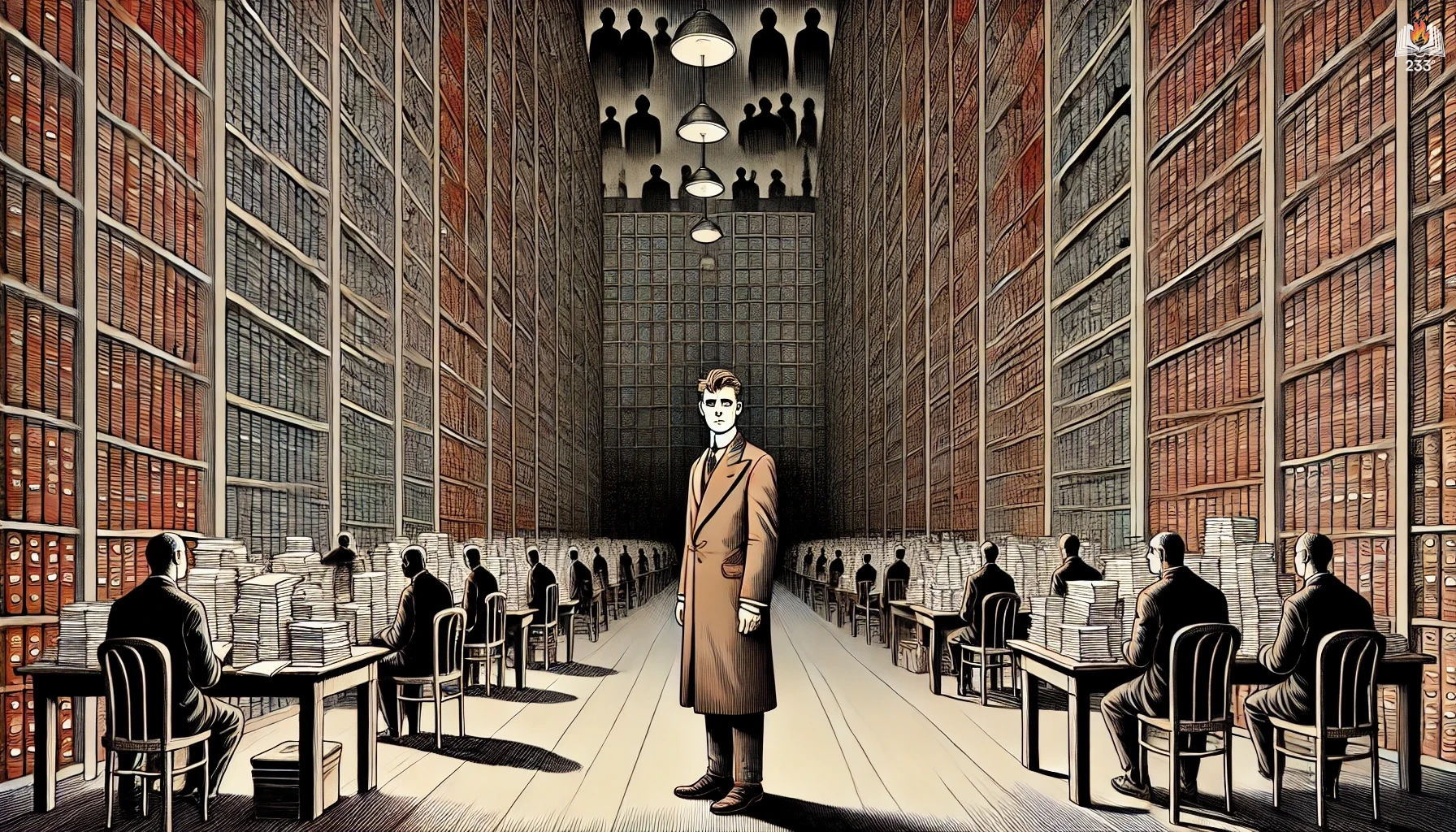
“Investigations of a Dog” by Franz Kafka, written in 1922 and published posthumously, is one of the most enigmatic and introspective works by the master of existential literature. Although Kafka is widely known for works like The Metamorphosis and The Trial, this story occupies a unique space in his oeuvre, embodying the philosophical alienation and surreal absurdity that define his style. The story takes the form of a monologue by a canine philosopher-scientist who, in search of existential and empirical truth, questions the customs and dogmas of its society. It was written during the same creative period as Kafka’s other significant short stories, including The Burrow, and is often included in collections of his later works.
Plot Summary
In a quiet and curiously rational world inhabited by dogs, one among them begins to pull at the fabric of his reality. He is not named, for names carry less meaning in a life consumed by relentless inquiry. What sets him apart is not his strength, nor his loyalty, but an unquenchable hunger – not for meat, but for knowledge. This dog, estranged in mind from his kind, devotes his life to investigating the mysteries of his world, most especially the phenomenon of food: where it comes from, how it appears, and what hidden forces govern its distribution.
From his earliest days, he is haunted by a vision. Seven dogs, singers of uncanny harmony, had appeared before him during his youth, performing an act so inexplicable, so sublime, that it had seared itself into his memory. They had seemed to summon nourishment not by barking or begging, but through some ritual of silence and stance. Their performance had no logic, no precedent in the natural laws he understood, and yet it bore fruit – or rather, food. The mystery lingers in him, festers even, as the world moves forward with its customary rhythms. While others forget, content with routine, he cannot. His questions take root in this single memory, growing wild and entangled in his thoughts.
He begins to challenge the customs of his society, not through rebellion, but through method. He tries experiments, sets traps of logic and observation. He chooses hunger, letting his body waste in hope that his suffering will force revelation from the void. He watches others with the gaze of a naturalist, noting every movement, every bark, every communal gathering, every strange silence. He approaches the matter as a scholar might, with hypotheses and discipline. Yet the more he investigates, the deeper the riddle grows.
His world is one of rituals – meals appear as if conjured, without visible agency. Other dogs accept this as the natural order. They dance, they wait, and food arrives. He suspects a conspiracy of silence. Why does no one question where it comes from? Why do they bark the way they do at certain times, fall silent at others? Are these acts conscious or automatic, spells or superstitions? He wonders if some secret caste among them knows the truth but chooses not to share it. He begins to distance himself from the community, observing them from afar, as if he himself no longer belonged to their species.
His skepticism leads him to an audacious conclusion: that there might be beings beyond dog perception – higher, stranger, perhaps the true providers of sustenance. The idea seems dangerous even in thought, heretical to the dog-mind. He dares not speak it aloud. In isolation, he watches for patterns, hoping to glimpse the veiled hand behind the world’s operations. At times, he is consumed by the belief that the others are keeping the secret from him intentionally, their cheerful ignorance a masquerade. Other times, he considers that they too are blind, content in their blindness.
He recalls an encounter, half-remembered, of a creature so immense and alien that he struggles to place it within his categories. A being that walked upright, with strange limbs and gestures, offering food without barking, without even acknowledging him as an equal. The figure haunted him not as a threat, but as a revelation. He could not reconcile its presence with the laws of his world. Was it a god, a demon, a master? Did it see him as something at all? This vision, though fleeting, deepens his sense of cosmic estrangement.
Despite the ridicule of others – for he is mocked, pitied, whispered about – he persists. He attempts public lectures, tries to communicate his doubts to other dogs, but they cannot or will not follow. They see his words as gibberish, his concerns as delusions. He becomes the mad dog among them, tolerated at best, avoided more often. Yet he believes himself to be the only one awake in a sleeping world, the only one suffering from the burden of knowing that nothing is known.
Time passes, seasons shift, but no answers come. The investigations grow more frantic, more desperate. He seeks out solitude, wandering far from the settled places. He howls not at the moon, but at the silence. His mind twists in loops of logic and doubt. Every answer splinters into more questions. He tries again to recreate the conditions of the seven singers, mimicking their positions, their silences, but nothing returns. The mystery, like the food, does not yield to hunger alone.
And as the years weigh upon his limbs, he finds his strength fading, though his mind races on. He no longer seeks truth with the expectation of finding it, but out of fidelity to the pursuit itself. The others grow more distant. Their games, their rituals, their unexamined joy no longer reach him. His life has become a narrow passage through which thoughts alone may pass, but not companionship, not certainty.
One evening, in a dark place that may be a forest or the edge of a dream, he sits quietly, no longer asking, no longer waiting. The silence that surrounds him is not empty, but full – full of the questions that shaped him, full of the absence of answers that made him who he is. Perhaps the others were right, and he has wasted his days on shadows. Or perhaps the truth, too large to be known, needed a seeker even if it would never be found.
In that stillness, his mind does not rest, but it no longer rebels. It contemplates without expectation. Around him, the world continues. Food appears. Dogs bark. And somewhere, beyond the reach of even his finest questions, the mystery remains.
Main Characters
The Narrating Dog: The central and only developed character in the story, this unnamed dog serves as both the protagonist and narrator. He is intensely inquisitive, plagued by metaphysical and scientific doubts about the nature of his world. His character is defined by obsessive introspection, rational skepticism, and a tragic inability to reconcile his observations with the entrenched beliefs of his species. As he distances himself from other dogs and entrenches himself in thought, his search for truth becomes a lonely, often despairing endeavor.
The Seven-Singer Dogs: A cryptic memory from the narrator’s youth, these dogs perform a mysterious collective act of singing that seems to tap into a profound, perhaps sacred, dimension of dog existence. They become a lasting symbol for the narrator – a mystery that catalyzes his lifelong investigation but which he never fully comprehends.
The Dog Society: While not individualized, the collective body of ordinary dogs represents the social norms, communal beliefs, and limitations of accepted dog “science.” Their rejection of the narrator’s investigations underscores the themes of isolation and intellectual alienation.
Theme
The Limits of Rational Inquiry: At the core of the story is the narrator’s futile attempt to explain the phenomena of his world through observation and reason. Kafka critiques the hubris and limitations of scientific method, especially when it is devoid of context or compassion. The dog’s rationalism borders on absurdity, as he uses empirical methods to understand the origins of food and rituals, yet he remains blind to deeper truths.
Alienation and Solitude: The narrator’s quest sets him apart from other dogs. His dedication to uncovering hidden realities alienates him from society, echoing the Kafkaesque motif of the outsider doomed by his difference. The loneliness that permeates the narrative reflects Kafka’s own sense of existential isolation.
Blind Faith vs. Skepticism: The story contrasts the unquestioning acceptance of tradition (by the average dog) with the skeptical dog’s refusal to accept what he cannot understand. This conflict reflects Kafka’s distrust of institutional thinking and his preoccupation with the unknowable.
The Absurdity of Existence: As in many of Kafka’s works, the dog’s world operates on obscure, paradoxical rules. The pursuit of meaning only deepens the mystery, and the dog’s sophisticated investigations often lead to ridiculous conclusions. This motif underlines Kafka’s existential absurdism.
Language and Miscommunication: The narrator struggles not only to understand his world but to communicate his findings. His internal monologue reveals the inadequacy of language – or perhaps the wrong frame of language – to capture reality. This reflects Kafka’s fascination with the slippage between words and meaning.
Writing Style and Tone
Kafka’s style in “Investigations of a Dog” is characteristically dense, introspective, and riddled with philosophical tension. The narrative unfolds as a single, unbroken monologue filled with extended ruminations, recursive thoughts, and speculative digressions. Kafka builds the story around the narrator’s internal logic, which is both rigorous and tragically flawed. The sentences are long and complex, embodying the narrator’s compulsive need to explain and classify everything. Kafka’s prose has a rhythmic, hypnotic quality that mirrors the obsessive thought patterns of his canine investigator.
The tone of the story is cerebral and contemplative, yet deeply ironic. Kafka’s brilliance lies in his ability to treat absurd premises with utmost seriousness, imbuing them with intellectual gravity and existential urgency. The dog’s philosophical sincerity is often undercut by the reader’s awareness of the absurdity of his assumptions and conclusions. At times, the tone becomes elegiac, especially when the narrator reflects on his loneliness and the mysteries he has failed to resolve. The overall mood is one of thoughtful melancholy, threaded with Kafka’s trademark irony and subtle humor.
Quotes
Investigations of a Dog – Franz Kafka (1922) Quotes
“Agreement is the best weapon of defense_and the matter would be buried.”
“Today one may pluck out one's very heart and not find it.”
“If you have food in your jaws you have solved all questions for the time being.”
“Every dog has, as I do, the urge to question. And I, like all dogs, have the compulsion to be silent.”
“I will probably die in silence, surrounded by silence”
“I had long been running through the darkness, this way and that, guided by nothing but a vague yearning”
“How can you hold their silence against others, and keep silent yourself?”
“Gustavo Solivellas dice: "I have the true feeling of myself only when I am unbearably unhappy" (Franz Kafka)”
We hope this summary has sparked your interest and would appreciate you following Celsius 233 on social media:
There’s a treasure trove of other fascinating book summaries waiting for you. Check out our collection of stories that inspire, thrill, and provoke thought, just like this one by checking out the Book Shelf or the Library
Remember, while our summaries capture the essence, they can never replace the full experience of reading the book. If this summary intrigued you, consider diving into the complete story – buy the book and immerse yourself in the author’s original work.
If you want to request a book summary, click here.
When Saurabh is not working/watching football/reading books/traveling, you can reach him via Twitter/X, LinkedIn, or Threads
Restart reading!