Published in 2000, Angels & Demons by Dan Brown is a gripping thriller that merges the realms of science, religion, and secret societies. The story follows Harvard symbologist Robert Langdon as he is called to investigate the murder of a renowned physicist and a sinister plot involving the ancient Illuminati and the Catholic Church. The novel takes readers through a high-stakes journey from Switzerland’s CERN facility to the Vatican City, blending mystery with historical intrigue.
Plot Summary
The sun was just rising over Harvard University when a call broke the early morning stillness in Robert Langdon’s home. The renowned professor of symbology and religious iconology was startled awake, soon finding himself on a whirlwind journey to Switzerland’s CERN research facility. There, he was confronted with a chilling sight: the lifeless body of Leonardo Vetra, a physicist-priest, branded with the ancient and ominous symbol of the Illuminati. Vetra’s groundbreaking research had yielded antimatter, a substance with the potential for both unimaginable power and destruction, but it had also drawn the attention of sinister forces.
Vetra’s daughter, Vittoria, a brilliant scientist, arrived from fieldwork only to find her father dead. Grief-stricken but resolute, she joined Langdon and CERN director Maximilian Kohler to uncover the mystery. The investigation revealed a terrifying reality—Vetra’s antimatter had been stolen. The Illuminati, a long-dormant secret society, had seemingly resurfaced, reigniting its ancient feud with the Catholic Church.
The trail led to Vatican City, where a conclave was underway to elect a new pope following the pontiff’s recent death. The Camerlengo, the pope’s trusted aide, welcomed Langdon and Vittoria, revealing a dire situation. The antimatter had been hidden somewhere within Vatican City, set to detonate at midnight. As if the threat of annihilation weren’t enough, four cardinals—the preferiti, frontrunners for the papacy—had been kidnapped. The Illuminati promised to execute one every hour, each death accompanied by a public display of their ancient brand.
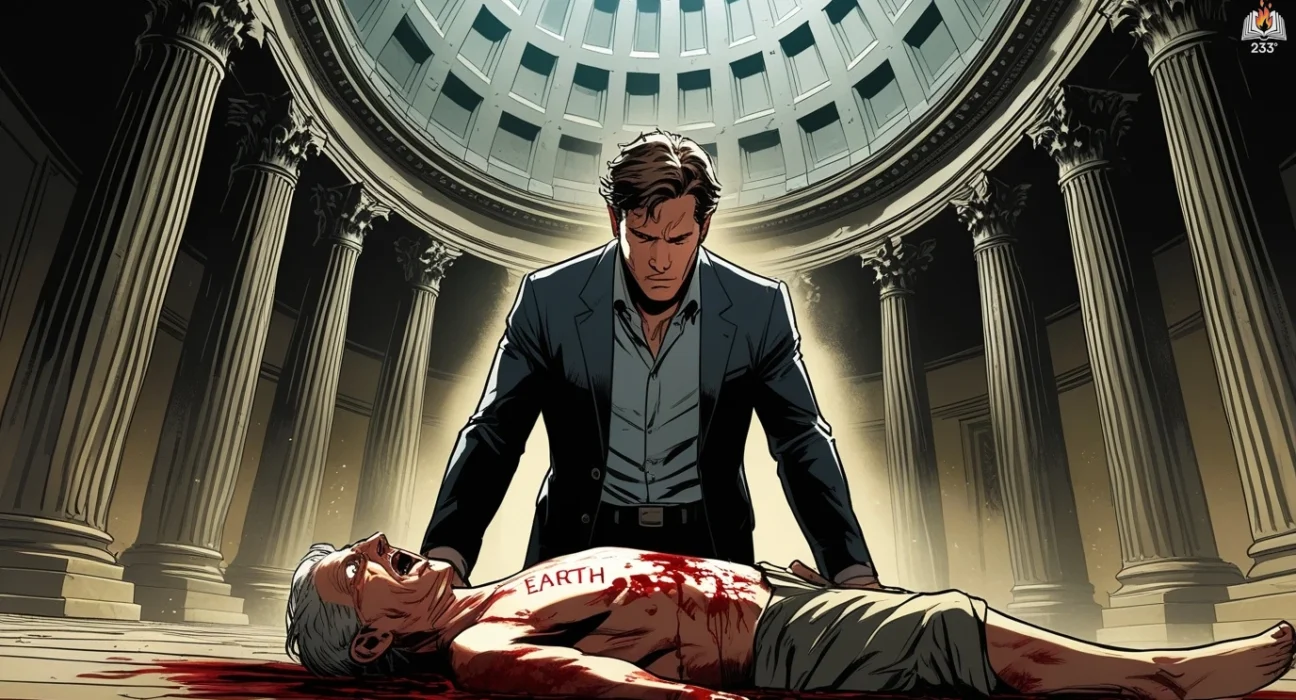
Langdon and Vittoria, now racing against time, began unraveling the cryptic Path of Illumination, a hidden trail through Rome that the Illuminati had used to recruit members. Guided by symbolic markers, they plunged into the city’s historic depths, deciphering enigmas left by their enigmatic adversaries. The first clue led them to the Pantheon, but they arrived too late to save the first cardinal. The man’s body was left branded and mutilated, a grim testament to the Illuminati’s brutality.
The journey grew darker as they followed the path to other iconic landmarks: Bernini’s church sculptures and the Piazza Navona. Each step brought them closer to understanding the Illuminati’s methods and intentions, but it also came with a price. Each cardinal was found murdered in grisly ways, their deaths symbolizing the four classical elements—Earth, Air, Fire, and Water.
At Castel Sant’Angelo, the ancient fortress revealed its hidden chambers, which housed both the Illuminati assassin and secrets long buried. Langdon and Vittoria confronted the Hassassin, a man driven by warped ideals of loyalty and retribution. Though he had carried out the murders and placed the antimatter device, his allegiance to the Illuminati’s supposed resurgence was as blind as it was fervent.
The assassin was defeated, but the mastermind behind the conspiracy remained unknown. As midnight approached, the tension within Vatican City reached its peak. Langdon and Vittoria, working alongside the Swiss Guard, discovered the antimatter canister hidden in the papal archives. However, its retrieval seemed impossible; its magnetic containment field was seconds away from failing.
The Camerlengo took decisive action. In a move both daring and sacrificial, he commandeered a helicopter and ascended into the heavens with the antimatter canister. Seconds before detonation, he parachuted to safety, while the device exploded high above Rome, sparing the city from devastation. His act was hailed as divine intervention, and he was celebrated as a hero of faith and courage.
But all was not as it seemed. Langdon and Vittoria unearthed a deeper, more insidious truth. The Camerlengo, driven by a misguided zeal to reinvigorate the Church, had orchestrated the entire crisis. He had manipulated the Illuminati legend, using it as a scapegoat to create a spectacle of martyrdom and redemption. His ambition had led him to poison the late pope and engineer the chaos that followed.
When the truth came to light, the Camerlengo’s world unraveled. He set himself ablaze in St. Peter’s Square, his final act a testament to his own unraveling faith and humanity. The Church, now exposed to its vulnerabilities yet reaffirmed in its enduring strength, moved forward. The conclave elected a humble and wise new pope, a man who embodied compassion and hope.
As dawn broke over Rome, Langdon and Vittoria stood together, their shared ordeal forging a bond deeper than words. They had faced the convergence of science and religion, ambition and morality, and emerged with a renewed sense of purpose. The mysteries of the Illuminati had once again faded into history, leaving behind echoes of their eternal conflict with the Church.
Main Characters
Robert Langdon: A Harvard professor of symbology and religious iconology, Langdon is an academic with an athletic build and a quick mind. Tasked with unraveling the Illuminati plot, he serves as the intellectual and moral anchor of the story.
Vittoria Vetra: A brilliant scientist and the adopted daughter of the murdered physicist Leonardo Vetra. Vittoria is compassionate and resourceful, driven by both a quest for justice and a deep-seated spirituality.
Leonardo Vetra: A physicist-priest working at CERN, he is killed while working on groundbreaking research involving antimatter. His death sets the novel’s events in motion.
The Hassassin: A cold-blooded assassin hired by the Illuminati. He embodies physical prowess and a fanatical devotion to his employer’s cause, which he believes is righteous.
Maximilian Kohler: The director of CERN, Kohler is a wheelchair-bound figure whose brusque demeanor hides a commitment to uncovering the truth.
Camerlengo Carlo Ventresca: A devout and charismatic aide to the Pope. Ventresca’s faith and loyalty to the Church mask deeper, more complex motivations that are revealed as the plot unfolds.
Commander Olivetti: Head of the Swiss Guard, he is pragmatic and protective, tasked with safeguarding Vatican City during a time of crisis.
Theme
Faith vs. Science: The central conflict of the novel revolves around the tension between scientific discovery and religious belief. This dichotomy is explored through the Illuminati’s historical struggle against the Catholic Church and Leonardo Vetra’s attempt to reconcile the two.
Power and Corruption: The novel examines how the pursuit of power, whether through religion, science, or secret societies, can lead to moral corruption and catastrophic consequences.
Symbols and Secrets: Symbols play a pivotal role in uncovering the Illuminati’s plans. Langdon’s expertise in decoding these symbols underscores the enduring human fascination with mystery and hidden meanings.
Sacrifice and Redemption: Sacrifice is a recurring theme, whether through acts of heroism or misguided attempts to achieve redemption. This theme ties closely with the characters’ personal journeys and the novel’s resolution.
Writing Style and Tone
Dan Brown’s writing style in Angels & Demons is fast-paced and cinematic, characterized by short chapters that often end with cliffhangers. His narrative is rich in historical and scientific detail, seamlessly weaving fact and fiction to create a sense of authenticity and intrigue.
Brown employs a third-person omniscient perspective, allowing readers to experience the unfolding events from multiple viewpoints. His prose is accessible, with a focus on vivid descriptions and intricate puzzles that keep readers engaged. The tone oscillates between suspenseful and reflective, mirroring the high stakes of the narrative and the philosophical questions it raises.
Quotes
Angels & Demons – Dan Brown (2000) Quotes
“Science and religion are not at odds. Science is simply too young to understand.”
“God answers all prayers, but sometimes his answer is 'no'.”
“Nothing captures human interest more than human tragedy.”
“Our minds sometimes see what our hearts wish were true.”
“Faith is universal. Our specific methods for understanding it are arbitrary. Some of us pray to Jesus, some of us go to Mecca, some of us study subatomic particles. In the end we are all just searching for truth, that which is greater than ourselves.”
“Science tells me God must exist. My mind tells me I will never understand God. And my heart tells me I am not meant to.”
“God, grant me strength to accept those things I cannot change.”
“Religion is like language or dress. We gravitate toward the practices with which we were raised. In the end, though, we are all proclaiming the same thing. That life has meaning. That we are grateful for the power that created us.”
“The media is the right arm of anarchy.”
“stand tall, smile bright, and let them wonder what secrets making you laugh!”
“Even the technology that promises to unite us, divides us. Each of us is now electronically connected to the globe, and yet we feel utterly alone.”
“Religion is flawed, but only because man is flawed.”
“No good deed goes unpunished.”
“Each of us is now electronically connected to the globe, and yet we feel utterly alone.”
“Skepticism has become a virtue. Cynicism and demand for proof has become enlightened thought. Is it any wonder that humans now feel more depressed and defeated than they have at any point in human history?”
“Buddha had said: "Each of us is a God. Each of us knows all. We need only open our minds to hear our own wisdom.”
“the most dangerous enemy is that which no one fears!”
“No love is greater than that of a father for His son.”
“Fear cripples faster than any implement of war.”
“But who is more ignorant? The man who cannot define lightning, or the man who does not respect its awesome power?”
“If it wasn't painfully difficult, you did it wrong!”
“One does not need to have cancer to analyze its symptoms.”
“From Santi's earthly tomb with demon's hole, 'Cross Rome the mystic elements unfold. The path of light is laid, the sacred test, Let angels guide you on your lofty quest.”
“sometimes to find truth one must move mountains -Kohler”
“Science tells me God must exist. My mind tells me I'll never understand God. My heart tells me I'm not meant to. [Vittoria Vetra]”
“It seemed there was always a close correlation between true believers and high body counts.”
“...In the end we are all just searching for truth, that which is greater than ourselves.”
We hope this summary has sparked your interest and would appreciate you following Celsius 233 on social media:
There’s a treasure trove of other fascinating book summaries waiting for you. Check out our collection of stories that inspire, thrill, and provoke thought, just like this one by checking out the Book Shelf or the Library
Remember, while our summaries capture the essence, they can never replace the full experience of reading the book. If this summary intrigued you, consider diving into the complete story – buy the book and immerse yourself in the author’s original work.
If you want to request a book summary, click here.
When Saurabh is not working/watching football/reading books/traveling, you can reach him via Twitter/X, LinkedIn, or Threads
Restart reading!