
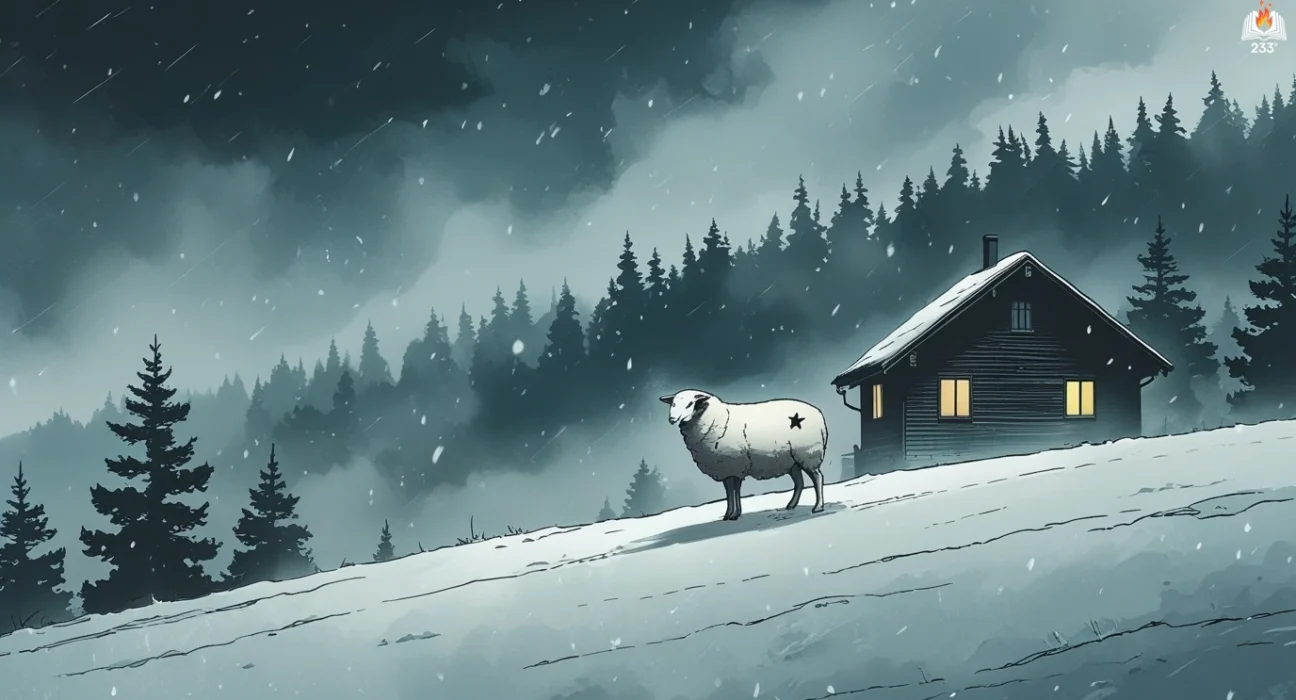
A Wild Sheep Chase by Haruki Murakami, published in 1982, is the third book in what is informally known as the “Trilogy of the Rat,” following Hear the Wind Sing and Pinball, 1973. This surreal novel blends detective fiction, magical realism, and existential inquiry, offering a narrative that is at once playful and profound. The unnamed narrator is thrust into a mysterious quest involving a peculiar sheep with a star-shaped birthmark, launching him on a journey across Japan that explores loss, identity, and the absurd underpinnings of modern life.
Plot Summary
In Tokyo, a thirty-something copywriter slides through the days with measured indifference. He works, he smokes, he drinks. His marriage disintegrates in silence, the divorce finalized with little drama. His ex-wife, a woman with a fading presence and no desire for permanence, leaves behind no photograph, no slipper, not even a scent. Only the memory of her evaporates slowly, like the last ring of smoke in a stale room. The man keeps living the same way he always has – translating drudgery into passable copy, eating omelettes in bars, tracing the rhythms of boredom like a chant.
Then comes the photograph. An innocuous image used in a magazine ad, a field with sheep scattered across it, one of which carries a star-shaped birthmark. Without warning, the photograph pulls him into the undertow. A shadowy man in a dark suit, an emissary of a right-wing power broker known simply as “the Boss,” arrives with an ultimatum. Find the sheep or disappear. The Boss, once an ordinary man, had been possessed by the star-marked sheep decades ago, transformed into a being of boundless influence and unseen authority. Now, the sheep has left him, and he lies in a coma – a hollow shell waiting for his power to be reclaimed.
With little choice, the man begins the hunt. He is not alone. His girlfriend, a woman with unearthly ears and a calm like still water, joins him. Her ears possess a quiet magic – exposed, they heighten everything, revealing beauty where it hides. She is intuitive, distant, and essential. She tells him he will find a sheep, and he believes her. Together they travel north, into the blankness of Hokkaido, where the world grows quieter and the snow seems to muffle thought.
The photograph, taken years earlier, came from an old friend – a man known only as the Rat. The Rat had once drifted beside him through the student cafés of Tokyo, both of them quietly resisting the gears of the system. Then, the Rat disappeared, drawn into a struggle with something larger, something consuming. It is this friend’s trail he now follows.
In the hills outside Junitaki, he finds an empty house where the Rat once lived – a house now covered in dust and silence, with a refrigerator humming like a ghost. The caretaker, a man in rubber boots and a hunter’s face, speaks in riddles and offers little. But the clues in the Rat’s letters point higher still, to the Sheep Professor – a man who once studied a mysterious sheep that would possess humans and steer their fates with chilling precision. The Professor, now senile and shivering in a mountain retreat, remembers fragments. The sheep is a force, not a creature. It chooses hosts, wears them down, then moves on. In its wake, it leaves power, corruption, silence.
Back in the house, the girlfriend disappears without a sound. No explanation, no farewell. Only the feeling of being suddenly alone deepens. The caretaker returns, this time not with words, but with a gun, and a warning. The man is meant to be possessed next, the sheep’s next host. That is why he was summoned. But he is not the chosen one. The Rat is.
And the Rat has already made his decision.
The Rat has been waiting in the house all along, hiding behind walls, watching. The sheep wanted him, but he denied it. He knew that to resist would require sacrifice. He had watched his father serve the Boss, watched good men vanish into the machinery, and he chose another path – exile, invisibility, defiance. To end the sheep’s path, someone had to take the house down with the sheep inside it.
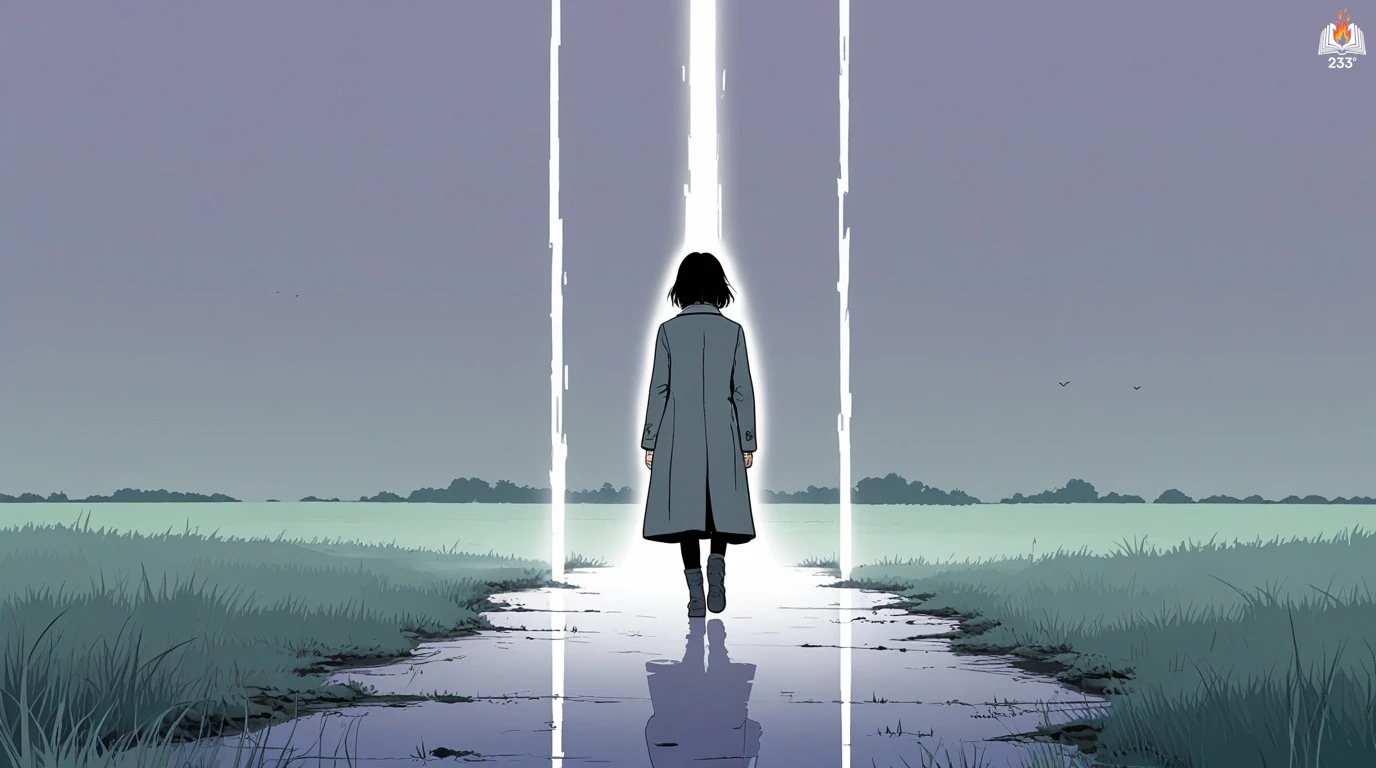
The man leaves the house on foot, through snow and wind, climbing the mountain in silence. Behind him, a timer counts down. At the summit, the mountain shrugs, and the house below erupts in a muted bloom of flame. No scream, no siren, only fire returning a forgotten place to ash. The Rat has chosen to go with it, a final act of rebellion. A man against a force.
Afterward, nothing is the same. The man returns to Tokyo, alone again. The girlfriend is gone, vanished like steam. His job is gone. His partner is absorbed into the corporate labyrinth. The sheep is gone too – or so it seems. But in quiet moments, he can still feel its presence, somewhere in the folds of the world. It has simply moved on.
He drifts through the city, beneath blinking signs and colorless skies, sensing the spaces where people once were and are no longer. There are no answers, only absence. But in that space, something has changed. He is not whole, but neither is he lost. Somewhere in that snow-blanketed wilderness, something ended. And something else, quieter and unresolved, has begun.
Main Characters
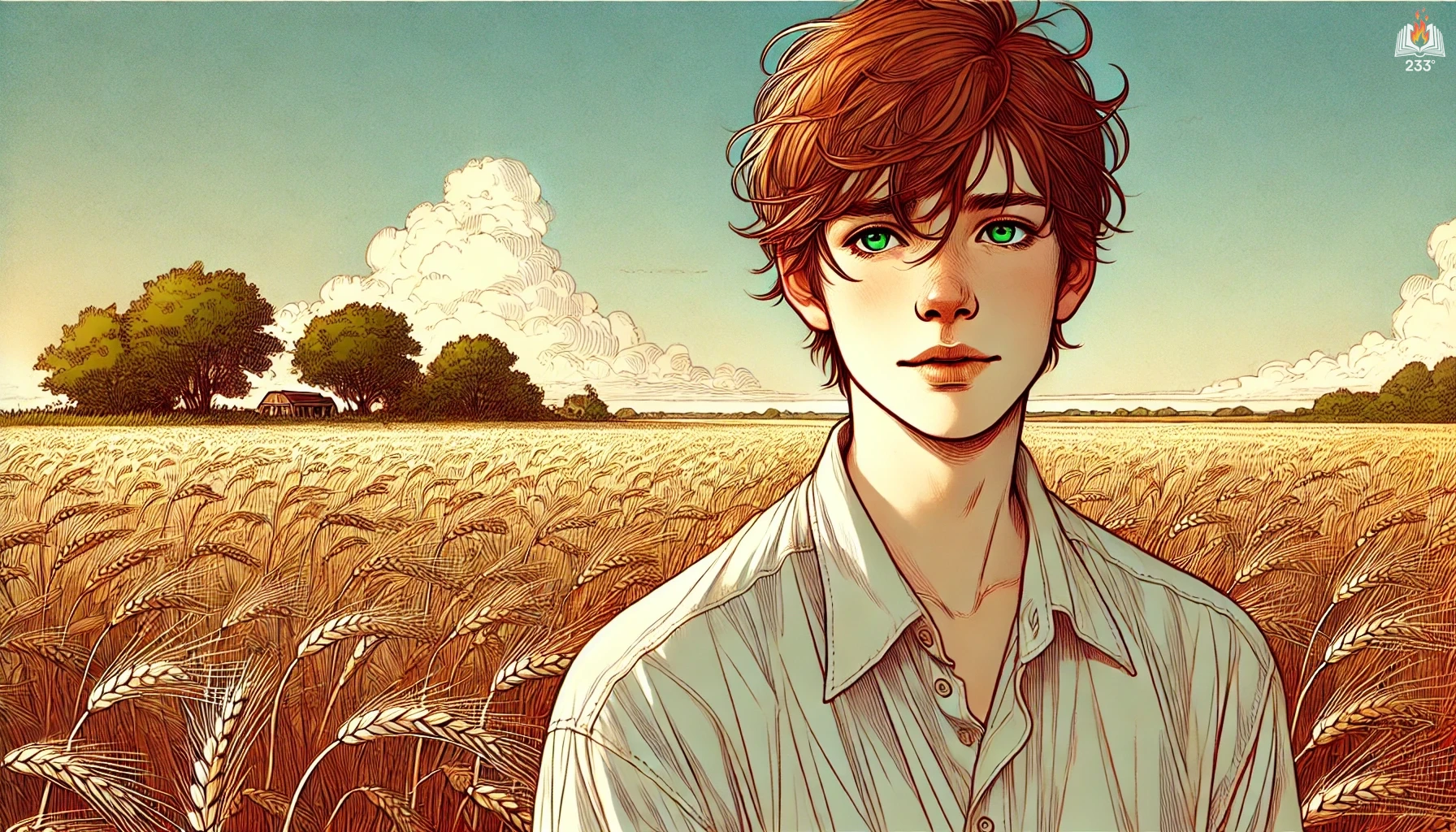
The Narrator – A disaffected Tokyo-based copywriter in his thirties, the narrator is laconic, introspective, and largely passive, drifting through life until a surreal sheep hunt jolts him into motion. His emotional detachment masks a yearning for meaning, which slowly unravels as he faces loneliness, failed relationships, and metaphysical riddles.
The Girlfriend – A model with inexplicably enchanting ears, she becomes the narrator’s companion in the sheep quest. Her physical allure and psychic sensitivity lend the narrative a dreamlike edge. Despite her beauty, she exhibits an inner calm and perceptiveness, and her mysterious aura hints at deeper metaphysical significance.
The Rat – The narrator’s enigmatic old friend who has disappeared. His involvement with the sheep, hinted through a photograph and letter, becomes the catalyst for the narrator’s journey. The Rat represents rebellion, withdrawal from society, and the enduring struggle for authenticity.
The Sheep Professor – A once-prominent academic who has retreated into seclusion, his obsession with the sheep grants the novel its mythological dimension. Rambling yet insightful, he helps the narrator decode the sheep’s significance while underscoring the novel’s surreal tone.
The Strange Man (Secretary) – A cold, impeccably dressed emissary of a shadowy right-wing political power. He coerces the narrator into searching for the mystical sheep, embodying authoritarian control, corporate power, and faceless threat.
Theme
Alienation and Identity – Central to the novel is the protagonist’s emotional detachment and the broader theme of modern isolation. As the narrator journeys through abandoned landscapes and empty relationships, he gradually confronts his sense of self, or lack thereof.
Power and Control – The sheep becomes a symbol of hidden influence, possession, and manipulation. Characters who come into contact with it are either corrupted or consumed, reflecting the insidious nature of power in political and personal spheres.
Memory and Loss – The past seeps through the present in conversations, photographs, and letters. Lost lovers, estranged friends, and forgotten selves haunt the story, evoking a poignant meditation on impermanence.
Surrealism and the Absurd – Murakami’s sheep is both literal and metaphorical, weaving a surrealist logic throughout the story. The blending of the banal with the fantastical creates a tone where ordinary life feels dreamlike, and dreams carry heavy existential weight.
The Search (Quests and Journeys) – Structurally, the novel is a quest. Yet it is a quest not just for a sheep, but for understanding, purpose, and spiritual reawakening. The protagonist’s travels mirror an inner excavation.
Writing Style and Tone
Murakami’s prose is cool, clean, and infused with ironic detachment. He frequently employs short, declarative sentences, with an almost journalistic precision that clashes intriguingly with the novel’s surreal elements. His language, though straightforward, allows rich subtext and philosophical musings to surface unobtrusively, making the mundane feel uncanny. Dialogue is spare but sharp, often laced with dry humor and understated emotion.
The tone is meditative and melancholic, yet punctuated with whimsical absurdity. Murakami writes with a gentle existentialism, guiding readers through themes of loss and alienation without succumbing to despair. The novel’s atmosphere is often cold and lonely—mirroring the narrator’s emotional state—yet it also carries a quiet beauty, especially in its empty spaces. Landscapes and silences often say more than words, and Murakami’s touch makes even the most fantastical premise feel grounded and believable.
Quotes
A Wild Sheep Chase – Haruki Murakami (1982) Quotes
“Most everything you think you know about me is nothing more than memories.”
“Body cells replace themselves every month. Even at this very moment. Most everything you think you know about me is nothing more than memories.”
“Sometimes I get real lonely sleeping with you.”
“The light of morning decomposes everything.”
“I don't know, there's something about you. Say there's an hourglass: the sand's about to run out. Someone like you can always be counted on to turn the thing over.”
“Whether you take the doughnut hole as a blank space or as an entity unto itself is a purely metaphysical question and does not affect the taste of the doughnut one bit.”
“Some things are forgotten, some things disappear, some things die.”
“I guess I felt attached to my weakness. My pain and suffering too. Summer light, the smell of a breeze, the sound of cicadas - if I like these things, why should I apologize?”
“My biggest fault is that the faults I was born with grow bigger each year.”
“Whenever I meet people for the first time, I get them to talk for ten minutes. Then I size them up from the exact opposite perspective of all they’ve told me. Do you think that’s crazy? “No,” I said, shaking my head, “I’d guess your method works quite well.”
“Generally, people who are good at writing letters have no need to write letters. They've got plenty of life to lead inside their own context.”
“I get irritated, I get upset. Especially when I'm in a hurry. But I see it all as part of our training. To get irritated is to lose our way in life.”
“Time really is one big continuous cloth, no? We habitually cut out pieces of time to fit us, so we tend to fool ourselves into thinking that time is our size, but it really goes on and on.”
“A friend to kill time is a friend sublime.”
“The song is over. But the melody lingers on.”
“I was feeling lonely without her, but the fact that I could feel lonely at all was consolation. Loneliness wasn't such a bad feeling. It was like the stillness of the pin oak after the little birds had flown off.”
“Mountains, according to the angle of view, the season, the time of day, the beholder's frame of mind, or any one thing, can effectively change their appearance. Thus, it is essential to recognize that we can never know more than one side, one small aspect of a mountain.”
“I don't really know if it's the right thing to do, making new life. Kids grow up, generations take their place. What does it all come to? More hills bulldozed and more ocean fronts filled in? Faster cars and more cats run over? Who needs it?”
“Age certainly hadn't conferred any smarts on me. Character maybe, but mediocrity is a constant, as one Russian writer put it. Russian writers have a way with aphorisms. They probably spend all winter thinking them up.”
“One of these days they'll be making a film where the whole human race gets wiped out in a nuclear war, but everything works out in the end. ”
“People can generally be classified into two groups: the mediocre realists and the mediocre dreamers. You clearly belong to the latter. Your fate is and will always be the fate of a dreamer.”
“I'd made it back to the land of the living. No matter how boring or mediocre a world it might be, this was it.”
“Sheep hurt my father, and through my father, sheep have also hurt me.”
“Most everything you think you know about me is nothing more than memories”
“It seems to me, though, that you always understand very well what I can't say very well. Trouble is I end up being even worse at saying things well.”
We hope this summary has sparked your interest and would appreciate you following Celsius 233 on social media:
There’s a treasure trove of other fascinating book summaries waiting for you. Check out our collection of stories that inspire, thrill, and provoke thought, just like this one by checking out the Book Shelf or the Library
Remember, while our summaries capture the essence, they can never replace the full experience of reading the book. If this summary intrigued you, consider diving into the complete story – buy the book and immerse yourself in the author’s original work.
If you want to request a book summary, click here.
When Saurabh is not working/watching football/reading books/traveling, you can reach him via Twitter/X, LinkedIn, or Threads
Restart reading!