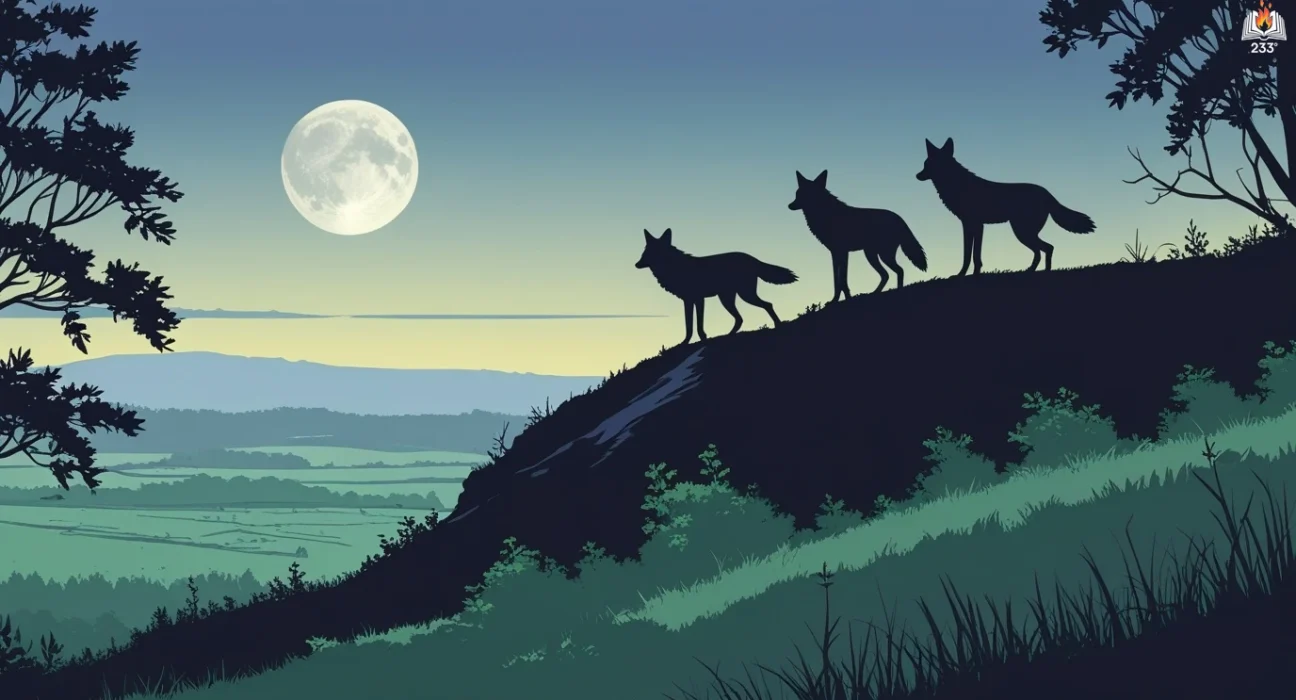
Prodigal Summer by Barbara Kingsolver, published in 2000, is a richly layered novel set in the Appalachian countryside during one heady, humid summer. With lyrical prose and a deep reverence for the natural world, Kingsolver entwines three parallel storylines that explore love, loss, renewal, and the ecological interdependence of all living things. The novel deftly blends human drama with biological insight, offering a tapestry of relationships as vibrant and complex as the wilderness it celebrates.
Plot Summary
High on Zebulon Mountain, where the Appalachian forest breathes in long, slow sighs, Deanna Wolfe lives wrapped in solitude. A wildlife biologist and ranger, she has forsaken the company of people for the quiet rhythms of the wilderness. Her days are ruled by tracking signs in the underbrush, watching for coyotes – spectral returns of a predator long banished from these mountains. The cabin she inhabits is weathered and small, nestled into the forest’s damp arms. It suits her. Solitude has become her second skin, until the unexpected footfall of Eddie Bondo disrupts the equilibrium.
Eddie arrives like a spark on dry leaves. A young, wiry hunter from the West, he carries with him the legacy of sheep ranchers and a distrust of predators. Yet something about Deanna’s world pulls at him – the damp hush of the forest, her fierce silences, her long stride through the undergrowth. She tries to resist him, mistrusting the motives of a man who hunts the very creatures she protects. But their bodies know what their minds deny. Drawn together in the charged green stillness, their connection unfolds with the same inevitability as spring sap rising in trees. Their passion is elemental, sudden, and rooted as deeply in instinct as it is in need.
Far below the ridge, in the wide folds of Zebulon Valley, Lusa Landowski is also learning the language of transformation. A city-bred entomologist of Palestinian and Jewish descent, she has married into the Widener family – tobacco farmers with deep local roots and a habit of mistrusting outsiders. When her husband, Cole, dies suddenly in a farm accident, Lusa is left adrift among his kin, a widow on unfamiliar soil. Cole’s five sisters, matriarchal and tightly woven into the life of the farm, expect her to fold herself into the family’s patterns or retreat entirely.
Grief presses down on her like summer heat, and yet Lusa listens closely – to the wind in the fencerows, to the old rhythms of the land, to the possibilities tucked into seeds and silences. She resists selling the farm, even as debt piles and the community doubts her resilience. Instead, she begins experimenting, planting a crop of goats and herbs where others see only tobacco and tradition. She is stubborn, curious, and quietly brave, reshaping her inheritance without permission. In the folds of grief, she begins to understand something profound – that roots are not only a matter of ancestry, but of choice.
Elsewhere in the valley, two elderly neighbors carry on a quiet war across a fence line. Garnett Walker, a retired school principal and apple grower, tends to his orchard with the stern resolve of a man who believes in the order of things. He dreams of resurrecting the American chestnut tree, wiped out by blight decades ago, and sees himself as a steward of heritage. His days are spent in scientific calculations, pesticide applications, and scowls aimed toward the neighboring land of Nannie Rawley.
Nannie is his opposite in every way. Earthy, unorthodox, and deeply rooted in organic farming, she lets nature do its work while she communes with bees and tends wild plants. Her irreverence infuriates Garnett, and yet her letters – which she pins to their shared mailbox post – are articulate, pointed, and impossible to ignore. In these missives, their battles over herbicides, bees, and God evolve into something more complex. Beneath the disagreements, there is a growing recognition, a grudging fondness that echoes with the wistfulness of all long-held rivalries.
Back on the mountain, Deanna’s connection with Eddie deepens. They move like animals together, wordless and intuitive, as the forest bursts around them with pollination and birth. Yet she cannot forget what he is – a hunter of coyotes, who would kill without hesitation the very pack she has spent two years tracking. She hides the truth from him: a den of coyotes, hidden under the root mass of an old fallen oak, where a mother and her sisters nurse a litter of pups. Deanna has seen them, listened to their movements in the shadows. They are her secret joy and vindication, proof that wildness endures in corners where humans do not look too closely.
Eddie speaks of extermination, of bounty hunts, of sheep lost in the West, but he also speaks of longing, of leaving behind the expectations of his birthright. His presence confuses her, softens her armor. When he eventually leaves, slipping out of her cabin and down the trail without a word, she does not follow. He takes with him the tension of dual loyalties, the unsolved equation of affection and ideology. She watches him go, not knowing if he will return, but certain of her choice – the coyotes will live.
In the valley, Lusa finds an unexpected kind of kinship with one of her young nephews, a boy left to her by circumstance. Through him, and through her slow transformation of the farm into something sustainable and new, she begins to root herself in the land. She discovers the potency of small revolutions – planting native trees, saving wild herbs, and teaching her goats to navigate rocky pastures. She makes mistakes. She gets sunburnt and dirty and lost. But she persists, and in that persistence, she begins to belong.
Garnett and Nannie, meanwhile, come to an uneasy truce. Garnett discovers that Nannie’s homemade concoctions repel the very pests he has failed to contain with chemicals. He begins listening to her, even if he pretends not to. She, in turn, tends his loneliness with biting wit and unexpected gifts. The fence remains, but the hostility weathers like wood in sun and rain. Between them, something almost tender emerges – an affection rooted in years of proximity and disagreement.
Summer in Zebulon is prodigal, generous in its wildness. Trees put forth new leaves with reckless ambition, insects mate with the urgency of brief lives, and people stumble into one another in the green overgrowth of possibility. There are mistakes and departures, misunderstandings and new beginnings. Nothing is permanent, and everything is connected. Coyotes howl at night, unbothered by the human stories playing out below. They return to the land not as intruders, but as reminders – that wilderness is never truly gone, only waiting.
The mountain breathes. The valley endures. And in the green heat of summer, life insists on itself.
Main Characters
- Deanna Wolfe: A fiercely independent forest ranger and wildlife biologist, Deanna has chosen a life of solitude on Zebulon Mountain to study the re-emergence of coyotes in Appalachia. At forty-something, she is sharp, self-reliant, and unapologetically attuned to the rhythms of the wild. Her worldview is disrupted when she meets Eddie Bondo, a charming young hunter whose arrival awakens long-suppressed desires and tests her ecological convictions.
- Eddie Bondo: A wandering sheep rancher and coyote hunter from the West, Eddie is both rugged and reflective. His arrival in Deanna’s remote territory introduces a dynamic tension between predator and protector, man and woman, wilderness and civilization. While outwardly confident and flirtatious, he wrestles with inherited notions of dominance and control over nature.
- Lusa Landowski: A widowed entomologist with Jewish-Palestinian roots, Lusa is a stranger in the rural Kentucky farming community she married into. Intelligent, sensitive, and observant, she struggles to find her place after the sudden death of her husband, gradually forging a new identity through unexpected bonds with her extended family and the land they tend.
- Garnett Walker: An aging, conservative apple grower with a fierce nostalgia for traditional farming methods, Garnett is locked in a long-standing feud with his liberal, organic-farming neighbor. He is stubborn and cantankerous but slowly reveals his vulnerabilities and regrets as his ideas about nature and control are subtly challenged.
- Nannie Rawley: Garnett’s neighbor and philosophical foil, Nannie is an eccentric, outspoken, and fiercely self-sufficient woman who lives according to her own ecological principles. Her warm wit, defiant independence, and commitment to organic farming offer a quiet counterpoint to Garnett’s rigidity and the broader ecological themes of the novel.
Theme
- Ecological Interdependence: Kingsolver weaves the interconnectedness of all life into every storyline, illustrating how human existence mirrors the complex web of relationships found in nature. Whether through predator-prey dynamics or the life cycles of plants and insects, the novel argues that survival and renewal depend on respect for balance and biodiversity.
- Gender and Power: The novel interrogates traditional gender roles and power structures, particularly through Deanna’s and Lusa’s narratives. Deanna resists patriarchal norms by living alone and immersing herself in nature, while Lusa reclaims her agency by challenging familial expectations and embracing unconventional methods of survival.
- Rebirth and Transformation: Summer, as the season of procreation and abundance, serves as a metaphor for the characters’ inner transformations. Grief gives way to growth, isolation to intimacy, and rigid ideologies to more nuanced understandings. The natural world reflects and facilitates these human evolutions.
- Human-Wildlife Relationships: The novel tackles the uneasy and often hostile relationship between rural communities and predators like coyotes. Through dialogue and observation, Kingsolver critiques the anthropocentric mindset that prioritizes dominance over coexistence, suggesting that predators are essential to ecological health and symbolic of suppressed aspects of human nature.
- Heritage and Belonging: Characters struggle with questions of ancestry, inheritance, and rootedness. Lusa, in particular, embodies the outsider’s quest to belong in a place steeped in tradition. The tension between preserving the past and adapting to the present is mirrored in the land itself, a repository of memory and possibility.
Writing Style and Tone
Barbara Kingsolver’s writing in Prodigal Summer is sensual, poetic, and infused with scientific precision. Her prose is lush and rhythmic, often mimicking the cadence of the natural world she so vividly portrays. The language blossoms with metaphors drawn from biology and ecology, yet remains grounded in the tangible details of rural life – the grit of soil, the hum of insects, the musk of animal scent. Her descriptions are immersive, making the forests, fields, and flora pulse with life.
Kingsolver employs a close third-person perspective that rotates among the three protagonists, allowing for intimate glimpses into each character’s thoughts and motivations. The tone is meditative and reverent, tempered with flashes of wit and irony. The author’s deep respect for nature permeates every page, creating a tone that is both celebratory and cautionary – warning against ecological hubris while championing the quiet, persistent resilience of life.
Quotes
Prodigal Summer – Barbara Kingsolver (2000) Quotes
“Solitude is a human presumption. Every quiet step is thunder to beetle life underfoot, a tug of impalpable thread on the web pulling mate to mate and predator to prey, a beginning or an end. Every choice is a world made new for the chosen.”
“How pointless life could be, what a foolish business of inventing things to love, just so you could dread losing them.”
“I lost a child," she said, meeting Lusa's eyes directly. "I thought I wouldn't live through it. But you do. You learn to love the place somebody leaves behind for you.”
“If you never stepped on anybody's toes, you never been for a walk.”
“Thanks for this day, for all birds safe in their nests, for whatever this is, for life.”
“Now I'm starting to think he wasn't supposed to be my whole life, he was just this doorway to me. ”
“I thought I wouldn't live through it. But you do. You learn to love the place somebody leaves behind for you.”
“This is how moths speak to each other. They tell their love across the fields by scent. There is no mouth, the wrong words are impossible, either a mate is there or he is not, and if so the pair will find each other in the dark.”
“I've always found people love you best if you can laugh at your own foolish misfortunes and keep mum about everyone else's”
“The loudest sound on earth, she thought, is a man with nothing to do.”
“A breeze shook rain out of new leaves onto their hair, but in their pursuit of eternity they never noticed the chill.”
“she's never forgotten, either, how a mystery caught in the hand could lose its grace”
“Feminine' was a test like some witch trial she was preordained to fail.”
“Her body moved with the frankness that comes from solitary habits. But solitude is only a human presumption. Every quiet step is thunder to beetle life underfoot; every choice is a world made new for the chosen. All secrets are witnessed.”
“A bird in the hand loses its mystery in no time flat.”
“she considered a language that could carry nothing but love and simple truth.”
“His scent burst onto her brain like a rain of lights, causing her to know him perfectly. This is how moths speak to each other. The wrong words are impossible when there are no words.”
“Solitude is a human presumption. Every quiet step is thunder to beetle life underfoot, a tug of impalpable thread on the web pulling mate to mate and predator to prey, a beginning or an end.”
“From what he could see she had the legs of a much younger woman. Certainly not what he would have expected in the way of Unitarian legs.”
“Lusa turned to Crys, her eyes shining. "That was a luna." Crys shrugged. "So?" "So? So what? You want it should sing, too?”
“Every family's its own trip to China.”
“She laid the side of her face against his frail old heart, where the pink shell of her ear could capture whatever song it had left.”
“Don’t you miss it, any of it?' ... 'I couldn’t say.' She thought about it. 'Not cars or electric lights, not movies. Books I can get if I ask. But walking around in a library, putting my hands on books I never knew about, that I miss. Any thing else, I don’t know.”
“How would you even begin to make a hush puppy, what in the world was in one? Nothing to do with a puppy, surely. Garnett had long known, though he didn’t much like to admit it, that God’s world and the better part of daily life were full of mysteries known only to women.”
We hope this summary has sparked your interest and would appreciate you following Celsius 233 on social media:
There’s a treasure trove of other fascinating book summaries waiting for you. Check out our collection of stories that inspire, thrill, and provoke thought, just like this one by checking out the Book Shelf or the Library
Remember, while our summaries capture the essence, they can never replace the full experience of reading the book. If this summary intrigued you, consider diving into the complete story – buy the book and immerse yourself in the author’s original work.
If you want to request a book summary, click here.
When Saurabh is not working/watching football/reading books/traveling, you can reach him via Twitter/X, LinkedIn, or Threads
Restart reading!