

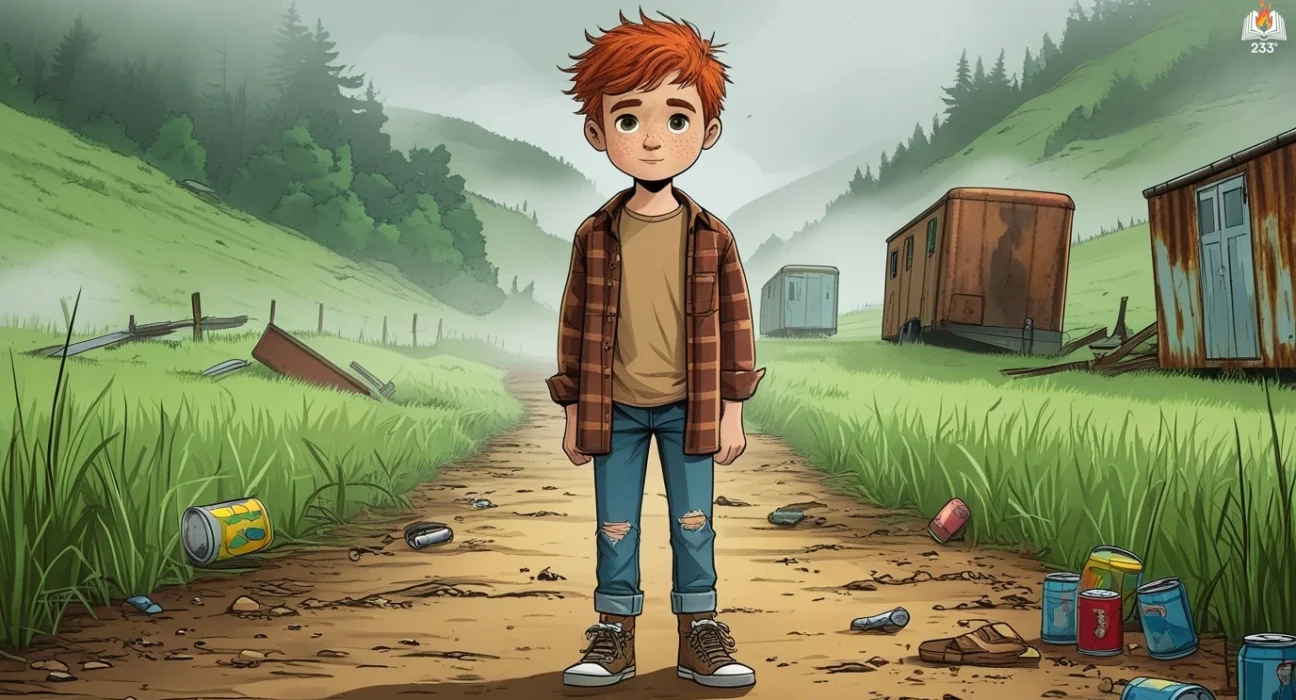
Demon Copperhead by Barbara Kingsolver, published in 2022, is a contemporary Appalachian retelling of Charles Dickens’s David Copperfield. Set in the rural hollers of southwest Virginia, this Pulitzer Prize-winning novel plunges readers into the raw and unforgiving realities of poverty, addiction, and identity in modern-day America. Through the unforgettable voice of Damon Fields – nicknamed Demon Copperhead – Kingsolver crafts a powerful coming-of-age saga that mirrors the structure and themes of its Dickensian predecessor while forging a visceral, fiercely American tale all its own.
Plot Summary
In the blue-shadowed hollers of southwest Virginia, a boy with a head of copper wire hair was born fighting. Damon Fields arrived into the world wrapped in a fetal sac, gasping through addiction-stained air while his mother, little more than a girl herself, lay passed out on a trailer floor surrounded by pills and emptiness. Folks would come to call him Demon Copperhead – a name more curse than nickname, trailing the redheaded ghost of a father who died before the boy took his first breath. That first breath, they say, promised he would never drown. But drowning takes many forms in the mountains.
Raised by a mother who loved him in flashes between stints in rehab and bad choices in men, Demon learned early that love could be both fierce and fleeting. The Peggots next door – firm, Bible-steady people – offered a pocket of safety. There was Mr. Peg, all bones and stories from a coal miner’s life, and Mrs. Peggot, sharp as a barbed wire fence, who fed him crockpot venison and called him Damon when no one else remembered. Their grandson, Maggot, became his partner in crime and creekside battles, two boys thrashing through summers like superheroes in the making.
But safety doesn’t last long in Lee County. When Demon was still small enough to dream big, his mother married Stoner – a bearded, tattooed man with a Harley, a temper, and a dog named Satan. Stoner wasted no time making the trailer his kingdom. He moved Demon into the smaller room, rearranged his action figures like prisoners of war, and built a pen for his dog just outside the window. It wasn’t long before the bruises came – some on Demon’s arms, others deeper and slower to fade. When his mother died of an overdose, it wasn’t grief that gutted him. It was the silence that followed – the sound of no one coming.
Child services stepped in with their clipboard promises and dead-end placements. From there, Demon passed through homes like whispered prayers, landing in foster care with families more interested in his body than his soul. One worked him like a farmhand. Another used him to pull government checks and then forgot to feed him. Everywhere he went, he carried a notebook of superhero sketches and a mind that wouldn’t stay down. He kept his sharp tongue, his wild hair, and a stubborn refusal to break – at least, not yet.
School was a joke, a holding pen for kids with nowhere else to be. But that’s where he met Tommy Waddell, a kid with football talent and a plan to escape, and Angus, a girl with blunt hair and a sharper mind who wasn’t afraid to call him out. When Coach Winfield spotted Demon’s speed and hunger, he was handed a helmet and a shot. For the first time, he felt wanted – not just tolerated. He ran like he was escaping something. And for a while, it worked.
But the thing about running is, you can’t outrun pain that lives inside you. An injury pulled him from the field and shoved pills into his palm – little white lies that promised sleep, numbness, peace. The town was already riddled with it, addiction spreading like kudzu. Demon fell hard. Oxy took the edge off everything – the aching body, the bruised heart, the memory of a mother who tried and failed, again and again. Soon, pills weren’t enough. Heroin came wrapped in promises, and he took it all.
Through the blur of addiction, there were still flashes of light. Emmy Peggot – Maggot’s cousin, the fierce girl with a Hello Kitty backpack and a bloodhound’s sense of betrayal – tied her fate to his during a summer in Knoxville. Later, Angus became his anchor, the only one who saw through the rust and rot to the boy still inside. She pushed him, challenged him, told him truths he didn’t want to hear. In her quiet way, she reminded him he was more than the needle, more than the wreckage trailing behind him.
When Demon hit bottom, it didn’t come with fireworks. It came in a borrowed room, a shaking hand, and the realization that his life had been pawned off piece by piece. He found himself in a recovery house, surrounded by others clawing their way back from the brink. It was there he picked up a pencil again – first to sketch, then to write. He spilled out the truth like blood, one line at a time, shaping the chaos into something that looked like meaning.
Redemption wasn’t quick. It came with setbacks, nights of sweat and shame, memories that gnawed at the edges. But it also came with letters to Emmy, laughter with Angus, and the slow rebuilding of friendships he thought were gone. He reconnected with Mr. Peg and Maggot, pieces of his past that hadn’t given up on him.
By the time he stood on the shore, staring out at the ocean he’d only ever seen in screensavers and dreams, Demon understood that survival wasn’t a victory – it was a beginning. He had been born into a world that expected him to fail, to follow the copperhead’s path straight into ruin. But somewhere in that long, crooked journey – through trailers and foster homes, overdoses and heartbreak – he’d found the one power that mattered: the will to keep going.
In the salt-blue wind, he thought of the promises Mrs. Peggot once made – about babies born in the sack never drowning. He wasn’t sure about the science, but he believed it now. Because the boy who had every reason to go under had stayed afloat. Not clean, not whole, but alive.
Main Characters
Damon Fields (Demon Copperhead): The novel’s narrator and protagonist, Demon is born to a teenage, opioid-addicted mother in a single-wide trailer in Lee County, Virginia. Fierce, imaginative, and heartbreakingly self-aware, Demon survives a cascade of traumas – abandonment, foster care, exploitation, addiction – yet clings to his intelligence and humor as survival tools. His distinctive voice propels the narrative, a blend of cynicism and yearning that captures the desperate dignity of the Appalachian experience.
Mom (Demon’s Mother): A deeply troubled woman with a history of addiction, Mom fluctuates between moments of maternal affection and periods of abandonment. Her vulnerability and failures leave lasting imprints on Demon’s life, particularly when she remarries a cruel man and later dies of an overdose.
Stoner (Murrell Stone): Mom’s volatile and abusive boyfriend-turned-husband, Stoner exerts controlling influence over their household, including Demon. With his menacing dog Satan and manipulative behavior, he personifies the toxic masculinity and neglect that haunt Demon’s early years.
The Peggots (Mrs. Peggot and Mr. Peg): A kind, practical older couple who provide Demon with temporary love and safety. Mrs. Peggot especially acts as a maternal figure, firm but warm, offering Demon the stability and compassion he craves in his chaotic life.
Maggot (Matt Peggot): Demon’s closest childhood friend, Maggot is the grandson of the Peggots and his confidant in adventures, dreams, and early hardships. Loyal and gentle despite his rough upbringing, he represents the kind of grounded brotherhood Demon desperately needs.
Emmy Peggot: Maggot’s cousin and daughter of the mysterious and deceased Humvee, Emmy is a sharp, emotionally complicated girl who becomes Demon’s first love. Her strength and trauma mirror his own, and their bond offers a rare moment of connection and hope amid growing darkness.
Aunt June: Emmy’s guardian and a hospital nurse, Aunt June offers a glimpse into a life of escape, independence, and purpose beyond the holler. Her compassion and strength become an anchor for Demon during one of his few peaceful interludes.
Theme
Addiction and the Opioid Crisis: One of the novel’s central themes, addiction permeates nearly every aspect of Demon’s life – from his mother’s dependency to his own descent into pills and heroin. Kingsolver illuminates the insidious grip of opioids in rural America, showing addiction not as moral failure but as a systemic trap sprung by poverty, exploitation, and despair.
Poverty and Social Invisibility: Demon’s story lays bare the economic and cultural isolation of rural Appalachia. The lack of opportunity, failing schools, and a predatory foster care system make survival a constant struggle. Kingsolver challenges stereotypes, painting a deeply human portrait of communities rendered invisible by mainstream society.
Resilience and Identity: At its heart, the novel is a meditation on identity. Demon wrestles with his inheritance – his copper hair, his father’s absence, his “cursed” birth – and with who he might become. His journey is one of self-definition, fueled by creativity, pain, and the stubborn hope that life could still mean something more.
Exploitation of Children: Foster care, child labor, emotional neglect – children in this novel are bartered, abandoned, and abused. Demon and his peers are shaped by systems that treat them as disposable, highlighting a societal failure to protect the vulnerable.
Nature and the Idea of Escape: Water, especially the ocean, recurs as a symbol of freedom and transcendence for Demon. The woods and creeks of his childhood are spaces of danger and wonder alike, while the distant sea becomes a mythic symbol of escape – a place he believes might never swallow him.
Writing Style and Tone
Barbara Kingsolver adopts a first-person narrative voice that is electrifyingly alive. Demon’s voice is raw, unschooled, often profane, but also poetic, deeply observant, and sharply funny. The language pulses with regional idioms and an unflinching honesty that makes every paragraph crackle with immediacy. Kingsolver writes not about Appalachia but from within it, honoring its rhythms, speech patterns, and cultural cadences. She avoids sentimentality by allowing the narrator to be simultaneously self-aware and self-deprecating, giving the novel both grit and grace.
The tone shifts fluidly between humor and heartbreak. Kingsolver’s prose captures the absurdity of suffering without making light of it, often finding beauty in ugliness and clarity in confusion. The intimacy of Demon’s voice invites readers into his inner world, where hope is fragile but never fully extinguished. The tone is tragic but never hopeless, tender without being maudlin, and consistently anchored in a hard-earned authenticity.
Quotes
Demon Copperhead – Barbara Kingsolver (2022) Quotes
“The wonder is that you could start life with nothing, end with nothing, and lose so much in between.”
“At the time, I thought my life couldn’t get any worse. Here’s some advice: Don’t ever think that.”
“a good story doesn’t just copy life, it pushes back on it.”
“I got up every day thinking the sun was out there shining, and it could just as well shine on me as any other human person.”
“It’s safer knowing more about people than they know about you.”
“I think most of humankind would agree, the hard part of high school is the people.”
“Never be mean in anything. Never be false. Never be cruel. I can always be hopeful of you.”
“Certain pitiful souls around here see whiteness as their last asset that hasn’t been totaled or repossessed.”
“Sunday school stories are just another type of superhero comic. Counting on Jesus to save the day is no more real than sending up the Batman signal.”
“People love to believe in danger, as long as it's you in harm's way, and them saying bless your heart.”
“Keeping secrets from young ears only plants seeds in between them,”
“I said probably they were just scared he was going to put ideas in our heads. She smiled. “Imagine that. A teacher, putting ideas in kids’ heads.”
“We both lay back down, and she looked at me in the eyes, and we were sad together for a while. I’ll never forget how that felt. Like not being hungry.”
“It hit me pretty hard, how there’s no kind of sad in this world that will stop it turning. People will keep on wanting what they want, and you’re on your own.”
“All God’s children have to take a shit, but you’d never know it from the way they treat the ones who have to clean it up.”
“Sometimes a good day lasts all about 10 seconds.”
“But time passed and eventually my mind had only one thought in it as regards childhood. For any kid that gets that as an option: take that sweet thing and run with it. Hide. Love it so hard. Because it's going to fucking leave you and not come back.”
“I can still feel in my bones how being mad was the one thing holding me together.”
“But the wicked have a different head for numbers than most. Any bad they do will end up on the side of never-mind. What’s done to them weighs double.”
“You lie down with snakes, you get up with the urge to bite back. All I’m saying.”
“This is what I would say if I could, to all smart people of the world with their dumb hillbilly jokes: We are right here in the stall. We can actually hear you.”
“Actual fact: you could make an entire second world out of what people throw away. The landfill is where I figured out one of my main philosophies, that everybody alive is basically in the process of trading out their old stuff for different stuff, day in day out.”
“An older boy that never knew safety himself, trying to make us feel safe.”
“Live long enough, and all things you ever loved can turn around to scorch you blind. The wonder is that you could start life with nothing, end with nothing, and lose so much in between.”
We hope this summary has sparked your interest and would appreciate you following Celsius 233 on social media:
There’s a treasure trove of other fascinating book summaries waiting for you. Check out our collection of stories that inspire, thrill, and provoke thought, just like this one by checking out the Book Shelf or the Library
Remember, while our summaries capture the essence, they can never replace the full experience of reading the book. If this summary intrigued you, consider diving into the complete story – buy the book and immerse yourself in the author’s original work.
If you want to request a book summary, click here.
When Saurabh is not working/watching football/reading books/traveling, you can reach him via Twitter/X, LinkedIn, or Threads
Restart reading!