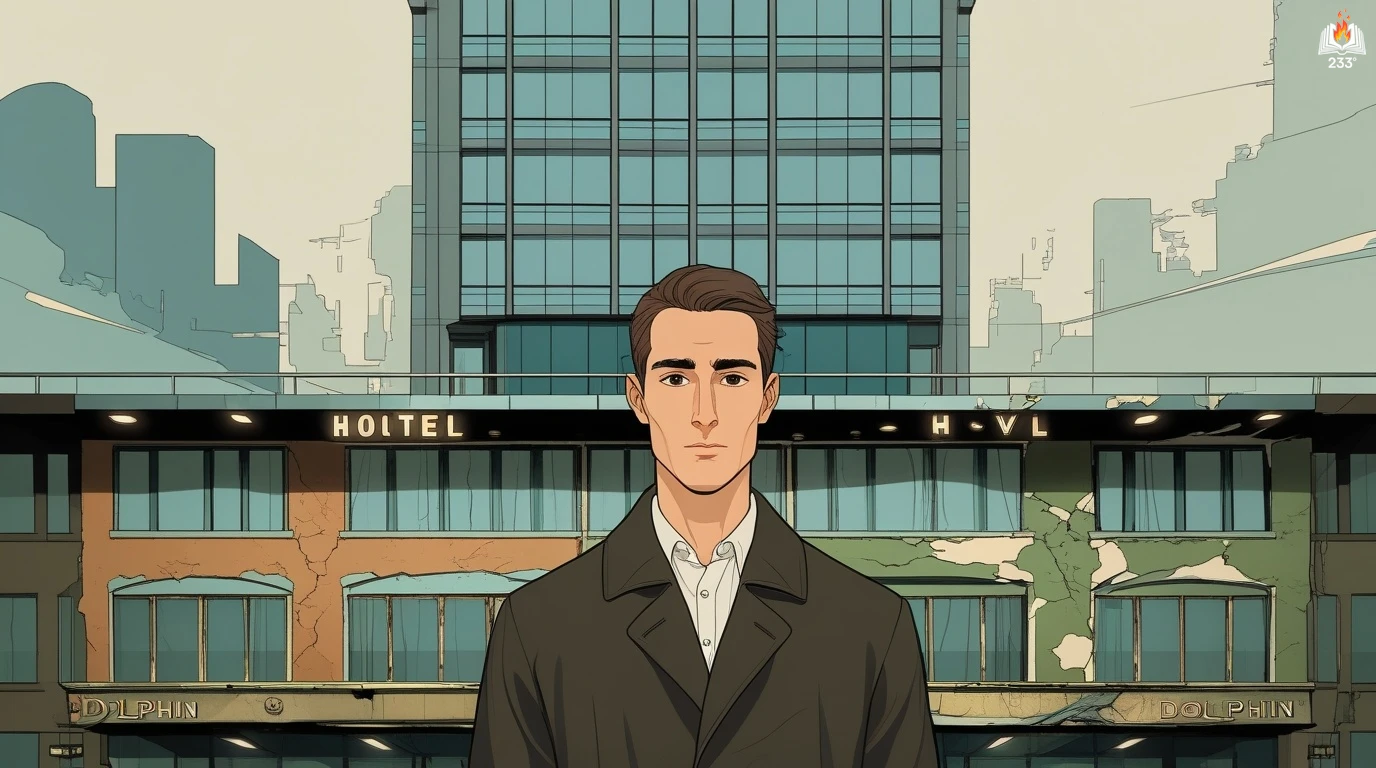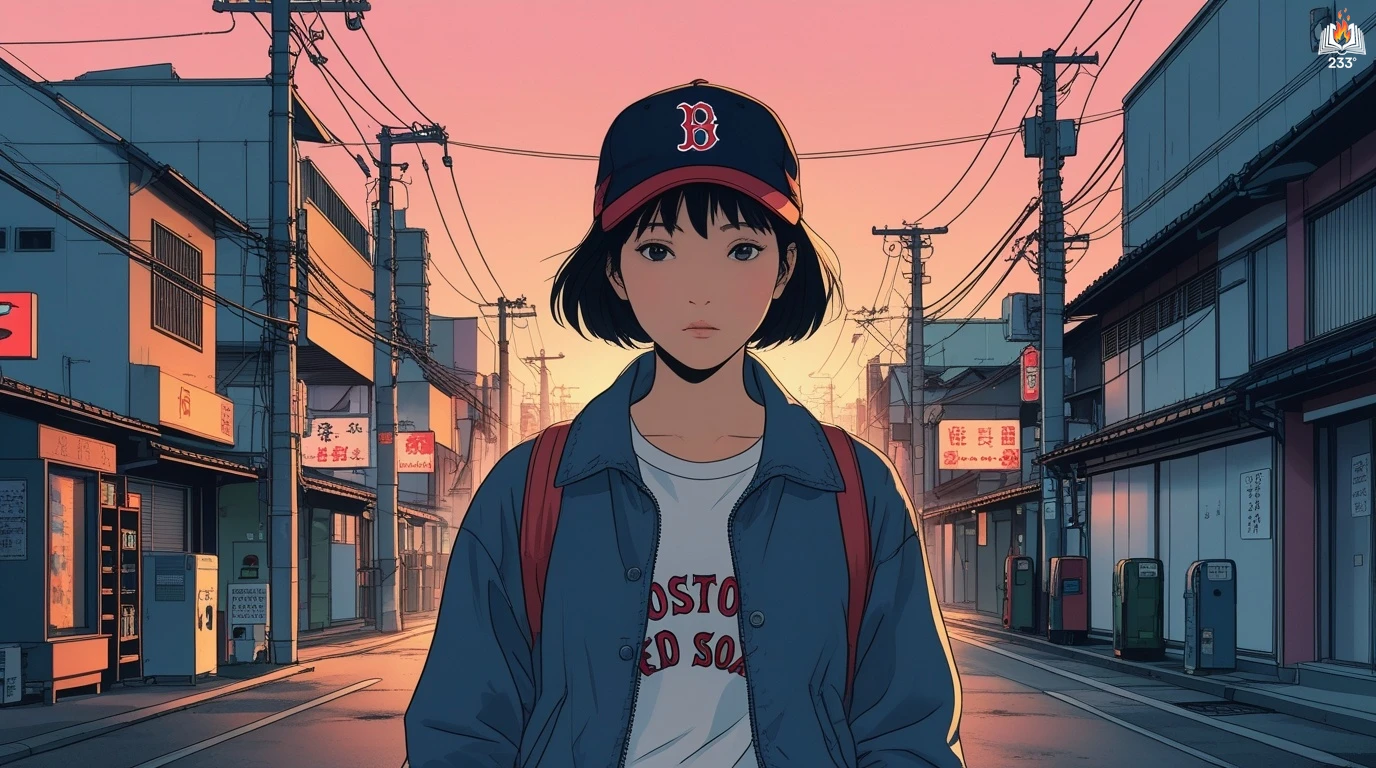
Pinball, 1973, written by Haruki Murakami and published in 1980, is the second installment in the “Trilogy of the Rat” series, which begins with Hear the Wind Sing and culminates in A Wild Sheep Chase. A quietly surreal meditation on nostalgia, disconnection, and the elusive nature of meaning, the novel follows two primary narrators – the unnamed protagonist and his friend, the Rat – as they drift through the landscapes of early 1970s Tokyo and rural Japan. Laced with melancholic humor, existential longing, and the enigmatic allure of a vintage pinball machine, Murakami’s novel stands as an early blueprint for the themes and style that would define his later work.
Plot Summary
In the cool, disconnected quiet of Tokyo’s early 1970s, a man runs a small translation business with a friend. Together, they work out of a modest office equipped with steel desks, bourbon, and an office girl who hums the Beatles and keeps the books tidy. Their lives, shaped by routines and whiskey, drift gently like smoke rising in still air. The narrator – unnamed, calm, vaguely discontent – spends his evenings with twin girls who appeared one day and never left. Identical in every way but for the numbers on their sweatshirts, 208 and 209 occupy his apartment with the weightlessness of ghosts. They wash their clothes in the bath, drink coffee, and ask strange questions about Vietnam and blood poisoning. They do not speak of pasts, and he does not ask.
The twins don’t seem to age. They float through days, drinking coffee, reading the newspaper, baking trout. They seem to know things without ever having learned them. Their presence brings a dreamlike stillness to the man’s life. When he returns from work, they are there. When he falls asleep, they flank him, bodies warm and silent. When he dreams of a pinball machine, he does not speak of it aloud, but something inside shifts.
Three years before, the pinball machine had lived in a game center – a mysterious, radiant machine with stars and flippers and electric promise. The machine disappeared, and with it, something else vanished from him, though he never could name it. Now, years later, he remembers it not as a game, but as a shape of meaning, the way light remembers a window once shattered.
Elsewhere, in a coastal town softened by sea air, the Rat – once the narrator’s friend – lives suspended in a haze of inertia. He quit university without a plan, moved into his father’s penthouse apartment, and passed days doing little but watching light pour in through windows and thinking about time. He drinks beer at J’s Bar, smokes cigarettes after five dry years, and tries to keep his sadness manageable. The bar is nearly empty most nights, its patrons as thin as the slices of lemon in a gin and tonic. But J – stoic, attentive – stays behind the counter, polishing glasses and listening.
The Rat drifts through weeks without purpose until he meets a woman selling a typewriter. Slender, composed, with a face like music played softly in another room, she lives in a seaside apartment filled with plants and well-chosen silences. Their conversations begin on the phone, move to a bar, then to a swim, and finally into bed. There is no fanfare. It just happens – like a breeze finding a window left open. She is precise, elegant, wearing tasteful dresses and perfume that smells like morning. He falls for her, or perhaps into her, not with the burning of romance but with the calm gravity of rain gathering in a pond.
Back in Tokyo, the man becomes sick. The twins bring him beer, soothe him with recorder sonatas, and take his temperature. The office girl continues to hum Penny Lane. He translates essays about hay fever and cats. In the evenings, the city presses its weightless loneliness through the windowpanes. The twins cook trout. The scent reminds him of mountain paths and lost summers. Something inside him begins to fray – not tear, just loosen – and he thinks more often of the pinball machine.
Autumn arrives, damp and precise. The Rat sits in a graveyard with the woman, watching the lights of the town below. She leans on him, and he watches the glow of her life – her fragility, her practiced smile, her elegance. He feels her as a weight, a promise, a thing alive and already slipping away. In the stillness of night, surrounded by future graves, he begins to understand how distance builds between people without sound.
The twins speak of the switch-panel that lives beside the kitchen sink. A useless relic, they claim, but vital in some symbolic, private way. It is dying, they say, and deserves a proper farewell. So they borrow a car and drive to a reservoir in the rain. The three of them eat roasted corn, speak very little, and perform a quiet ceremony by the water. The man watches the ripples in the rain, feeling the dull echo of something that used to mean something. He buries the panel in silence.
The Rat watches his relationship grow hollow. Perfection becomes unbearable. The woman grows more remote, her elegance turning brittle. He cannot breach the gap between them. On the surface, everything remains intact – but the rhythm falters. He drives alone, recalls childhood walks to a beacon by the sea, and remembers the weight of not understanding the vastness of the world. Sometimes, the memory is more real than the day.
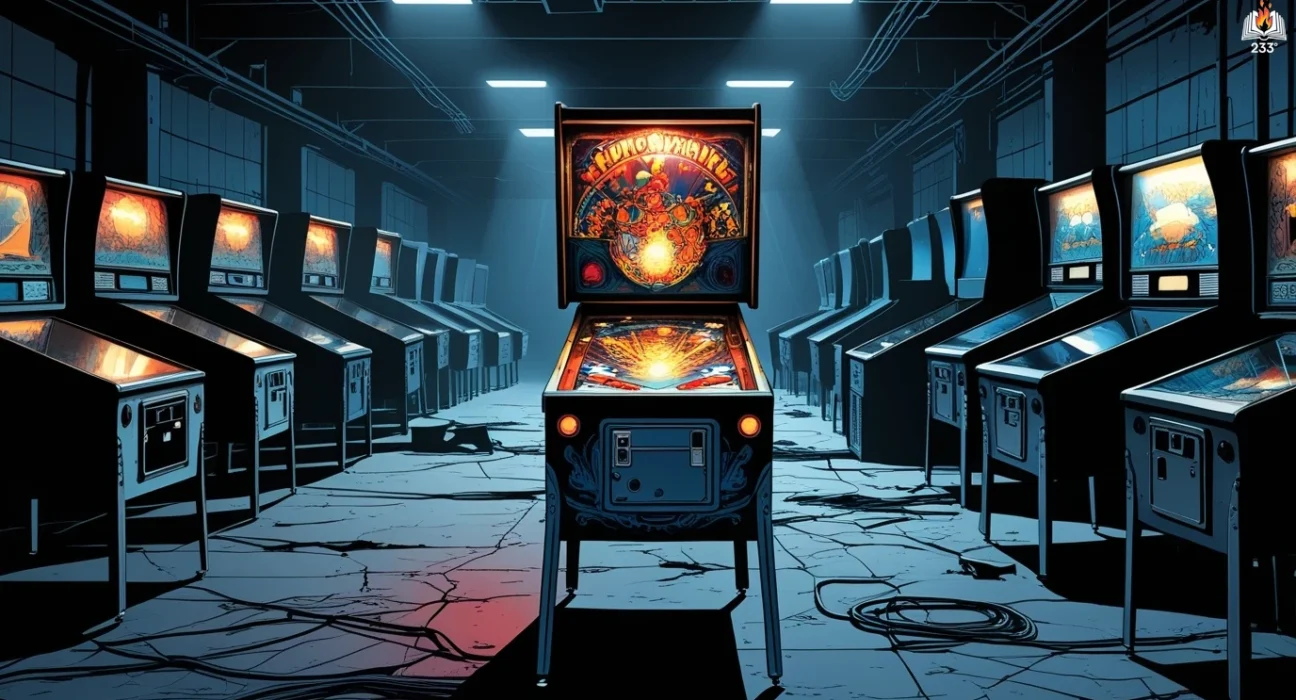
Back in the city, the man finds a listing for an old game center. A hunch – or a memory’s whisper – takes him on a quiet search. He walks into a warehouse outside town and finds it: the pinball machine, tilted and flickering, resting like a half-forgotten god among broken arcade relics. The machine is the same – its silver balls, the spinning lights, the soft glow of replay. He plays one game. Just one. Then he leaves it behind without saying goodbye. The game meant something once. But now, even magic machines cannot save him from the quiet inside.
He returns to his apartment. The twins are gone. A note is left. Nothing poetic, just an absence filled with coffee cups, clean sheets, and silence. He lies in bed, listens to rain, and stares at the ceiling. The world continues, slowly and without explanation.
Far away, the Rat writes a letter. He speaks of the bar, the typewriter, the woman, the seasons. He says he might leave soon – not sure when, or where to. He speaks of silence, of driving through night roads, of waiting. The letter drifts toward the narrator like a ship in fog, unseen but approaching.
Time passes. The rain continues. The twin sweatshirts no longer hang in the window. The pinball machine flickers in darkness. Somewhere, the Rat waits in a car, engine humming. The sea lies beyond the trees. And the sky, heavy with clouds, begins to open.
Main Characters
The Narrator: An unnamed, introspective thirty-something man running a translation business in Tokyo. He drifts through life with a passive detachment, sharing his apartment with a pair of mysterious identical twins. Haunted by memories of a pinball machine from his youth, he embarks on a subtle quest for lost meaning. His character embodies Murakami’s archetype of the disaffected urban male, plagued by quiet existentialism and searching for solace in the mundane.
The Rat: The narrator’s distant friend, living in a coastal town and struggling with isolation and disillusionment. A dropout from university and the son of a wealthy family, the Rat spends his time in a bar owned by J, wrestling with the futility of his existence and an undefined emotional paralysis. He is thoughtful, self-aware, and spiritually adrift, often caught between the past and a future he cannot visualize.
208 and 209: Identical twin girls who suddenly appear in the narrator’s apartment and move in without explanation. Mysterious, enigmatic, and eerily synchronized, they are marked only by the numbers on their sweatshirts. While childlike in behavior, they also possess a strange serenity and quietly philosophical nature, often reflecting the narrator’s inner state more than challenging it.
J: A gentle and observant Chinese bartender who serves as a grounding presence in the Rat’s world. He listens, gives occasional advice, and offers silent companionship. J represents continuity and a connection to the real, tangible world in contrast to the Rat’s inner turmoil.
The Woman (the Rat’s lover): A composed and elegant woman the Rat meets in a quiet, almost accidental romance. Her perfection and emotional restraint add to the Rat’s sense of detachment and melancholy. She is drawn with delicate detail and remains somewhat elusive, reflecting the Rat’s inner conflict between connection and solitude.
Theme
Nostalgia and the Search for Meaning: Central to the novel is the narrator’s obsession with a specific pinball machine from his past. This quest symbolizes a deeper yearning for a lost sense of purpose or identity. The past looms large, not as memory but as an emotional space where meaning might once have existed.
Isolation and Emotional Detachment: Both narrators are deeply isolated characters. The narrator shares his home with near-strangers, while the Rat is ensnared in a lonely routine. Relationships are shallow, communication is sparse, and intimacy often seems unattainable. This detachment is not dramatic but quiet, almost natural.
Repetition and Stagnation: The imagery of replays in pinball mirrors the cycles of the characters’ lives. The narrator’s routine at the translation office and the Rat’s return to the bar each night illustrate a stagnant existence – days blur into each other, and time becomes circular.
Technology and the Absurd: The focus on the evolution of the pinball machine offers both a literal and metaphorical commentary on modern life. The absurd reverence for a game that leads nowhere mirrors the characters’ own pursuit of meaning through repetition, distraction, and artifice.
The Fragility of Identity: The interchangeable twins, the Rat’s changing moods, and the narrator’s vague motivations suggest a fluid and fragmented sense of self. Murakami questions whether identity is stable or if it is merely a composite of actions, memories, and temporary desires.
Writing Style and Tone
Haruki Murakami’s writing in Pinball, 1973 is marked by cool detachment, poetic minimalism, and quiet surrealism. The language is deceptively simple, with short declarative sentences that veil profound emotional undertows. Murakami constructs an atmosphere of dreamlike reality, where mundane moments carry a strange weight, and everyday objects – like a pinball machine or a coffee mug – take on near-mythic significance. He avoids traditional exposition, instead choosing to evoke mood through lists, idle conversations, and meditative reflection.
The tone is wistful and introspective, tinged with melancholy and gentle humor. There is a persistent sense of drifting – emotionally, physically, and temporally. Murakami captures the dislocation of modern existence without overt angst, often letting silence and omission speak louder than action. His characters rarely articulate their emotions directly, instead revealing them through subtle shifts in behavior, dreams, and the objects they attach meaning to. The novel flows like a jazz composition – loosely structured, rich with pauses, and defined by what is not said as much as by what is.
Quotes
Pinball, 1973 – Haruki Murakami (1980) Quotes
“Sometimes I feel like a caretaker of a museum -- a huge, empty museum where no one ever comes, and I'm watching over it for no one but myself.”
“So many dreams, so many disappointments, so many promises. And in the end, they all just vanish.”
“If you look at things from a distance, most anything looks beautiful.”
“The problem was, I think, that the places I fit in were always falling behind the rimes.”
“Good question, but no answer. Good questions never have answers.”
“An old cat is a good friend to talk to.”
“When it's all over, it'll seem like a dream.”
“She gave me this look – she might have been watching from a lifeboat as the ship went down. Or maybe it was the other way around.”
“This uneasiness comes over me from time to time, and I feel as if I've somehow been pieced together from two different puzzles.”
“Happiness is a warm friendship.”
“Where there's an entrance, there's got to be an exit. Most things work that way.”
“Things that come out of nowhere go back to nowhere, that's all.”
“From his shoulder on down, the Rat felt the supple weight of her body. An odd sensation, that weight. This being that could love a man, bear children, grow old, and die; to think one whole existence was in this weight.”
“Phone calls in the dead of the night never brought good news.”
“That's when I gave up pinball. When the times comes, everybody gives up pinball. Nothing more to it.”
“Like the song says, rainy days and Mondays always get ya down .”
“If you can let it go at not understanding, that's the best anyone could expect.”
“My face, my self, what would they mean to anybody? Just another stiff. So this self of mine passes some other's self on the street
“Good style, clear argument, but you're not saying anything.”
We hope this summary has sparked your interest and would appreciate you following Celsius 233 on social media:
There’s a treasure trove of other fascinating book summaries waiting for you. Check out our collection of stories that inspire, thrill, and provoke thought, just like this one by checking out the Book Shelf or the Library
Remember, while our summaries capture the essence, they can never replace the full experience of reading the book. If this summary intrigued you, consider diving into the complete story – buy the book and immerse yourself in the author’s original work.
If you want to request a book summary, click here.
When Saurabh is not working/watching football/reading books/traveling, you can reach him via Twitter/X, LinkedIn, or Threads
Restart reading!