

Goliath by Scott Westerfeld, published in 2011, is the thrilling conclusion to the Leviathan trilogy, a steampunk reimagining of World War I. Blending history with bioengineering and fantastical machinery, Westerfeld crafts an alternate past where Darwinist beasts clash with Clanker machines. The novel continues the airborne odyssey of Prince Aleksandar of Hohenberg and Deryn Sharp aboard the living airship Leviathan, as their journey spans from Siberia to Japan and the Americas. Amidst scientific marvels, political intrigue, and romantic revelations, the fate of the world—and their personal destinies—hangs in the balance.
Plot Summary
High above the frozen sprawl of Siberia, the living airship Leviathan carved its path through the clear October sky. Prince Aleksandar of Hohenberg stood restless at the window, feeling every thrum of the beast-ship’s engines as a bitter reminder that he was far from the war, from purpose, from the throne he’d never claimed. Aboard the vessel, he was a Clanker prince among Darwinists, an outsider suspended between two worlds – and one step removed from usefulness.
By his side, midshipman Dylan Sharp devoured potatoes with a soldier’s indifference to comfort. But beneath the uniform, Deryn Sharp nursed a secret that made each heartbeat a gamble: she was a girl in disguise, fighting for a life the world wouldn’t grant her by right. Her affection for Alek had only deepened, tangled in the silence she had sworn to keep. As the Leviathan pressed eastward, both hearts bore the weight of truths unsaid.
The sky soon brought interruption. A two-headed imperial eagle, flapping with strange grace, delivered a sealed message from the czar of Russia. Its presence turned the ship’s mood taut with urgency, its eyes watching like those of fate itself. Dr. Nora Barlow, the ever-enigmatic scientist, received the czar’s scroll and uttered nothing beyond polite dismissal. Yet the Leviathan veered northward, toward the unknown, and the world shifted beneath them.
Cargo awaited the ship, not at a port, but on the back of a thunderous, genetically engineered fighting bear, careening down the Trans-Siberian Trailway. In a daring maneuver involving gliding wings, steel cables, and sheer nerve, Deryn and fellow middy Newkirk snatched a pallet midair, skimming treetops and outrunning ballast-laden disaster. Inside the crate, nestled beneath salted meat and hidden weight, lay something curious – elegant Clanker machinery disguised as dead cargo.
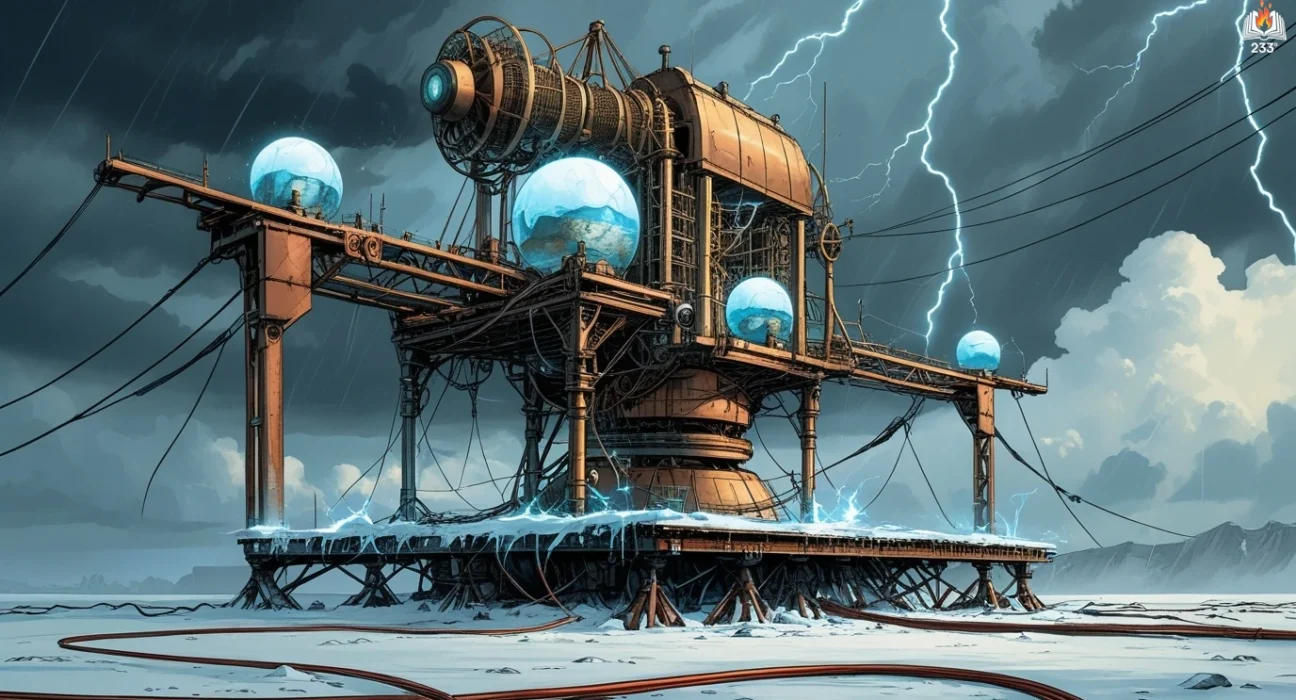
As Alek and his companions – Klopp, Bauer, Hoffman – pieced together the gleaming puzzle, its nature began to emerge: a magnetic device sensitive enough to detect metal from great distances. A tool perhaps, or a weapon, or something in between. It had no name, but it drew light to its glass globes like lightning bottled for a storm.
The machine’s purpose remained obscure, but its path led the ship onward to the icy reaches of Siberia, where the Leviathan touched down at a secret compound. There they met a man who defied simplicity: Nikola Tesla. Cloaked in ambition and mystery, Tesla welcomed them into a fortress of isolation, surrounded by electrified defenses and guarded truths. He claimed to possess the power to end the Great War with a single stroke – a weapon he called Goliath, one that could summon the heavens to strike the Earth.
To Alek, the idea shimmered with possibility. An end to war, to senseless death, to the clash of ideologies that had taken his family and sundered the continent. Tesla saw in him a symbol – a prince without a throne, a beacon of hope to rally peace around. The world, he insisted, would listen to a voice born of royal blood and tragedy.
But not all were so convinced. Dr. Barlow watched Tesla’s madness with quiet disdain, noting the exaggerations in his claims and the instability in his method. Deryn, too, grew wary of his hold over Alek, for she could see the gleam in the prince’s eyes – the hope of becoming something greater than a symbol, something decisive. Yet between them stood silence, thick with unshed confessions and the ache of unspoken longing.
As Tesla’s ambitions grew bolder, the Leviathan pressed on to Japan, its diplomatic mission hanging by threads. In the Emperor’s court, the fabricated beasts of Britain met the precision of Japanese Darwinism, and Tesla offered demonstrations of his power. With each display, Alek’s certainty deepened. But the weapon remained unproven, a myth spun in wires and static.
Then came New York.
The American press, thirsty for spectacle, hailed the prince as a hero and peace-bringer. The Leviathan floated above the skyline, trailing wonders and whispers. But beneath the celebration, Tesla’s grip began to falter. His health waned, his logic frayed. He insisted on deploying Goliath over the Pacific, to terrify the Central Powers into surrender. Dr. Barlow objected. So did the American authorities. But the machine hummed with energy, and the moment approached.
It was in the silence between strategy and strike that Deryn finally stepped forward. The weight of her secret, once held close, now trembled on her lips. She told Alek the truth – that Dylan Sharp was Deryn, and she had loved him in secret, served beside him not as a comrade but as herself.
The revelation cracked the world open.
Alek, stunned, turned inward. Deryn’s courage had reached him, but his thoughts swirled in a storm of betrayal and awe. Here was the boy he had admired, envied, trusted – now a girl, a soldier more valiant than any prince. And something more.
As Tesla readied Goliath for its final act, Alek made his choice. He would not be the figurehead of fear. He would not be the emperor of a forced peace. Taking the public stage, he denounced Tesla’s weapon, calling for diplomacy over devastation. His voice, clear and princely, echoed through the airwaves.
Tesla, undone by rejection and illness, was escorted away. The Leviathan, its course now its own, prepared to return to Europe.
But not before Alek found Deryn in the quiet below decks.
He did not speak of betrayal. He spoke of trust. Of friendship, and something blooming beyond it. The world would not approve. His old life, his Clanker inheritance, might never accept the truth of her. But he did.
Above them, Bovril whispered fragments of their past, mimicking the sounds of affection, of secrets shared. As dawn broke over the Atlantic, the ship flew not with the burden of empire, but with the hush of possibility.
The war had not ended. But something else had begun.
Main Characters
Prince Aleksandar of Hohenberg – The rightful heir to the Austro-Hungarian throne, Alek is caught between his Clanker heritage and his loyalty to the Darwinists aboard the Leviathan. Haunted by his lineage and the war that took his parents, Alek yearns to forge his own path. Throughout Goliath, his personal growth is profound as he wrestles with questions of identity, leadership, and love, ultimately embracing a purpose greater than any throne.
Deryn Sharp (a.k.a. Dylan) – A bold and resourceful girl disguised as a boy to serve in the British Air Service. As “Dylan,” Deryn has proven herself a capable midshipman. Her internal conflict deepens in Goliath as her affection for Alek grows and the pressure to reveal her secret identity intensifies. Deryn’s journey is a delicate balance between duty, disguise, and the vulnerability of love.
Dr. Nora Barlow – A brilliant and enigmatic British scientist and a key Darwinist figure, Dr. Barlow brings a mix of cunning, mystery, and sharp intellect. Her secretive missions and cryptic motivations often guide the narrative’s direction, and she plays a critical role in navigating the geopolitical tensions the crew encounters.
Count Volger – Alek’s protector and mentor, Volger is a shrewd and pragmatic Clanker nobleman. Though his loyalties are clear, his methods often clash with the more idealistic tendencies of Alek and Deryn, making him a foil to their youthful convictions.
Bovril – A perspicacious loris, Bovril is a genetically engineered creature capable of mimicry and perceptive insight. More than just comic relief, Bovril acts as a bridge between Darwinist invention and emotional intuition, often parroting critical truths and secrets.
Nikola Tesla – A reclusive and brilliant scientist drawn into the fray, Tesla is portrayed as a visionary with dangerous ambitions. His invention, “Goliath,” a supposed doomsday device, becomes central to the plot and raises questions about the price of power and progress.
Theme
Identity and Secrecy – Both Alek and Deryn grapple with hidden truths: Alek conceals his royal lineage while Deryn hides her gender. The novel explores how these dual identities shape their decisions, create tension, and ultimately forge their deepest bonds. The revelation of truths becomes a pivotal force in their character arcs.
Science vs. Nature – The central conflict between Darwinist bioengineering and Clanker mechanics serves as a broader metaphor for differing worldviews. Through encounters with fabricated beasts and mechanized marvels, Westerfeld examines humanity’s evolving relationship with technology and nature.
The Burden of Legacy – Alek’s lineage and Tesla’s legacy both raise questions about inheritance, responsibility, and destiny. Characters struggle with the weight of the past and whether they must follow in others’ footsteps or carve their own futures.
Loyalty and Betrayal – Shifting alliances and the fog of war make loyalty a complex theme. Friendships are tested, secrets are kept, and trust becomes a rare currency. The choices characters make under pressure highlight the moral ambiguity of wartime.
Gender and Role Reversal – Deryn’s disguise challenges traditional gender roles and emphasizes her competence in a male-dominated environment. Her storyline questions societal norms and the arbitrary boundaries placed on identity and ambition.
Writing Style and Tone
Scott Westerfeld’s writing in Goliath is brisk, vivid, and immersive. He combines steampunk flair with YA accessibility, using crisp dialogue and dynamic pacing to propel the story forward. The alternating perspectives between Alek and Deryn allow readers to experience both the inner turmoil and outward adventure of the narrative. Westerfeld excels at world-building without sacrificing character depth, embedding technical marvels and biological inventions seamlessly into the plot.
His tone is adventurous yet contemplative. Beneath the high-stakes missions and whimsical creations lies a thoughtful exploration of duty, emotion, and transformation. Westerfeld balances humor—often delivered through Bovril’s mimicry and Deryn’s sharp tongue—with moments of profound introspection. Through rich description and carefully constructed character dynamics, he invites readers into a world that feels both fantastical and eerily familiar.
Quotes
Goliath – Scott Westerfeld (2011) Quotes
“Do you love him?" Deryn swallowed, then pointed at the screen. "He makes me feel like that. Like flying.”
“Let others wage war. You, lucky Austria, shall marry.”
“Have a little faith in me, Volger." "I have great faith, tempered with vast annoyance.”
“Reality had no gears, and you never knew what surprises would come spinning out of its chaos.”
“Oh, this beast? It's...perspicacious loris. 'Perspicacious' meaning 'wise or canny'." "Get stuffed," Bovril said, then giggled. "And it insults people," Telsa said. "How peculiar.”
“To everyone who loves a long-secret romance, revealed at last.”
“Emperors are vain and useless things.”
“You can't blame a match for a house made of straw”
“You young things are too easily persuaded by the touch of lips.”
“Alek said, "Do you think I'm being a fool?" "I think you're trying to do something good. But doing good is rarely easy, and no weapon has ever stopped a war.”
“What if destiny doesn't care?”
“Did you really think I was too fragile to know what Deryn was?" "Fragile?" Volger looked about. "I hadn't thought so, but now I find you brooding in a bathroom. This doesn't speak well of your sturdiness.”
“He thinks Goliath can end the war," Alek managed at last. "The man wants peace!" "As do we all," Count Volger said. "But there are many ways to end a war. Some are more peaceful than others.”
“Surely no one would ever use such a weapon against a city." "There are no limits in war," Volger said, still staring out the window.”
“...that was what kept the world interesting...reality had no gears, and you never knew what surprises would come spinning out of its chaos.”
“It's just the way things are." she shrugged. "It's no one's fault." "Or everyone's.”
“But they're already singing our praises!" "They are Americans. They toot their horns for anything.”
“Fate didn't care a squick about what anybody was meant to do.”
“No matter how far from the war we run, it always catches up with us.”
“Ah. So he's forgotten the most important rule of warfare. Which is... That nothing ever goes to plan.”
“Assisted him? Dylan made the repairs. I only fell and hit my head, from what I can recall. Yes, I make excellent deadweight.”
“You have a bad habit of listing anything that can go wrong, Volger." "I have always considered that a good habit”
“Perhaps Clankers and Darwinists would always be at war, if only in their hearts.”
We hope this summary has sparked your interest and would appreciate you following Celsius 233 on social media:
There’s a treasure trove of other fascinating book summaries waiting for you. Check out our collection of stories that inspire, thrill, and provoke thought, just like this one by checking out the Book Shelf or the Library
Remember, while our summaries capture the essence, they can never replace the full experience of reading the book. If this summary intrigued you, consider diving into the complete story – buy the book and immerse yourself in the author’s original work.
If you want to request a book summary, click here.
When Saurabh is not working/watching football/reading books/traveling, you can reach him via Twitter/X, LinkedIn, or Threads
Restart reading!