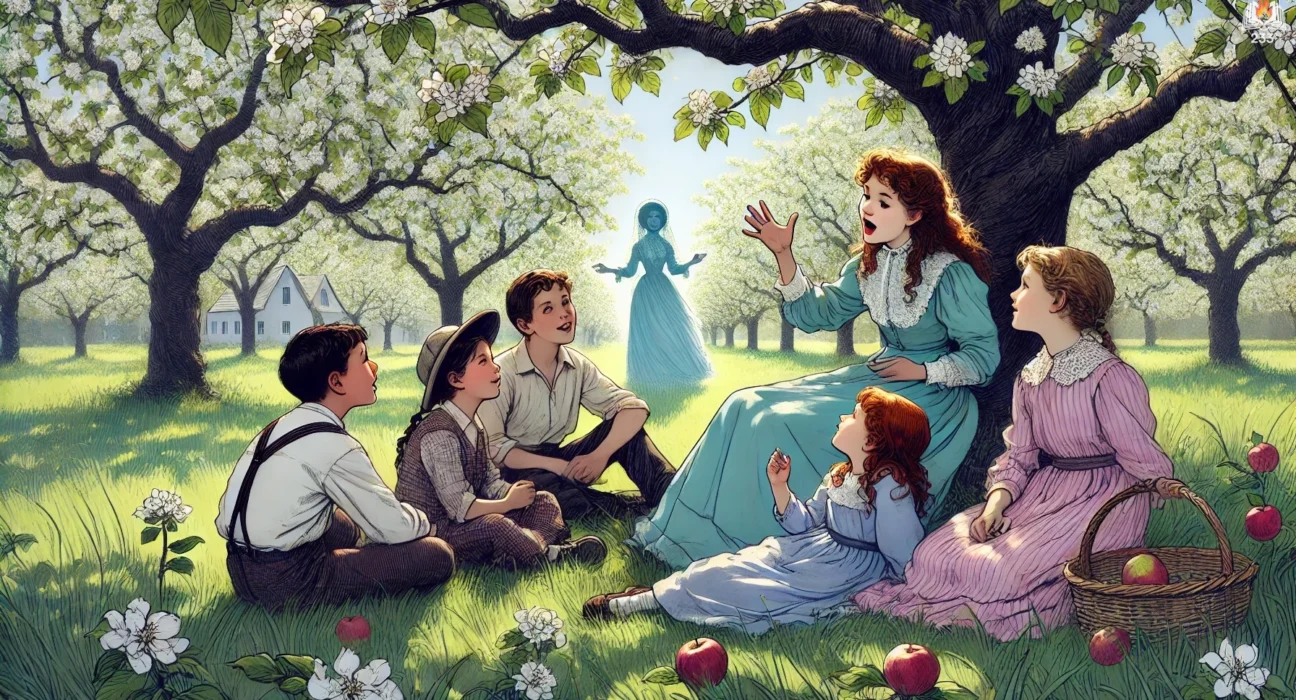
The Story Girl, published in 1911 by Lucy Maud Montgomery, is a delightful novel set on Prince Edward Island, Canada. It follows a group of children as they explore the wonders and challenges of growing up on a rural farm. At the heart of the narrative is Sara Stanley, a young girl with a captivating gift for storytelling. Through her enchanting tales, Sara brings magic to the everyday lives of the children around her, weaving folklore and family history into their adventures. This coming-of-age story captures the charm of rural life, childhood imagination, and the complexities of friendship and family.
Plot Summary
On a bright May morning, young Beverley King and his brother Felix left their home in Toronto, filled with excitement about their journey to Prince Edward Island. The boys were going to live on the family’s ancestral farm for the summer, under the care of their Uncle Alec and Aunt Janet. The prospect of seeing the land where their father had grown up, with its sprawling orchard and the King family homestead, filled them with a sense of adventure. They hadn’t met all their cousins yet, but they knew about Felicity, Cecily, and Dan—children who would soon become central to their days.
When they arrived at the old King farm, they were warmly welcomed by their aunt and uncle. Soon, they met their cousins: Felicity, a beautiful but somewhat vain girl, Cecily, sweet and gentle, and Dan, a lively boy who quickly took to them. But it was Sara Stanley, their cousin known as the Story Girl, who captured their imaginations from the moment they met her. She wasn’t like anyone else. Sara wasn’t traditionally pretty, but there was something about her—a spark of life, a magic in her voice—that made the boys see her in a way they had never seen anyone before.
Sara’s voice had an enchanting quality. When she spoke, the ordinary world transformed. It was as if her words turned everyday things into scenes from a grand and beautiful tapestry. The children often gathered around her, completely mesmerized by the stories she told—tales of their ancestors, ghosts, and legends that filled the air with wonder. One of her favorite places to tell stories was the King orchard, which itself was rich with family history. Every tree had a story; every corner held a memory.
The summer passed in a series of adventures, where reality and imagination intertwined. The children explored the orchard and fields, climbed trees, and discovered hidden corners of the farm. They played games and enacted the stories Sara told them, sometimes even inventing their own. One of their closest friends was Peter Craig, a hired boy who worked on the farm. Though Peter came from a humble background, he quickly became a cherished part of their group, especially drawn to the Story Girl’s tales.
Throughout their adventures, the children’s personalities began to shine more vividly. Felicity, for all her vanity, was a talented cook, always proud of the meals she could prepare. But she was also stubborn and not easily swayed by others, especially when it came to Peter, whom she saw as below her. Cecily, on the other hand, grew more endearing with her quiet charm, always trying to keep the peace between her siblings and friends. Dan’s mischief was a constant source of amusement, and Beverley and Felix felt more at home with each passing day.
One of the most fascinating tales Sara told was of the King family ghost, a spectral figure believed to haunt the orchard. According to legend, a young woman named Emily King, who had tragically lost her lover, could sometimes be seen waiting beneath the trees, dressed in the pale blue muslin gown she had worn the day she received the news of his death. The children, both enthralled and slightly spooked, could never quite shake the feeling that they might glimpse her pale figure among the shadows of the trees. Sara’s stories often blurred the line between reality and fantasy, making every day an adventure.
But the summer wasn’t just about games and stories. There were moments of learning and growing for each of them. When Sara invited Peter to join them at church, it caused a stir among the children. Felicity, with her pride in family status, was less than pleased about Peter’s inclusion. Yet Peter’s sincerity and willingness to change made an impact on everyone. Despite his rough upbringing, he was intelligent, thoughtful, and resourceful, and by the end of the summer, even Felicity’s feelings toward him began to soften.
As the days slipped by, the children shared experiences that would remain in their hearts forever. The Story Girl’s gift made the simple moments of their lives feel extraordinary. Whether they were planting flowers in the garden, helping Aunt Janet with household chores, or simply lying in the grass watching clouds, everything took on a special significance. Together, they attended weddings, funerals, and fairs, each event colored by the unique perspectives of the Story Girl’s tales.
By the end of the summer, the children had not only grown closer to each other but also to the land and the history that surrounded them. Beverley and Felix, once visitors to the Island, now felt like they belonged to it as much as any of their cousins. It was hard to leave the farm and return to their life in the city, but they carried with them the stories, the memories, and the magic of that golden summer.
As they prepared to return to Toronto, they knew they were leaving behind more than just a place. They were leaving behind a chapter of their lives filled with wonder, imagination, and the discovery of who they were, not only as individuals but as a family. Yet, they also knew that the stories they had lived and heard that summer would remain with them forever, binding them to each other and to the Island in a way that nothing else ever could.
Main Characters
Sara Stanley (The Story Girl): Sara, known as the Story Girl, is a 14-year-old with a remarkable talent for spinning captivating stories. Her creativity and natural storytelling ability make her a central figure in the group of children. Despite not being traditionally beautiful, her charm and vivid imagination make her seem enchanting to those around her.
Beverley King: Beverley, often called Bev, serves as the novel’s narrator. He is reflective, curious, and sensitive to the emotional dynamics around him. Bev and his brother Felix come to live at the King family farm, where they meet their cousins and Sara.
Felix King: Beverley’s younger brother, Felix is plump and self-conscious about his appearance, though he frequently tries to engage in exercise to slim down. Felix is a good-natured, humorous character who often gets involved in the playful banter of the group.
Felicity King: The 12-year-old cousin of Beverley and Felix, Felicity is considered beautiful but is also vain and proud. She is an excellent cook and takes pride in her domestic skills, which often make her the subject of admiration, but her vanity sometimes distances her from the others.
Cecily King: Cecily is the youngest of the cousins and is described as delicate and sweet-natured. She lacks Felicity’s beauty but has a kind and gentle soul, which makes her likable. She is often overshadowed by her more outgoing sister, Felicity.
Dan King: Cousin to Beverley and Felix, Dan is mischievous and energetic. He loves teasing and causing trouble but is also loyal and protective of his family and friends.
Peter Craig: Peter is a hired boy who works for the King family and is good friends with the children. Despite being from a poorer background, Peter is intelligent, resourceful, and often surprises the group with his sharp insights.
Aunt Janet and Uncle Alec: These are the adult figures who care for the children during the summer. Aunt Janet is a strong, no-nonsense woman, while Uncle Alec is warm, easygoing, and beloved by the children.
Theme
The Power of Storytelling: Central to the novel is the idea that stories have the ability to shape reality, offer comfort, and help people understand their world. Sara’s gift for storytelling binds the group together, transporting them into other realms and helping them cope with their everyday challenges. Storytelling becomes a way for the children to process their fears, hopes, and dreams.
Childhood Innocence and Imagination: The novel celebrates the purity and creativity of childhood. The children’s adventures are imbued with the magic of their imaginations, turning mundane rural life into a series of adventures. This innocence is contrasted with the encroaching realities of adulthood, making the story both joyful and nostalgic.
Family and Belonging: The King family is at the heart of the novel, and the strong familial ties between the cousins are explored in depth. The novel depicts family as both a source of comfort and conflict. The various generations of Kings, their traditions, and their shared history enrich the children’s lives and provide a sense of belonging.
Rural Life and Nature: The idyllic setting of Prince Edward Island is almost a character in itself, with its orchards, fields, and natural beauty providing a backdrop for the children’s adventures. The novel reflects a deep connection to the land, capturing the simplicity and beauty of rural life.
Coming of Age: The Story Girl touches on the bittersweet nature of growing up. While much of the story is lighthearted, there are moments where the children encounter the complexities of life, loss, and disappointment, signaling their gradual transition into adulthood.
Writing Style and Tone
Lucy Maud Montgomery’s writing in The Story Girl is characterized by a lyrical, almost poetic style that brings the rural landscapes of Prince Edward Island to life. The author is known for her evocative descriptions of nature, which she uses to create a warm and nostalgic atmosphere. Montgomery’s prose is vivid and full of sensory detail, allowing readers to feel as though they are part of the children’s world, hearing the rustling of leaves, smelling the fresh countryside air, and witnessing the colors of the changing seasons.
The tone of the novel is generally light and whimsical, befitting a story about childhood. However, there are moments of reflection and melancholy that add depth to the narrative. Montgomery skillfully balances the joyous exuberance of childhood with a quieter, more contemplative tone, particularly when the children grapple with themes of loss or change. The dialogue between the children is often playful and witty, capturing the natural rhythms of their conversations and the unique dynamics of their relationships.
Montgomery also infuses the novel with a sense of nostalgia, reflecting her deep affection for the rural life of her youth. Through the eyes of Beverley and his companions, readers are invited to look back on their own childhoods, with its moments of wonder, discovery, and heartache.
Quotes
The Story Girl – Lucy Maud Montgomery (1911) Quotes
“Nothing is ever really lost to us as long as we remember it.”
“The beauty of winter is that it makes you appreciate spring.”
“It's not vanity to know your own good points. It would just be stupidity if you didn't; It's only vanity when you get puffed up about them.”
“Proverbs are all very fine when there's nothing to worry you, but when you're in real trouble, they're not a bit of help.”
“It is always safe to dream of spring. For it is sure to come; and if it be not just as we have pictured it, it will be infinitely sweeter.”
“When weeds go to heaven, I suppose they will be flowers.”
“Well, I don't know," said the Story Girl thoughtfully. "I think there are two kinds of true thing - true things that are , and true things that are not , but might be.”
“I do like a road, because you can be always wondering what is at the end of it.”
“I told you the Bible was more to be depended on than newspapers!”
“It is not vanity to know your own good points. It would just be stupidity if you didn't”
“Felicity, if I die from the effects of eating sawdust pudding, flavoured with needles, you'll be sorry you ever said such a thing to your poor old uncle," said Uncle Roger reproachfully.”
“It's no wonder we can't understand the grown-ups," said the Story Girl indignantly, "because we've never been grown-up ourselves. But THEY have been children, and I don't see why they can't understand us.”
“When you know things you have to go by facts. But when you just dream things there's nothing to hold you down.”
“Oh, aren't you glad it is spring? The beauty of winter is that it makes you appreciate spring.”
“It's better to know than to imagine," said Felicity. "Oh, no, it isn't," said the Story Girl quickly. "When you know things you have to go by facts. But when you just dream about things there's nothing to hold you down.”
“There is such a place as fairyland—but only children can find the way to it. And they do not know that it is fairyland until they have grown so old that they forget the way.”
“I can tell stories that will freeze the blood in your veins.”
“But, Felix, you may be sure that God is infinitely more beautiful and loving and tender and kind than anything we can imagine of Him. Never believe anything else, my boy.”
“I think there are two kinds of TRUE THINGS-- true things that ARE, and true things that ARE NOT, but MIGHT be.”
“We could not really believe that Peter was going to die—to DIE. Old people died. Grown-up people died. Even children of whom we had heard died. But that one of US—of our merry little band
“Well, it was awful said," said Felicity, wiping her eyes. "But it was long ago and we can't do any good by crying over it now. Let us go and get something to eat. I made some nice little rhubarb tarts this morning.”
We hope this summary has sparked your interest and would appreciate you following Celsius 233 on social media:
There’s a treasure trove of other fascinating book summaries waiting for you. Check out our collection of stories that inspire, thrill, and provoke thought, just like this one by checking out the Book Shelf or the Library
Remember, while our summaries capture the essence, they can never replace the full experience of reading the book. If this summary intrigued you, consider diving into the complete story – buy the book and immerse yourself in the author’s original work.
If you want to request a book summary, click here.
When Saurabh is not working/watching football/reading books/traveling, you can reach him via Twitter/X, LinkedIn, or Threads
Restart reading!