The Wind-Up Bird Chronicle by Haruki Murakami, first published in Japan in 1994, is a hypnotic literary fusion of mystery, surrealism, and psychological exploration. Set in Tokyo during the mid-1980s, the novel follows the unraveling life of Toru Okada, a quiet and unambitious man drawn into an ever-deepening vortex of personal loss, bizarre encounters, and hidden historical trauma. Across its three-part structure, Murakami blends the mundane and the fantastical, crafting a labyrinthine narrative that examines the tension between memory, identity, and reality.
Plot Summary
In a quiet Tokyo suburb during the summer of 1984, Toru Okada prepares spaghetti while listening to Rossini’s The Thieving Magpie. A phone rings. A strange woman on the line insists they can understand each other in ten minutes. Her voice is calm, seductive, yet unfamiliar. She knows things she shouldn’t. Toru, newly unemployed and adrift, brushes off the call as odd but insignificant. Then the family cat, Noboru Wataya, named after his loathed brother-in-law, disappears. Soon after, so does his wife, Kumiko.
Toru’s days unfold in dreamlike repetitions. Searching for the cat leads him through tangled alleys and into the company of a teenage girl named May Kasahara, who lounges in the sun with dark sunglasses and questions shaped like riddles. She speaks freely of death and deformity, her leg injured in a motorcycle accident, her tone disarmingly casual. She invites him to sit with her, to watch the cats pass by the garden. A peculiar intimacy develops between them – not romantic, not parental, but rooted in shared silence and a hunger to make sense of things that do not make sense.
Toru’s routine unravels. The phone rings again. Kumiko speaks to him less. Then she doesn’t come home. Then she writes to say she has gone. Not forever, she says, but she needs time, space. Her absence becomes the center of his days. He receives visits from strange women – Malta Kano and her sister Creta. Malta wears a peculiar hat and offers spiritual insights with formal precision. Creta, once a prostitute, now seems ethereal, haunted. She tells Toru about a violation, a tearing apart of body and soul, inflicted by Noboru Wataya. It is not just a violation of flesh, but of being, and it binds her story to Kumiko’s.
The house becomes a place of whispers. The wind-up bird’s call – mechanical and mournful – echoes from the stand of trees near the alley, winding the spring of an invisible clock. The sound becomes an omen, a marker of something hidden beneath the surface of daily life.
Toru descends – first figuratively, then literally – into a dry well behind a vacant house. In the darkness, time fractures. He dreams, or perhaps does not. Faces visit him in the dark – Kumiko, Creta, a boy he once knew. Memories surface like bubbles in deep water. The well becomes his refuge, his chrysalis. He leaves it changed. Bruised, quieter, more focused. The act of sinking into the earth brings him closer to whatever truth lies buried in the silence around him.
Then come the letters from Lieutenant Mamiya, a frail man with hollow eyes who speaks in whispers and smells of talcum. Mamiya recounts the horrors of Manchuria during the war – the heat, the sand, the cruelty of men. His tales are meticulous, terrible, and they stretch across the years like threads in a tapestry Toru didn’t know he was part of. In the desert, a man is flayed alive. In a prison hole, time drips like water, wearing down the soul. These stories are not simply history – they are keys, reflections, echoes of something personal.
Noboru Wataya rises to public prominence, his image clean, composed, clinical. He is everything Toru is not – powerful, visible, impossible to confront directly. He becomes a symbol of the forces that twist truth into something shapeless. Toru’s resentment grows, but not in rage – in resolve. He begins to dream of a blue mark on his cheek, one that appears in his vision but then manifests physically, a mark he cannot explain. It becomes a sign of his transformation, a stain of purpose.
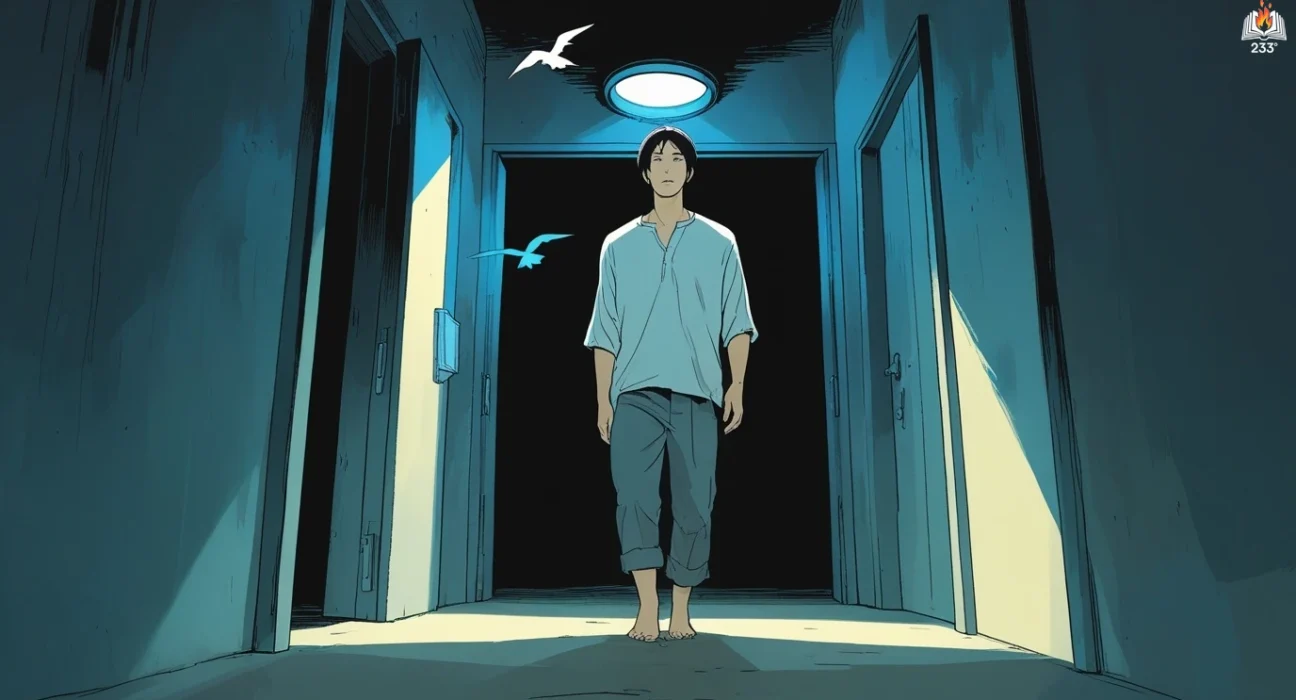
Creta disappears. Kumiko’s letters become erratic, apologetic, and then stop altogether. Toru waits, listens. He dreams of a hotel – strange, quiet, seemingly outside of time. There, he meets a silent man with a guitar, a prostitute who does not speak. The boundary between waking and sleeping softens. Toru begins to shape the world from within these dreams. He discovers a corridor behind a wardrobe, a dark hallway he must walk barefoot. At the end lies the heart of the mystery – the room where he must act, not wait.
As the blue moon rises, he returns to the well. This time he does not simply descend – he crosses. He emerges into the hotel of his vision, though he cannot say if he is truly there or dreaming. Time bends. He finds Noboru Wataya, or a version of him, lying unconscious. He strikes him with a bat – once, twice, three times. Not in anger, but in quiet necessity. The blue mark on his cheek pulses. There is no blood, but something is broken.
Toru wakes in his own bed, weakened. The mark on his face has faded. The phone rings. It is Kumiko. She is in a clinic, under her brother’s control. She has confessed to stabbing Noboru. He survived. She turned herself in. But she speaks calmly, clearly, and tells Toru that she heard him. That he came for her. That something has shifted.
Toru does not rush to find her. He does not chase the cat, which never returns. He goes on with his quiet life, cooking simple meals, listening for the wind-up bird. The world has not been fixed. But something deep has been touched, moved, perhaps healed. In the well of his own being, something has stirred.
Main Characters
Toru Okada – The novel’s passive but emotionally perceptive protagonist. Recently unemployed and content with domestic simplicity, Toru is jolted into a surreal investigation when his wife disappears. His character arc evolves from passivity to quiet determination, as he delves into dreams, memories, and psychic experiences to uncover unsettling truths about himself and others.
Kumiko Okada – Toru’s wife, whose emotional withdrawal and eventual disappearance form the emotional center of the novel. Intelligent and mysterious, Kumiko harbors deep psychological scars, and her story unfolds through absence, letters, and fragments, revealing a woman battling unseen forces within and without.
Noboru Wataya – Kumiko’s older brother and Toru’s antagonist, a manipulative and charismatic academic and media figure. Noboru embodies power without morality, and his shadow looms over much of the novel, representing societal corruption, repression, and the dangerous allure of control.
May Kasahara – A quirky, sharp-tongued teenage neighbor with a fascination for death and physical disfigurement. May forms a curious bond with Toru, challenging his perceptions and offering cryptic insights while dealing with her own emotional dislocation.
Malta and Creta Kano – Enigmatic sisters with spiritual and clairvoyant abilities. Malta appears as a medium of fate and guidance, while Creta’s painful personal history and surreal experiences connect deeply with Kumiko’s and Toru’s own emotional labyrinths.
Lieutenant Mamiya – A former soldier whose harrowing stories of wartime atrocities offer a stark historical and metaphysical counterpoint to the present. Mamiya’s letters and recollections act as windows into the novel’s deeper themes of violence, memory, and the soul’s endurance.
Theme
Alienation and Emotional Distance – Throughout the novel, characters struggle with an inability to fully connect. Murakami probes the emotional chasms between individuals, emphasizing how even intimate relationships are fraught with secrecy, repression, and unspoken trauma.
Search for Identity and Meaning – Toru’s journey is one of internal discovery as much as it is a mystery to be solved. As he navigates surreal realms, memory, and history, his search mirrors a broader existential quest: to find authentic meaning in a fragmented, often incomprehensible world.
The Supernatural and the Subconscious – Dreams, psychic phenomena, and symbolic landscapes blur the line between reality and the metaphysical. The novel treats the subconscious mind as a literal space – a subterranean world that must be entered and explored to understand the self and others.
Historical Trauma and Memory – Murakami weaves in graphic, haunting depictions of Japanese military actions during World War II, confronting the lingering scars of violence. The personal and historical traumas of the characters intertwine, underscoring the collective weight of suppressed memory.
The Well as Symbol – A central motif, the well represents isolation, descent into the subconscious, and the need for introspection. Characters are drawn toward literal and metaphorical wells, where time dilates and transformation becomes possible.
Writing Style and Tone
Haruki Murakami’s prose in The Wind-Up Bird Chronicle is deceptively simple yet rhythmically hypnotic, blending the mundane with the metaphysical in an intimate, conversational tone. He moves effortlessly between first-person narration, epistolary segments, dream sequences, and historical recollections. The fluidity of style allows the surreal to bleed into the everyday, creating a reading experience that feels immersive, dreamlike, and often disconcerting.
The tone oscillates between detached observation and emotional intensity. Murakami frequently juxtaposes deadpan humor with deep melancholy, moments of eroticism with existential dread. There is a philosophical calmness to his narration, even when confronting scenes of horror or emotional breakdown. The layering of narratives – dreams within stories within history – evokes a sense of spiraling descent, as though the reader, like Toru, is being pulled deeper into an enigmatic vortex where logic bends and reality splinters. This balance between cool distance and haunting intimacy defines the novel’s unique atmospheric power.
Quotes
The Wind-Up Bird Chronicle – Haruki Murakami (1994) Quotes
“Spend your money on the things money can buy. Spend your time on the things money can’t buy.”
“Memories and thoughts age, just as people do. But certain thoughts can never age, and certain memories can never fade.”
“I realize full well how hard it must be to go on living alone in a place from which someone has left you, but there is nothing so cruel in this world as the desolation of having nothing to hope for.”
“I'm not so weird to me.”
“In a place far away from anyone or anywhere, I drifted off for a moment.”
“Have you ever had that feeling—that you’d like to go to a whole different place and become a whole different self?”
“For both of us, it had simply been too enormous an experience. We shared it by not talking about it . Does this make any sense?”
“I'd be smiling and chatting away, and my mind would be floating around somewhere else, like a balloon with a broken string.”
“To know one’s own state is not a simple matter. One cannot look directly at one’s own face with one’s own eyes, for example. One has no choice but to look at one’s reflection in the mirror. Through experience, we come to believe that the image is correct, but that is all.”
“When you are used to the kind of life -of never getting anything you want- you stop knowing what it is you want.”
“What we see before us is just one tiny part of the world. We get in the habit of thinking, this is the world, but that's not true at all. The real world is a much darker and deeper place than this, and much of it is occupied by jellyfish and things.”
“Results aside, the ability to have complete faith in another human being is one of the finest qualities a person can possess.”
“I could disappear from the face of the earth, and the world would go on moving without the slightest twinge. Things were tremendously complicated, to be sure, but one thing was clear: no one needed me.”
“You might think you made a new world or a new self, but your old self is always gonna be there, just below the surface, and if something happens, it'll stick its head out and say 'Hi.' You don't seem to realize that. You were made somewhere else.”
“Tell me, Doctor, are you afraid of death?" "I guess it depends on how you die.”
“Nothing so consumes a person as meaningless exertion”
“This person, this self, this me, finally, was made somewhere else. Everything had come from somewhere else, and it would all go somewhere else. I was nothing but a pathway for the person known as me.”
“I don't know -- maybe the world has two different kinds of people, and for one kind the world is this completely logical, rice pudding place, and for the other it's all hit-or-miss macaroni gratin.”
We hope this summary has sparked your interest and would appreciate you following Celsius 233 on social media:
There’s a treasure trove of other fascinating book summaries waiting for you. Check out our collection of stories that inspire, thrill, and provoke thought, just like this one by checking out the Book Shelf or the Library
Remember, while our summaries capture the essence, they can never replace the full experience of reading the book. If this summary intrigued you, consider diving into the complete story – buy the book and immerse yourself in the author’s original work.
If you want to request a book summary, click here.
When Saurabh is not working/watching football/reading books/traveling, you can reach him via Twitter/X, LinkedIn, or Threads
Restart reading!