

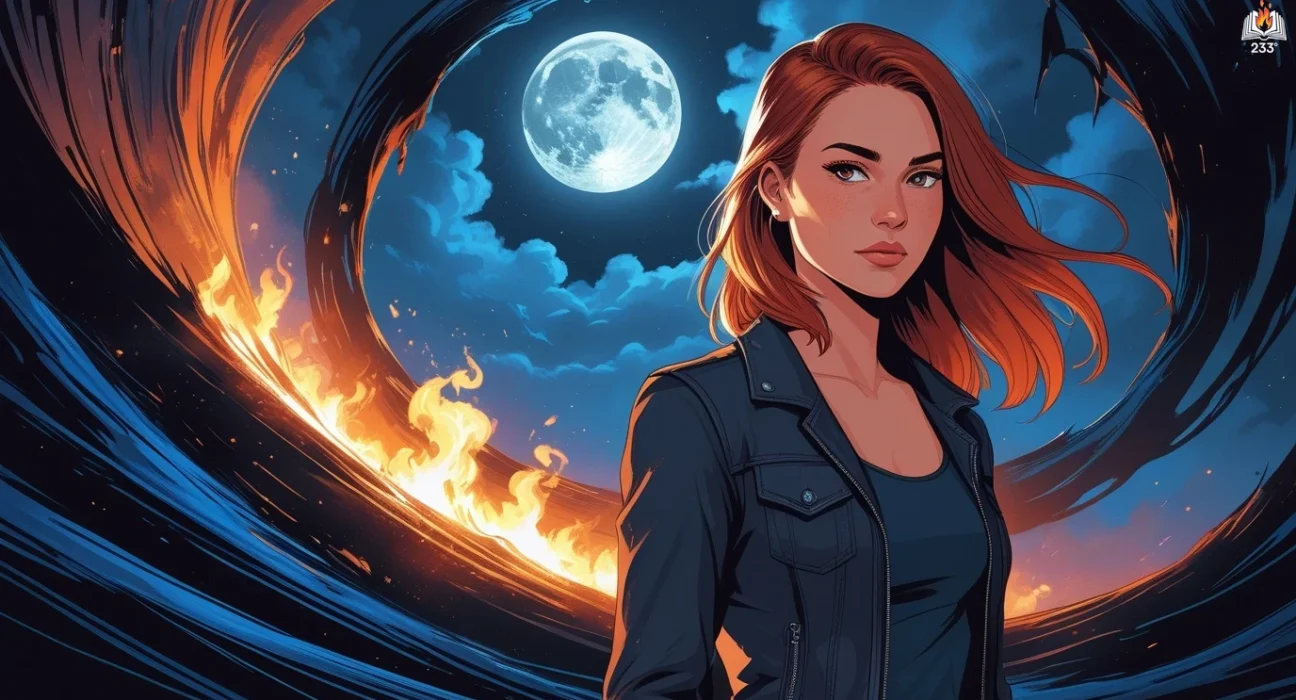
Blue Noon (published in 2006), written by Scott Westerfeld, is the final installment in the Midnighters Trilogy, a gripping young adult series that blends supernatural suspense with mathematical mysticism and teenage angst. Set in the seemingly mundane town of Bixby, Oklahoma, the story unfolds around a secret “blue hour” – a 25th hidden hour that occurs at midnight, accessible only to a few gifted teens known as the Midnighters. In Blue Noon, the boundaries of this secret time begin to collapse, bringing the blue hour into broad daylight and threatening to trap the protagonists in a world outside normal time.
Plot Summary
In Bixby, Oklahoma, the clockwork rhythm of the secret hour – the hidden twenty-fifth slice of midnight – begins to fray. Jessica Day, the flame-bringer, wakes on a Monday morning unaware that time is about to rebel. In the gymnasium during a routine pep rally, the blue light floods in, freezing every student and teacher mid-chant. It’s only 9 A.M., but the secret hour has arrived in broad daylight.
The five Midnighters – Jessica, Rex, Melissa, Jonathan, and Dess – break from the frozen crowd, bewildered. Something ancient and wrong ripples through the air. The dark moon hangs in the sky, unmoving, holding back the sun and pinning the world into the blue. Jessica’s instincts as the flame-bringer surge; whatever has begun, it’s not an accident. And it’s not stopping.
Rex, still grappling with the aftershocks of his forced transformation by the darklings, feels the primal hunger stir inside. He’s a halfling now – part human, part predator. His vision sharpens, his mind pulses with the lore of an ancient world, but beneath that knowledge is something feral. When an old school bully confronts him, Rex doesn’t just defend himself. He radiates fear, uncoiling like a snake, and leaves the boy shattered. Melissa sees it happen. She tastes it in his mind – the power, the darkness, the loss of human restraint.
The blue time becomes more unpredictable. It strikes at odd hours, crashes into daylight, and leaves the Midnighters scrambling to keep it secret. Jessica begins to notice the strain it places on them. Jonathan, her gravity-defying boyfriend, relishes the freedom of suspended time, but even he grows cautious. Melissa, newly strengthened by Madeleine’s teachings, keeps everyone sane, but tension still simmers from her mindcasting violation of Dess’s memories. Dess, bitter and brilliant, buries herself in equations and map coordinates, trying to chart the shifting borders of the blue.
The group seeks Madeleine, the elder mindcaster, hiding in her twisted house of folded dimensions. She cannot explain what’s happening, only that the walls of the secret hour are breaking. And she fears what might be pushing from the other side.
The darklings celebrate. Melissa hears them shrieking in the desert, not in fear but in joy. Something about the unraveling pleases them – this is no natural phenomenon. It’s a victory.
As the blue hour intrudes further, Rex’s mind begins to warp. The symbols of the lore, once his refuge, become traps. Numbers threaten to paralyze him. Math becomes poison. Melissa holds him together, their bond deepening into something raw and fierce, but even she fears he is slipping.
Jessica, grounded and weary from arguments with her parents, balances her double life with care. Her sister Beth, once a carefree majorette, now watches her with suspicion, sensing secrets without knowing them. The streets of Bixby tighten around Jessica like a cage.
Then the Midnighters witness the impossible: time freezes during the day, and doesn’t snap back. The secret hour stretches, unnatural and oppressive. The sky stays blue, the moon fixed. They are trapped in a moment that refuses to end.
Exploring the town, they realize that the blue now touches places it never reached before. The boundaries of the secret hour have changed. Where once the edges were predictable, the hour now pulses with shape and intent. This is no random expansion. It’s being guided.
The darklings, long driven into hiding by the evolution of human intelligence and symbols, have found a way to reclaim their dominance. The blue hour, their domain, is seeping into human time. Their prey will be frozen. Powerless. And they will be free.
The Midnighters formulate a desperate plan. They must find the source – the rift where the blue is breaking through. They trace it to a collapsed area near the Badlands. Something beneath the ground, something ancient, has stirred.
As they descend into the breach, the blue becomes darker, more absolute. Time hangs heavy. The air is thick with memory. Rex, no longer entirely himself, moves with quiet certainty. He speaks with a predator’s calm, identifying dangers before they emerge. Melissa stays close to him, tethering his humanity with her presence.
They reach the epicenter – a spiraling pit of fractured time, where past and present blur. A pressure builds. The rift cannot be closed without an anchor. Something – or someone – must stay behind.
Jessica understands before anyone says it. The blue hour needs a guardian. The tear in time must be sealed from the inside. She is the flame-bringer. Her light is the only force the darklings fear, and the only one strong enough to stabilize the rift.
There is no debate. Jessica makes the choice.
She says her goodbyes in the space between seconds. Jonathan holds her hand, trembling, the gravity between them threatening to pull her back. She smiles, kisses him once, and lets go.
The others flee as the rift begins to close. Jessica remains. Time wraps around her like a cocoon. She becomes the center of the secret hour, the fire at the heart of midnight.
Back in Bixby, the blue hour returns to its rightful place – once again confined to midnight, unseen by the world. The Midnighters regroup, wounded but alive. The rift is gone, the sky clear.
Rex walks the daylight with a new balance. The hunger remains, but so does Melissa’s hand in his. Dess starts mapping again, marking the edges of midnight with careful precision. Jonathan, heavier now with grief, still looks to the sky but does not fly as often.
And far away, where time folds in silence, Jessica watches over the hour no one sees.
Main Characters
- Jessica Day: The “flame-bringer,” Jessica is the linchpin of the group and the only one who can wield light during the blue hour. Her powers make her especially lethal to darklings. In this installment, Jessica struggles with the burdens of leadership, balancing her growing relationship with Jonathan and the emotional gravity of the midnighters’ deteriorating situation. Her courage, loyalty, and eventual acceptance of a great personal sacrifice define her arc.
- Rex Greene: Once the group’s seer and lore expert, Rex continues to battle the psychological and physiological aftereffects of his partial transformation into a darkling in the previous book. In Blue Noon, Rex’s dual nature brings both insight and danger, as he teeters between control and becoming something other. His internal conflict and slow descent into something feral underscore his struggle to remain human.
- Melissa: A powerful mindcaster who can sense and manipulate thoughts, Melissa has matured significantly since the series began. Once reclusive and volatile, she’s now more stable, especially due to her growing closeness with Rex and tutelage under the elder mindcaster Madeleine. Her role as an emotional and strategic anchor grows more prominent.
- Jonathan Martinez: Known as “Flyboy” for his ability to become gravity-defiant in the blue hour, Jonathan remains Jessica’s loyal boyfriend. His recklessness and love of freedom contrast sharply with the increasingly claustrophobic and apocalyptic tone of the narrative. He represents a grounding force for Jessica but also embodies the conflict between escape and duty.
- Dess (Desdemona): A math prodigy and polymath, Dess provides much of the group’s tactical knowledge and geographic insight into the blue hour. Though marginalized in emotional subplots, she remains critical to unraveling the mysteries of the shifting temporal boundaries. Her skeptical, practical nature often balances out the others’ more emotional impulses.
- Madeleine: An elder mindcaster from a previous generation of midnighters, Madeleine acts as a mentor figure, particularly to Melissa. Her reemergence into the story brings historical weight and arcane knowledge but also a reminder of what can be lost to time, secrecy, and fear.
Theme
- Time and Its Fragility: At the heart of Blue Noon is the instability of time. The secret hour begins to seep into regular daylight, violating its own rules. This anomaly raises questions about permanence, the nature of reality, and the cost of crossing temporal boundaries. The fragility of time reflects the characters’ own instability and looming sacrifices.
- Identity and Transformation: Rex’s partial darkling transformation serves as a metaphor for hybrid identity and internal struggle. Themes of alienation, monstrosity, and self-acceptance unfold through him and resonate with other characters facing emotional change and moral dilemmas.
- Power and Responsibility: Jessica’s role as flame-bringer carries immense power but even greater burden. The series repeatedly questions the ethics of power and whether those gifted with it have a duty to sacrifice for the greater good. This culminates in the characters’ ultimate choices, which resonate with maturity and loss.
- Friendship, Trust, and Betrayal: The dynamic among the midnighters is tense and shifting. Melissa’s violation of Dess’s mind in the previous book has lasting repercussions, leading to feelings of betrayal, tension, and gradual forgiveness. Loyalty is constantly tested as external pressures increase.
- The Monstrous and the Human: Darklings, long seen as the inhuman “other,” are recontextualized through Rex’s experience. The novel blurs the line between predator and prey, showing how ancient enemies were once dominant species, and how humans have become the true apex threat through invention and violence.
Writing Style and Tone
Scott Westerfeld’s writing in Blue Noon is marked by a balance of lyrical intensity and sharp, character-driven dialogue. His language often mirrors the temporal setting – the prose can be fast and tense during moments of crisis, then stretch into poetic introspection during the blue hour’s frozen silence. This mirroring reinforces the atmosphere, making time itself feel like a tangible force within the narrative.
The tone throughout Blue Noon is one of mounting dread and melancholy. Though moments of humor and camaraderie appear, especially in the banter among the teens, the story is undercut by a sense of finality and impending loss. Westerfeld does not shy away from exploring the costs of heroism, making the narrative emotionally weighty and thematically rich. The conclusion, especially, carries a tragic poignancy that lingers long after the last page.
Quotes
Blue Noon – Scott Westerfeld (2006) Quotes
“Fifteen!" Dess's distant cry reached him. "Where the hell are you, Rex? Ten. You're-an-idiot-nine, get-back-here-eight, you-dimwit-seven...”
“Maybe kissing is sort of like nature's coffee. -Jonathan”
“Fine. Seer knows best, even if he is nuts. Maybe I can stand to wait a few more... whoa. What the hell happened to my car? -Melissa”
“He squeezed her hand. "Then I'll come get you, wherever you are when it happens. We'll be okay." "But what about everybody else?" He stared out across the river, nodding slowly. "My guess is, everybody else is in big trouble.”
“It was way cool, being the one who did the math.”
“Battered by the mind noise, huddled in the back with eyes closed and fists clenched, the old Melissa had understood pep rallies about as well as a bird sucked through a jet engine comprehended aircraft design.”
We hope this summary has sparked your interest and would appreciate you following Celsius 233 on social media:
There’s a treasure trove of other fascinating book summaries waiting for you. Check out our collection of stories that inspire, thrill, and provoke thought, just like this one by checking out the Book Shelf or the Library
Remember, while our summaries capture the essence, they can never replace the full experience of reading the book. If this summary intrigued you, consider diving into the complete story – buy the book and immerse yourself in the author’s original work.
If you want to request a book summary, click here.
When Saurabh is not working/watching football/reading books/traveling, you can reach him via Twitter/X, LinkedIn, or Threads
Restart reading!