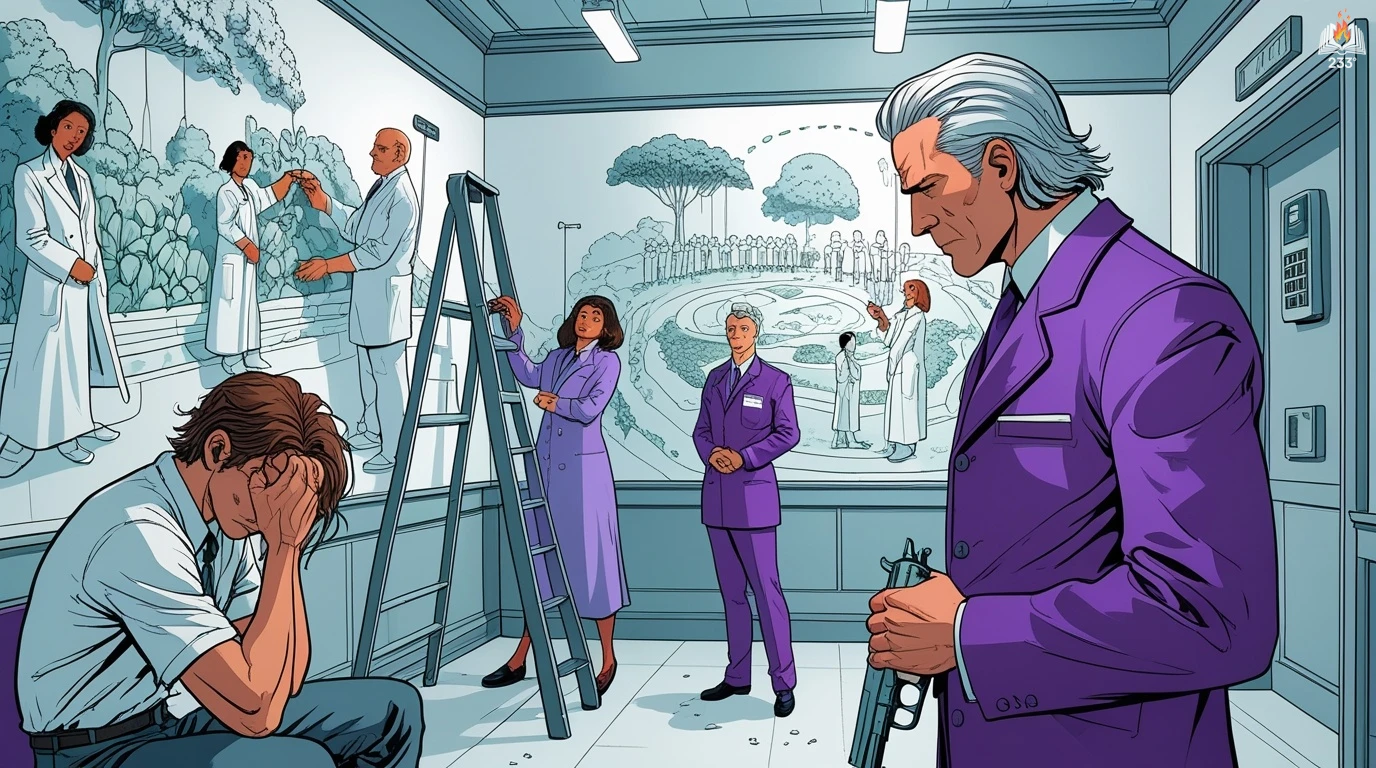
Galápagos by Kurt Vonnegut Jr., published in 1985, is a darkly comedic novel that blends science fiction, satire, and evolutionary philosophy, chronicling the collapse of human civilization and the unexpected survival of a small group stranded on the Galápagos Islands. The novel is part of Vonnegut’s broader body of work known for sharp satire and is often grouped with his major works like Slaughterhouse-Five and Cat’s Cradle.
Plot Summary
A million years ago, back in the forgotten year of 1986, the little South American port of Guayaquil simmered in tropical heat, its streets patrolled by soldiers as a worldwide financial collapse strangled nations. On the edge of this unraveling world, the Bahía de Darwin prepared for her maiden voyage – the “Nature Cruise of the Century” – bound for the Galápagos Islands. But her passengers were not just tourists seeking sunshine and blue-footed boobies. They were the future, though none of them knew it.
James Wait sat in the cocktail lounge of the Hotel El Dorado, wearing a crisp new shirt with the price tag still dangling. A consummate swindler and seducer of wealthy, lonely women, James had arrived in Guayaquil on the run, hoping to vanish once again into the anonymity of paradise. Upstairs, Mary Hepburn, a biology teacher from Ilium, New York, sat in her room, mourning her husband Roy, who had died just months before. Mary had promised Roy on his deathbed that she would take this cruise for the both of them, but now, staring at a red evening dress on the closet floor, she toyed with despair and the terrible seduction of oblivion.
Zenji Hiroguchi, a Japanese computer genius, and his pregnant wife Hisako waited nervously in their room, speaking in soft susurrations. Zenji’s invention, Mandarax, a small translation and medical advice device, hummed with cold precision, offering diagnoses and translations alike. The blind Selena MacIntosh and her seeing-eye dog Kazakh waited with her father, Andrew MacIntosh, an exuberant American financier who dreamed of scooping up Ecuadorian assets in the chaos. Captain Adolf von Kleist, a stolid bachelor and commander of the Bahía de Darwin, approached the airport, unaware that his destiny stretched beyond the bounds of this voyage.
The next morning, under a searing equatorial sun, the Bahía de Darwin slipped away from the ruined port. Onboard, the mood was uneasy, the ship half-empty, the world back onshore unraveling. Wait, ever the predator, set his sights on Mary Hepburn, sensing a new mark to charm and devastate. Mary, however, wrapped in grief and fatigue, barely noticed him. Zenji, meanwhile, found himself tangled in Andrew MacIntosh’s financial schemes, while Hisako, quiet and observant, nurtured the life inside her, the future stirring in her womb.
But fate, always eager to prove its indifference, intervened with a virus. Carried aboard by a sailor and devastating in its efficiency, the virus swept across the globe, decimating the human race. By the time the Bahía de Darwin reached the Galápagos, the ship was no longer a vessel of leisure but a floating ark, its passengers the last remnant of a species that had outwitted itself. On the mainland, governments fell, currencies crumbled, and the mighty brain that had lifted humanity to dominion over the earth proved to be its fatal flaw.
Stranded on the islands, the survivors grappled with their predicament. Mary Hepburn, stripped of her identity as teacher and widow, found new purpose among the wreckage. James Wait, that master of deception, could not cheat death, felled by his own brittle heart. Zenji Hiroguchi, weighed down by genius and ambition, met a violent end, leaving Hisako alone with the unborn child who carried the seed of a new world. Selena MacIntosh, blind but perceptive, leaned on her dog Kazakh as she navigated the strange volcanic landscape. And Captain von Kleist, a quiet man of duty, became the unlikeliest of patriarchs.
Time, that old magician, worked its slow, relentless magic. As the years passed, evolution reshaped what remained of humankind. The children born on the islands grew smaller-brained, better adapted to their environment. They swam like seals, their fingers webbed, their brains no longer burdened by the destructive ambitions of their ancestors. The world outside the Galápagos – its skyscrapers, its stock markets, its armies, its bombs – faded into silence, reclaimed by ocean and jungle.
Mary Hepburn, who had once stood trembling in a hotel room, became a mother to this strange new brood, though not by blood. She taught, not from textbooks, but from instinct and tenderness, guiding a generation that would never know money, war, or pride. Captain von Kleist fathered the children of the surviving women, and together they created a lineage unburdened by the weight of history. Mandarax, once a symbol of dazzling intellect, became a toy and then a relic, its batteries spent, its words silenced.
The animals of the Galápagos watched as the humans adapted to their world. Flightless cormorants, blue-footed boobies, and giant tortoises shared the beaches with children who no longer cared for clothes, children who slid into the sea as easily as they once might have stepped onto playgrounds. The mighty human brain, that machine of war, ambition, and self-destruction, shrank to fit a simpler life. Survival, once measured in bank accounts and skyscrapers, was now counted in fish caught, in children fed, in the rhythm of the tides.
As the centuries rolled on, the archipelago remained a quiet stage where the new humans lived in harmony with their world. The old questions that had haunted Mary’s generation – the meaning of life, the purpose of suffering, the triumph of progress – faded away like footprints in volcanic ash. The children no longer needed the answers. They knew only the sea, the sun, and the soft murmur of wind in the grasses.
Above them, the ghost of Leon Trout drifted on the wind, watching with the bemused detachment of one who had seen too much and expected too little. Once the son of a shipbuilder, once a soldier, once a witness to the foolishness of the species he had belonged to, Leon now floated outside time, observing as evolution smoothed away the sharp edges of humankind. Where once there had been presidents, generals, philosophers, and swindlers, now there were swimmers, fishers, and lovers, moving to the quiet rhythms of nature.
On the beaches where lava once hardened under the searing sun, where Darwin once pondered the mysteries of finches and tortoises, the children of the Bahía de Darwin played in the surf. Their laughter carried on the wind, a song of survival, simple and unadorned. The Galápagos, once seen as a laboratory of natural selection, had become a cradle, holding within its rocky arms the last flicker of human life – a life gentler, quieter, and more durable than the world that came before.
Main Characters
Leon Trout (narrator): The ghost of a shipbuilder’s son and a war veteran, Leon narrates from beyond death, providing sardonic commentary on human folly, evolution, and the events leading to humanity’s decline.
Mary Hepburn: A widowed American biology teacher, grappling with grief and depression, whose journey from suicidal despair to becoming a pivotal figure in the survival of the stranded group forms a central emotional arc.
James Wait: A charming but deeply flawed American con man and swindler, whose journey aboard the Bahía de Darwin reflects the themes of deception, survival, and the collapse of human pretensions.
Zenji Hiroguchi: A brilliant Japanese computer scientist carrying his translation device, Mandarax, whose genius contrasts with his vulnerability amid chaos; his relationship with his pregnant wife adds emotional weight.
Hisako Hiroguchi: Zenji’s pregnant wife and a practitioner of ikebana (Japanese flower arranging), who embodies quiet strength and resilience in the face of disaster.
Selena MacIntosh: A blind young woman traveling with her wealthy father, Andrew MacIntosh, whose reliance on her guide dog Kazakh underlines the novel’s exploration of adaptation and dependence.
Captain Adolf von Kleist: Captain of the Bahía de Darwin and eventual progenitor of the new human race, whose practical leadership plays a decisive role in humanity’s survival.
Theme
Evolution and Adaptation: Central to the novel is the idea that humanity’s oversized brain, once a mark of superiority, becomes its downfall. Vonnegut explores how survival favors simplicity, adaptability, and biological resilience over intellect.
The Failure of Human Institutions: From economic collapse to political turmoil, the novel dissects how human systems crumble under pressure, exposing the fragility of civilization when stripped of its illusions.
Isolation and Survival: The isolation of the survivors on the Galápagos Islands mirrors humanity’s existential loneliness. Their gradual adaptation to a simpler existence underscores a harsh but oddly hopeful vision of survival.
Technology and Futility: Devices like Mandarax symbolize the heights of human ingenuity, but in the face of catastrophe, they become absurd relics, emphasizing the limits of progress.
Satire of Human Vanity: Vonnegut relentlessly mocks human pride, ambition, and self-importance, using dark humor to highlight how these traits contribute to societal collapse.
Writing Style and Tone
Vonnegut’s style in Galápagos is marked by his signature black humor, fragmented narrative, and matter-of-fact delivery of catastrophic events. The use of a ghost narrator allows for a detached, often wry perspective on human affairs, blending tragic and comic elements with ease. His writing is laced with irony, understatement, and a deliberate flattening of emotional highs and lows, which creates a uniquely disorienting but compelling reading experience.
The tone swings between melancholy and absurdity, balancing deep sadness over human failure with a playful, almost mischievous curiosity about what will come next. Vonnegut’s language is accessible yet layered with philosophical reflection, inviting readers to laugh even as they confront unsettling truths about human nature. The repetitive use of “so it goes”–style refrains and future-tense foreshadowing creates an elegiac rhythm, reminding readers that even in decline, life persists, reshaped by forces beyond our control.
Quotes
Galpagos – Kurt Vonnegut Jr (1985) Quotes
“Some automatic device clicked in her big brain, and her knees felt weak, and there was a chilly feeling in her stomach. She was in love with this man. They don't make memories like that anymore”
“It pains me even now, even a million years later, to write about such human misbehaviour. A million years later, I feel like apologizing for the human race. That’s all I can say.”
“Why so many of us knocked us major chunks of our brains with alcohol from time to time remains an interesting mystery. It may be that we were tring to give evolution a shove in the right direction - in the direction of smaller brains.”
“For some people, getting pregnant is as easy as catching cold." And there certainly was an analogy there: Colds and babies were both caused by germs which loved nothing so much as a mucous membrane.”
“Just in the nick of time they realized that it was their own habitat they were wrecking -- that they weren't merely visitors.”
“What made marriage so difficult back then was yet again that instigator of so many other sorts of heartbreak: the oversize brain.”
“I say the same thing about the death of James Wait. "Oh, well -- he wasn't going to write the Beethoven's Ninth Symphony anyway.”
“I'll tell you what the human soul is, Mary,' he whispered, his eyes closed. 'Animals don't have one. It's the part of you that knows when your brain isn't working right. I always knew, Mary. There wasn't anything I could do about it, but I always knew.”
“Thanks to their decreased brainpower, people aren't diverted from the main business of life by the hobgoblins of opinion anymore.”
“Colds and babies were both caused by germs which loved nothing so much as a mucous membrane.”
“I didn't know then what a sperm was, and so wouldn't understand his answer for several years. "My boy," he said, "you are descended from a long line of determined, resourceful, microscopic tadpoles-- champions every one.”
“In the era of big brains, life stories could end up any which way. Look at mine.”
“Like so many other pathological personalities in positions of power a million years ago, he might do almost anything on impulse, feeling nothing much. The logical explanations for his actions, invented at leisure, always came afterwards”
“There are all these people bragging about how they’re survivors, as though that’s something very special. But the only kind of person who can’t say that is a corpse.”
“This woman was so ugly and stupid, she probably never should have been born. And yet Wait was the second person to have married her.”
“Only one English word adequately describes his transformation of the islands from worthless to priceless: magical.”
“And people still laugh about as much as they ever did, despite their shrunken brains. If a bunch of them are lying around on a beach, and one of them farts, everybody else laughs and laughs, just as people would have done a million years ago.”
“They were suddenly saying to people with nothing but paper representations of wealth, “Wake up, you idiots! Whatever made you think paper was so valuable?”
“It was humanity's ability to heal so quickly, by means of babies, which encouraged so many people to think of explosions as show business, as highly theatrical forms of self-expression, and little more.”
“Mere opinions, in fact, were as likely to govern people’s actions as hard evidence, and were subject to sudden reversals as hard evidence could never be.”
“I can still remember what I was like when I was sixteen. It was hell to be that excited. Then as now, orgasms gave no relief. Ten minutes after an orgasm, guess what? Nothing would do but that you have another one. And there was homework besides!”
We hope this summary has sparked your interest and would appreciate you following Celsius 233 on social media:
There’s a treasure trove of other fascinating book summaries waiting for you. Check out our collection of stories that inspire, thrill, and provoke thought, just like this one by checking out the Book Shelf or the Library
Remember, while our summaries capture the essence, they can never replace the full experience of reading the book. If this summary intrigued you, consider diving into the complete story – buy the book and immerse yourself in the author’s original work.
If you want to request a book summary, click here.
When Saurabh is not working/watching football/reading books/traveling, you can reach him via Twitter/X, LinkedIn, or Threads
Restart reading!