

Slapstick, or Lonesome No More!, published in 1976 by Kurt Vonnegut, is a darkly comedic science fiction novel and part of Vonnegut’s acclaimed body of satirical work. It explores themes of family, loneliness, and societal collapse, all framed within Vonnegut’s trademark blend of absurdism and melancholy. This novel stands as a unique expression of Vonnegut’s lifelong concerns with human connection and the absurdity of existence.
Plot Summary
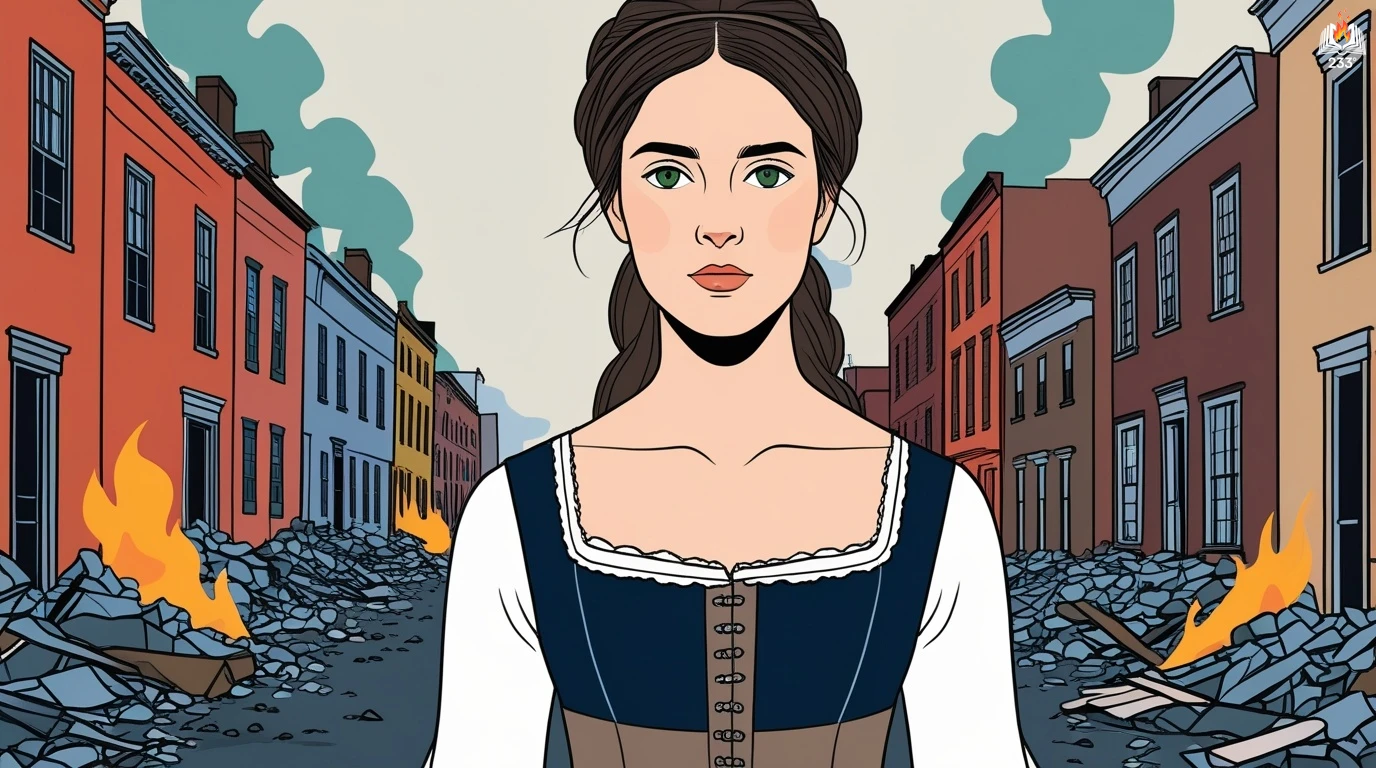
In the ruins of Manhattan, where vines climb shattered skyscrapers and silence hums over cracked streets, Dr. Wilbur Daffodil-11 Swain, a towering old man clad in a purple toga, rules what remains of the Empire State Building. Once the final President of the United States, now just a lonely relic surrounded by memories, Wilbur spends his days with Melody, his sixteen-year-old granddaughter, and Isadore, her lover. They are young and illiterate, their minds uncluttered by history, content in their narrow world while Wilbur drifts through the wreckage of his past, haunted by the laughter and sorrow of a life grotesque and grand.
Wilbur’s life began in strangeness. Born alongside his twin sister Eliza, they emerged into the world as deformed giants, six fingers on each hand, six toes on each foot, extra nipples dotting their massive bodies, their brows sloping like Neanderthals. Their wealthy parents, descendants of America’s moneyed dynasties, were stunned into shame and buried them in an isolated Vermont mansion. There, behind barbed fences and under the care of servants and Dr. Mott, Wilbur and Eliza were presumed to be hopeless idiots. But within the secret passageways of the mansion, the twins’ minds flourished. Wilbur, the reader and scholar; Eliza, the leaper of intuition. Together they formed a single genius, a mind so vast and playful it devoured languages, sciences, and philosophies by candlelight while the household saw only drool and babble.
For fifteen years, they danced in their private world of books and whispers. Their parents, visiting once a year, were greeted with the same pantomime of idiocy. The servants, clinging to their jobs and their illusions, never suspected. But innocence fractured one night when the twins, hidden behind a peephole, overheard their mother’s breaking heart. She wished them dead, whispered into the firelight that she could not love these giants, these drooling totem poles. With solemn resolve, Wilbur and Eliza decided to end the charade. By morning, the mansion awoke to two graceful, articulate young giants. The miracle frightened the household to its bones.
The world, however, was less welcoming. Separated, Wilbur discovered his mind dimmed, half a whole. Eliza, sent away to a home on Mars, fared little better, perishing in an avalanche, while Wilbur drifted alone through adulthood, his brilliance fractured. He became a pediatrician, tending children with the gentleness he had learned from years of being misunderstood. Yet his life spiraled into the absurd. Swept by political tides, Wilbur stumbled into the presidency, a figurehead of a collapsing nation splintered by disease and chaos.
Loneliness gnawed at the nation’s bones as it gnawed at Wilbur’s. In a desperate attempt to heal the collective ache, Wilbur introduced a system of artificial families. Citizens were given new middle names and numbers, forming instant kinships across the country. A man in Montana might become a cousin to a woman in Florida simply by virtue of sharing a numeric surname. It was a whimsical, mad experiment, but for a brief time, it worked. People found solace in strangers, and for once, America laughed together in the face of doom.
But no system could halt the green plague creeping over the world. Cities emptied, bridges fell, tunnels collapsed, and soon Manhattan became a graveyard, its inhabitants withered away or fled. Wilbur remained, a stubborn monument among the ruins, watching the world shrink around him. He clung to Melody and Isadore, who saw no point in the past, no weight in history. To them, Wilbur was just an old man with candlesticks and stories, a relic of a world they barely understood.
Their nearest neighbor, Vera Chipmunk-5 Zappa, thrived where others perished. On the banks of the East River, Vera and her small band of slaves built a kingdom of chickens, goats, and corn, grinding grain with a windmill, smoking meats, distilling brandy. She was a fireplug of a woman, fiercely alive, a reminder to Wilbur that survival was not always about intellect but about stubborn, practical heart.
Wilbur’s days became a ritual of recollection. He scribbled his autobiography on the stationery of a long-defunct driving school, filling pages with memories of Eliza, their secret passages, their games of intellect and mischief. He mourned his sister not with tears, but with sentences, trying to shape the emptiness into meaning. Melody and Isadore, indifferent to his stories, dreamed only of becoming Vera’s slaves someday, where life promised steadiness, not the burdens of remembrance.
Wilbur thought often of gravity, how in his childhood, he and Eliza had speculated that the ancients lifted stone monoliths on days when gravity turned kind, when it loosened its grip and let humanity dream bigger. Now, in his old age, the world’s weight pressed down in new ways, not in the pull of physics, but in the sag of loneliness and loss. Yet even amid the ruins, there were moments of weightlessness – a crowing rooster in the distance, the slap of laughter from Melody and Isadore, the simple pleasure of scratching words onto paper no one would read.
In the Empire State Building, among the candlesticks and crumbling walls, Wilbur lingered like a lighthouse keeper watching over an ocean drained of ships. His body, once monstrous, was now just old. His mind, once half a genius, was now a full man looking backward. And though the world had largely forgotten him, though his own artificial family system had scattered and dissolved, Wilbur’s heart carried a stubborn beat. He could still look out at the ruins of a city, hear a rooster crow, feel the softness of gravity on his bones, and whisper to no one in particular, Hi ho.
Main Characters
Dr. Wilbur Daffodil-11 Swain: The narrator and protagonist, Wilbur is a grotesquely deformed genius who becomes the last President of the United States. His introspective, weary voice carries the novel as he reflects on humanity’s collapse and his own attempts to address loneliness. His arc revolves around his efforts to engineer artificial familial connections in a fragmented society.
Eliza Mellon Swain: Wilbur’s twin sister and intellectual counterpart, Eliza shares an intense, symbiotic bond with her brother. Though also deformed and dismissed as an “idiot,” she embodies emotional intuition and creativity, forming half of the genius mind they share. Her tragic fate on Mars underscores the novel’s themes of isolation and loss.
Vera Chipmunk-5 Zappa: A hearty and resilient woman, Vera becomes a symbol of pragmatic survival in post-apocalyptic Manhattan. She manages to build a thriving farm community and represents the adaptability of human nature, contrasted against Wilbur’s nostalgic melancholy.
Melody Oriole-2 von Peterswald and Isadore Raspberry-19 Cohen: Wilbur’s granddaughter and her lover, these young characters symbolize a new, simpler generation, disconnected from the past but content in their reduced world. They highlight the tension between the wisdom of the old and the indifference of the young.
Theme
Loneliness and Artificial Family: The novel’s subtitle, “Lonesome No More!,” refers to Wilbur’s political campaign to eliminate loneliness by creating artificial family networks. Vonnegut critiques the erosion of authentic human bonds and asks whether invented kinship can fill that void.
Decay of Civilization: Through disease, environmental collapse, and political chaos, the novel envisions a world crumbling into absurdity. Vonnegut uses this collapse not just as apocalyptic spectacle but as a backdrop for examining human resilience and failure.
The Absurdity of Existence: Like much of Vonnegut’s work, Slapstick embraces absurdity as both tragic and comedic. From the twins’ bizarre childhood to Wilbur’s presidency over a dying nation, life is presented as a cosmic joke where dignity comes from playing along in good faith.
The Limits of Intelligence and Progress: Despite their combined genius, Wilbur and Eliza cannot prevent disaster, suggesting that intellectual prowess is powerless against fate and human folly. Vonnegut questions the value of progress when compassion and connection are lacking.
Writing Style and Tone
Vonnegut’s style in Slapstick is conversational, sardonic, and deceptively simple. He employs fragmented storytelling, short chapters, and direct address to the reader, creating an intimate, confessional tone. His language often mixes childlike wonder with bitter irony, as when Wilbur recounts global catastrophes alongside his own trivial musings. This approach allows the novel to oscillate between profound sadness and slapstick humor.
The tone is both melancholic and playful. Vonnegut’s black humor permeates the text, softening its bleak subject matter while amplifying its critique of human nature. He constantly undercuts sentimentality with absurdity, using catchphrases like “Hi ho” as verbal shrugs at life’s tragedies. The resulting mood is one of wistful detachment – a kind of laughing grief at the collapse of the world and the stubborn beauty of human persistence.
Quotes
Slapstick, or Lonesome No More! – Kurt Vonnegut Jr (1976) Quotes
“Love is where you find it. I think it is foolish to go around looking for it, and I think it can be poisonous. I wish that people who are conventionally supposed to love each other would say to each other, when they fight, 'Please
“Since Alice had never received any religious instruction, and since she had led a blameless life, she never thought of her awful luck as being anything but accidents in a very busy place. Good for her.”
“Why don't you take a flying fuck at a rolling doughnut? Why don't you take a flying fuck at the mooooooooooooon?”
“There is no peace, I'm sorry to say. We find it. We lose it. We find it again. We lose it again.”
“History is merely a list of surprises,' I said. 'It can only prepare us to be surprised yet again. Please write that down.”
“Love is where you find it. I think it is foolish to go looking for it, and I think it can often be poisonous.”
“Perhaps I am the turtle, able to live simply anywhere, even underwater for short periods, with my home on my back.”
“Perhaps some people really are born unhappy. I surely hope not. Speaking for my sister and myself: We were born with the capacity and determination to be utterly happy all the time. Perhaps even in this we were freaks. Hi ho.”
“This person has just arrived on this planet, knows nothing about it, has no standards by which to judge it. This person does not care what it becomes. It is eager to become absolutely anything it is supposed to be.”
“Aside from battles, the history of nations seemed to consist of nothing but powerless old poops like myself, heavily medicated and vaguely beloved in the long ago, coming to kiss the boots of young psychopaths.”
“I can think of another quickie education for a child, which, in its way, is almost as salutary: Meeting a human being who is tremendously respected by the adult world, and realizing that that person is actually a malicious lunatic.”
“Also: I cannot distinguish between the love I have for people and the love I have for dogs.”
“Fascists are inferior people who believe it when somebody tells them they’re superior,”
“Standing among all those tiny, wavering lights, I felt as though I were God, up to my knees in the Milky Way.”
“And how did we then face the odds, of man's rude slapstick, yes, and God's? Quite at home and unafraid, Thank-you, in a game our dreams remade.”
“What does seem important? Bargaining in good faith with destiny.”
“We have hugged each other maybe three or four times - on birthdays,very likely, and clumsily. We have never hugged in moments of grief.”
“I am a brother to writers everywhere.”
“In case nobody has told you," she said, "this is the United States of America, where nobody has a right to rely on anybody else--where everybody learns to make his or her own way.”
“It’s as though you were pointing a gun at my head. It’s just a way of getting somebody to say something they probably don’t mean. What else can I say, or anybody say, but, ‘I love you too’?”
“My brother said this to him, tapping his own forehead with his fingertips: “If you think this laboratory is bad, you should see what it’s like in here.” And so on. ***”
We hope this summary has sparked your interest and would appreciate you following Celsius 233 on social media:
There’s a treasure trove of other fascinating book summaries waiting for you. Check out our collection of stories that inspire, thrill, and provoke thought, just like this one by checking out the Book Shelf or the Library
Remember, while our summaries capture the essence, they can never replace the full experience of reading the book. If this summary intrigued you, consider diving into the complete story – buy the book and immerse yourself in the author’s original work.
If you want to request a book summary, click here.
When Saurabh is not working/watching football/reading books/traveling, you can reach him via Twitter/X, LinkedIn, or Threads
Restart reading!