
The Arabian Nights (also known as One Thousand and One Nights) is a collection of Middle Eastern folk tales compiled and translated by Andrew Lang in 1898. This timeless anthology is known for its intricate storytelling, weaving multiple narratives within the framing device of Queen Scheherazade’s plight to save her life by captivating her husband, Sultan Schahriar, with a series of fascinating tales. These stories—ranging from magical adventures to moral fables—are set in a richly imagined ancient world of sultans, viziers, genies, and mythical creatures.
Plot Summary
In the kingdom of Persia, long ago, there reigned a mighty king named Schahriar. For many years, he ruled with justice and wisdom, loved by his people and admired by his neighbors. But when he discovered his queen’s betrayal, a deep wound darkened his heart. Distrustful of women and convinced of their treachery, he devised a cruel vengeance. Each night, he would take a new bride, only to have her executed the next morning before she could betray him, just as his wife had. The kingdom fell into despair, as the cries of fathers losing their daughters echoed through the land.
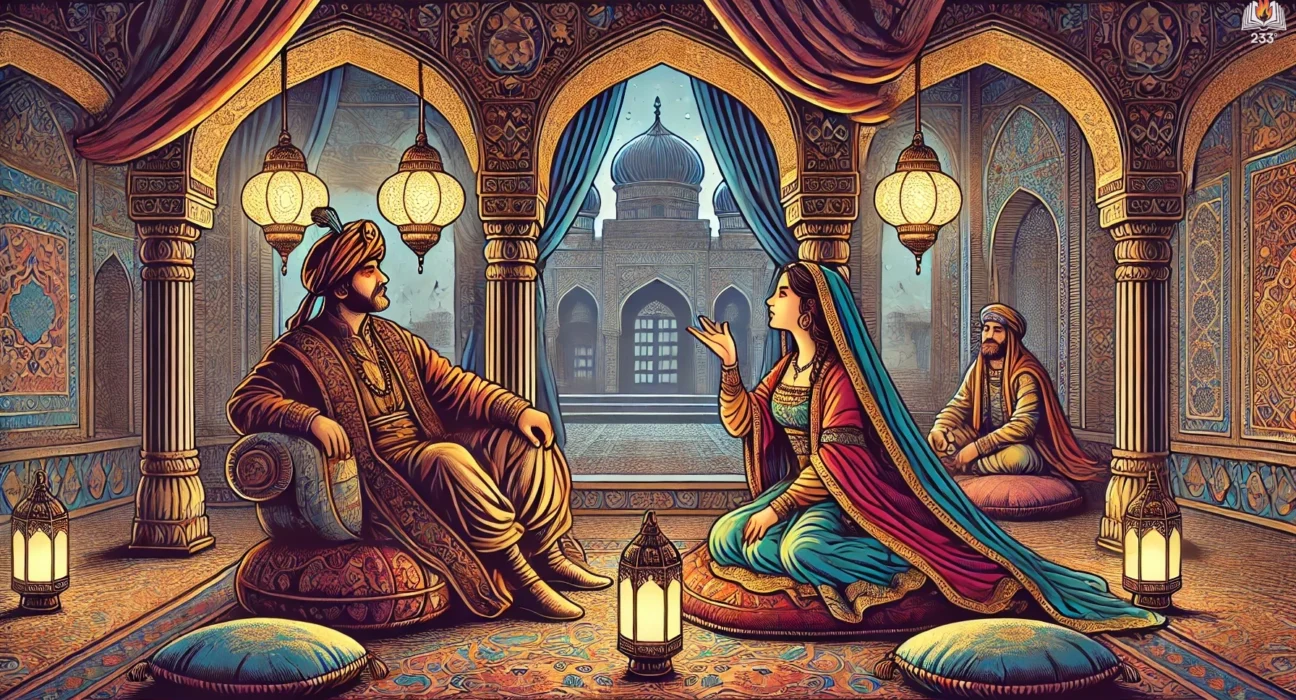
Amid this sorrow lived Scheherazade, the eldest daughter of the grand vizier. She was known for her beauty, but it was her intelligence and bravery that set her apart. Determined to end the king’s reign of terror, she approached her father with an audacious plan: she would marry the Sultan and try to save the kingdom by capturing his interest with her stories. Horrified, her father begged her to reconsider, but Scheherazade remained resolute. She believed that if she could tell the Sultan tales of wonder and adventure, she could change his heart and save the women of Persia.
That evening, Scheherazade became the Sultan’s bride. Before they retired for the night, she made one request—that her sister, Dinarzade, be allowed to sleep in the royal chamber so they could say their final goodbyes. The Sultan, intrigued by this unusual request, agreed. As the night deepened, Dinarzade, following Scheherazade’s plan, woke her an hour before dawn and asked, “Sister, if you are not asleep, please tell me one last story.” With the Sultan’s permission, Scheherazade began a tale of mystery and magic.
She spun the story of a merchant who, through an accidental act, found himself at the mercy of an enraged genie. Just as the Sultan was hanging on to every word, dawn broke. Scheherazade fell silent, promising to finish the tale the next night if the Sultan allowed her to live. Curiosity piqued, the Sultan spared her for another day.
Thus began the nights of storytelling. Every evening, Scheherazade wove new tales—of powerful genies, enchanted princes, heroic voyages, and magical creatures. With each tale, she left the Sultan on the edge of suspense, compelling him to spare her life again and again. Through her stories, Scheherazade subtly exposed the Sultan to the values of wisdom, justice, and mercy. She introduced him to characters who embodied these virtues, slowly dissolving the bitterness in his heart.
One night, she recounted the tale of Sinbad the Sailor, a brave adventurer who traveled to distant lands filled with unimaginable wonders. From battling giant rocs to escaping enchanted islands, Sinbad’s resilience and cunning won the Sultan’s admiration. Through these tales, Scheherazade painted a world where bravery and intellect triumphed over cruelty, and where love and compassion led to redemption.
In another story, she told of Aladdin, a poor but clever boy who came into possession of a magical lamp containing a powerful genie. With the genie’s help, Aladdin rose from poverty to wealth, winning the heart of a beautiful princess. But it was not just wealth that defined Aladdin—it was his quick thinking, his integrity, and his ability to navigate challenges that earned him his fortune. The Sultan, drawn to the idea of transformation through perseverance and wisdom, listened intently.
Night after night, the tales continued. There was the cunning Ali Baba, who outwitted forty thieves to protect his family’s fortune, and the tragic King of the Black Isles, who suffered under a sorceress’s curse but was eventually freed through courage and cleverness. Each tale offered the Sultan something different—an escape into a world of magic and adventure, but also a reflection of his own soul.
As time passed, the Sultan’s heart began to change. He no longer looked at Scheherazade as a potential betrayer, but as a source of wisdom and light. Her courage, in facing death night after night, had earned his respect. Her stories, rich with lessons on love, justice, and the importance of trust, began to reshape his worldview. He realized that not all women were deceitful, and that there was goodness in the world worth cherishing.
For one thousand and one nights, Scheherazade told her tales. During this time, the kingdom flourished under her influence. The cries of despair that once echoed through the streets had been replaced by hope and joy. Fathers no longer feared for their daughters, and families began to rebuild their lives.
At the end of the thousand and first night, Scheherazade, having completed her final tale, quietly awaited her fate. But by then, the Sultan had changed. No longer the bitter and vengeful man he once was, he had fallen deeply in love with Scheherazade, not just for her beauty, but for her intelligence, her bravery, and her kindness. He realized that she had saved not only the kingdom but his own soul as well.
Moved by her wisdom and patience, the Sultan declared Scheherazade his queen, vowing to rule with the fairness and justice she had shown him through her stories. Peace returned to the land, and the kingdom of Persia prospered once more under their rule.
The power of Scheherazade’s stories had transformed a tyrant into a just ruler and restored hope to a broken kingdom. Her legacy lived on, not just in the tales she told but in the hearts of the people who witnessed the power of compassion, wisdom, and love.
Main Characters
Scheherazade: The intelligent and courageous daughter of the grand vizier. She volunteers to marry the tyrannical Sultan Schahriar, despite his habit of killing his wives after one night. Through her storytelling, she manages to delay her execution by keeping the Sultan intrigued with unfinished tales.
Sultan Schahriar: A once-just ruler who becomes a merciless tyrant after being betrayed by his wife. His bitterness leads him to marry and kill a new bride every day until Scheherazade’s stories begin to change his heart.
Dinarzade: Scheherazade’s sister, who plays a crucial role in her sister’s plan by waking her each night to request a story, ensuring Scheherazade can continue her narrative thread to captivate the Sultan.
Grand Vizier: Scheherazade’s father, who reluctantly aids in finding the Sultan’s brides, including his own daughter, fearing her inevitable execution.
Theme
Power of Storytelling: Central to the work is the idea that stories have the power to transform, heal, and provide wisdom. Scheherazade uses storytelling to not only save her life but to gradually transform the Sultan’s heart and view of women.
Fate and Destiny: Many tales in The Arabian Nights explore characters’ attempts to evade fate, often to no avail. The notion that destiny is unavoidable, despite one’s best efforts, resonates throughout the stories.
Justice and Mercy: Scheherazade’s tales often highlight the importance of justice and the consequences of cruelty or unjust leadership. Her stories subtly critique Schahriar’s tyrannical behavior while promoting mercy and fairness.
Magic and the Supernatural: Magic is woven through the stories in the form of genies, enchanted objects, and supernatural events, reflecting the ancient belief in a world influenced by unseen forces.
Writing Style and Tone
Andrew Lang’s retelling of The Arabian Nights maintains the charm and exoticism of the original tales while adapting them for a Western audience. His style is simple and elegant, designed to evoke the sense of wonder and mystery intrinsic to the ancient stories. Lang strips away some of the more adult content, aiming the tales toward a broader, often younger, audience. This makes his version more accessible, while still preserving the magical allure that captivates readers.
The tone throughout the collection is both fantastical and moralistic, with lessons embedded in the narratives. Lang’s prose allows for the drama of each tale to unfold naturally, focusing on vivid descriptions and dialogue that immerses readers in a world of luxury, peril, and intrigue. There is a careful balance between entertainment and ethical instruction, with each story carrying subtle moral undertones that reflect the cultural values of the time.
Quotes
The Arabian Nights – Andrew Lang Quotes
“A loss that can be repaired by money is not of such very great importance.”
“Glory be to Him who changes others and remains Himself unchanged!”
“WHOEVER TALKS ABOUT WHAT DOES NOT CONCERN HIM, OFTEN HEARS WHAT DOES NOT PLEASE HIM!”
“A library of books is the fairest garden in the world, and to walk there is an ecstasy.”
“My story is of such marvel that if it were written with a needle on the corner of an eye, it would yet serve as a lesson to those who seek wisdom.”
“We live in biological time, and we have beginnings, middles, and ends.”
“Psychology claims that when you can't sleep at night, you are actually awake in someone's dream.”
“It is amazing what women in love will do”
“A truth once seen by a single mind ends up by imposing itself on the totality of human consciousness.”
“If you need a hug, give it to someone else.”
“A funny thing happened on the way to my potential”
“merchant”
“One night when we were sleeping they threw my wife and myself into the sea. My wife, however, was a fairy, and so she did not let me drown, but transported me to an island.”
“I took in anything that was new and strange,”
“Only in utter solitude can man be safe from the doings of this vile world! By Allah, life is naught but one great wrong.”
“Close thine eyes, and while thou sleepest Heaven will change thy fortune from evil to good.”
“the more one has, the more one wants.”
“doubtless imagine that I have acquired all the wealth and luxury that you see me enjoy without difficulty or danger, but this is far indeed from being the case. I have only reached this happy state after having for years suffered every possible kind of toil and danger.”
“eager to see such a wonderful thing,”
“much is gained by patience,”
“Whoso meddles in affairs that are no business of his, will hear truths that will not please him.”
“Moreover, as I was still in the prime of life, it pleased me better to be up and doing.”
“accompanies the Caliph was also a real person of the great family of the Barmecides. He was put to”
“there are many out-of-the-way things it is as well to know, but one should never boast of them.”
We hope this summary has sparked your interest and would appreciate you following Celsius 233 on social media:
There’s a treasure trove of other fascinating book summaries waiting for you. Check out our collection of stories that inspire, thrill, and provoke thought, just like this one by checking out the Book Shelf or the Library
Remember, while our summaries capture the essence, they can never replace the full experience of reading the book. If this summary intrigued you, consider diving into the complete story – buy the book and immerse yourself in the author’s original work.
If you want to request a book summary, click here.
When Saurabh is not working/watching football/reading books/traveling, you can reach him via Twitter/X, LinkedIn, or Threads
Restart reading!