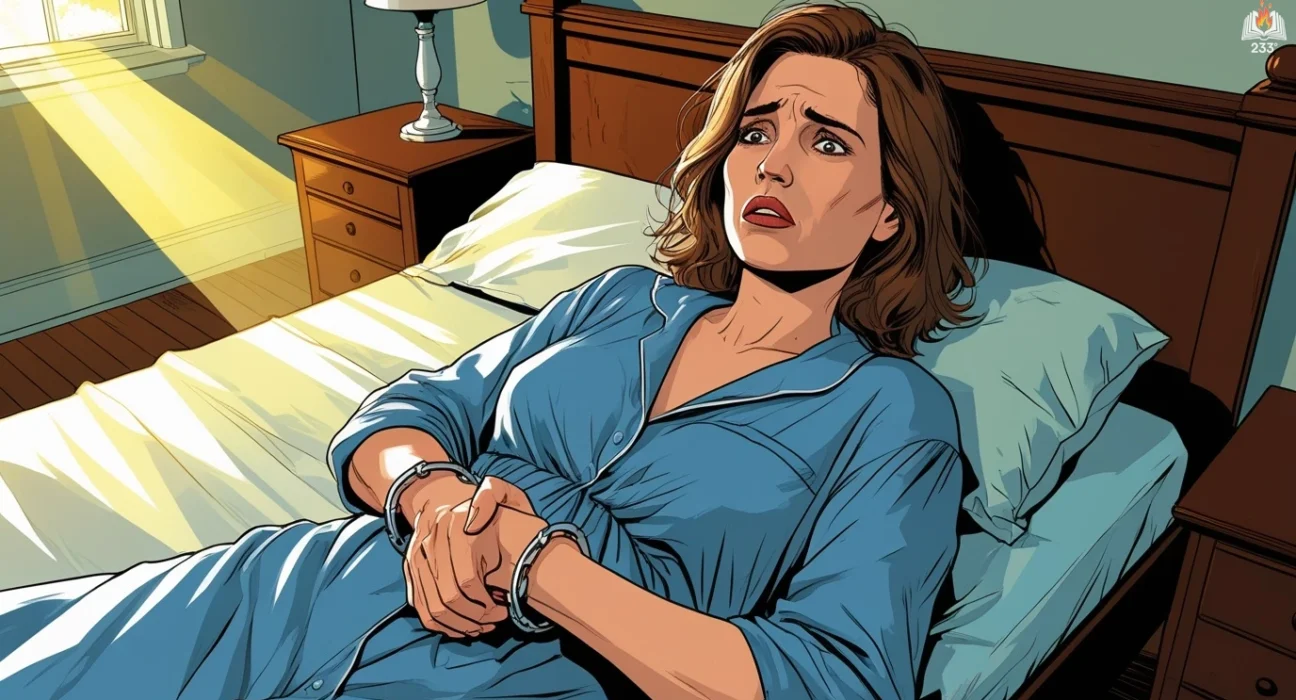
Gerald’s Game by Stephen King, published in 1992, is a psychological horror novel that explores survival, trauma, and the dark corners of the human mind. When a bondage game between a married couple goes terribly wrong, Jessie Burlingame finds herself alone, handcuffed to a bed in an isolated lake house with no way to escape. As time passes, she battles dehydration, hallucinations, and resurfacing childhood trauma while confronting a terrifying presence lurking in the shadows.
Plot Summary
The afternoon sun shimmered on Kashwakamak Lake as Jessie Burlingame lay on the bed, wrists secured to the mahogany headboard with handcuffs. It had started as a game, something her husband, Gerald, had enjoyed far more than she ever had. This time, though, she had finally said no. But Gerald, sweating and grinning, had chosen not to hear her. His hand had reached for her thigh, his touch no longer playful but insistent. Something inside her had snapped, a deep, hidden fury rising like bile. With a swift, desperate kick, her foot drove into his stomach, another striking his groin. He gasped, staggered back, and suddenly clutched at his chest, a strangled word escaping his lips before his eyes bulged in horror. He teetered at the edge of the bed, and then he was gone. The thud of his body hitting the hardwood floor echoed through the empty house.
Silence followed, thick and oppressive. Jessie lay frozen, staring at the ceiling, heart pounding in her throat. The sharp metallic bite of the cuffs pressed into her wrists. She called his name, once, then again, louder. No answer. A sense of unreality swept over her, a terrible weight sinking into her chest. She twisted, craned her neck, and saw one pale arm sprawled out from behind the bed, motionless.
For a while, she could do nothing but listen – to the wind outside, to the distant call of a loon, to the rhythmic slap of the back door left unlatched. She willed herself to believe this was just another of Gerald’s sulks, a punishment for not playing along. But the stillness of his hand, the awkward angle of his legs, told her otherwise.
Hours passed. The light shifted, shadows lengthening across the floor. Her arms ached, the position unnatural, her shoulders burning from the strain. The metal cuffs had been meant for a game, not for hours of confinement. Panic flickered at the edges of her mind, a distant alarm growing steadily louder.
Then the dog came. A rangy, half-starved stray, it padded cautiously into the bedroom, nose twitching at the scent of death. Jessie watched in horror as it sniffed at Gerald’s outstretched hand, hesitated, then lowered its head and sank its teeth into the flesh. The sound – the wet, slow tearing of muscle – sent a shudder through her. She screamed, a raw, furious sound that echoed off the walls, but the dog barely flinched. It had found food, and it was not about to leave.
Time lost its meaning. The pain in her wrists became a dull, constant throb. Her throat ached from thirst, lips cracked and dry. The hunger came in waves, sharp and insistent, before fading into an empty, gnawing ache. She drifted in and out of consciousness, slipping into a strange half-dreaming state where voices whispered in her head.
They were familiar voices. Ruth, her old college friend, sharp-tongued and pragmatic. Goodwife Burlingame, the scolding presence of duty and guilt. And the younger voice, the one she had tried so hard to forget, speaking of things buried long ago.
Memories surfaced, unbidden. A hot summer day, her father’s reassuring hand on her shoulder as they sat together watching an eclipse. The way his fingers had lingered too long. The way his voice had been too soft when he told her to keep their special moment a secret. The fear, the confusion, the realization that something had been stolen from her before she even understood what it was.
The shadows in the room grew deeper. Night pressed against the windows, and with it came something else. A figure in the corner, half-hidden in darkness. Too tall, too thin, its face a pale, skeletal mask. A silent watcher, waiting. Jessie’s breath caught in her throat. Was this real, or another trick of exhaustion and fear?
The voices argued. Ruth said it was a hallucination, a mind pushed too far. Goodwife Burlingame whispered that it was death itself, come to claim her. The younger voice said nothing. It didn’t have to.
She forced herself to think. There had to be a way out. The bed was old, the wooden slats loose. If she could break one, she might have enough room to slip a hand free. She twisted, strained, pain lancing through her wrists as the skin tore against the cuffs. Her vision blurred with tears. The dog returned, dragging something across the floor – a piece of Gerald, something she refused to look at. She clenched her teeth, fought against the rising tide of revulsion.
The man in the corner had not moved. But he was still there. Watching. Waiting.
She worked at the bedpost with everything she had left, the wood groaning beneath her efforts. The voices in her head screamed warnings, encouragement, doubts, prayers. Then, at last – a crack, a splintering sound. A surge of adrenaline burned through her veins. She twisted harder, felt the give of the slat beneath her wrist. One hand came free in a rush of pain.
Trembling, she fumbled for the key on the nightstand, stretching her numbed fingers to grasp it. The moment she felt the cold metal, a sob broke from her throat. She undid the second cuff, muscles protesting as she pulled her arms down. The room swam, the floor tilting beneath her as she staggered to her feet.
She turned toward the corner.
The figure was still there.
Jessie did not run. She walked, step by step, toward the pale-faced thing that had haunted her throughout the night. As she reached the edge of the shadows, the illusion broke. The man was real. A grave robber, a lurking scavenger, his pockets filled with stolen jewelry and bones.
For the second time in her life, something inside Jessie snapped.
She did not scream. She did not flee. She walked past him, out of the house, into the cold October air, where the wind carried the last of her fear away.
Days later, when they found the man – when they confirmed he was real, that he had been in the house that night – she did not feel fear. She had already faced him. Faced all of them.
There were no more cuffs around her wrists. No more chains.
Jessie Burlingame was finally free.
Main Characters
Jessie Burlingame – The protagonist, a woman trapped in a life-threatening situation, forced to confront her past traumas and find the strength to survive. She undergoes a psychological transformation, moving from helplessness to empowerment.
Gerald Burlingame – Jessie’s husband, a successful yet controlling lawyer whose attempt at a kinky role-play session leads to his sudden death, leaving Jessie stranded. His presence lingers in her mind as a tormenting hallucination.
The Voices (Ruth, Goodwife, etc.) – Different aspects of Jessie’s psyche that manifest as voices inside her head, guiding, criticizing, and encouraging her through her ordeal.
The Space Cowboy – A mysterious and terrifying figure that may be real or a hallucination, symbolizing death, fear, and Jessie’s suppressed trauma.
Prince (The Dog) – A stray dog that stumbles into the house, representing both a real physical threat and the harsh reality of Jessie’s vulnerability.
Theme
Survival and Resilience – Jessie’s battle against physical and psychological torment highlights human endurance in the face of hopelessness.
Trauma and Repression – The novel explores the long-lasting effects of childhood abuse, showing how buried memories resurface in moments of crisis.
Isolation and the Mind’s Power – Alone and restrained, Jessie’s mind becomes both her greatest enemy and her key to survival, blurring the line between reality and delusion.
Feminine Empowerment – As she fights for her life, Jessie reclaims her agency, breaking free not only from her literal restraints but also from the emotional chains of her past.
Fear of the Unknown – The lurking presence of the Space Cowboy and the vast emptiness of the lake house play on deep-seated human fears of being watched and powerless.
Writing Style and Tone
Stephen King employs an intensely psychological and claustrophobic writing style, delving deep into Jessie’s thoughts and memories through a stream-of-consciousness narrative. The novel is largely introspective, relying on internal monologue, hallucinations, and fractured memories to create tension. King’s prose is vivid and unsettling, using sharp imagery and unrelenting suspense to immerse the reader in Jessie’s ordeal.
The tone is dark, oppressive, and deeply psychological, shifting between raw terror, emotional introspection, and moments of bitter humor. King masterfully builds suspense through Jessie’s gradual mental unraveling while keeping the horror grounded in realism, making the dread all the more palpable.
Quotes
Gerald’s Game – Stephen King (1992) Quotes
“If anyone ever asks you what panic is, now you can tell them: an emotional blank spot that leaves you feeling as if you've been sucking on a mouthful of pennies.”
“Sometimes it takes heart to write about a thing, doesn't it? To let that thing out of the room way in the back of your mind and put it up there on the screen.”
“When all the normal patterns and routines of a person’s life fell apart—and with such shocking suddenness—you had to find something you could hold onto, something that was both sane and predictable.”
“Words had a way of creating their own imperatives.”
“men were not so much gifted with penises as cursed with them.”
“It was as if the body disdained memory... or refused the responsibility of it.”
“Listening to it was like having a mud-slimed piece of silk drawn lightly back and forth across her face.”
“Some nightmares never completely ended.”
“Some memories battened onto a person's mind like evil leeches, and certain words could bring them instantly back to squirming, feverish life.”
“They ought to make it a law that you have to get a license, or at least a learner’s permit, before you’re allowed to talk. Until you pass your Talker’s Test, you should have to be a mute.”
“Oh, what the fuck,' she told the empty house. 'Bring on the night.”
“Men still think the same things about us they have always thought, Ruth - I'm sure of it. A lot of them have learned to say the right things at the right times, but as my mother used to say, 'Even a cannibal can learn to recite the Apostles' Creed'.”
“Even if things go all wrong they'll work out just fine.”
“Jesus, sometimes I can’t believe how dumb people can be. They ought to make it a law that you have to get a license, or at least a learner’s permit, before you’re allowed to talk. Until you pass your Talker’s Test, you should have to be a mute. It would solve a lot of problems.”
“How can things have possibly gotten from there to here? Sorry, folks, but this just has to be a dream. It’s much too absurd for reality.”
“What I think is this: Gerald died before he ever had a chance to climb into the saddle, but he fucked me good and proper just the same.”
“The truth, first encountered on that day, was this: there was a well inside her, the water in that well was poisoned, and when he goosed her, William had sent a bucket down there, one which had come up filled with scum and squirming gluck.”
“Her mind’s constant insistence that it was a mistake was understandable but irrelevant.”
“She felt a swollen green sac of poison pulsing somewhere inside her -- bitter stuff, hateful as hemlock. She was afraid that if that sac burst, she would choke on her own frustrated rage.”
“She waited to feel a pang of shame at hitting below the belt like this and was pleased - or maybe it was relief she felt - when no pang came. I guess maybe I'm just tired of pretending she thought.”
“I’m peeling my hand, she thought. Oh dear Jesus, I’m peeling it like an orange.”
“nothing cheered up a handcuffed woman more reliably than a little Country Morning Rose Blusher. All the women’s magazines said so.”
We hope this summary has sparked your interest and would appreciate you following Celsius 233 on social media:
There’s a treasure trove of other fascinating book summaries waiting for you. Check out our collection of stories that inspire, thrill, and provoke thought, just like this one by checking out the Book Shelf or the Library
Remember, while our summaries capture the essence, they can never replace the full experience of reading the book. If this summary intrigued you, consider diving into the complete story – buy the book and immerse yourself in the author’s original work.
If you want to request a book summary, click here.
When Saurabh is not working/watching football/reading books/traveling, you can reach him via Twitter/X, LinkedIn, or Threads
Restart reading!