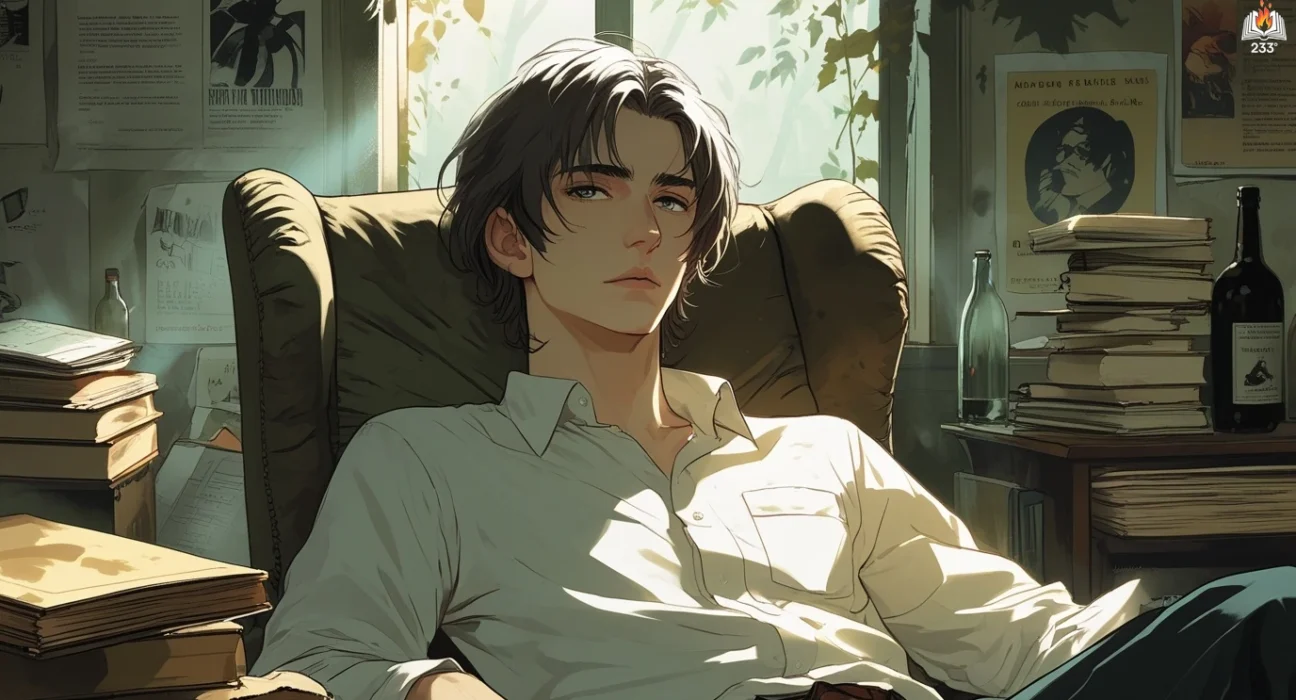
Hear the Wind Sing, Haruki Murakami’s debut novel released in 1979, marks the beginning of the “Trilogy of the Rat,” which continues with Pinball, 1973 and A Wild Sheep Chase. Set in a sleepy seaside town during the summer of 1970, the novel introduces readers to Murakami’s signature themes and existential tone. Through the introspective voice of an unnamed narrator, the story drifts through conversations, memories, and ephemeral connections. More than plot, the book focuses on atmosphere, alienation, and the melancholic reflections of youth.
Plot Summary
On the sun-scorched coast of a nameless Japanese town in the summer of 1970, a 21-year-old student returns home from Tokyo during university break. He spends his days adrift between books, beer, and jazz records, caught in a still life of humid afternoons and smoke-hazed evenings. His closest companion is the Rat – a rich, disillusioned young man whose restlessness boils beneath a thin, calm surface. Together they haunt the dim recesses of J’s Bar, exchanging weary words about life, women, and the failure of rich men to possess imagination.
Everything moves slowly. The wind carries old thoughts instead of change. The days bleed into one another until a girl collapses in the bar bathroom. She has four fingers on her left hand and no memory of what happened. He finds her, lifts her carefully, asks the room if anyone knows her – no one does. With only a key and a postcard in her bag, he takes her home and stays through the night. She wakes confused and wary. There are no romantic flourishes, no declarations, only sunlight catching the edge of her tanned skin and the quiet space between two people who don’t yet know whether they matter to each other.
They speak in fragments. Her tone is brittle. She asks if he touched her. He says no. She doesn’t believe him but lets the moment pass. Her anger has the tired weight of someone who has lived through too many disappointments. She leaves for work without saying goodbye, and he drives her silently to the harbor, her cigarette smoke curling between them, mingling with the heat.
Back at J’s Bar, he drinks alone. The Rat doesn’t show. A divorced woman with grapefruit-sized breasts sits beside him and borrows coins for the payphone. She laughs too easily and watches him with tired curiosity. He answers her with dry wit but little interest. She makes phone calls, sips gimlets, disappears and reappears like someone auditioning for a life that no longer fits. When she vanishes again, he whistles a song on the drive home, trying to remember the name. It turns out to be the Mickey Mouse Club theme.
A few days later, the radio rings. An announcer hiccups through the call, announcing that someone has requested a song for him – California Girls by The Beach Boys. The voice on the radio pulls him back to a field trip five years ago and a girl who lost a contact lens. He helped her look for it, and in return, she lent him a record. He never returned it. That girl might be listening now. Maybe.
Spurred by memory, he buys the record and tries to return it. He searches school rosters, calls former classmates, follows threads that unravel into dead ends. He lies to a university office, posing as a salad dressing salesman to get an old address. Nothing leads anywhere. The girl from the field trip has vanished, and with her, that small piece of forgotten kindness.
Meanwhile, the girl with four fingers returns. He finds her working at a dusty little record shop. She sees him and raises a wall of suspicion. He buys three records – one for her, one for the Rat, one just because. She thanks him with sarcasm. He asks her to lunch. She refuses. He tells her she should forget about him. She agrees.
Later, he gives one of the records – Beethoven’s Piano Concerto No. 3 – to the Rat, wrapped in brown paper. The Rat is touched. He is also halfway through a Henry James novel and frustrated by it, but reading carefully. He quotes Vadim, muses about intelligence, and laughs when reminded that hunger and a full fridge are mutually exclusive in the early morning hours.
Time moves forward in low gear. On a sleepy, cicada-filled day, the girl calls. She tracked him down through J’s Bar, through the Rat. She wants to apologize. Her voice is soft, tinged with regret. He listens. They agree to meet at 8.
At the bar, she waits with a ginger ale. She didn’t think he’d show. He tells her about polishing his father’s shoes – a family tradition. She talks about her own family – a father lost to brain cancer, a family crumbled under the weight of his suffering. Her mother sends New Year’s cards from a distance. She has a twin sister, thirty thousand light years away. When she laughs, it’s like something sharp finally uncoils.
He asks about her missing finger. She lost it in a vacuum cleaner accident when she was eight. She places her hand on the counter – four fingers, neatly aligned, looking strangely natural. She says it only bothers her when she wears gloves.
He offers no comfort, just a steady presence. They talk about small things, drink white wine, share silence. Something unspoken lingers between them – not love, but the chance of understanding.
He thinks often of the three women he has slept with. The first was a high school love who vanished after graduation. The second was a sixteen-year-old runaway he took in during a night of riots – she stayed a week, then disappeared with a few items and left a note calling him a rat bastard. The third hanged herself in a forest behind their college’s tennis courts. Her body hung unnoticed for two weeks. Now no one enters those woods after dark.
One night, back at the bar, she stirs the last of her drink and confesses that she wants to be a great person someday. Doesn’t everyone? They sit close without touching. Their words fall away. The jukebox hums quietly. J pours another drink. Outside, the wind starts to pick up, bringing a shift in the air.
That summer ends without ceremony. Nothing explodes. No one changes the world. But something unspoken is shared between two people on the edge of adulthood – fragile, tentative, and fleeting as the wind that dances along the sea.
Main Characters
The Narrator: An unnamed 21-year-old college student and part-time writer, the narrator embodies detachment and quiet introspection. Haunted by nostalgia and the shadows of past relationships, he grapples with identity, loneliness, and the act of writing itself. He’s an observer more than a participant, drawn to quiet bars, drifting thoughts, and uncertain romances.
The Rat: A moody, philosophical, and cynical young man from a wealthy family, the Rat is the narrator’s closest companion. He disdains materialism and societal expectations, spending his time reading, drinking, and exploring abstract ideas. His contradictions – both privileged and bitter, intelligent yet evasive – reflect a deeper existential malaise.
The Girl with Four Fingers: A mysterious, nameless young woman the narrator meets in a bar after finding her passed out in the bathroom. Her missing pinky, guarded demeanor, and melancholic presence give her a surreal, tragic air. She embodies Murakami’s archetype of the elusive woman who brings depth and mystery into the male protagonist’s life.
J: The stoic Chinese bartender at J’s Bar, a local dive where much of the novel unfolds. J is a quiet, grounding presence, dispensing drinks and occasional wisdom without intruding. He represents a fixed point of normalcy amidst the emotional drift of the other characters.
Theme
Alienation and Isolation: The narrator and the Rat both dwell in a state of emotional and social detachment. The novel captures the inertia of a generation disillusioned with conventional paths, seeking meaning in aimless conversations and late-night beers. Characters float in and out of each other’s lives like dreams, unable to connect fully.
Transience and Memory: Summer, youth, and human connections are portrayed as fleeting. Memories dissolve as quickly as they form, and even names are forgotten. The novel dwells on the impermanence of people and emotions, emphasizing the difficulty of holding onto anything concrete.
The Struggle of Expression: The narrator frequently discusses the difficulty of writing, and by extension, the difficulty of expressing truth. Language is shown as limited and unreliable, and writing becomes a metaphor for existential grappling – a futile but necessary act.
Disconnection from Society: Characters in the novel exist on the margins. They reject ambition, distrust institutions, and live in temporal, almost invisible spheres. There’s a quiet protest in their detachment, a rejection of conformity in favor of introspection and emotional honesty.
Writing Style and Tone
Murakami’s style in Hear the Wind Sing is sparse, unadorned, and deeply reflective. The prose mimics the rhythm of jazz – one of the narrator’s passions – with pauses, digressions, and free-form flow. Murakami employs short chapters and stream-of-consciousness passages that blur memory, dream, and present action, creating a meditative and emotionally distant effect.
Dialogues are crisp, often laconic, and leave much unsaid. Characters speak in indirect ways, revealing more through silence and gesture than direct expression. The narrative voice is casual yet philosophical, weaving literary references (notably to Derek Hartfield, a fictional pulp writer), mundane details, and emotional undercurrents with subtlety. Despite its simplicity, the writing evokes a dreamlike atmosphere that lingers.
In tone, the novel is melancholic but not despairing. It is tinged with nostalgia, loneliness, and a quiet yearning. Rather than offering resolution or catharsis, Murakami lets questions hang in the air, inviting readers to find resonance in the ambiguity. The result is a delicate, lyrical exploration of youth on the cusp of fading.
Quotes
Hear the Wind Sing – Haruki Murakami (1979) Quotes
“There's no such thing as perfect writing, just like there's no such thing as perfect despair.”
“Whenever I look at the ocean, I always want to talk to people, but when I'm talking to people, I always want to look at the ocean.”
“Everyone who has something is afraid of losing it, and people with nothing are worried they'll forever have nothing. Everyone is the same.”
“People with dark souls have nothing but dark dreams. People with really dark souls do nothing but dream.”
“Things pass us by. Nobody can catch them. That's the way we live our lives.”
“If writers only wrote about things everybody knew, what the hell would be the point of writing?”
“Still, in the end, we all die just the same.”
“I like the sky. You can look at it forever and never get tired of it, and when you don’t want to look at it anymore, you stop.”
“The more honest I try to be, the more the right words recede into the distance.”
“Whatever can't be expressed might as well not exist.”
“Expression and communication are essential; without these, civilization ends.”
“That's how it is with art. Mere humans who root through their refrigerators at three o'clock in the morning are incapable of such writing.”
“When the time comes, everybody’s got to end up where they belong. Only me, I didn’t have a place to call my own. It’s like musical chairs.”
“Even if you don't acknowledge it, people die, and guys sleep with girls. That's just how it is.”
“Of course you keep telling yourself there's something to be learned from everything, and growing old shouldn't be that hard. That's the general drift.”
“I tell lies sometimes. The last time I lied was a year ago. I absolutely detest lying. You could say that lying and silence are the two greatest sins of present day society. Actually, I lie a lot, and I'm always clamming up.”
“The worst thoughts usually strike in the dead of the night.”
“You keep looking at the sea and you start to miss being with people; you stay around people all the time and you just want to go look at the sea.”
“The things we try our hardest not to lose, we really just put deep abysses in the spaces between them.”
“Even so, everything was ever so slightly off, as if little by little the tracing paper had slipped irretrievably from the lines of summers past.”
“Compared to the complexity of the universe, this world of ours is like the brain of a worm.”
“Whenever I wake up in a strange house I always feel as if the wrong soul got stuffed into the wrong body.”
“When people are dead, you can forgive them 'most anything.”
We hope this summary has sparked your interest and would appreciate you following Celsius 233 on social media:
There’s a treasure trove of other fascinating book summaries waiting for you. Check out our collection of stories that inspire, thrill, and provoke thought, just like this one by checking out the Book Shelf or the Library
Remember, while our summaries capture the essence, they can never replace the full experience of reading the book. If this summary intrigued you, consider diving into the complete story – buy the book and immerse yourself in the author’s original work.
If you want to request a book summary, click here.
When Saurabh is not working/watching football/reading books/traveling, you can reach him via Twitter/X, LinkedIn, or Threads
Restart reading!