
Hard-Boiled Wonderland and the End of the World by Haruki Murakami, first published in 1985, is a remarkable fusion of speculative fiction, hard-boiled detective narrative, and philosophical allegory. Split between two parallel narratives – one a cyberpunk noir in Tokyo, the other a surreal, dreamy town encased by walls – the novel weaves together a tale of consciousness, memory, and identity. Through these dual narratives, Murakami explores the outer edges of science and inner dimensions of the mind, creating one of his most enigmatic and thematically rich works.
Plot Summary
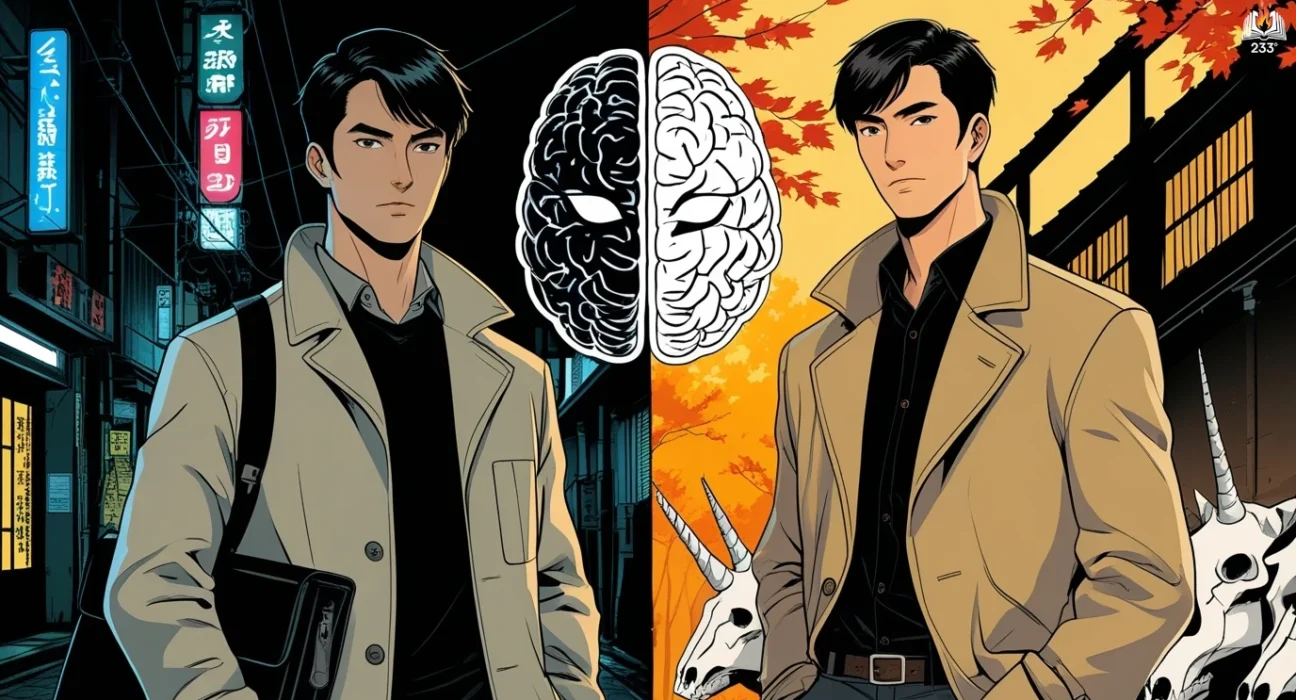
Beneath a city veined with secret passageways and the hum of invisible networks, a man arrives in a building with no windows and an elevator that defies logic. He is a Calcutec, an encryption agent trained to process data through the delicate choreography of his bifurcated brain – the left and right, performing separately, yet united. Tasked with an assignment by a peculiar scientist, he is drawn into a labyrinth of neural experiments, labyrinths of memory, and whispers of an unauthorized technique known as “shuffling.”
The scientist, an eccentric figure obsessed with acoustics and skulls, offers no clarity but promises danger. His research, stored not only in paper and files but in encoded brainwaves, must be safeguarded from the rival faction, the Factory, and its rogue agents – the Semiotecs. But there is a darker, stranger force prowling the underground: the INKlings, creatures of shadow and fluid, who dwell in silence and chase minds. The Calcutec accepts the job, unaware that his agreement initiates a collapse of boundaries – between systems, between memories, between worlds.
Beneath the city, through a closet that opens into a subterranean river, the man descends. Waterfalls, echoless and sonically sterilized by the scientist’s tinkering, guard the entrance to the lab. The scientist’s granddaughter – chubby, mute, emanating the scent of summer fruit – assists in this surreal initiation. The man receives the data, encoded with the echoes of bone, and begins the laundering process, preparing for the final shuffle. Yet in that shuffle lies more than encryption – it is a map, a passage, a transplant of consciousness.
In another place, surrounded by a great Wall, a man with no shadow enters a quiet Town. His arrival is procedural – his shadow is taken, he is assigned a residence, and told to begin his work as the Dreamreader. His task is to read dreams from the skulls of unicorns housed in a silent Library, where a woman with soft hands and still eyes awaits. Time is ambiguous. The air is golden with autumn. At dusk, the beasts of the Town – golden-haired, single-horned – return through the gate, summoned by a horn sounded by the Gatekeeper, a stoic man who speaks little and sharpens his blades in silence.
The Dreamreader begins to notice the odd texture of the Town. People do not remember, and they do not dream. Shadows – removed upon arrival – are confined outside the Wall, bound and fading. His own shadow, caged and articulate, warns him not to surrender his mind. The dream-skulls reveal fragments of lives, emotions, longings – but never entirely. The Dreamreader grows attached to the Librarian, who remains gentle yet unreachable. Still, he reads, and the Town becomes familiar. Its routines bury him in calm, in stillness.
Meanwhile, in Tokyo, the Calcutec’s world begins to crack. The Semiotecs arrive. Two thugs beat him in an alley and ransack his apartment. They are after the same data. He is warned – flee or perish. He goes into hiding with the scientist’s granddaughter, where they share awkward meals and quiet domesticity. The girl’s soundless presence unsettles him, but something stirs – a need for touch, for understanding. The two grow closer, bound not by passion but by proximity and strangeness.
The Calcutec finishes the shuffle. The data has been transformed. But the act comes at a cost. In order to complete the operation, his brain has been altered. The left and right halves have been split, rerouted. One consciousness remains in Tokyo. The other has been sent elsewhere.
In the Town, the Dreamreader begins to understand. He is the product of a mind that was divided. His presence in this peaceful place is not natural. He was inserted – a consciousness transplanted, his memories scrubbed, his identity suspended. His shadow – emaciated, trembling in the woods outside the Wall – pleads for release. It begs him to remember, to escape before winter locks the Town and all thought into hibernation.
But the Town has a seduction of its own. The Librarian, though without past or desire, offers the Dreamreader a kind of warmth. The beasts, with their golden coats and solemn eyes, parade in silence, embodying a peace he cannot explain. The Gatekeeper, in his grim wisdom, warns against departure. The dreamreading, though meaningless, continues. To leave would require joining his shadow, abandoning all that the Town offers – stability, routine, silence.
In Tokyo, the Calcutec makes a final visit to the scientist. He learns the truth – the experiment has split his consciousness. One half must die. The world will end, not in fire or ice, but in forgetting. The Factory closes in. The INKlings stir. The city, filled with data streams and echoing footsteps, prepares to swallow him. He chooses to stay with the granddaughter, letting the world fade.
In the Town, the Dreamreader takes a walk with the Librarian. They climb a hill and look at the Wall. Beyond it, the woods stretch endlessly, and the wind speaks in gestures the Town cannot translate. He visits his shadow once more. It is dying. He knows it is part of him, yet separate. He offers the shadow a farewell, not out of cruelty but resignation. The decision is made not from cowardice, but from a desire for stillness.
Snow begins to fall. The Town prepares for winter. The horn sounds once more. The beasts gather in golden herds, vanishing into the mist. The Dreamreader, alone in the Library, begins to read another skull, its grooves familiar, its silence comforting. He does not remember who he was. But he understands who he is now.
Main Characters
The Calcutec (Unnamed Narrator in “Hard-Boiled Wonderland”): A highly skilled data encryptor working for the System, the Calcutec is intelligent, analytical, and emotionally restrained. As he navigates a dangerous assignment involving experimental brainwork and underground intrigue, his internal monologue reveals a wry sense of humor, a longing for connection, and a quiet existential reflection. He functions as both participant and observer in a disintegrating world of espionage, science, and absurdity.
The Dreamreader (Unnamed Narrator in “The End of the World”): Living in a walled, mysterious town where residents are separated from their shadows, the Dreamreader reads old dreams from unicorn skulls in the town’s library. His perspective is contemplative, poetic, and filled with an aching sense of loss and curiosity. Unlike his counterpart, he moves through a world stripped of memory, language, and identity, seeking understanding and escape.
The Professor: A brilliant, eccentric scientist who pioneers the experimental technique used on the Calcutec’s brain, the Professor is whimsical, obsessed with sound manipulation, and deeply protective of his research. His layered dialogue and mysterious motivations add to the book’s themes of knowledge as both salvation and danger.
The Professor’s Granddaughter: Quirky, chubby, and endearing, she is both a helper and silent communicator, often speaking in lip movements due to an experiment gone wrong. She assists the narrator with a sense of loyalty, warmth, and silent intrigue, providing a rare emotional anchor in the Hard-Boiled narrative.
The Librarian (in “The End of the World”): Gentle and enigmatic, she guides the Dreamreader through his tasks and memories. Her presence evokes a strange intimacy, and she seems to embody the emotional resonance that the town seeks to suppress.
The Gatekeeper: A towering, stoic figure in “The End of the World” who regulates the town’s borders and rituals. He represents authority and control, often brusque but deeply symbolic in the context of the narrative’s rules about identity and memory.
Theme
Consciousness and Identity: At its heart, the novel probes the nature of consciousness. The division of the two worlds reflects a mind split between rational thought and emotion, between logic and subconscious desire. The idea of separating a person from their shadow (or subconscious) becomes a central metaphor for the loss and reconstruction of self.
Technology and the Human Mind: The novel explores how scientific advancements intersect with human cognition, posing questions about the morality of manipulating memory and thought. The Professor’s neural experiments and the cyber warfare between the System and Factory mirror real-world anxieties about data privacy, artificial intelligence, and the integrity of memory.
Isolation and Connection: Both narratives feature lonely protagonists seeking meaning and connection. Their isolation – in Tokyo or within a walled town – reflects the broader alienation of modern existence, while their fleeting relationships provide moments of hope and emotional authenticity.
Dreams and Reality: Dreams serve not just as escapist fantasies but as repositories of truth, emotion, and lost memories. In the End of the World sections, dreams take physical form, and their reading becomes an act of emotional rediscovery, challenging the boundary between what is real and imagined.
Sound and Silence: Sound, particularly its manipulation, becomes a metaphor for perception and control. The idea that sound can be extracted from experience, leaving behind mute forms of life, underscores a haunting concern with sensory disconnection and existential numbness.
Writing Style and Tone
Haruki Murakami’s prose in Hard-Boiled Wonderland and the End of the World is spare, elliptical, and rich with surreal imagery. In the “Hard-Boiled Wonderland” chapters, his tone leans toward deadpan noir – ironic, detached, tinged with humor and absurdity. The narrator’s internal commentary is often self-deprecating, filled with metaphysical musings and mundane details that collide in strangely poetic ways. Dialogue is clipped, the pace brisk, and the language steeped in urban ennui and technological tension.
Conversely, the “End of the World” sections adopt a dreamlike, lyrical quality. The pace slows, the prose becomes more meditative, and sensory descriptions heighten to portray an uncanny, time-dislocated world. These chapters feel like fairy tales for adults – suffused with melancholy, longing, and the quiet terror of forgetting. The rhythm of Murakami’s sentences, the repetition of actions (such as walking the same paths or reading skulls), and the poetic imagery build a hypnotic atmosphere where emotion transcends logic.
Together, these two styles alternate and harmonize like a dual-track melody. Murakami uses this narrative structure not only to show two worlds but to echo the structure of the human psyche itself – one part wired, methodical, external; the other dreamy, silent, internal. His tone is at once tender and cynical, abstract yet emotional, creating a haunting literary landscape.
Quotes
Hard-Boiled Wonderland and the End of the World – Haruki Murakami (1985) Quotes
“two people can sleep in the same bed and still be alone when they close their eyes”
“Everyone may be ordinary, but they're not normal.”
“Whiskey, like a beautiful woman, demands appreciation. You gaze first, then it's time to drink.”
“Music brings a warm glow to my vision, thawing mind and muscle from their endless wintering.”
“Unclose your mind. You are not a prisoner. You are a bird in fight, searching the skies for dreams.”
“I never trust people with no appetite. It's like they're always holding something back on you.”
“Only where there is disillusionment and depression and sorrow does happiness arise; without the despair of loss, there is no hope.”
“Kindness and a caring mind are two separate qualities. Kindness is manners. It is superficial custom, an acquired practice. Not so the mind. The mind is deeper, stronger, and, I believe, it is far more inconstant.”
“Losing you is most difficult for me, but the nature of my love for you is what matters. If it distorts into half-truth, then perhaps it is better not to love you. I must keep my mind but loose you.”
“Open your eyes, train your ears, use your head. If a mind you have, then use it while you can.”
“You got to know your limits. Once is enough, but you got to learn. A little caution never hurt anyone. A good woodsman has only one scar on him. No more, no less.”
“Genius or fool, you don't live in the world alone. You can hide underground or you can build a wall around yourself, but somebody's going to come along and screw up the works.”
“Everything, everything seemed once-upon-a-time.”
“I wasn't particularly afraid of death itself. As Shakespeare said, die this year and you don't have to die the next.”
“Life's no piece of cake, mind you, but the recipe's my own to fool with.”
“I've always liked libraries. They're quiet and full of books and full of knowledge.”
“Most human activities are predicated on the assumption that life goes on. If you take that premise away, what is there left?”
“Once again, life had a lesson to teach me: It takes years to build up, it takes moments to destroy.”
“It's like a kid standing at the window watching the rain.”
“What was lost was lost. There was no retrieving it, however you schemed, no returning to how things were, no going back.”
“Huge organizations and me don't get along. They're too inflexible, waste too much time, and have too many stupid people.”
“But didn't you say you were satisfied with your life?" "Word games," I dismissed. "Every army needs a flag.”
“The best musicians transpose consciousness into sound; painters do the same for color and shape.”
“I am here, alone, at the end of the world. I reach out and touch nothing.”.”
We hope this summary has sparked your interest and would appreciate you following Celsius 233 on social media:
There’s a treasure trove of other fascinating book summaries waiting for you. Check out our collection of stories that inspire, thrill, and provoke thought, just like this one by checking out the Book Shelf or the Library
Remember, while our summaries capture the essence, they can never replace the full experience of reading the book. If this summary intrigued you, consider diving into the complete story – buy the book and immerse yourself in the author’s original work.
If you want to request a book summary, click here.
When Saurabh is not working/watching football/reading books/traveling, you can reach him via Twitter/X, LinkedIn, or Threads
Restart reading!