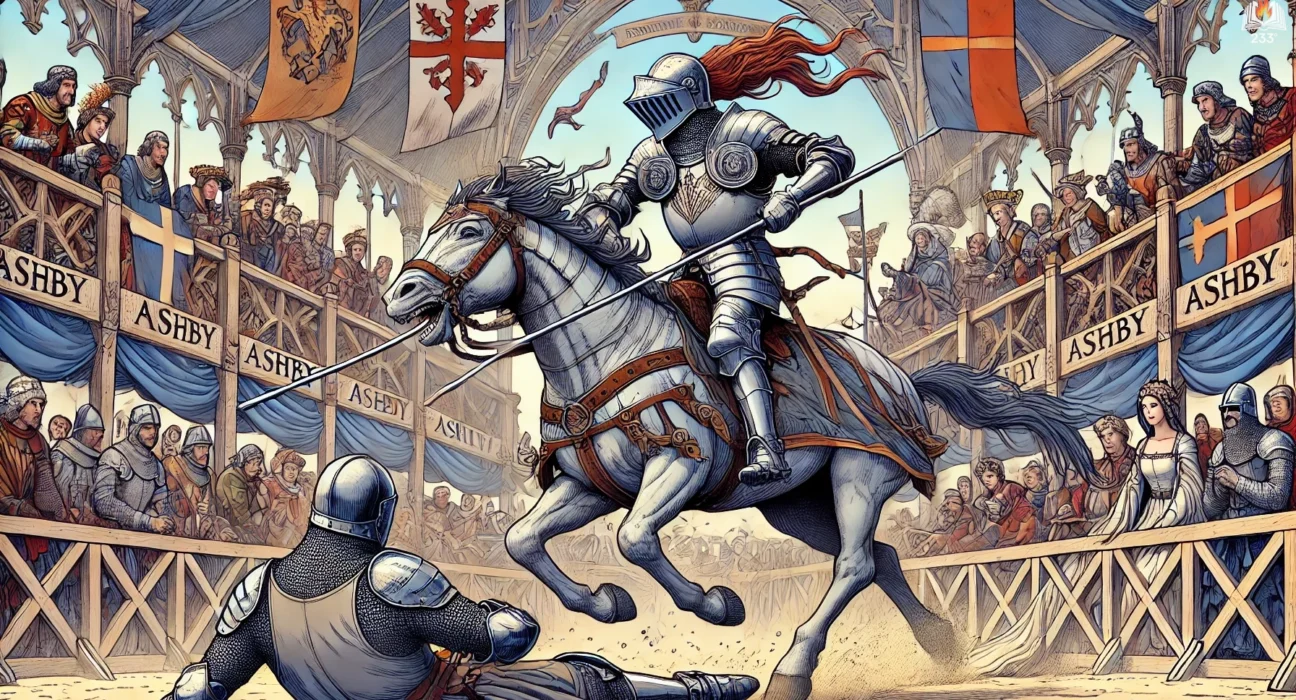
“Ivanhoe,” authored by Sir Walter Scott and published in 1820, is a historical novel set in 12th-century England during the reign of King Richard I. The novel blends romance, chivalry, and historical events, offering a rich tapestry of the medieval world. It explores the tension between the Norman conquerors and the subjugated Saxons, providing a vivid portrayal of the era’s social, political, and cultural dynamics.
Plot Summary
In the twilight of King Richard I’s absence, England languishes under the oppressive rule of Norman nobles. The Saxons, once proud and free, are now subjugated, their land and honor stripped away by the conquerors. Amidst this turmoil lives Wilfred of Ivanhoe, a brave knight disowned by his father, Cedric the Saxon, for his unwavering loyalty to King Richard and his forbidden love for Cedric’s ward, the fair Lady Rowena.
At the heart of the tale lies a grand tournament at Ashby-de-la-Zouche, a spectacle of chivalry and skill. Nobles from across the realm gather to witness the feats of arms, and amidst them appears a mysterious figure, the “Disinherited Knight.” With a visor that conceals his identity, he vanquishes all who dare to challenge him, including the fierce Templar, Brian de Bois-Guilbert. The crowd erupts in cheers, and Lady Rowena, the queen of beauty and love at the tournament, awards him the victor’s crown. But the triumph is fleeting, as the knight collapses from his wounds, revealing himself as none other than Ivanhoe, returned from the Crusades.
In the shadows of the tournament’s splendor, another story unfolds. Rebecca, the beautiful and compassionate daughter of Isaac of York, a Jewish moneylender, tends to the injured Ivanhoe. Her skills as a healer are unmatched, and she nurtures him with a grace and kindness that transcends the prejudice of the times. Isaac, though wary of the dangers his people face, supports her efforts, and an unspoken bond forms between Ivanhoe and Rebecca, one marked by mutual respect and an unfulfilled longing.
While Ivanhoe recuperates, Prince John, the scheming brother of the absent king, seeks to consolidate his power. He gathers his allies, including the brutish Reginald Front-de-Boeuf and the ambitious Bois-Guilbert, plotting to usurp the throne. Their machinations lead to the capture of Cedric, Lady Rowena, and other Saxon nobles, who are taken to Front-de-Boeuf’s grim fortress, Torquilstone. Ivanhoe, still weakened, is taken captive alongside them.
As the captives languish in the dungeons of Torquilstone, hope seems dim. Front-de-Boeuf, a man devoid of mercy, threatens them with torture and death. Cedric, proud and unyielding, refuses to bow to the Norman yoke, while Rowena’s fate hangs perilously as the object of unwanted advances. Yet, in the darkest hour, an unexpected alliance forms. Robin Hood, known here as Locksley, rallies his band of outlaws, and with the Black Knight, a mysterious figure of immense strength and valor, they launch a daring assault on the castle.
The battle for Torquilstone is fierce and chaotic. Flames lick the sky as arrows fly and swords clash. The Black Knight fights with the might of a lion, and Front-de-Boeuf meets his fiery end amidst the chaos he wrought. The captives are freed, but at a cost. Rebecca, in the turmoil, is seized by Bois-Guilbert, who is tormented by a forbidden passion for her. He spirits her away to the Templar stronghold of Templestowe, where she is accused of witchcraft, a charge fueled by the Grand Master’s fanaticism.
Rebecca stands before her accusers with unbroken spirit. Her only hope lies in a trial by combat, where a champion must fight to prove her innocence. Bois-Guilbert, torn between his love for Rebecca and his loyalty to the Templars, is driven to the brink of madness. He proposes to Rebecca that if she consents to be his lover, he will forfeit the trial and take her away from the grasp of the Templars. But Rebecca, noble and resolute, refuses to compromise her integrity.
Word of Rebecca’s plight reaches Ivanhoe, who, though his heart belongs to Rowena, cannot ignore the call of justice. He steps forward as her champion, a decision that sets the stage for a final confrontation. The trial by combat begins, and the eyes of many watch as Ivanhoe, still recovering from his wounds, faces the powerful and conflicted Bois-Guilbert. The duel is intense, not just a clash of steel but a battle of wills and emotions. Yet, as they fight, it becomes clear that Bois-Guilbert is fighting an internal war more fierce than the physical one. Overcome by his turmoil and the weight of his conflicting desires, he collapses, dying without a strike from Ivanhoe’s blade.
Rebecca is declared innocent, her honor and virtue shining through the darkness that sought to consume her. She is free, but her path leads her away from Ivanhoe. Understanding the insurmountable divide between them, she chooses to leave England with her father, Isaac, seeking a new life in Granada, where they hope to find peace and acceptance away from the prejudices that have long plagued them.
With the rightful king’s return, Richard the Lionheart reclaims his throne, bringing a semblance of order to a fractured kingdom. Cedric, softened by the trials they have endured, reconciles with Ivanhoe, acknowledging the strength and honor his son has displayed. Ivanhoe and Rowena’s union is celebrated, a symbol of hope and the potential for harmony between the Saxons and Normans.
As for Robin Hood and his band, they are granted amnesty, their deeds in aiding King Richard and rescuing the captives earning them a place in the annals of legend. The Black Knight reveals his true identity as King Richard himself, who has been traveling incognito to gauge the state of his realm. His presence inspires loyalty and a renewed hope for the future of England.
The characters’ lives, forever changed by these events, find a semblance of peace. Ivanhoe and Rowena build a life together, embodying the possibility of unity in a land torn by strife. Cedric, with the marriage of his son, sees the blending of Saxon and Norman as a path forward, though the scars of conquest are not easily healed. Rebecca, though her heart harbors unspoken love for Ivanhoe, sets forth on a journey to a distant land, her spirit unbroken, her dignity intact.
The sun sets on this chapter of England’s tumultuous history, but the echoes of valor, love, and sacrifice linger. The land, once divided by conquest and hatred, now sees a glimmer of unity and understanding. The deeds of Ivanhoe and his companions become legend, a testament to the enduring quest for justice, honor, and the hope of a better tomorrow.
Main Characters
- Wilfred of Ivanhoe: The noble and chivalrous protagonist, loyal to King Richard and in love with Lady Rowena. His bravery and sense of justice drive much of the plot.
- Lady Rowena: Cedric’s ward and Ivanhoe’s love interest. She represents the ideal of Saxon beauty and virtue.
- Cedric the Saxon: Ivanhoe’s father, staunchly proud of his Saxon heritage and initially estranged from his son due to political and personal reasons.
- Rebecca: The beautiful and wise Jewish healer who loves Ivanhoe. She is a figure of strength and grace, enduring persecution with dignity.
- Brian de Bois-Guilbert: A Templar knight, complex and tormented by his unrequited love for Rebecca, ultimately leading to his downfall.
- Richard the Lionheart: The heroic king who returns to reclaim his throne, embodying the ideal of medieval kingship.
- Prince John: The scheming and treacherous brother of King Richard, seeking to usurp the throne.
- Reginald Front-de-Boeuf: The brutal Norman knight who captures Cedric and his companions, embodying the cruelty of the Norman oppressors.
Theme
- Chivalry and Knighthood: The novel explores the ideals and contradictions of chivalry, depicting knights both noble and corrupt.
- Social Injustice and Oppression: The tension between Normans and Saxons reflects broader themes of conquest, power, and resistance.
- Religious Intolerance: The persecution of Jews, exemplified by the character of Rebecca, highlights the theme of religious bigotry.
- Love and Sacrifice: Romantic and familial love drive many characters’ actions, often requiring great personal sacrifice.
- Heroism and Valor: Characters like Ivanhoe and King Richard embody the virtues of courage and honor, essential to the narrative’s moral fabric.
Writing Style and Tone
Sir Walter Scott’s writing style in “Ivanhoe” is marked by rich descriptive detail and a blend of historical accuracy with romanticized elements. His narrative technique combines third-person omniscient perspective with deep character introspection, allowing readers to engage with the characters’ inner lives and motivations. The tone is often heroic and adventurous, capturing the grandeur of the medieval setting while also delving into moments of intense personal drama and moral conflict.
Scott’s language is formal and ornate, reflecting the literary conventions of his time and enhancing the historical ambiance of the novel. He employs dialogue that is both period-appropriate and expressive, adding to the authenticity and immersive quality of the story. Through his skilled use of language and narrative structure, Scott creates a compelling and enduring tale of romance, heroism, and historical intrigue.
Quotes
Ivanhoe – Sir Walter Scott (1819) Quotes
“For he that does good, having the unlimited power to do evil, deserves praise not only for the good which he performs, but for the evil which he forbears.”
“We are like the herb which flourisheth most when trampled upon”
“I have heard men talk about the blessings of freedom," he said to himself, "but I wish any wise man would teach me what use to make of it now that I have it.”
“Silence, maiden; thy tongue outruns thy discretion.”
“I envy thee not thy faith, which is ever in thy mouth but never in thy heart nor in thy practice”
“Chivalry!---why, maiden, she is the nurse of pure and high affection---the stay of the oppressed, the redresser of grievances, the curb of the power of the tyrant ---Nobility were but an empty name without her, and liberty finds the best protection in her lance and her sword.”
“I will tear this folly from my heart, though every fibre bleed as I rend it away!”
“In the name of God!" said Gurth, "how came they prisoners? and to whom?" "Our master was too ready to fight," said the Jester, "and Athelstane was not ready enough, and no other person was ready at all.”
“I have sought but a kindred spirit to share it, and I have found such in thee.”
“I forgive you, Sir Knight," said Rowena, "as a Christian." "That means," said Wamba, "that she does not forgive him at all.”
“He that does good, having the unlimited power to do evil, deserves praise not only for the good which he performs, but for the evil which he forbears.”
“Certainly," quoth Athelstane, "women are the least to be trusted of all animals, monks and abbots excepted.”
“the worst evil which befalls our race is, that when we are wronged and plundered, all the world laughs around, and we are compelled to suppress our sense of injury, and to smile tamely, when we would revenge bravely.”
“The lovers of the chase say that the hare feels more agony during the pursuit of the greyhounds, than when she is struggling in their fangs.”
“And my father!-oh, my father! evil is it with his daughter, when his grey hairs are not remembered because of the golden locks of youth!”
“Thou hast had thty day, old dame, but thy sun has long been set. Thou art now the very emblem of an old warhorse turned out on the barren heath; thou hast had thy paces in thy time, but now a broken amble is the best of them.”
“Now, it is well known, that a man may with more impunity be guilty of an actual breach either of real good breeding or of good morals, than appear ignorant of the most minute point of fashionable etiquette.”
“Rebecca! she who could prefer death to dishonor must have a proud and powerful soul!”
“Thy resolution may fluctuate on the wild and changeful billows of human opinion, but mine is anchored on the Rock of Ages.”
“Thou and I are but the blind instruments of some irresistible fatality, that hurries us along, like ships driving before the storm, which are dashed against each other, and so perish”
“...[T]o restrain [evil men] by their sense of humanity is the same as to stop a runaway horse with a bridle of silk thread.”
“Is death the last sleep? No, it is the last final awakening.”
“Thus do men throw on fate the issue of their own wild passions.”
“Revenge is a feast for the gods!”
“...[T]hou knowest not the heart of woman... [N]ot in thy fiercest battles hast thou displayed more of thy vaunted courage than has been shown by woman when called upon to suffer by affection or duty.”
“Far better was our homely diet, eaten in peace and liberty, than the luxurious dainties, the love of which hath delivered us as bondsmen to the foreign conqueror!”
We hope this summary has sparked your interest and would appreciate you following Celsius 233 on social media:
There’s a treasure trove of other fascinating book summaries waiting for you. Check out our collection of stories that inspire, thrill, and provoke thought, just like this one by checking out the Book Shelf or the Library
Remember, while our summaries capture the essence, they can never replace the full experience of reading the book. If this summary intrigued you, consider diving into the complete story – buy the book and immerse yourself in the author’s original work.
If you want to request a book summary, click here.
When Saurabh is not working/watching football/reading books/traveling, you can reach him via Twitter/X, LinkedIn, or Threads
Restart reading!