

The Secret Garden, written by Frances Hodgson Burnett and first published in 1911, is a beloved classic of children’s literature. Set in the English countryside, the novel tells the story of Mary Lennox, a young, spoiled girl who is sent to live with her uncle in a vast, lonely manor after the death of her parents. There, she discovers a neglected garden, and as she brings it back to life, she undergoes a profound transformation. The novel explores themes of rejuvenation, healing, and the transformative power of nature.
Plot Summary
On a hot, oppressive day in colonial India, Mary Lennox, a sour, sickly child, wakes to find that her parents are dead, victims of a cholera outbreak that has swept through the household. Unwanted and forgotten, she is shipped off to England to live with her uncle, Archibald Craven, at Misselthwaite Manor, a sprawling, gloomy estate on the edge of the Yorkshire moors. Mary, raised by indifferent servants, has never known love or kindness, and her spoiled, demanding nature makes her unlikable to those around her.
Misselthwaite Manor is vast and full of secrets. Most of the rooms are closed, and its master, Archibald Craven, is seldom seen, lost in his grief over the death of his beloved wife, who passed away ten years earlier. Mary is left to her own devices, her days stretching into dull sameness. But slowly, her isolation forces her outside. The wildness of the Yorkshire moors and the fresh, cold air stir something in her, and she begins to explore the sprawling gardens surrounding the manor.
It is Martha, a spirited young servant girl, who first tells Mary about the mysterious garden—a walled paradise that has been locked and abandoned since Mrs. Craven’s death. Mary’s curiosity is piqued. Why would anyone abandon a garden? And where is the key?
As the days pass, Mary grows stronger from the fresh air and exercise, and she begins to feel less cross. Her mood softens further when she meets Martha’s brother, Dickon, a boy with a magical connection to animals and nature. Dickon seems to befriend every living thing, from the wild birds to the sheep on the moor. His warmth and gentleness contrast with Mary’s sharpness, and slowly, she begins to open up to him.
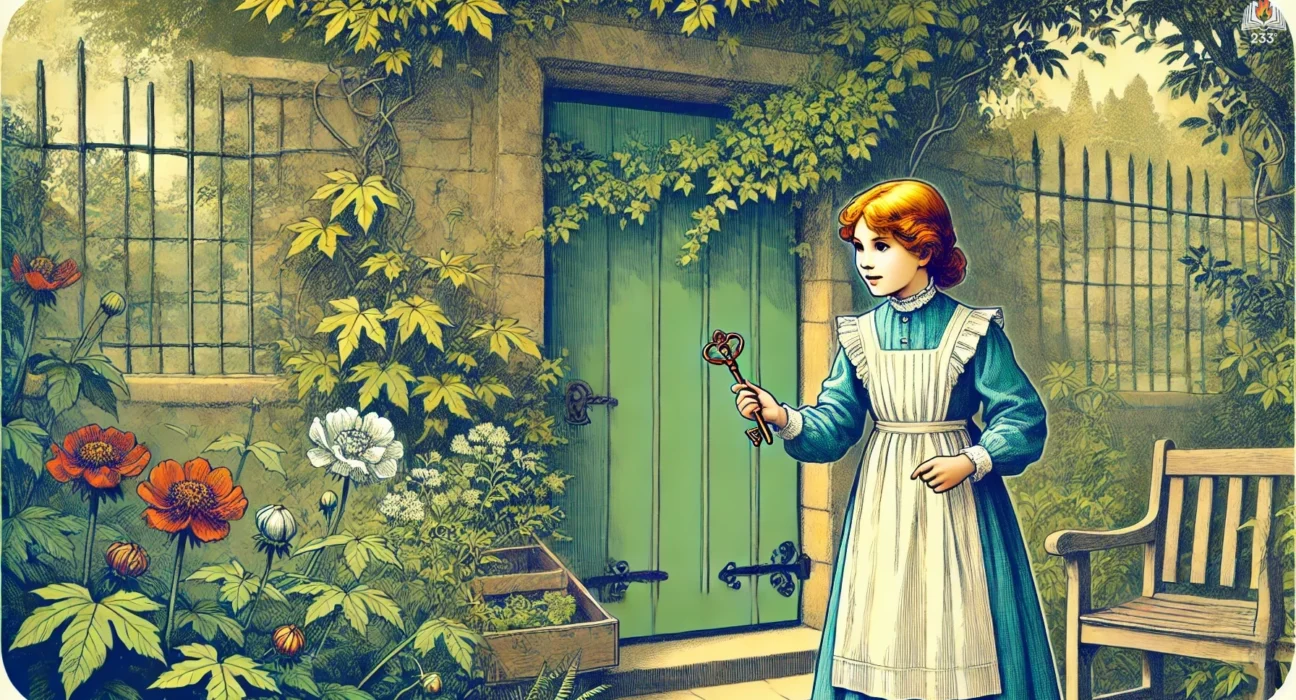
One day, while exploring the grounds, Mary finds an old key buried in the earth, and soon after, she discovers the door to the secret garden hidden beneath thick ivy. The garden is overgrown and wild, a shadow of what it once was. Yet, despite the tangle of dead branches and weeds, Mary sees beauty in it. With Dickon’s help, she begins to tend to the garden, clearing away the dead growth and planting seeds. As the garden begins to come alive, so too does Mary. The once sour, selfish girl begins to change, her heart softening with every new leaf and bloom.
But Misselthwaite Manor holds another secret. On stormy nights, Mary hears strange cries echoing through the corridors. At first, the servants deny it, but Mary’s curiosity cannot be quieted. One night, she follows the sound and discovers a hidden room where her cousin, Colin Craven, lies bedridden. Colin, like Mary, has been spoiled and neglected, but his suffering is deeper. He is convinced that he is dying, crippled by a spinal condition, and has lived his entire life in isolation, fearing that he is doomed to die young like his mother.
Mary, who has grown strong from the garden, is indignant at Colin’s weakness and self-pity. She refuses to indulge his fears and instead challenges him, insisting that he is not dying, that his illness is more a product of his mind than his body. Slowly, Colin begins to believe her, and the two form an unlikely friendship. Mary shares the secret of the garden with him, and for the first time in his life, Colin ventures outside.
The garden works its magic on Colin just as it did on Mary. Day by day, he grows stronger. He learns to walk, first with help and then on his own, as he, Mary, and Dickon work together to bring the garden back to life. Colin, who once believed himself to be frail and helpless, becomes more confident and full of life, casting aside his bitterness and fear.
Meanwhile, Archibald Craven, haunted by the loss of his wife and estranged from his son, wanders Europe in a state of despair. He has left the care of his estate to others, believing that nothing can heal the pain of his past. But one night, while resting in a village, he dreams of his wife, calling him back to Misselthwaite, to the garden. The dream is so vivid that he decides to return home, driven by an inexplicable feeling of hope.
When Mr. Craven arrives at Misselthwaite, he finds the manor strangely alive with a new energy. In the garden, he hears laughter—children’s laughter—and as he enters, he is astonished to see his son, standing tall and healthy, walking among the blooming flowers. Colin, radiant with joy and newfound strength, runs to him, embracing the father who had long since abandoned hope. The garden, which had once been a place of sorrow and death, is now a place of life and love.
Archibald Craven, overwhelmed with emotion, finally lets go of the grief that has held him captive for so long. The garden, his son’s healing, and Mary’s transformation all become symbols of rebirth and renewal. Together, they find peace in the beauty of the world around them, a beauty that had been hidden, waiting for someone to uncover it.
As the garden flourishes, so too do the lives of those who have tended it. Mary, once unloved and unwanted, finds a family in Colin and Dickon. Colin, who had been imprisoned by his fear, is freed by the power of belief and love. And Archibald Craven, who had been lost in grief, is brought back to life by the sight of his son’s happiness. The secret garden, once forgotten and neglected, becomes a symbol of healing for them all, a reminder that even in the darkest of places, life can bloom again.
Main Characters
Mary Lennox: The protagonist, Mary begins as a disagreeable, spoiled child who has been neglected by her parents and raised by servants in India. Her journey throughout the novel is one of personal growth, as she learns empathy, self-reliance, and the joy of nurturing life, both in the garden and in her relationships.
Colin Craven: Mary’s cousin, Colin is a sickly, bedridden boy who is believed to be crippled and is feared to be dying. Like Mary, he has been neglected and is filled with bitterness and self-pity. His transformation, spurred by his interactions with Mary and the garden, is central to the novel’s themes of healing and rejuvenation.
Dickon Sowerby: A local boy who has a magical connection to animals and nature, Dickon serves as a guide to Mary and Colin. He is kind, gentle, and wise beyond his years, representing a deep bond with nature that contrasts with the emotional isolation of the other characters.
Archibald Craven: Mary’s uncle and Colin’s father, Mr. Craven is a withdrawn and grief-stricken man, haunted by the death of his beloved wife. His emotional detachment from his son and the neglect of the garden are central to the novel’s exploration of healing from emotional pain.
Martha Sowerby: Dickon’s sister and Mary’s maid, Martha is a warm, no-nonsense character who introduces Mary to the joys of simple living and the Yorkshire moor. Her kindness and encouragement help Mary begin her transformation.
Theme
Healing and Rejuvenation: The central theme of The Secret Garden is the idea that nature has the power to heal both physically and emotionally. As Mary and Colin work to restore the garden, they are healed of their own inner wounds—Mary from her loneliness and selfishness, and Colin from his despair and fear of death. The novel suggests that reconnecting with nature and nurturing life can lead to profound personal growth.
Isolation vs. Connection: Both Mary and Colin begin the novel in isolation—physically separated from the world by illness or emotional neglect. The garden, however, becomes a symbol of connection and renewal. Through their work in the garden, they form friendships, learn to care for others, and eventually reconnect with their estranged families.
The Power of Positive Thinking: Another key theme is the power of positive thinking and the importance of a hopeful attitude. Colin’s recovery is linked to his shift from a mindset of illness and despair to one of health and possibility. The novel emphasizes that one’s thoughts and beliefs can significantly influence physical and emotional well-being.
Secrets and Discovery: The hidden garden is a metaphor for the secrets that each character holds—the pain, grief, and anger they hide from the world. As the garden is brought back to life, so too are the characters’ hidden emotions revealed and healed. The discovery of the garden parallels the characters’ self-discovery and emotional awakening.
Writing Style and Tone
Frances Hodgson Burnett’s writing style in The Secret Garden is rich and evocative, marked by a deep appreciation for nature and its restorative powers. Her descriptions of the garden and the moors are lush and vivid, bringing the natural world to life in a way that makes it almost a character in its own right. Burnett employs sensory detail to immerse the reader in the changing seasons, the blooming flowers, and the fresh air, emphasizing the contrast between the bleak, closed-off manor and the vibrant, living world of the garden.
Burnett’s tone is hopeful and often tender, particularly in her portrayal of the children’s transformation. She writes with a quiet sense of optimism, suggesting that even the most neglected and emotionally scarred individuals can find healing through love, friendship, and a connection to the natural world. At the same time, there is a sense of mystery and wonder, especially surrounding the hidden garden, which imbues the story with a magical, almost fairy-tale quality. The novel’s third-person omniscient narration allows Burnett to delve into the inner lives of her characters, highlighting their emotional journeys with empathy and care.
Quotes
The Secret Garden – Frances Hodgson Burnett (1911) Quotes
“If you look the right way, you can see that the whole world is a garden.”
“Is the spring coming?" he said. "What is it like?"... "It is the sun shining on the rain and the rain falling on the sunshine...”
“At first people refuse to believe that a strange new thing can be done, then they begin to hope it can be done, then they see it can be done--then it is done and all the world wonders why it was not done centuries ago.”
“She made herself stronger by fighting with the wind.”
“Where you tend a rose my lad, a thistle cannot grow.”
“It made her think that it was curious how much nicer a person looked when he smiled. She had not thought of it before.”
“Of course there must be lots of Magic in the world," he said wisely one day, "but people don't know what it is like or how to make it. Perhaps the beginning is just to say nice things are going to happen until you make them happen. I am going to try and experiment.”
“And the secret garden bloomed and bloomed and every morning revealed new miracles.”
“I am sure there is Magic in everything, only we have not sense enough to get hold of it and make it do things for us”
“Two worst things as can happen to a child is never to have his own way - or always to have it.”
“Much more surprising things can happen to anyone who, when a disagreeable or discouraged thought comes into his mind, just has the sense to remember in time and push it out by putting in an agreeable, determinedly courageous one. Two things cannot be in one place.”
“However many years she lived, Mary always felt that 'she should never forget that first morning when her garden began to grow'.”
“Might I," quavered Mary, "might I have a bit of earth?”
“There's naught as nice as th' smell o' good clean earth, except th' smell o' fresh growin' things when th' rain falls on 'em.”
“Nothing in the world is quite as adorably lovely as a robin when he shows off and they are nearly always doing it.”
“I shall live forever and ever and ever ' he cried grandly. 'I shall find out thousands and thousands of things. I shall find out about people and creatures and everything that grows - like Dickon - and I shall never stop making Magic. I'm well I'm well”
“My mother always says people should be able to take care of themselves, even if they're rich and important.”
“The robin flew from his swinging spray of ivy on to the top of the wall and he opened his beak and sang a loud, lovely trill, merely to show off. Nothing in the world is quite as adorably lovely as a robin when he shows off - and they are nearly always doing it.”
“So long as I know what's expected of me, I can manage.”
“People never like me and I never like people," she thought. "And I never can talk as the Crawford children could. They were always talking and laughing and making noises.”
“To speak robin to a robin is like speaking French to a Frenchman”
“Oh, how she did love that queer, common boy!”
“Of course there must be lots of Magic in the world, but people don't know what it is like or how to make it.”
We hope this summary has sparked your interest and would appreciate you following Celsius 233 on social media:
There’s a treasure trove of other fascinating book summaries waiting for you. Check out our collection of stories that inspire, thrill, and provoke thought, just like this one by checking out the Book Shelf or the Library
Remember, while our summaries capture the essence, they can never replace the full experience of reading the book. If this summary intrigued you, consider diving into the complete story – buy the book and immerse yourself in the author’s original work.
If you want to request a book summary, click here.
When Saurabh is not working/watching football/reading books/traveling, you can reach him via Twitter/X, LinkedIn, or Threads
Restart reading!