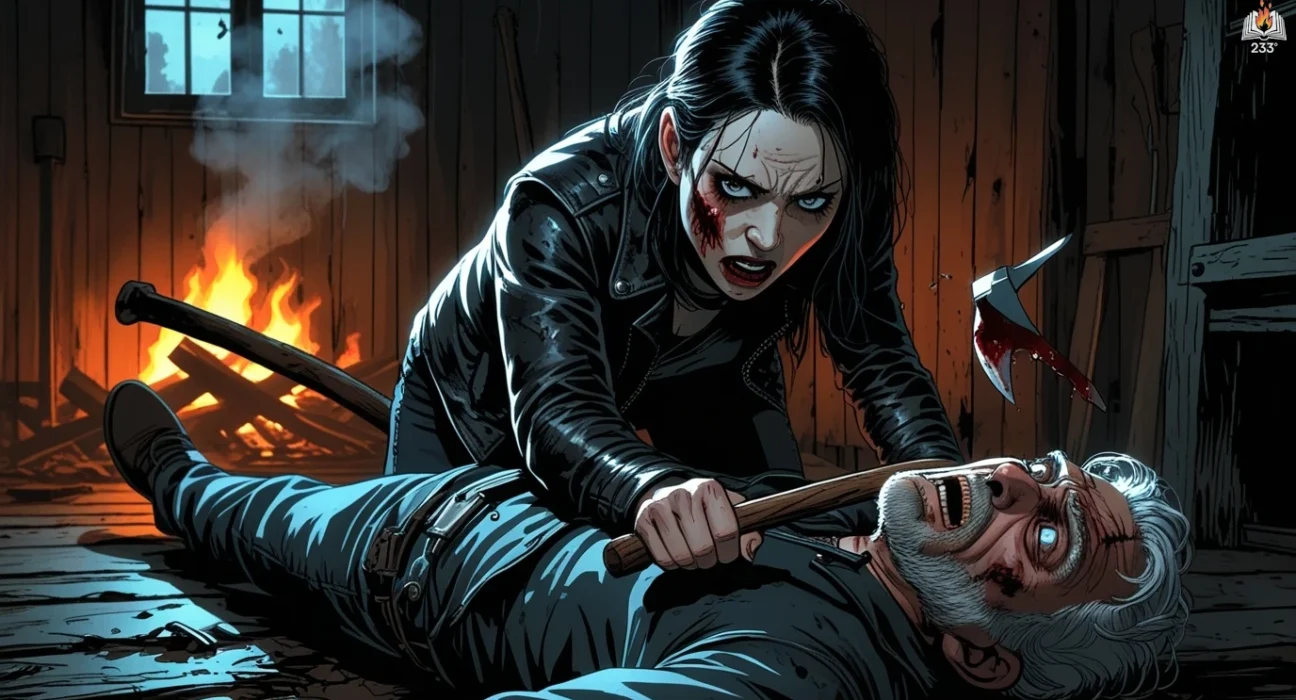
The Girl Who Played with Fire (2006) by Stieg Larsson is the second novel in the Millennium Trilogy. This gripping Swedish crime thriller follows journalist Mikael Blomkvist and hacker Lisbeth Salander as they become entangled in a high-stakes investigation involving human trafficking, corrupt institutions, and personal vendettas. The novel seamlessly blends action, mystery, and social critique, cementing Larsson’s reputation as a master storyteller.
Plot Summary
In Stockholm’s quiet shadows, Lisbeth Salander lives a solitary life, leaving behind the chaos of the Wennerström affair. The enigmatic hacker, now financially secure, tries to build a life of independence, but her past is never far away. She travels the world, delving into mathematics and keeping her distance from Mikael Blomkvist, the journalist with whom she once shared a bond of trust and survival.
At Millennium magazine, Mikael Blomkvist pursues his next big story. A pair of investigative journalists, Dag Svensson and his partner Mia Johansson, approach him with a chilling exposé on sex trafficking in Sweden. Their research unveils a network of powerful men exploiting vulnerable women, threatening to expose influential figures within politics, business, and law enforcement. Dag and Mia’s passion for justice aligns with Millennium’s mission, and they plan to publish their findings in an explosive special issue.
Lisbeth, meanwhile, discovers that Nils Bjurman, her corrupt guardian, has broken the truce they maintained since their violent confrontation. He is plotting to regain control over her life and erase her hold over him. Unbeknownst to her, Bjurman’s actions pull them both into the orbit of Alexander Zalachenko, a former Soviet defector with ties to organized crime—and to Lisbeth’s traumatic past.
When Dag and Mia are murdered in their apartment, Blomkvist finds their bodies. The tragedy rocks Millennium and Mikael personally, as the killings seem linked to their investigation. The murder weapon is traced to fingerprints belonging to Lisbeth Salander, making her the prime suspect. The media frenzy paints her as a violent, disturbed individual, feeding on her troubled history. Mikael, however, refuses to believe Lisbeth is guilty and begins his own investigation, determined to uncover the truth.
Lisbeth, aware of the accusations, goes into hiding. Using her unparalleled hacking skills, she follows the trail left by Dag and Mia’s research, uncovering the identity of a mysterious figure they had called “Zala.” Her pursuit takes her deep into a world of criminality tied to her own past, forcing her to confront memories she had long buried.
Blomkvist, following leads from Dag’s files, learns about Zala’s connection to Zalachenko, a notorious figure who had been involved in trafficking and violence for decades. As Mikael digs deeper, he uncovers evidence that points to Zalachenko’s role not only in the trafficking ring but also in Lisbeth’s life. Zalachenko is her father—a sadistic man who inflicted unimaginable pain on Lisbeth and her mother. The revelations bind Mikael’s investigation with Lisbeth’s quest for justice, though they remain apart, each navigating their own path through danger.
In parallel, Lisbeth confronts her own history. Zalachenko had been protected by the Säpo, Sweden’s secret police, due to his value as a defector. This protection allowed him to operate with impunity, leaving a trail of victims, including Lisbeth’s mother. The institutional betrayal fuels Lisbeth’s rage as she edges closer to a final reckoning with her father.
The web tightens around Lisbeth as law enforcement, manipulated by corrupt forces, closes in on her. Her former employer, Dragan Armansky, reluctantly becomes involved, aiding her discreetly while grappling with doubts about her innocence. At the same time, Erika Berger, Blomkvist’s colleague and confidante, faces escalating threats, underscoring the stakes of exposing the trafficking network.
Lisbeth’s journey culminates in a confrontation at Zalachenko’s secluded farmhouse. Her arrival is anything but stealthy, and she is ambushed by Ronald Niedermann, Zalachenko’s hulking and emotionless henchman, who proves impervious to pain. Despite his overwhelming strength, Lisbeth uses her cunning to evade him and reaches Zalachenko. A violent clash ensues as she seeks justice for years of abuse and betrayal. Zalachenko shoots her, leaving her severely injured and buried alive.
Blomkvist, following the trail of events, arrives at the farmhouse. He finds Lisbeth barely alive, having clawed her way out of the grave. Calling for help, he ensures her survival while also leaving evidence for the authorities to implicate Zalachenko and his network. The final moments bring Lisbeth to a hospital bed, battered but unbroken. For the first time, the truth about her past is poised to come to light, and the forces that sought to destroy her are finally exposed.
The darkness that haunted her is not entirely dispelled, but Lisbeth has faced it head-on, emerging as a survivor. Her resilience and Blomkvist’s unwavering belief in justice create a glimmer of hope amidst the bleakness. Though the scars remain, the story closes with Lisbeth alive, defiant, and determined to reclaim her life.
Main Characters
- Lisbeth Salander: A brilliant but enigmatic hacker with a traumatic past. Lisbeth is fiercely independent, resourceful, and driven by a quest for justice, often navigating the fine line between hero and antihero.
- Mikael Blomkvist: An investigative journalist and co-founder of Millennium magazine. Blomkvist is persistent and ethical, determined to uncover the truth despite personal and professional risks.
- Dragan Armansky: Lisbeth’s former employer and a compassionate figure who becomes a reluctant ally in her battles against injustice.
- Nils Bjurman: Lisbeth’s corrupt guardian, whose actions and fate set off a series of events that ripple through the story.
- Zala (Alexander Zalachenko): A shadowy figure from Lisbeth’s past whose criminal activities and personal connection to her become central to the plot.
- Erika Berger: Blomkvist’s colleague and confidante, whose loyalty to him and Millennium underscores the narrative’s exploration of journalistic integrity.
Theme
- Justice and Revenge: The story revolves around Lisbeth’s pursuit of justice for herself and others, often blurring the lines between revenge and moral retribution.
- Corruption and Exploitation: The narrative exposes institutional corruption, from law enforcement to media, and examines the exploitation of marginalized groups.
- Trauma and Resilience: Lisbeth’s resilience in the face of her traumatic past underscores her strength, while also illustrating the lingering effects of abuse.
- Gender and Power Dynamics: The novel critiques societal misogyny, with female characters like Lisbeth embodying defiance against patriarchal oppression.
- Technology and Surveillance: The story explores the dual-edged nature of technology, showcasing how it can both oppress and empower individuals.
Writing Style and Tone
Stieg Larsson’s writing is detailed and meticulously structured, blending journalistic precision with a flair for narrative suspense. His prose is sharp, with descriptions that capture both character psychology and the stark Swedish landscapes. Larsson masterfully integrates complex subplots and builds tension through layers of intrigue, making the narrative both intellectually engaging and emotionally compelling.
The tone is gritty and intense, often shifting between a sense of foreboding and bursts of action. Larsson’s critical view of societal injustices adds a moral urgency to the story, while moments of quiet reflection offer insight into his characters’ inner lives. This blend of realism and intensity creates a dark yet captivating atmosphere.
Quotes
The Girl Who Played with Fire – Stieg Larsson (2006) Quotes
“There are no innocents. There are, however, different degrees of responsibility.”
“Don’t ever fight with Lisbeth Salander. Her attitude towards the rest of the world is that if someone threatens her with a gun, she’ll get a bigger gun.”
“But she wished she had had the guts to go up to him and say hello. Or possibly break his legs, she wasn't sure which.”
“Salander was the woman who hated men who hate women.”
“Always retain the ability to walk away, without sentimentality, from a situation that felt unmanageable. That was a basic rule of survival. Don't lift a finger for a lost cause.”
“Dear Government... I'm going to have a serious talk with you if I ever find anyone to talk to.”
“There were not so many physical threats that could not be countered with a decent hammer.”
“She had stared at him for a whole minute and decided that she did not have a grain of feeling left, because it would have been the same as bleeding to death. Fuck You.”
“He felt that he had to find Salander and hold her close. She would probably bite him if he tried.”
“Men could be as big as a house and made of granite, but they all had balls in the same place.”
“I believe that everyone has it in them to kill another person. In desperation, or hatred, or at least to defend themselves.”
“It proved once again the theory that no security system is a match for a stupid employee.”
“Those pointless equations, to which no solution exists, are called absurdities.”
“their relationship was built on friendship, and in matters of friendship he was boundlessly loyal. It was a relationship that would survive the harshest test.”
“No matter how hard she tried to concentrate on something else, to pass the time and to distract her from the situation she was in, the fear came trickling out. It hovered like a cloud of gas around her, threatening to penetrate her pores and poison her.”
“I am what I am,' Salander said 'I ran away from everything and everybody. I should have said goodbye.”
“It was completely impossible to box with her. She had only one style, which we called Terminator Mode. She would try to nail her opponent, and it didn’t matter if it was just a warm-up of friendly sparring.”
“Zalachenko...you're just an ordinary asshole who hates women.”
“You're an entropic chaos factor”
“She had discovered that the most effective method of keeping the fear at bay was to fantasize about something that gave her a feeling of strength. She closed her eyes and conjured up the smell of gasoline.”
“From a purely physical standpoint she didn't have a chance, but her attitude was that death was better than capitulation.”
“She cursed her gender. Nobody would have dared attack her if she had been a man.”
“Harley-Davidson," she said. "Sweet.”
“His attitude had always been that if a woman clearly indicated that she did not want anything more to do with him, he would go on his way. Not respecting such a message would in his eyes, show a lack of respect for her.”
“Consider this a fair warning.”
“Salander's fingers emerged like something dead from beneath the earth. Had there been any human watching, he would probably have reacted like the fox. He was gone like a shot.”
“She saw him drenched with gasoline. She could actually feel the box of matches in her hand.”
“I have a truly marvellous demonstration of this proposition which this margin is too narrow to contain.”
We hope this summary has sparked your interest and would appreciate you following Celsius 233 on social media:
There’s a treasure trove of other fascinating book summaries waiting for you. Check out our collection of stories that inspire, thrill, and provoke thought, just like this one by checking out the Book Shelf or the Library
Remember, while our summaries capture the essence, they can never replace the full experience of reading the book. If this summary intrigued you, consider diving into the complete story – buy the book and immerse yourself in the author’s original work.
If you want to request a book summary, click here.
When Saurabh is not working/watching football/reading books/traveling, you can reach him via Twitter/X, LinkedIn, or Threads
Restart reading!