“Meditations” is a collection of personal writings by Marcus Aurelius, Roman Emperor from 161 to 180 AD, and a significant figure in Stoic philosophy. The work was published posthumously and is believed to have been written around 170-180 AD. Although originally meant as a private journal for self-reflection and philosophical guidance, it has become one of the most renowned works in the field of ethics and self-improvement. The Meditations offers deep insights into Stoic thought, where the emperor contemplates life, governance, and the nature of the universe, all while dealing with the burdens of ruling a vast empire. The text provides a timeless guide on how to live a virtuous life in harmony with nature and rationality.
Plot Summary
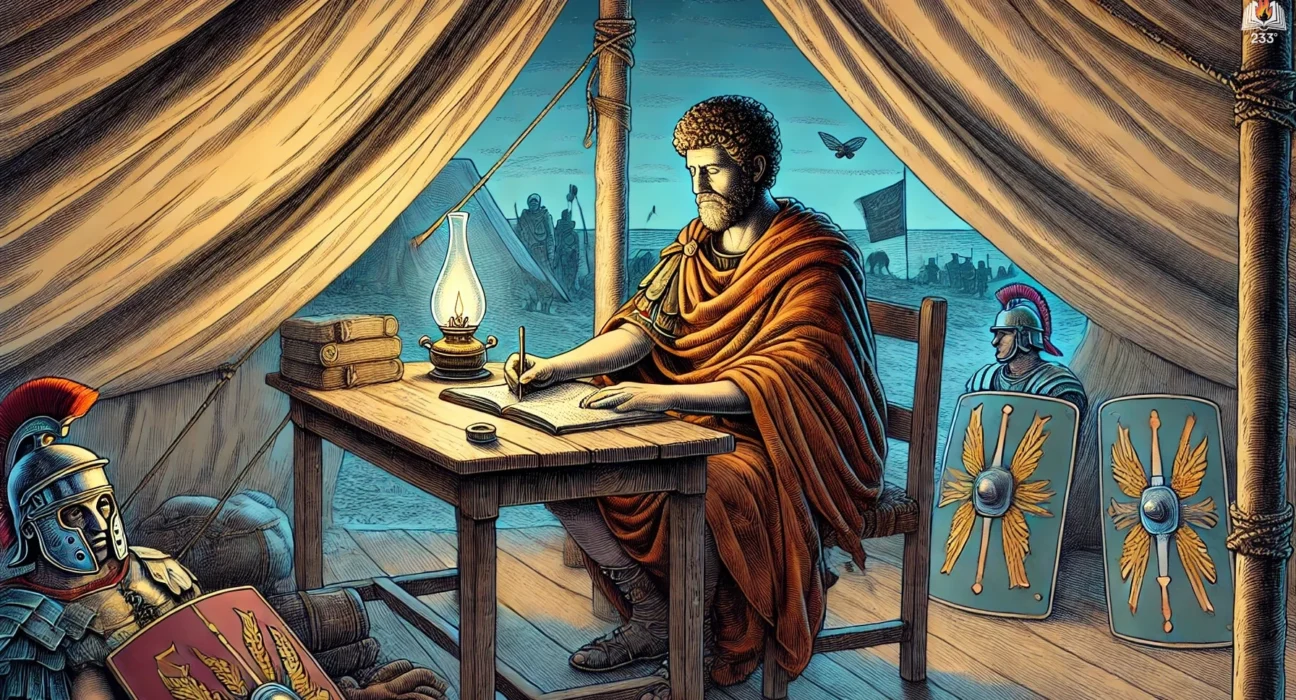
In the vast expanse of the Roman Empire, amid the turmoil of wars, famine, and internal strife, Marcus Aurelius, a ruler burdened by responsibility, sits alone, reflecting on the nature of life. His tent is nestled on the cold, hostile frontiers where enemies gather, but his mind is elsewhere—on the eternal questions of existence, purpose, and the soul. He contemplates the universe and his place within it, a speck of dust in a vast, indifferent cosmos.
Though he wields immense power as emperor, Marcus seeks mastery not over others, but over himself. From the earliest days of his youth, he was taught the principles of Stoicism—the importance of living in harmony with nature, the rejection of fleeting pleasures, and the pursuit of virtue as the highest good. Each lesson, each teaching was etched into his mind like a guiding star in the dark night. His grandfather taught him gentleness, his mother the value of simplicity and restraint, and his tutors instilled in him the discipline of the Stoic way.
As he assumes the mantle of emperor, Marcus feels the weight of the world pressing down on him. The empire is beset by wars on all sides. In the east, the Parthians rise in rebellion, while in the north, the barbarian tribes threaten to spill over the borders, their cries echoing through the cold forests. His co-emperor, Lucius Verus, sent to quell the eastern revolt, abandons his duties to indulge in excess and debauchery. Meanwhile, in Rome, pestilence sweeps through the streets, and starvation grips the people. It is a time of immense trial, and Marcus is left to shoulder the burden of these crises largely alone.
In the midst of this chaos, Marcus turns inward. He retreats into his thoughts, finding solace in the teachings of the Stoics. He writes to himself in his private moments, reminding his soul of the need for temperance, reason, and the acceptance of fate. He muses on the brevity of life, knowing that death is inevitable, even for an emperor. The emperor contemplates the nature of mortality, recognizing that all men—rich or poor, noble or common—are bound for the same end. And yet, this inevitability brings him a kind of peace. Death is but a natural part of life, a return to the cosmos from which all things arise.
As Marcus reflects, his thoughts often return to the concept of duty. To him, duty is sacred, a moral obligation to serve not only the empire but the greater good. Even as those around him fall to corruption and vice, Marcus remains steadfast in his resolve to act justly. He knows that the world is filled with injustice, cruelty, and falsehoods, yet he believes that one must rise above these failings. He speaks often of the need to forgive those who offend, to pity rather than condemn, for all men are bound by ignorance. He reminds himself that a virtuous man should never seek revenge, for vengeance is a form of weakness.
At times, he is surrounded by men like Avidius Cassius, a once-loyal general who betrays him by declaring himself emperor, mistakenly believing Marcus to be dead. News of the rebellion reaches the emperor, but instead of reacting with anger or seeking retribution, Marcus wishes only to avoid bloodshed. His greatest sorrow is the thought of civil war and the suffering it will bring to the people. He prays that Cassius might see the error of his ways and lay down his arms, hoping to forgive him. But fate intervenes—Cassius is killed by his own soldiers before Marcus can offer clemency. Though relieved at the end of the conflict, Marcus cannot help but grieve for the loss of a man who could have been spared.
Through these trials, Marcus Aurelius finds companionship in the idea of a cosmic order. He often reflects on the unity of all things, from the stars in the heavens to the humble lives of those who serve under him. He believes that each person plays a role in the grand design of the universe, no matter how insignificant that role may seem. The hardships he faces as emperor, the loss of comrades, the treachery of friends—all these things, he believes, are part of the divine plan. To rebel against one’s fate is to rebel against the universe itself.
Even in moments of personal loss, such as the death of his beloved wife Faustina, Marcus steels himself. His grief is tempered by his Stoic belief that all attachments, even to those we love most dearly, must eventually be relinquished. Life is transient, and to hold on to grief is to deny the natural order of things. He mourns, but he moves forward, ever striving to be at peace with the world as it is, not as he wishes it to be.
As the years pass, Marcus grows weary. His body, never strong, begins to fail him, but his spirit remains unbowed. He continues to lead his armies in battle, fighting to secure the empire’s borders, even as he contemplates the futility of it all. He knows that in time, all his victories will be forgotten, his reforms undone. His son Commodus, the sole surviving heir, will one day take the throne, and Marcus knows with a heavy heart that he is not the man to continue his legacy of wisdom and justice.
In his final days, as he lies on his deathbed on the frontier, Marcus Aurelius faces death with the same calm acceptance he has shown throughout his life. He feels no fear, for death is merely a return to the natural order, a dissolution of the body into the elements from which it came. His only wish is that he has lived according to the Stoic principles he has long held dear, and that he has served both his people and the cosmos with integrity and virtue. The emperor closes his eyes, not with despair, but with a serene understanding that he has done his duty, and that, in the grand sweep of the universe, that is enough.
Main Characters
Marcus Aurelius: The central figure and author of Meditations. As the Roman Emperor and a devout Stoic philosopher, he is portrayed as a deeply introspective leader who strives for moral integrity and inner peace amidst the challenges of war, personal loss, and governing a turbulent empire. His reflections demonstrate his dedication to Stoic ideals such as self-discipline, duty, and rational thought.
Lucius Verus: Marcus Aurelius’ co-emperor from 161 to 169 AD, Verus is a secondary character whose actions contrast with Marcus’s ideals. While Verus indulged in luxury and vice, leaving Marcus to shoulder the heavier burdens of the empire, Marcus is always contemplative about leadership and the weight of responsibility.
Avidius Cassius: A Roman general who briefly rebelled against Marcus, proclaiming himself emperor, yet was ultimately defeated. Marcus’s thoughts about him in Meditations reflect his Stoic beliefs in handling betrayal and adversity with wisdom and forgiveness.
Theme
Stoicism and Virtue: The core theme of Meditations is Stoic philosophy, especially the notion that virtue is the highest good. Marcus constantly emphasizes the importance of living in accordance with nature and reason, advocating for self-control, humility, and the acceptance of fate as central tenets of Stoic thought.
Impermanence and Mortality: Marcus often meditates on the fleeting nature of life, the inevitability of death, and the importance of preparing one’s soul for it. He reflects on the ephemeral quality of worldly achievements, status, and pleasures, reminding himself that everything is transient and that we must focus on what is truly under our control.
Self-discipline and Rationality: Marcus advises himself to master his emotions, desires, and reactions, especially in the face of adversity. Rationality, for him, is the guiding principle that helps individuals maintain a calm, balanced perspective in all circumstances, aligning themselves with the natural order of the world.
Duty and Leadership: As an emperor, Marcus contemplates the moral and ethical responsibilities of leadership. He urges himself to stay true to his values, focus on the well-being of his subjects, and avoid the corrupting influence of power. His writings are a testament to the emotional and philosophical struggles of ruling justly.
Writing Style and Tone
The writing style of Meditations is introspective, concise, and aphoristic, capturing the essence of Marcus Aurelius’ Stoic philosophy in straightforward yet profound reflections. The emperor’s tone is one of humility and self-correction, as he constantly reminds himself of the principles of Stoicism—calm acceptance of events, rational thinking, and emotional restraint. His language is devoid of elaborate ornamentation, which reflects the Stoic disdain for excess and superficiality.
Despite his imperial status, Marcus Aurelius writes with a remarkable lack of pretension. His musings are personal and candid, filled with vulnerability as he grapples with the weight of his duties and the frailties of human nature. The meditative tone offers insight into his earnest attempts to live according to Stoic principles while acknowledging the constant challenges and imperfections of life. His reflections are often written in the form of reminders to himself, giving the reader the impression of overhearing the emperor’s inner dialogue as he strives to better himself morally and philosophically.
Quotes
Meditations – Marcus Aurelius Quotes
“You have power over your mind - not outside events. Realize this, and you will find strength.”
“Dwell on the beauty of life. Watch the stars, and see yourself running with them.”
“The happiness of your life depends upon the quality of your thoughts.”
“Everything we hear is an opinion, not a fact. Everything we see is a perspective, not the truth.”
“Waste no more time arguing about what a good man should be. Be one.”
“If you are distressed by anything external, the pain is not due to the thing itself, but to your estimate of it; and this you have the power to revoke at any moment.”
“When you arise in the morning think of what a privilege it is to be alive, to think, to enjoy, to love ...”
“The best revenge is to be unlike him who performed the injury.”
“The soul becomes dyed with the colour of its thoughts.”
“It is not death that a man should fear, but he should fear never beginning to live.”
“Accept the things to which fate binds you, and love the people with whom fate brings you together,but do so with all your heart.”
“Never let the future disturb you. You will meet it, if you have to, with the same weapons of reason which today arm you against the present.”
“Our life is what our thoughts make it.”
“Whenever you are about to find fault with someone, ask yourself the following question: What fault of mine most nearly resembles the one I am about to criticize?”
“If someone is able to show me that what I think or do is not right, I will happily change, for I seek the truth, by which no one was ever truly harmed. It is the person who continues in his self-deception and ignorance who is harmed.”
“I have often wondered how it is that every man loves himself more than all the rest of men, but yet sets less value on his own opinion of himself than on the opinion of others.”
“If it is not right do not do it; if it is not true do not say it.”
“The object of life is not to be on the side of the majority, but to escape finding oneself in the ranks of the insane.”
“Very little is needed to make a happy life; it is all within yourself in your way of thinking.”
“The best revenge is not to be like your enemy.”
“Reject your sense of injury and the injury itself disappears.”
“When another blames you or hates you, or people voice similar criticisms, go to their souls, penetrate inside and see what sort of people they are. You will realize that there is no need to be racked with anxiety that they should hold any particular opinion about you.”
“How much more grievous are the consequences of anger than the causes of it.”
“The first rule is to keep an untroubled spirit. The second is to look things in the face and know them for what they are.”
“Think of yourself as dead. You have lived your life. Now, take what's left and live it properly. What doesn't transmit light creates its own darkness.”
“Here is a rule to remember in future, when anything tempts you to feel bitter: not "This is misfortune," but "To bear this worthily is good fortune.”
“Look well into thyself; there is a source of strength which will always spring up if thou wilt always look.”
“You always own the option of having no opinion. There is never any need to get worked up or to trouble your soul about things you can't control. These things are not asking to be judged by you. Leave them alone.”
“How much time he gains who does not look to see what his neighbour says or does or thinks, but only at what he does himself, to make it just and holy.”
We hope this summary has sparked your interest and would appreciate you following Celsius 233 on social media:
There’s a treasure trove of other fascinating book summaries waiting for you. Check out our collection of stories that inspire, thrill, and provoke thought, just like this one by checking out the Book Shelf or the Library
Remember, while our summaries capture the essence, they can never replace the full experience of reading the book. If this summary intrigued you, consider diving into the complete story – buy the book and immerse yourself in the author’s original work.
If you want to request a book summary, click here.
When Saurabh is not working/watching football/reading books/traveling, you can reach him via Twitter/X, LinkedIn, or Threads
Restart reading!