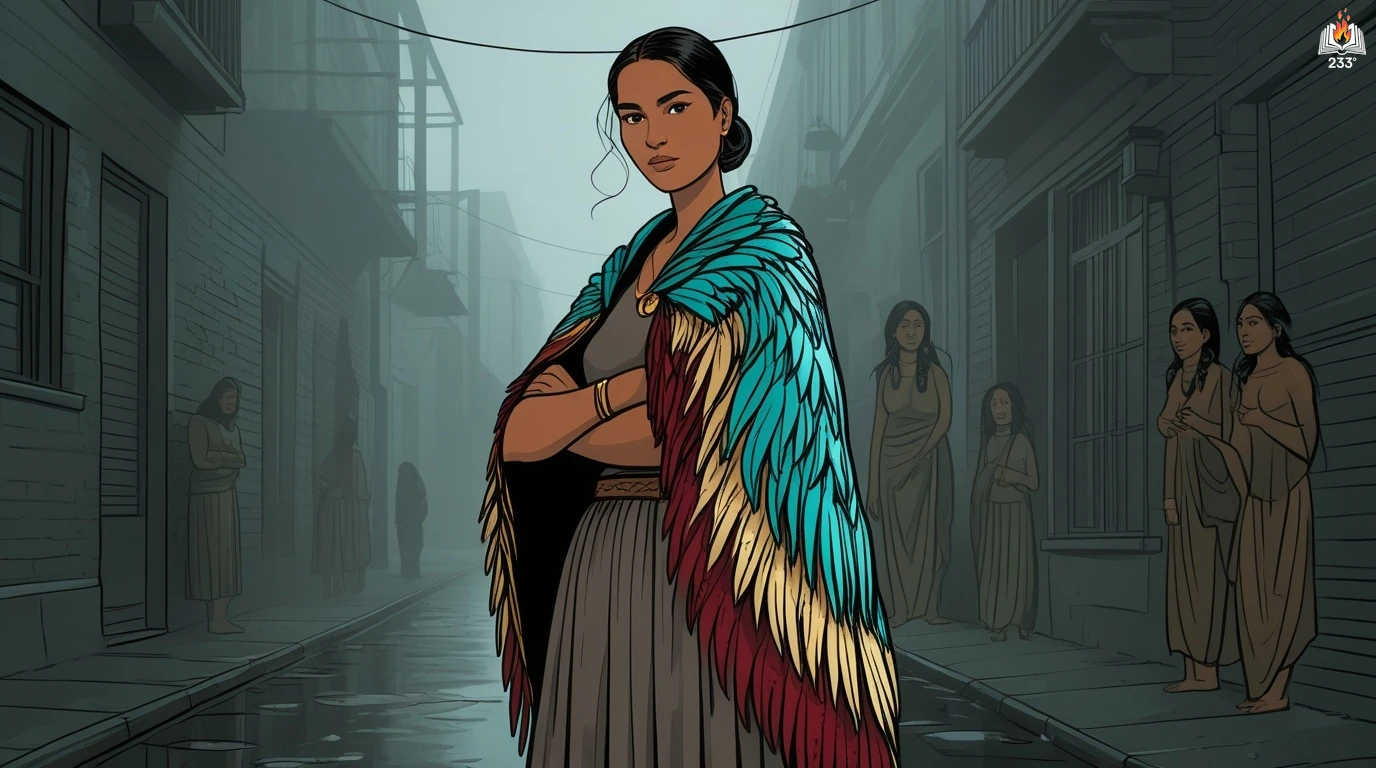
By the Light of My Father’s Smile by Alice Walker, published in 1998, is a lyrical, spiritual, and emotionally charged novel that explores the power of sexuality, love, and forgiveness across generations. Infused with mysticism and memory, the narrative moves between life and the afterlife as it follows the lives of the Robinson family – two daughters, their mother, and a father who observes from beyond the grave. Through intersecting perspectives, Walker addresses deep emotional scars left by cultural repression, patriarchal control, and the denial of sexual freedom. The story stretches across the United States, Mexico, and Greece, folding intimate confessions into a meditative narrative about grace, redemption, and the light that survives death.
Plot Summary
In the quiet afterlife, a father watches his daughter drive through winding mountain roads, music swelling around her like memory. She does not know he’s there, nor does she recall him with fondness. He watches, burdened by regret, as she moves freely through the world he once tried to mold, the same daughter whose spirit he once attempted to crush with silence and control. His presence lingers, unseen, like the echo of a withheld smile.
Susannah, his youngest, searches for meaning in angels and love, for the threads that connect her body to her soul. Her relationships – tender, erotic, broken – unfold across continents, from Kalimasa’s jeweled coastlines to the cold rooms she shares with lovers who fail to hear her sorrow. Her hunger for understanding leads her back to the village where angels hang on every wall and the sea knows her name. There, amid candlelight and foreign whispers, she wears a ring she finds in a quiet shop, black onyx circled with flecks of gold. It fits as if destined. It calls forth a part of her spirit she forgot she once possessed.
Her time in Kalimasa is split between the heat of the streets and the coldness in her heart. She travels with Pauline – demanding, carnal, wounded. Their nights twist into each other, bodies lit by sweat and history. Their intimacy is tangled with power, silence, and a raw need to be seen. Underneath it all is a shadow – a father remembered not for his embrace but for his rage. Susannah bears the weight of witnessing, of the moment she saw her father’s darkness through a keyhole, when the man who taught forgiveness lashed out against her sister.
Magdalena was always wild, radiant, untamed. She was the sun rising against propriety, called MacDoc, then Mad Dog, and finally June. She leapt across boulders in the Sierra Madre, matched only in spirit by Manuelito, the boy who found her amidst mountains and bluebells. Their cave became a sanctuary – their house – where the light was holy and their bodies sacred. Their love was fierce and wordless, a prayer whispered through the skin. She was never lost until her father found out. And when he did, the silver belt he used sang against her flesh with all the fury of a broken man.
Her father punished her in silence. No sermon. No grace. Just the echo of leather on skin, and the unseen sobbing of Susannah pressed to the other side of the door. Her mother packed, furious yet resigned. The family moved north. Life folded itself into quiet disarray.
Years passed. The girls grew tall, built stories around their scars. Magdalena, renamed June, wore silence like armor. Her rage turned inward, thickening into cynicism, hunger, and eventually stillness. Her sister floated between lovers, always looking for a reflection of the self she could no longer remember. Their father, living with his own undoing, tried to make sense of the voice in his head that led him to believe punishment was godliness. He’d spent a lifetime listening to something older than him – an inherited belief that drowned his own spirit.
Langley, their mother, bore her own sorrows. She had followed him to Mexico out of love and left it hollowed by betrayal. She’d traded anthropology for submission, donned long white dresses and the mask of a pastor’s wife. But after the beating, she turned away from him, shut him out of their room, and into a nightly ritual of penance. He begged outside her door. She threw vases and silence at him. Still, she softened in grief, in illness, in memory. When her brother Jocko died – flamboyant, mysterious, and full of dreams – she cried into her boots and let her husband hold her again.
Together, they rediscovered each other in the shadows of loss. Their love was not young, but it was urgent. They touched each other as if they’d forgotten how, laughed through mourning, and remembered what it meant to be desired. She stood in silver boots and declared her grief with wild elegance. He watched, stunned by her rawness, undone by the way she wore heartbreak like perfume. They made love with tenderness and force, shedding years of blame, skin pressed to skin, sorrow against sorrow.
Susannah, too, moved toward healing. She wrote, but the words came without passion. Her father watched from the veil, urging her to remember even the dogs she thought were twins, forever hooked in copulation. He knew her repression was not hers alone – it had been planted, bent like a sapling, in the moment she saw her sister beaten for loving. Her voice had been stilled by fear, her sensuality wrapped in caution. He begged her, without breath or body, to reclaim it.
In Greece, her ex-husband Petros sailed the green waters and thought of her. She had taught him how to love his own past, how not to discard it like a broken spoon. He remembered the way she studied relics and kissed like it was scripture. But it was never enough. She had always belonged to herself.
The daughters drifted. Their father’s death had left no peace, only questions. But his spirit lingered. He watched June gobble food with defiance, raising bread above his reach. He watched Susannah kiss a woman with weary affection. He watched them become the women they were meant to be – not despite him, but perhaps because of what he failed to give.
Somewhere, in the land of the Mundo, angels still dance on walls. Bluebells bloom in secret caves. A belt lies forgotten beneath a pillow. And Susannah, her fingers wrapped in onyx and gold, learns that to write of passion is not to betray the past, but to reclaim it. Her body, once a battlefield of silence, becomes again a source of light.
And the father, finally, smiles.
Main Characters
Susannah Robinson – A reflective, sensual, and emotionally complex woman whose journey is at the novel’s heart. As the younger daughter, she grapples with the emotional legacy of her father’s rigid morality and physical abuse toward her sister. She explores her sexuality freely, through both heterosexual and homosexual relationships, and gradually seeks spiritual healing and connection – especially with her late father, who becomes a guiding presence in her introspections.
Magdalena “June” Robinson / MacDoc / Mad Dog – Susannah’s elder sister, passionate, rebellious, and fiercely independent. She defies her father’s control by embracing her sexuality and a deep romantic bond with a Mundo boy, Manuelito. Her punishment at the hands of her father becomes a symbolic and literal rupture, shaping the emotional and spiritual rift within the family. Magdalena’s character represents both resistance and trauma, as well as the struggle for self-authentication.
Langley Robinson – The girls’ mother, an intelligent and emotionally grounded woman. A former anthropologist turned pastor’s wife, Langley sacrifices a great deal in the name of love and duty. Her quiet resilience and eventual return to herself after her husband’s betrayal offer a powerful depiction of feminine endurance and sensual revival.
Mr. Robinson (Unnamed Father/Narrator) – A conflicted minister and anthropologist who punishes his daughter’s sexual awakening, only to spend the afterlife coming to terms with his actions. From beyond the grave, he narrates much of the story with a mix of regret, longing, and an evolving understanding of grace, love, and forgiveness. His character arc is central to the novel’s spiritual exploration.
Pauline – A woman Susannah travels with to Kalimasa. Pauline is emotionally complex, attention-seeking, and sexually assertive. Their intense and sometimes uneasy relationship mirrors Susannah’s internal struggle with intimacy and trust.
Theme
Sexuality and Spirituality – Walker presents sexuality not as a carnal distraction but as a spiritual gateway. The novel links sexual fulfillment with divine presence, especially in contrast to religious repression. The sensual is sacred; repression is death.
Forgiveness and Redemption – Central to the story is the father’s posthumous desire for forgiveness. The narrative becomes a meditative pilgrimage toward reconciliation – between father and daughters, husband and wife, and the self with its own past.
Memory and Ancestry – Memory acts as a sacred space, where the dead linger and the living seek truth. The Robinsons’ journey involves uncovering hidden histories – both personal and cultural – to find healing.
Cultural Collision and Identity – The novel examines the intersections of race, gender, and heritage, particularly through the family’s anthropological work with the Mundo people. The Mundo, in their openness and harmony with nature, become a contrasting mirror to the repressed Western ideals the Robinsons represent.
The Power of Naming and Identity – The shifting names of Magdalena (June, MacDoc, Mad Dog) reflect her journey through imposed identities and self-definition. Names become a means of reclaiming agency and rewriting one’s narrative.
Writing Style and Tone
Alice Walker’s prose in By the Light of My Father’s Smile is sensual, poetic, and layered with spiritual resonance. She fuses first-person and omniscient narration in a fluid, dreamlike rhythm that allows voices of the living and the dead to coexist. The novel often reads like an incantation or a confession, where the sacred and erotic blend without shame. Walker’s descriptions are vivid and emotionally rich, often symbolic, inviting readers into a world where the seen and unseen blur.
Walker also employs fragmented storytelling – nonlinear, nonlinear sequences, inner monologues, and shifting perspectives – to echo the rhythms of memory and emotion. Her tone moves between mournful, reflective, and celebratory, always anchored in compassion for human frailty and strength. Despite addressing heavy themes like sexual trauma and regret, the novel is suffused with grace and hope. It is, at its core, a spiritual offering that exalts liberation through honesty and love.
Quotes
By the Light of My Father’s Smile – Alice Walker (1998) Quotes
“We do not believe in heaven or hell...; we do not believe in eternal damnation. We believe only in the unavoidable horror of hurting others and of likewise being hurt.”
“The only way to solace anyone who loved you in life is to be a good memory”
“Some people think politeness is an invitation to invade.”
“It is the need to be remembered that has caused most of the trouble in the world,”
“It is a way of saying you must not live too much in your head. It is a way of reminding you to stay in your emotions, no matter how nutty they are; it is a way of saying, also, that craziness has value.”
“Sighing, Irene said, Why is it that we can love so much that which only makes us cry? Susannah thought for only a moment, and then, with certainty, she said: Because it is that which calls us home to the heart.”
“Susannah was glad that, on principle, she rarely listened to men. Rarely believed, really, a word they said. No matter how much she might love them.”
“Fantasy was the reality of my life. Thank you for enjoying it with me.”
“It is because when you truly love someone you wish them no suffering, although they must suffer, just in the course of life. You are always reaching out to them, to heal them. They instinctively do the same for you.”
“The dead are required to finish two tasks before all is over with them: one is to guide back to the path someone you left behind who is lost, because of your folly; the other is to host a ceremony so that you and others you have hurt may face eternity reconciled and complete.”
“To love someone over many years is all the opportunity you need to learn how to love them back from anywhere.”
“There was a saying among the Mundo: It takes only one lie to unravel the world.”
We hope this summary has sparked your interest and would appreciate you following Celsius 233 on social media:
There’s a treasure trove of other fascinating book summaries waiting for you. Check out our collection of stories that inspire, thrill, and provoke thought, just like this one by checking out the Book Shelf or the Library
Remember, while our summaries capture the essence, they can never replace the full experience of reading the book. If this summary intrigued you, consider diving into the complete story – buy the book and immerse yourself in the author’s original work.
If you want to request a book summary, click here.
When Saurabh is not working/watching football/reading books/traveling, you can reach him via Twitter/X, LinkedIn, or Threads
Restart reading!