The Temple of My Familiar by Alice Walker, first published in 1989, is a rich, multi-voiced novel that continues the spiritual and ideological journey initiated in her Pulitzer Prize-winning The Color Purple. This sweeping narrative weaves together ancestral memory, African and Indigenous spirituality, feminist consciousness, and personal transformation. Told through interlocking stories and the voices of interconnected characters, the novel explores the legacy of oppression and the power of love, art, and identity to transcend trauma.
Plot Summary
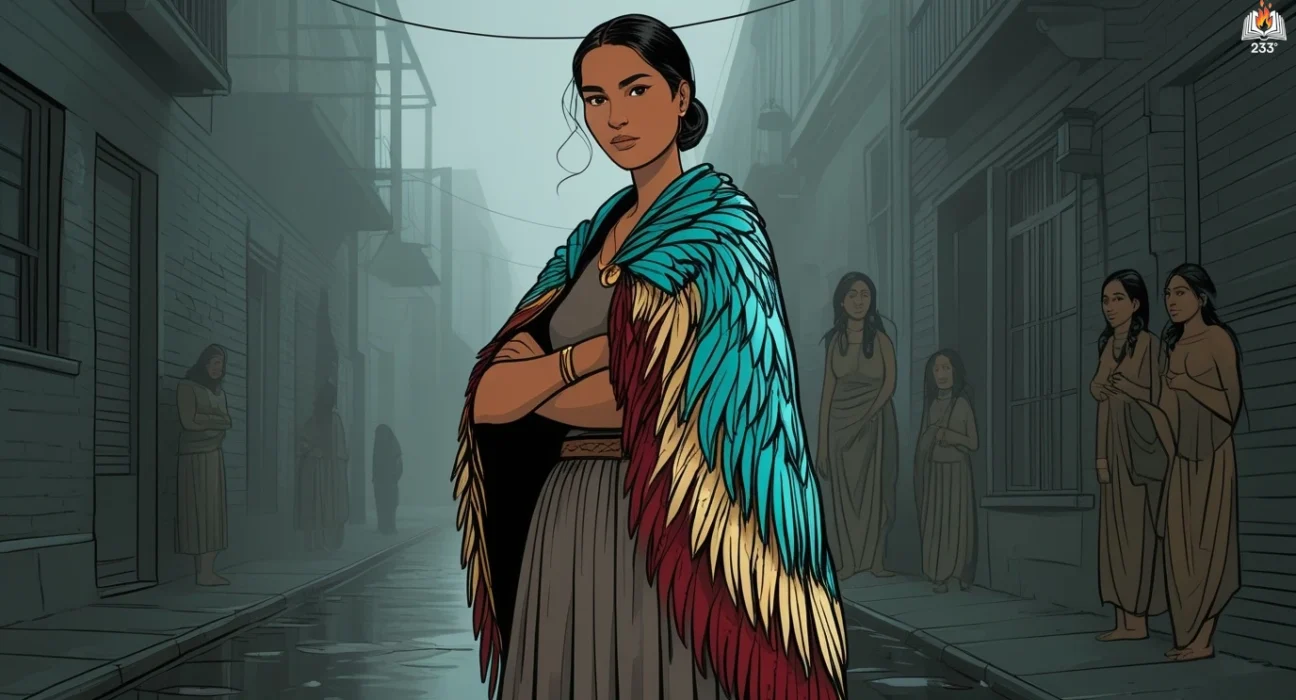
In a world stretched across continents, time, and the thin veil between memory and myth, a woman named Carlotta is born behind prison walls. Her mother, Zedé, once a gifted feather artisan from South America, had dared to teach children in the hills after the regime had closed the schools. For this, she was condemned as a Communist and vanished into a reeducation camp disguised as a papaya plantation. There, amidst the stolen lands of Indigenous people, Carlotta comes into the world. Somehow – perhaps by a riverboat mistaken for seaweed or some quiet grace of the gods – mother and child escape and drift their way into the fog-drenched city of San Francisco.
In that strange, gray land, Zedé continues the craft of feathers. Though her fingers are tired and her eyes wary, her creations – capes, headdresses, earrings – glisten with ancestral magic. Carlotta, serious-eyed and almond-skinned, learns to move quietly through the world. She becomes a courier for the capes, the shawls, the jewelry that rich white women and rock stars wear without seeing the brown hands that shaped them. One day, she delivers a cape to Arveyda, a world-famous musician whose eyes hold both mischief and stillness. He looks at her – truly sees her – and recognizes her not as a servant but as his mirror. Brown skin, ancestral ache, untold stories.
Their love grows, fluid and warm, folding into a shared rhythm. Zedé watches them with tenderness and grief, for in Arveyda’s face she sees someone long gone – the father of her daughter, a man with rough hair and sad eyes. And perhaps because the spirit of that man lingers in Arveyda, or perhaps because the soul takes liberties the flesh fears to name, Zedé and Arveyda fall in love too. Quietly, powerfully. Once only, their bodies meet, and though they vow to never cross that line again, the longing never leaves them. It clings to Arveyda’s music – discordant, luminous, uncontainable. It swells in Zedé’s chest like a second heartbeat. Carlotta, sensing shadows in the light of her marriage, eventually unearths the truth.
Betrayed, Carlotta leaves. She takes the children and with her goes the illusion of wholeness. She retreats into the silence of academia, where she teaches women’s literature and tries to forget the ache in her mother’s letters or the warmth of her husband’s voice. But the letters come – thin-scented pages from foreign lands – from Zedé, who now travels with Arveyda through Mexico, Central and South America. Their journey, filled with mangoes and rivers, laughter and light, awakens something that had been sleeping inside Zedé. For the first time in her life, she lives without fear. Her body grows soft again. Her eyes shine. Her voice begins to sing.
Elsewhere, in a time both now and ancient, a man named Suwelo arrives in Baltimore to bury his great-uncle Rafe. In the quiet halls of the row house he inherits, he finds more than dust and antimacassars. He finds Lissie – not in flesh, but in scribbled notes and stories passed down like secret songs. Lissie, who remembers being a lion. Lissie, who remembers being enslaved, being worshipped, being hunted, being divine. Through her, Suwelo begins to understand the weight of history – the way memory can warp the spine, how forgetting is a kind of death. As she tells him of past lives and deeper truths, his understanding of masculinity, of women, of time itself begins to shift.
Fanny, Suwelo’s ex-wife, reappears not as the bitter woman he once abandoned, but as a spiritual warrior. She reclaims herself through dance, through dreams, through the women she teaches. The gap in her teeth – once a source of embarrassment – becomes her mark of power, a symbol of her uncolonized beauty. She no longer needs Suwelo’s remorse. She has moved into the sacred, away from the noise of longing.
Meanwhile, Carlotta, carrying her heartbreak like an heirloom, slowly begins to see. The pain she felt, the betrayal, the loss – all of it part of a deeper current, older than marriage or motherhood. When she finally sees her mother again, the sight is disorienting. Zedé is not the stooped seamstress of her childhood but a woman reborn, glowing like a ripe fruit. The distance between them shortens, not with apologies, but with understanding.
Arveyda continues to play. On stage, beneath feathered lights, in capes that whisper of jungle and sky, he becomes a conduit for the pain and pleasure of the world. His music carries the vibrations of unborn dreams and remembered wounds. People flock to him, not for fame, but for healing. His songs are spells. And in each note, Zedé’s spirit rises. She who taught him silence could be sacred. She who loved him without claiming him.
Years pass. Children grow. Bodies age. But the soul – that restless, remembering thing – keeps circling back. In dreams, in music, in the smell of mangoes. In the glint of feathers once plucked but now shimmering again in flight.
No one ends up where they began. Carlotta learns that pain can be a doorway. Suwelo learns that wisdom is often delivered by those he once ignored. Fanny rediscovers joy in her own body. And Zedé, who once hid her hands in fear, now raises them to the sun.
The earth spins. The ancestors whisper. The temple – familiar and sacred – is found not in stone, but in the body, in memory, in love. It is found in the refusal to forget.
Main Characters
Carlotta – A perceptive and emotionally complex woman of South American Indigenous descent, Carlotta is shaped by her mother’s silent strength and her own journey through identity, love, and betrayal. Her growth from a quiet child to a scholar of women’s literature and eventual mother navigating heartbreak reflects her deep emotional and cultural evolution.
Zedé – Carlotta’s mother, a once-persecuted feather artist and political prisoner, embodies resilience, trauma, and maternal love. Her quiet grace hides a past of great suffering, but she blooms later in life through love and travel, revealing the depth and sensuality often denied to older women in literature.
Arveyda – A famous musician of African and Native descent, Arveyda represents spiritual longing, artistic genius, and emotional complexity. Torn between his love for Carlotta and an unexpected soul-deep connection with Zedé, he channels his inner conflict and longing through haunting, transformative music.
Suwelo – A university professor undergoing a personal crisis, Suwelo serves as a vessel for masculine introspection and change. His path to redemption is guided by his great-uncle Rafe’s memories and a series of spiritual and sexual revelations shared by the mysterious woman Lissie.
Lissie – A mystical, shape-shifting woman with memories of being a black woman for thousands of years, including past lives as a lion and a slave. Lissie’s stories challenge history, gender, and temporality. She is Walker’s spiritual guide for reclaiming a suppressed, feminine, and ancient wisdom.
Fanny – Suwelo’s ex-wife, Fanny is an independent and intellectual woman who reclaims her dignity after years of betrayal. Her journey toward self-love and spiritual rebirth exemplifies the feminist message of the novel.
Theme
Reincarnation and Ancestral Memory: The novel suggests that personal and collective trauma spans generations and lives. Lissie’s stories of past lives emphasize how souls evolve through centuries of struggle and love, challenging Western linear perceptions of time and identity.
The Sacred Feminine and Goddess Worship: Walker reclaims the divine power of womanhood by embedding matriarchal spirituality into the narrative. Through characters like Zedé and Lissie, the novel explores how suppressed feminine divinity can heal historical wounds.
Colonialism and Cultural Erasure: Whether through Zedé’s imprisonment or the theft of Indigenous feathers for Western fashion, the novel reveals the violence of colonization. Walker critiques how culture, beauty, and spirituality are commodified or destroyed under imperialism.
Love, Desire, and Betrayal: At its core, this is a love story – not a simple one, but a layered tapestry of longing, fidelity, betrayal, and passion. The forbidden love between Arveyda and Zedé underscores the complexity of human emotion, while Fanny’s journey symbolizes the reclamation of self after heartbreak.
Art and Music as Healing Forces: Arveyda’s music, Zedé’s feathers, and the stories the characters share are all portrayed as sacred art forms. They are tools of transformation and resistance, echoing the novel’s belief that creativity can preserve and restore the soul.
Writing Style and Tone
Alice Walker’s style in The Temple of My Familiar is fluid, lush, and unapologetically poetic. She employs multiple narrators, shifting perspectives, and a nonlinear structure that reflects the mystical and cyclical nature of the stories. Her prose is rich with sensual imagery, particularly of nature, bodies, and colors, infusing the narrative with a dreamlike quality. By fusing oral tradition, folklore, and magical realism, Walker constructs a spiritual tapestry that honors ancestral voices and sacred truths.
The tone is both reverent and revolutionary. Walker treats her characters with deep compassion, even as she lays bare their flaws. There is a sacredness to her depictions of the feminine body, love-making, childbirth, and artistic creation. Yet the novel is also a fierce critique of patriarchal domination, racism, and the suppression of spiritual knowledge. Through sorrow, satire, wonder, and eroticism, Walker invites the reader not just to witness but to awaken.
Quotes
The Temple of My Familiar – Alice Walker (1989) Quotes
“I'm mad about the waste that happens when people who love each other can't even bring themselves to talk.”
“Helped are those who are content to be themselves; they will never lack mystery in their lives and the joys of self-discovery will be constant.”
“What you hope for, you also fear. ”
“Resist the temptation to think what afflicts you is peculiar to you. Have faith that what is in your consciousness can be communicated to the consciousness of all. And is, in many cases, already there.”
“Some people don't understand that it is the nature of the eye to have seen forever, and the nature of the mind to recall anything that was ever known.”
“Too much respect for people who are not respectful to you is a sure sign of insecurity.”
“Helped are those who forgive; their reward shall be forgetfulness of every evil done to them. It will be in their power, therefore, to envision the new Earth. -----“The Gospel According to Shug”
“Keep in mind always the present you are constructing. It should be the future you want.”
“The life of my people is to remember forever; each head granary is full. The life of your people is to forget: your thing granaries ("museums"), and not yourselves, are full.”
“that the reason Athena had sprung ‘full blown’ from the mind of Zeus was because she was an idea, given by Greek men to their God; and that ‘idea’ was the destruction of the African Goddess Isis and the metamorphosis of Isis into the Greek Goddess Athena.”
“I’m mad about the waste that happens when people who love each other can’t even bring themselves to talk.”
“Perhaps this is simply the way it is with writers. It's when they don't see you that you matter. Because then you can belong to them in a way that permits them complete possession. You are determined by them. You are controlled. You are, generally speaking, exaggerated.”
“Our mothers taught us that in the old, old days, when they were their grandmothers and their grandmothers were old—for we are our grandmothers, you understand, only with lots of new and different things added”
“You must learn to love only that which cannot be stolen,”
“She was so angry. The maddest human being I’ve ever seen in all my years of living. Because she saw people losing ground in the battle against ignorance and she could see how it would turn out, whatever the battle was, because she had seen it all before.”
“They were not good people—they had too much money to have ever been good people”
“Life was so peaceful that Zedé did not realize they were poor.”
“Keep in mind always the present you are constructing. It should be the future you want. —Ola”
“tribal cloth, the magic of which is that as long as it is woven, the tribe exists; as long as you know how to weave it, so do you.”
“This, then, was the power people like us had. The power to enslave others and to frustrate their dreams.”
“He was in the jovial mood, as he sometimes phrased it, of the literarily inclined escaped convict.”
“Did people leave you, did their spirits simply take off, because you wouldn’t read a book that turned them on? He now knew the answer was yes.”
We hope this summary has sparked your interest and would appreciate you following Celsius 233 on social media:
There’s a treasure trove of other fascinating book summaries waiting for you. Check out our collection of stories that inspire, thrill, and provoke thought, just like this one by checking out the Book Shelf or the Library
Remember, while our summaries capture the essence, they can never replace the full experience of reading the book. If this summary intrigued you, consider diving into the complete story – buy the book and immerse yourself in the author’s original work.
If you want to request a book summary, click here.
When Saurabh is not working/watching football/reading books/traveling, you can reach him via Twitter/X, LinkedIn, or Threads
Restart reading!