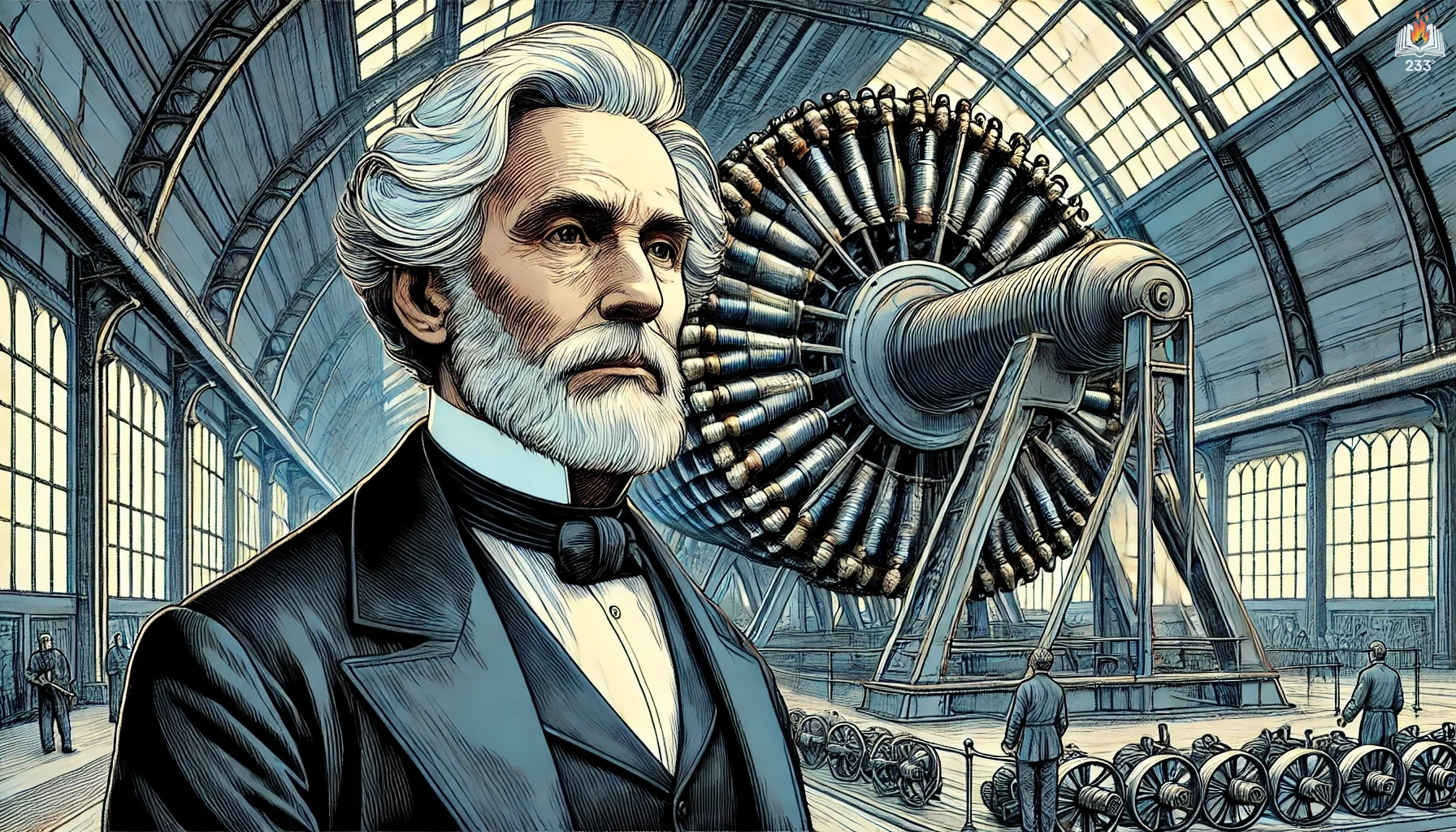

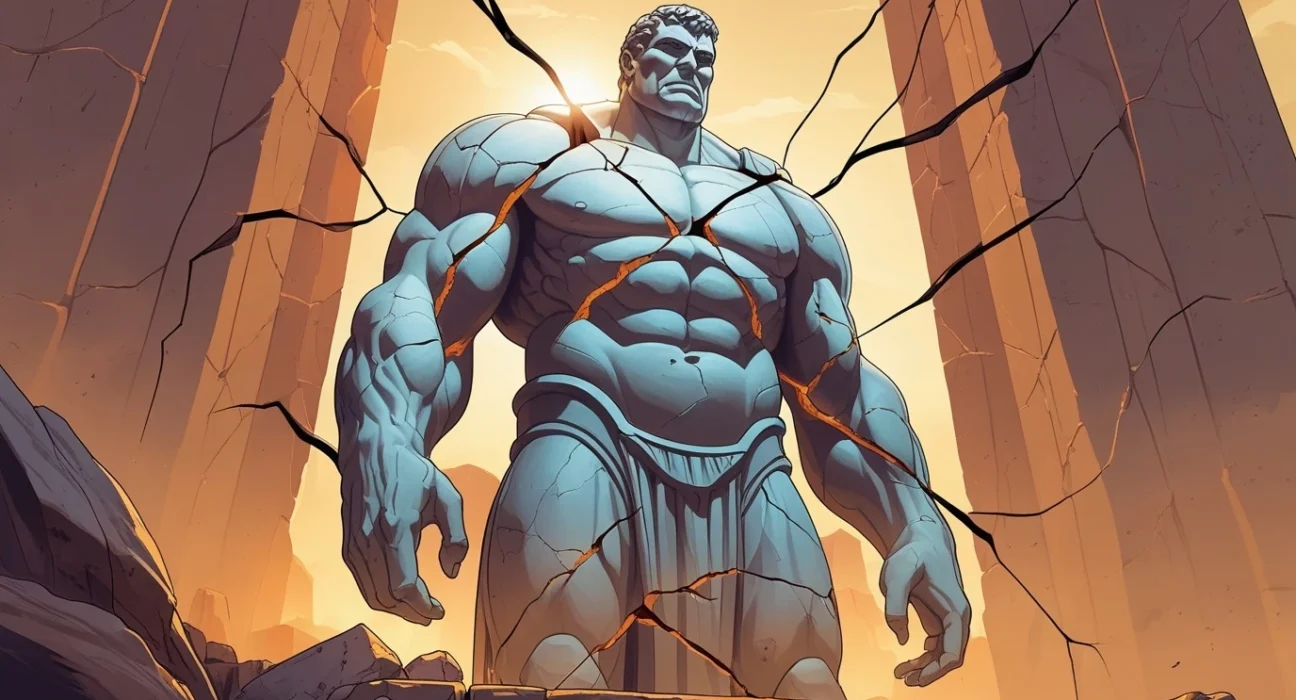
David and Goliath: Underdogs, Misfits, and the Art of Battling Giants by Malcolm Gladwell, published in 2013, explores the hidden dynamics behind apparent disadvantages and challenges conventional ideas of power and advantage. Known for his narrative-rich style and insightful dissections of social psychology, Gladwell begins with the iconic biblical battle between David and Goliath, reinterpreting it through a modern lens to frame a deeper exploration of how perceived weaknesses often mask hidden strengths. The book spans various domains – education, warfare, sports, and personal adversity – to reveal how those who seem to have the odds stacked against them may, in fact, be best positioned to succeed.
Plot Summary
In a sun-drenched valley in ancient Palestine, two armies stand locked in a standoff. On one side, the Philistines, battle-hardened and powerful, with their greatest warrior leading the charge – a giant clad in heavy armor, flanked by a shield-bearer. On the other side, the Israelites, motionless with fear, unable to find a champion to face this towering opponent. Then, a shepherd boy steps forward. Small, swift, and unarmored, he carries no sword, only a sling and a few stones. He runs toward the giant, not away, and with one calculated strike, he topples the beast. The battle, many thought, should have ended before it began. But it didn’t. Because Goliath was never as strong as he looked, and David, never as weak.
From that fabled duel emerges a deeper tale – one not of brute strength, but of perception, adaptability, and the unacknowledged advantages of disadvantage. Time and again, what seems like weakness is shown to be a hidden strength, and what appears to be power turns out to be brittle.
Years later, in a gym in Silicon Valley, a father with no knowledge of basketball agrees to coach his daughter’s junior league team. Vivek Ranadivé, a man more at home in a software boardroom than a basketball court, refuses to accept the rules as given. He notices something others don’t – that most teams concede seventy feet of the court without a fight, content to play the game only in their own half. But his girls aren’t tall, they aren’t skilled, and they’ve barely played before. So he teaches them to press – not for a minute or two, but for every second of every game. They trap, steal, intercept. Opposing teams stumble in confusion, unable to adapt to this chaos. Ranadivé’s girls, a team of so-called misfits, march to the national championships, not by playing the game better, but by playing a different game entirely.
A similar spirit drives Lawrence of Arabia, a scholar turned military leader, who leads Bedouin rebels through blistering deserts to outwit the Turkish army. Where others see a superior force with strongholds and numbers, Lawrence sees vulnerability – slow supply lines, reliance on railroads, rigid formations. His men, fleet on camels, strike not at the heart but at the edges, dissolving the enemy’s control one sabotage at a time. They attack Aqaba not from the sea, where Turkish guns face west, but from the land – from the unthinkable direction, where no army was supposed to come.
The same pattern repeats in silent classrooms and polished boardrooms. In Connecticut, a middle school shrinks in size, and with it, the class sizes. Fewer students, more individual attention – an ideal on paper. But as the desks empty, the silence grows too loud. Students withdraw, discussion fades, and the energy that once thrived in a crowded room dissipates. The assumption that smaller is better collapses under the weight of real human behavior. Sometimes, a little disorder is the price of vibrancy.
At the other end of the spectrum, immense wealth brings its own blind spots. A Hollywood mogul, who once earned every dollar with effort and ingenuity, finds himself raising children in mansions with endless privilege. He watches, uneasily, as the hunger that once drove him seems to vanish from his children’s eyes. The challenge shifts – from making money to instilling values in a world where deprivation is unknown. He can buy anything, but struggles to teach the worth of things.
Across continents and careers, the same thread emerges – strength lies not in abundance, but in the ability to see clearly. To defy convention when it no longer serves. Time and again, the underdog triumphs, not by mimicking the strong, but by refusing to play by the strong’s rules. Just as David rejects the heavy armor of King Saul and chooses speed and skill over brute force, others discover their own way by walking away from the script.
In Northern Ireland, a woman whose child was killed during The Troubles faces the impossible choice of justice or peace. Her pain, deep and enduring, drives her not to vengeance, but to forgiveness. She joins hands with those she should hate, choosing dialogue over division. It’s not weakness that makes her forgive – it’s strength, sharpened by grief, honed by purpose.
Later, a young man with dyslexia stumbles through school, unable to read like his peers. But while others rely on text, he learns to listen, observe, memorize. What once seemed a crippling limitation becomes an asset. He builds an empire by hiring the right people, delegating, thinking differently. His struggle, harsh and humiliating at times, taught him resilience and innovation that would serve him far better than perfect grades ever could.
A pattern takes shape – when the world says no, these unlikely contenders ask why not. They absorb pressure, adapt, and persist. They come not with might but with insight. They find room in the margins, and turn it into their arena. Goliaths are strong, yes, but also slow, over-reliant on the familiar, blind to possibilities outside their frame. Davids are nimble, unconventional, unwilling to be measured by the same yardstick.
And so, the myth of David and Goliath endures, not as a tale of miraculous odds, but as a lesson in seeing clearly. What appears powerful may be vulnerable. What seems to be a disadvantage may in fact be the key to survival, even success. The shepherd boy was not lucky. He was prepared. He understood the game differently. And that – that changed everything.
Main Characters
David (Biblical Figure): Reimagined not as a weak underdog, but as a strategic, agile slinger facing a lumbering, slow, and possibly visually impaired Goliath. David’s courage and innovation set the thematic tone for the entire book. He becomes a metaphor for all who challenge the status quo with unconventional tactics.
Vivek Ranadivé: A Silicon Valley software entrepreneur who coached his daughter’s underdog basketball team to unexpected victories by employing an unorthodox full-court press strategy. His refusal to follow traditional norms exemplifies the power of thinking differently when disadvantaged.
T. E. Lawrence (Lawrence of Arabia): A historical figure who led Bedouin rebels against the Ottoman Empire during World War I. Like David, he leveraged mobility, unconventional warfare, and psychological strategy to defeat a much stronger adversary.
Teresa DeBrito: A school principal who confronts the assumption that smaller class sizes are always beneficial, showcasing how what is considered an “advantage” may not universally lead to better outcomes.
The Hollywood Mogul (Unnamed): A self-made millionaire reflecting on the unintended consequences of wealth on parenting, especially how affluence can undermine the values of effort and resilience he learned growing up without privilege.
Theme
The Advantage of Disadvantage: Gladwell repeatedly argues that what appears to be a setback can, under certain circumstances, be an asset. He introduces the “inverted-U curve” to show how traits like class size, wealth, or authority may become counterproductive when taken to extremes.
Unconventional Strategy as Power: Characters like David, Ranadivé, and Lawrence demonstrate that success often lies in rejecting conventional rules and inventing new approaches that better suit one’s unique position or resources.
Misjudgment of Power: One of the book’s core ideas is that people and institutions frequently misinterpret what constitutes strength. Goliath’s apparent might conceals profound weaknesses; likewise, institutions may overestimate their control due to traditional indicators of success.
The Psychology of Underestimation: Gladwell explores how being underestimated can embolden individuals to innovate, develop resilience, and outmaneuver stronger competitors by exploiting their blind spots.
Faith and Meaning in Struggle: Many stories in the book (including the biblical David’s) show how adversity forces individuals to clarify their values and dig deeper into their purpose, often resulting in transformative success.
Writing Style and Tone
Malcolm Gladwell’s writing in David and Goliath is characteristically lucid, anecdotal, and investigative. He blends storytelling with social science, seamlessly transitioning from biblical exegesis to modern case studies, historical events, and psychological research. His structure often follows a three-part progression: introduce an unexpected or paradoxical situation, delve into a detailed narrative or real-life case, then unpack the implications using insights from sociology, psychology, or statistics. This lends the book a rhythm that is both intellectually stimulating and emotionally compelling.
The tone of the book is inquisitive and reframing, often challenging prevailing assumptions with a tone of intellectual humility. Gladwell does not speak from a place of certainty or authority but rather from curiosity and fascination. He invites the reader to see the world through a new lens, presenting his arguments with clarity but also with room for complexity. This tone, combined with his storytelling prowess, makes the book not just a philosophical treatise on disadvantage, but a celebration of human ingenuity and perseverance.
Quotes
David and Goliath – Malcolm Gladwell (2013) Quotes
“Courage is not something that you already have that makes you brave when the tough times start. Courage is what you earn when you’ve been through the tough times and you discover they aren’t so tough after all.”
“Giants are not what we think they are. The same qualities that appear to give them strength are often the sources of great weakness.”
“As the playwright George Bernard Shaw once put it: “The reasonable man adapts himself to the world: the unreasonable one persists in trying to adapt the world to himself. Therefore all progress depends on the unreasonable man.”
“Any fool can spend money. But to earn it and save it and defer gratification—then you learn to value it differently.”
“What is learned out of necessity is inevitably more powerful than the learning that comes easily.”
“You can’t concentrate on doing anything if you are thinking, “What’s gonna happen if it doesn’t go right?”
“We spend a lot of time thinking about the ways that prestige and resources and belonging to elite institutions make us better off. We don’t spend enough time thinking about the ways in which those kinds of material advantages limit our options.”
“The excessive use of force creates legitimacy problems, and force without legitimacy leads to defiance, not submission.”
“When people in authority want the rest of us to behave, it matters—first and foremost—how they behave.”
“There is a set of advantages that have to do with material resources, and there is a set that have to do with the absence of material resources- and the reason underdogs win as often as they do is that the latter is sometimes every bit the equal of the former.”
“Much of what we consider valuable in our world arises out of (these) one-sided conflicts. Because the act of facing overwhelming odds, produces greatness and beauty.”
“... they were not really afraid. They were just afraid of being afraid.”
“For every remote miss who becomes stronger, there are countless near misses who are crushed by what they have been through. There are times and places, however, when all of us depend on people who have been hardened by their experiences.”
“The reasonable man adapts himself to the world: the unreasonable one persists in trying to adapt the world to himself. Therefore all progress depends on the unreasonable man.”
“But so much of what is beautiful and valuable in the world comes from the shepherd, who has more strength and purpose than we ever imagine.”
“Some pretend to be rich, yet have nothing; others pretend to be poor, yet have great wealth.”
“capitalization learning”: we get good at something by building on the strengths that we are naturally given.”
“A woman who walks away from the promise of power finds the strength to forgive – and saves her friendship, her marriage, and her sanity. The world is turned upside down.”
“as it may be—matters. How you feel about your abilities—your academic “self-concept”—in the context of your classroom shapes your willingness to tackle challenges and finish difficult tasks. It’s a crucial element in your motivation and confidence.”
“Gifted children and child prodigies seem most likely to emerge in highly supportive family conditions.In contrast, geniuses have a perverse tendency of growing up in more adverse conditions.”
We hope this summary has sparked your interest and would appreciate you following Celsius 233 on social media:
There’s a treasure trove of other fascinating book summaries waiting for you. Check out our collection of stories that inspire, thrill, and provoke thought, just like this one by checking out the Book Shelf or the Library
Remember, while our summaries capture the essence, they can never replace the full experience of reading the book. If this summary intrigued you, consider diving into the complete story – buy the book and immerse yourself in the author’s original work.
If you want to request a book summary, click here.
When Saurabh is not working/watching football/reading books/traveling, you can reach him via Twitter/X, LinkedIn, or Threads
Restart reading!