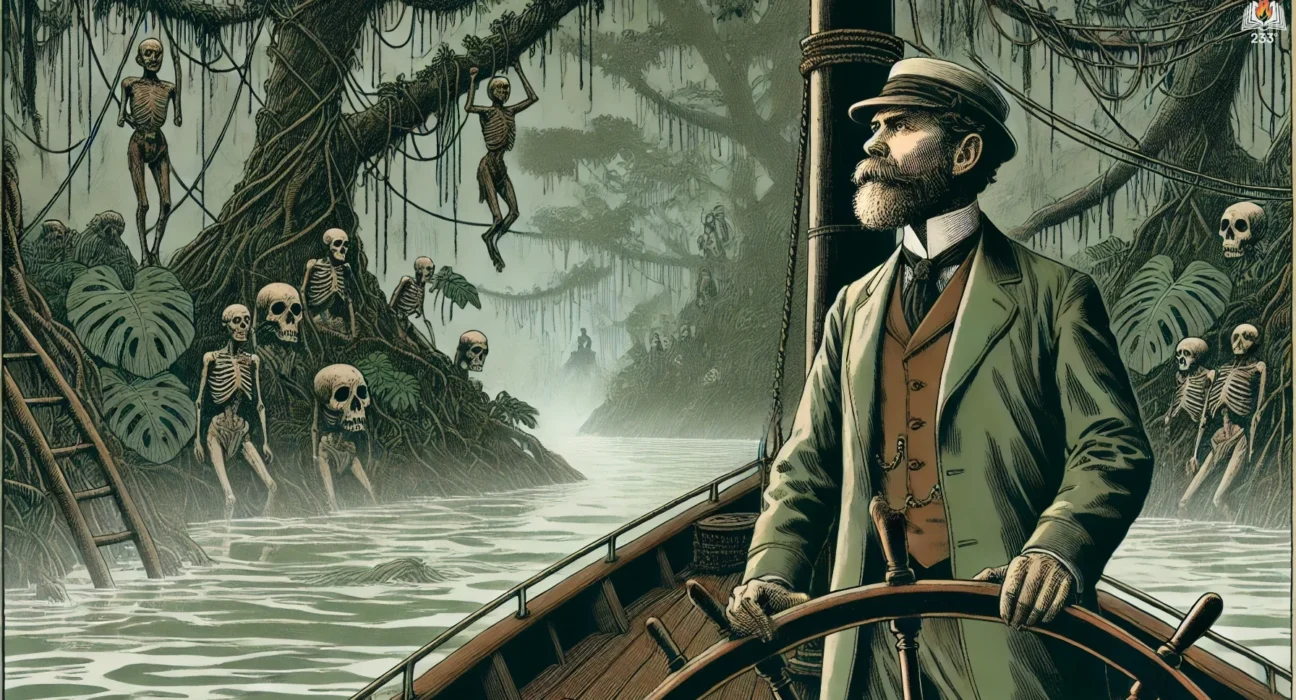
Heart of Darkness, written by Joseph Conrad and first published in 1902, is a profound exploration of colonialism, human nature, and the darkness within both the physical and psychological realms. Set primarily in the Congo, it follows the journey of Charles Marlow, a sailor, as he travels deep into the African wilderness to find Mr. Kurtz, an enigmatic ivory trader. The novella is celebrated for its rich narrative, its psychological complexity, and its incisive critique of European colonialism, often regarded as a forerunner of modernist literature.
Plot Summary
At dusk, a boat rests on the River Thames, quietly moored. A small group of men, former seafarers, sit in contemplative silence, watching the fading light. Among them is Marlow, whose somber demeanor and faraway gaze hint at untold experiences. As the gloom deepens, he begins to speak, recalling his journey into the heart of Africa, a journey that led him not only into the wilderness but into the darkness within man’s soul.
Marlow had always been fascinated by the blank spaces on maps, the unknown lands that beckoned with the allure of adventure. Africa, particularly the Congo River, became his obsession, a place that held the promise of discovery. With the help of a well-connected relative, Marlow secures a position as the captain of a riverboat for a European trading company, which operates deep in the Congo’s interior, extracting ivory. Eager for the journey, he embarks on a long voyage to Africa, where the land seems hostile and indifferent, its coast a grim and impenetrable jungle.
Upon arrival at the company’s outer station, Marlow encounters scenes of despair and degradation. The local inhabitants, who are employed as laborers, are treated with brutality, left to waste away under the oppressive sun. Marlow witnesses their suffering, but the Europeans at the station seem indifferent, driven by a singular desire for profit. The manager of the station is a man of hollow authority, concerned only with his own survival and advancement within the company. It is here that Marlow first hears of Kurtz, an enigmatic and brilliant ivory trader who has established himself deep in the jungle. Kurtz is spoken of in both awe and fear, revered for the vast amounts of ivory he collects and feared for his increasing madness.
Marlow is soon sent to the Central Station, where he is to take command of a steamship that will travel up the Congo River to retrieve Kurtz, who is reported to be ill. However, upon his arrival, he learns that the ship is damaged and will require extensive repairs before it can be used. The station itself is chaotic, with the European agents there seemingly lost in a haze of incompetence and idleness. The manager of the station is a cold, calculating man, suspicious of Kurtz’s growing influence and popularity with the company’s higher-ups. Marlow senses a dangerous tension, as Kurtz’s legend casts a long shadow over the men who resent him.
During the long months spent repairing the ship, Marlow becomes more intrigued by Kurtz. He hears more stories about the man, each one adding to the myth of Kurtz’s genius and madness. Kurtz is described as a man of great ideals, who once spoke eloquently of bringing enlightenment and civilization to the “savages.” Yet the deeper Marlow travels into the wilderness, the more he realizes that these ideals have been corrupted by the overwhelming power and isolation Kurtz has experienced.
Eventually, the ship is ready, and Marlow begins his journey up the river. The further he travels, the more the jungle closes in, an oppressive force that seems to swallow everything in its path. The silence of the wilderness is punctuated by the cries of unseen creatures, and the atmosphere grows heavier, more suffocating with each passing mile. The river, winding and seemingly endless, becomes a symbol of the journey into the unknown recesses of the human soul. Along the way, Marlow and his crew are attacked by unseen natives, arrows flying out of the thick brush. One of the crew is killed, and Marlow senses the danger that surrounds them. The wilderness is not only physical but psychological, and it begins to take its toll on those who venture too far into its depths.
When they finally reach Kurtz’s station, Marlow is greeted by a bizarre sight. A gaunt, Russian wanderer, dressed in rags, welcomes them and speaks with an almost religious reverence about Kurtz. He warns Marlow that Kurtz is gravely ill but still commands a terrifying power over the natives, who worship him as a god. The station is a place of horror. Human skulls are mounted on stakes around Kurtz’s compound, evidence of the brutal authority he has wielded over the local tribes. Kurtz, once a man of grand ideals, has descended into madness, consumed by his lust for power and ivory. He no longer speaks of civilization but of his own dominion over the jungle and its people.
Marlow finally meets Kurtz, who is bedridden and frail, yet his voice remains commanding. Despite his physical decay, Kurtz exudes an almost supernatural influence. Marlow realizes that Kurtz has embraced the darkness within himself, casting off all pretense of morality. Kurtz’s final words to Marlow, spoken in a whisper of despair, are a haunting declaration: “The horror! The horror!” These words encapsulate the profound emptiness and destruction that has consumed him.
As Kurtz dies, Marlow takes his body aboard the ship for the journey back down the river. The return trip is marked by silence and reflection. Kurtz’s death leaves a void, and Marlow feels the weight of his own disillusionment with the world he thought he knew. The journey back to Europe is a return to a society that remains blind to the darkness lurking beneath its veneer of progress and civilization.
Back in Europe, Marlow visits Kurtz’s fiancée, a woman who still believes in Kurtz’s nobility and vision. She asks Marlow what Kurtz’s final words were. Unable to bring himself to tell her the truth, Marlow lies, saying that Kurtz’s last words were her name, preserving her illusion of Kurtz as the man she loved.
The tale concludes as the men on the boat remain silent, contemplating the dark truths Marlow has revealed. The Thames, stretching out into the distance, merges with the wider world, carrying the weight of history, exploration, and the shadow of humanity’s darkest impulses.
Main Characters
Charles Marlow: The novella’s narrator and central character, Marlow is a sailor who becomes deeply introspective as he recounts his journey into the Congo. His experience with the horrors of colonial exploitation transforms him, making him a reflective figure on the blurred line between civilization and savagery.
Mr. Kurtz: A once-idealistic ivory trader who has become a tyrant ruling over native Africans in the Congo. Kurtz represents the corrupting influence of power and greed, his character embodying the destructive potential of unchecked ambition and moral decay.
The Manager: The calculating and inscrutable manager of the Central Station, whose bureaucratic mindset represents the soulless, mechanical nature of colonialism. He is obsessed with maintaining his position and cares little for the suffering around him.
The Russian Harlequin: A devoted follower of Kurtz, the Russian is naïve yet deeply loyal. He admires Kurtz’s charisma, becoming a symbol of how charisma and power can manipulate those seeking meaning and purpose.
Theme
Colonialism and Its Brutality: The novella exposes the exploitative nature of European colonialism, presenting it as a facade of bringing civilization to the “savage” lands, while in reality, it is driven by greed, cruelty, and the dehumanization of the native population.
Darkness and Light: Darkness in Heart of Darkness is symbolic of the unknown, both in the African wilderness and in the human soul. It contrasts with the supposed light of European civilization, questioning whether moral “light” really exists in a world marred by hypocrisy and barbarism.
Madness and Isolation: The farther Marlow travels into the Congo, the more isolated and detached from reality he becomes, reflecting the psychological impact of the wilderness and Kurtz’s own descent into madness. This theme explores how isolation from societal norms can lead to a collapse of reason and morality.
The Fragility of Civilization: Through Marlow’s journey, Conrad reveals the fragility of European notions of civilization. The novella suggests that beneath the veneer of social order lies an inherent savagery, waiting to emerge when societal structures break down.
Writing Style and Tone
Joseph Conrad’s writing in Heart of Darkness is dense, layered with symbolism, and imbued with a heavy, brooding tone. His use of first-person narrative, as seen through Marlow’s introspective monologues, brings a deeply psychological element to the story. The narrative technique is non-linear, with Marlow’s recounting of events often moving between past and present thoughts, which reinforces the hazy, dreamlike atmosphere of the novel.
The tone is dark, foreboding, and contemplative, mirroring Marlow’s internal struggle as he grapples with the horrors of colonialism and the enigmatic figure of Kurtz. Conrad employs descriptive, almost poetic language to evoke the eerie landscapes of the Congo, using it as a metaphor for the inscrutable and dangerous depths of the human psyche. The novella’s symbolic richness and moral ambiguity are central to its modernist qualities, leaving the reader with unsettling questions about humanity’s true nature.
Quotes
Heart of Darkness – Joseph Conrad (1899) Quotes
“We live as we dream--alone....”
“It was written I should be loyal to the nightmare of my choice.”
“I don't like work--no man does--but I like what is in the work--the chance to find yourself. Your own reality--for yourself not for others--what no other man can ever know. They can only see the mere show, and never can tell what it really means.”
“Your strength is just an accident arising from the weakness of others.”
“No, it is impossible; it is impossible to convey the life-sensation of any given epoch of one’s existence--that which makes its truth, its meaning--its subtle and penetrating essence. It is impossible. We live, as we dream--alone.”
“Droll thing life is -- that mysterious arrangement of merciless logic for a futile purpose. The most you can hope from it is some knowledge of yourself -- that comes too late -- a crop of inextinguishable regrets.”
“We live as we dream - alone. While the dream disappears, the life continues painfully.”
“The mind of man is capable of anything.”
“He struggled with himself, too. I saw it -- I heard it. I saw the inconceivable mystery of a soul that knew no restraint, no faith, and no fear, yet struggling blindly with itself.”
“But his soul was mad. Being alone in the wilderness, it had looked within itself and, by heavens I tell you, it had gone mad.”
“We live in the flicker -- may it last as long as the old earth keeps rolling! But darkness was here yesterday.”
“The horror! The horror!”
“You know I hate, detest, and can't bear a lie, not because I am straighter than the rest of us, but simply because it appals me. There is a taint of death, a flavour of mortality in lies - which is exactly what I hate and detest in the world - what I want to forget.”
“It echoed loudly within him because he was hollow at the core.”
“Even extreme grief may ultimately vent itself in violence--but more generally takes the form of apathy”
“We penetrated deeper and deeper into the heart of darkness”
“Like a running blaze on a plain, like a flash of lightning in the clouds. We live in the flicker.”
“the mind of man is capable of anything--because everything is in it, all the past as well as the future”
“His very existence was improbable, inexplicable, and altogether bewildering. He was an insoluble problem. It was inconceivable how he had existed, how he had succeeded in getting so far, how he had managed to remain -- why he did not instantly disappear.”
“I couldn't have felt more of lonely desolation somehow, had I been robbed of a belief or had missed my destiny in life...”
“He hated all this, and somehow he couldn't get away.”
“They were conquerors, and for that you want only brute force--nothing to boast of, when you have it, since your strength is just an accident arising from the weakness of others.”
“We couldn't understand because we were too far... and could not remember because we were traveling in the night of first ages, those ages that had gone, leaving hardly a sign... and no memories.”
“Watching a coast as it slips by the ship is like thinking about an enigma. There it is before you, smiling, frowning, inviting, grand, mean, insipid, or savage, and always mute with an air of whispering, "Come and find out".”
We hope this summary has sparked your interest and would appreciate you following Celsius 233 on social media:
There’s a treasure trove of other fascinating book summaries waiting for you. Check out our collection of stories that inspire, thrill, and provoke thought, just like this one by checking out the Book Shelf or the Library
Remember, while our summaries capture the essence, they can never replace the full experience of reading the book. If this summary intrigued you, consider diving into the complete story – buy the book and immerse yourself in the author’s original work.
If you want to request a book summary, click here.
When Saurabh is not working/watching football/reading books/traveling, you can reach him via Twitter/X, LinkedIn, or Threads
Restart reading!