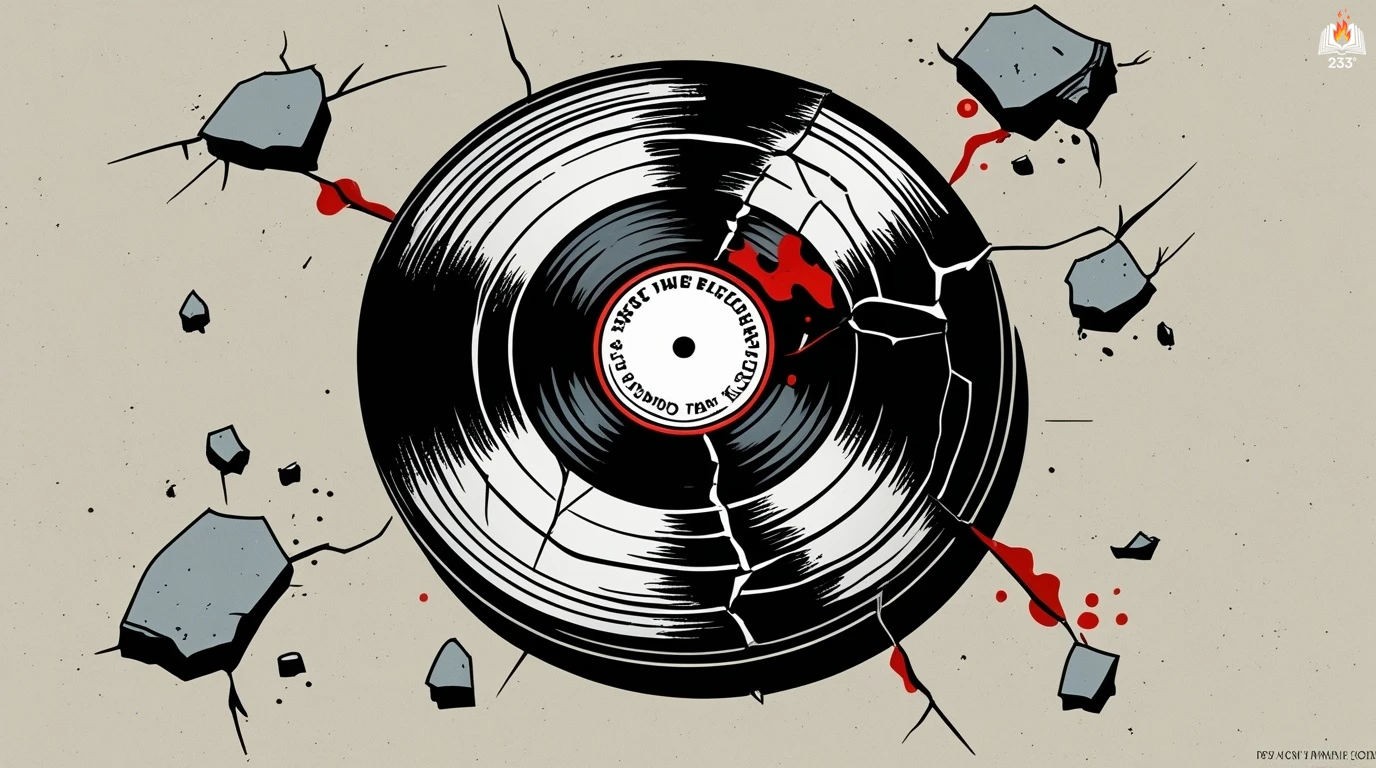
Beautiful You by Chuck Palahniuk, published in 2014, is a satirical dystopian novel that explores the intersection of consumerism, technology, and female sexuality through the lens of outrageous hyperbole and provocative narrative. Known for his incendiary style in works like Fight Club, Palahniuk turns his focus here to the tech and self-help industries, framing his story around a global conspiracy to monopolize female pleasure. In typical Palahniuk fashion, the novel fuses shock, dark comedy, and biting social critique in equal measure, creating a unique blend of absurdity and subversion.
Plot Summary
In a city where even ambition had been commodified, Penny Harrigan was a nobody. Not a lawyer, not quite an intern, stuck in legal purgatory at Manhattan’s most prestigious firm. Her dreams felt as secondhand as the hand-me-down ideologies she’d inherited – feminism rehashed, success repackaged. She fetched coffee, carried chairs, and failed the bar exam twice. But one wrong turn, one splash of scalding soy lattes, and she landed face-first on a silk rug inside the sanctum of Cornelius Linus Maxwell – tech mogul, tabloid fixture, and the richest man in the world.
He didn’t see a coffee-stained skirt or her unremarkable shoes. He saw something else. What, exactly, remained unclear. He invited her to dinner at Chez Romaine, where presidents booked years in advance. Penny, dazed and buzzing, borrowed pearls, piñata earrings, and a dragon-shaped jade pendant from her roommates, dipped into her credit line for couture, and held her breath. Cinderella didn’t get a fairy godmother. She got a receipt.
The world saw them together – his golden hair, her unassuming figure – splashed across headlines, the “Nerd Prince” and his new Cinderella. But dinner felt less like seduction and more like examination. Maxwell listened without flinching, writing in his silver notebook, hanging on every unfiltered admission. Penny spilled the secrets of her stalled life and unchosen dreams, and he scribbled like a man discovering a cure. He didn’t touch her, didn’t flatter her, just stared like she was a prototype. She left unsure whether she’d been adored or audited.
Then nothing. No call. No follow-up. No chariot made of champagne. Just silence, gossip headlines, and pitying glances in grocery store lines. Penny, bloated on free sympathy and butter brickle ice cream, tried to forget. But Maxwell returned, finally, with an invitation and an apology – and a proposition. She would test something new. Something beautiful. Something powerful.
The first time she tried it, she thought she might die from the sheer velocity of pleasure. It wasn’t a sex toy. It was an awakening. A revolution disguised in silicone and batteries. Each device more refined than the last – smooth, sentient, precise in its orchestration of bliss. She orgasmed until she forgot what silence was. Her body, once a vague and awkward outline in the mirror, became its own orchestra. Maxwell watched, always watching, recording the results with scientific delight. Penny became Exhibit A in a global launch.
Then the Beautiful You line hit the world. Women across continents vanished into their bedrooms. Marriage proposals dried up. Babies stopped being born. Men were left stunned and obsolete. All intimacy became remote – packaged and pulsed through neural frequencies. Penny saw the chaos through television screens and press coverage. Entire cities operated on silence as the Beautiful You devices sedated their women with tailored rapture. Maxwell’s vision had come true: the end of desire as anyone knew it. Female pleasure was now optimized, automated, monopolized.
She confronted him. He welcomed her to the top floor of his crystalline tower, surrounded by satellite uplinks and devices like sacred relics. He didn’t see tyranny. He saw progress. He told her she had helped perfect the future. The world would thank him. Penny, shellshocked and haunted, realized her own body had become his prototype – and her pleasure the blueprint for enslavement.
She fled to the Himalayas, chasing whispers of women who’d refused Maxwell’s promise. There, in the caverns and firelit halls of the Yoni Temple, she met the Matriarchs – ancient and scarred, speaking in coded chants and sexual riddles. They welcomed her not as a victim but as an initiate. Through trials that blistered the soul and flayed the ego, Penny learned to wield her body not as a receptor but as a weapon, a vessel of will rather than surrender. The Matriarchs taught her to hone her breath, summon heat, move blood like currents of power. She became, not a woman improved, but a woman remade.
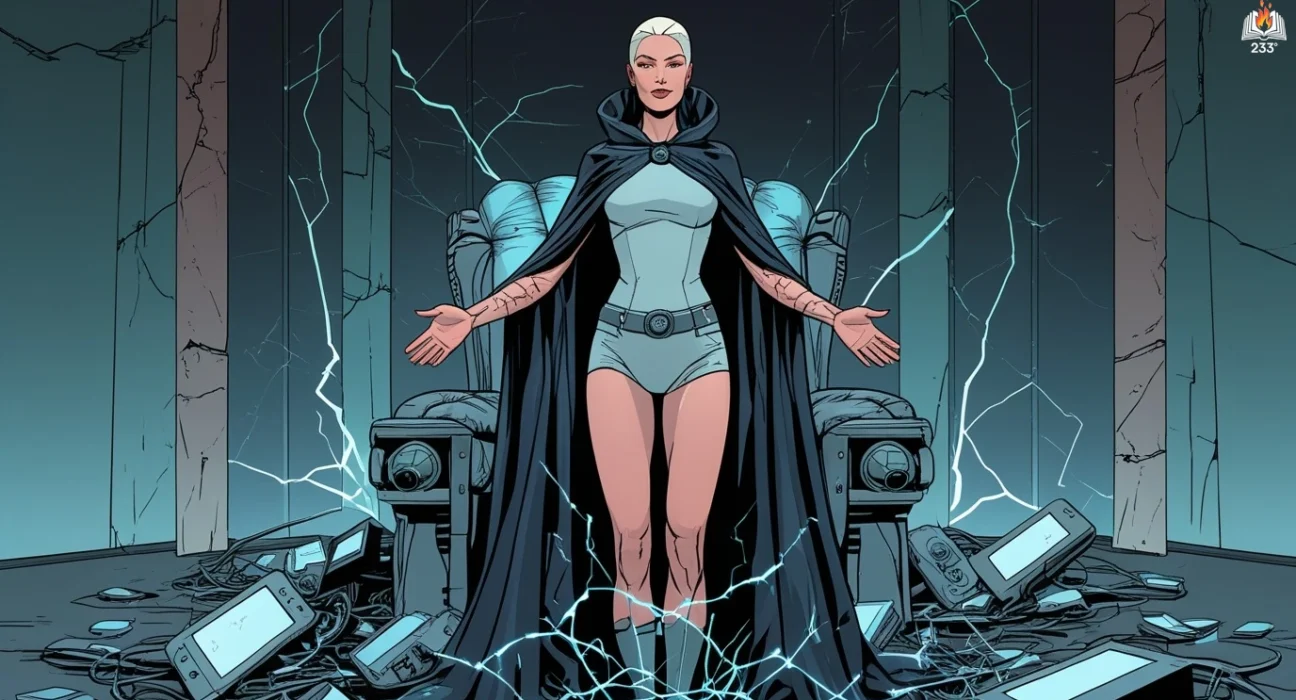
When she returned, Maxwell’s empire had grown teeth. Men now begged for attention, and women ruled through endless climax. Courts collapsed, marriages disintegrated, commerce shifted to the erotic economy. Penny, cloaked and prepared, stormed his tower once more. She carried no weapon, only intent. What ensued wasn’t a battle of fists or laws but of currents – flesh versus circuitry, ancient muscle against modern programming. Her body, no longer his lab rat, overwhelmed his machines. Circuits failed. Devices burst. Towers blacked out. The web that spanned continents unraveled, and for the first time in months, the world exhaled.
Maxwell didn’t scream. He didn’t beg. He watched her with the same curious awe as before, but this time, something fragile cracked behind his eyes. Maybe it was fear. Maybe it was recognition. She left him seated in his throne of broken tech, surrounded by the fragments of synthetic orgasms and power that had slipped from his grasp like breath in cold air.
The silence that followed was not empty. It was full – of women walking out of locked bedrooms, of men staring at each other as though waking from anesthesia, of a world restarting without instructions. Penny didn’t return to the firm. She didn’t return to her roommates. She vanished into that silence like a name no longer needed.
And yet, in the corners of the world, whispers spread. Some said she was dead. Others, that she had joined the Matriarchs and now taught in secret. Some claimed she had been Maxwell’s only failure. But there were those who believed she had succeeded in something he never could: becoming untouchable, unreplicable, and entirely, irreversibly, herself.
Main Characters
Penny Harrigan – A modest, directionless young woman from Nebraska trying to make her way in New York City. Penny is intelligent but plagued by self-doubt and shaped by others’ expectations. She works as a low-level assistant in a prestigious law firm, having failed the bar exam multiple times. Her life changes dramatically after an unexpected encounter with the world’s richest man. Penny’s arc transforms her from an insecure nobody into a woman grappling with power, exploitation, and self-realization in an increasingly bizarre and threatening world.
C. Linus Maxwell – Also known in tabloids as “Climax-Well”, Maxwell is a suave, enigmatic tech billionaire whose public persona is a hybrid of Steve Jobs and Hugh Hefner. He is Penny’s lover, benefactor, and, ultimately, antagonist. He’s obsessed with control and perfection, orchestrating a global empire built on female sexuality. His character embodies the exploitative force of capitalism, and his relationships with women reveal his underlying desire to shape the world in his image.
Alouette D’Ambrosia – A French actress and one of Maxwell’s famous ex-lovers. Though not a central figure in the ongoing plot, she represents the pattern of powerful women whose identities are reshaped or discarded by Maxwell. Her brief but significant appearance early on helps foreshadow Maxwell’s manipulative tendencies.
Clarissa Hind – The former first female President of the United States and another of Maxwell’s high-profile ex-lovers. She illustrates the strange overlap between political power and personal subjugation, suggesting Maxwell’s influence extends even to global leadership. Her background reinforces the disturbing extent of his reach and control.
Kwan Qxi and Esperanza – Penny’s roommates who add humor and diversity to the narrative. Though minor, they function as reflections of female archetypes and underscore themes of cultural identity and solidarity (or lack thereof) among women.
Theme
Consumerism and Technological Control – At the core of Beautiful You is a satirical critique of consumer capitalism, especially as it pertains to the female body. Maxwell’s plan to conquer the world through high-tech sex toys that render men obsolete illustrates a grotesque commodification of desire. Palahniuk skewers the tech world’s fetish for disruption, highlighting its invasive and dehumanizing aspects.
Feminism and Female Agency – The novel interrogates modern feminism with both reverence and irreverence. Penny’s journey is an allegory of reclaiming identity from institutional and cultural imposition. Her attempts to define herself beyond the binaries of virgin vs. whore, wife vs. career woman, become the novel’s emotional and ideological backbone.
Power and Exploitation – Maxwell’s romantic conquests and his business empire blur the lines between intimacy and domination. His use of pleasure as a means of control comments on the sinister potential of power disguised as empowerment.
Identity and Transformation – Penny undergoes numerous literal and metaphorical transformations, moving from invisibility to infamy. Her path mimics a twisted fairy tale, where each step toward self-discovery is filtered through degradation and revelation. The motif of the “Cinderella” tale is deconstructed and subverted.
Writing Style and Tone
Chuck Palahniuk’s writing in Beautiful You is unmistakably provocative, characterized by a brisk, punchy prose that blends satire, surrealism, and cultural critique. His frequent use of repetition, aphoristic dialogue, and media-like phrasing mimics the rhythms of advertising and self-help literature, effectively parodying both. The narrative is highly visual and sensory, often tilting into the grotesque, employing vivid and outrageous imagery to reflect emotional and social truths.
The tone shifts from farcical to dystopian, weaving dark humor with horror. Palahniuk employs irony with a scalpel’s precision, and much of the novel’s tension stems from his willingness to dive headlong into absurdity while still grounding the narrative in recognizable social commentary. The novel flirts with the ridiculous, but it does so intentionally, as a mirror to the consumerist excesses and gender politics it critiques. His tone is unsparing, sometimes crude, and often shocking—but always deliberate in its discomfort.
Quotes
Beautiful You – Chuck Palahniuk (2014) Quotes
“The future had a way of breaking your heart if you expected too much.”
“Artificial over stimulations seemed like the perfect way to stifle a generation of young people who wanted more and more from a world where less and less was available.”
“The mistakes we make in our youth," she said solemnly, "we pay for with the rest of our lives.”
“She kept hoping that something would happen to rescue her from her own small-scale, predictable dreams.”
“She wanted a choice beyond: Housewife versus lawyer. Madonna versus whore. An option not mired in the lingering detritus of some Victorian-era dream.”
“An ancient truism had once decreed, "Self improvement is masturbation..”
“In her experience every man thought he was a natural dancer, and every one thought he was good in bed. The truth was that most men only knew one dance step—usually the pogo—and between the sheets they were like a monkey in a nature film poking at an anthill with a stick.”
“Artificial overstimulation seemed like the perfect way to stifle a generation of young people who wanted more and more from a world where less and less was available.”
“Artificial over-stimulation seemed like the perfect way to stifle a generation of young people who wanted more and more from a world where less and less was available. Whether the victims were men or women, arousal addiction seemed to have become the new normal.”
“As if she ought to know better than to scream and bleed in public.”
“She'd exchanged her dreams of her parents for the dogma of her instructors, but neither of those outlooks were innately her own.”
“Good news didn't seem real until you'd told at least a dozen friends.”
“She reflected on her time in Paris and thought how it seemed as if she'd spent half her life drinking wine in bed and covered with contusions. This, it occurred to her, was how it must feel to be Melanie Griffith.”
“She wanted a choice beyond: Housewife versus lawyer.”
We hope this summary has sparked your interest and would appreciate you following Celsius 233 on social media:
There’s a treasure trove of other fascinating book summaries waiting for you. Check out our collection of stories that inspire, thrill, and provoke thought, just like this one by checking out the Book Shelf or the Library
Remember, while our summaries capture the essence, they can never replace the full experience of reading the book. If this summary intrigued you, consider diving into the complete story – buy the book and immerse yourself in the author’s original work.
If you want to request a book summary, click here.
When Saurabh is not working/watching football/reading books/traveling, you can reach him via Twitter/X, LinkedIn, or Threads
Restart reading!