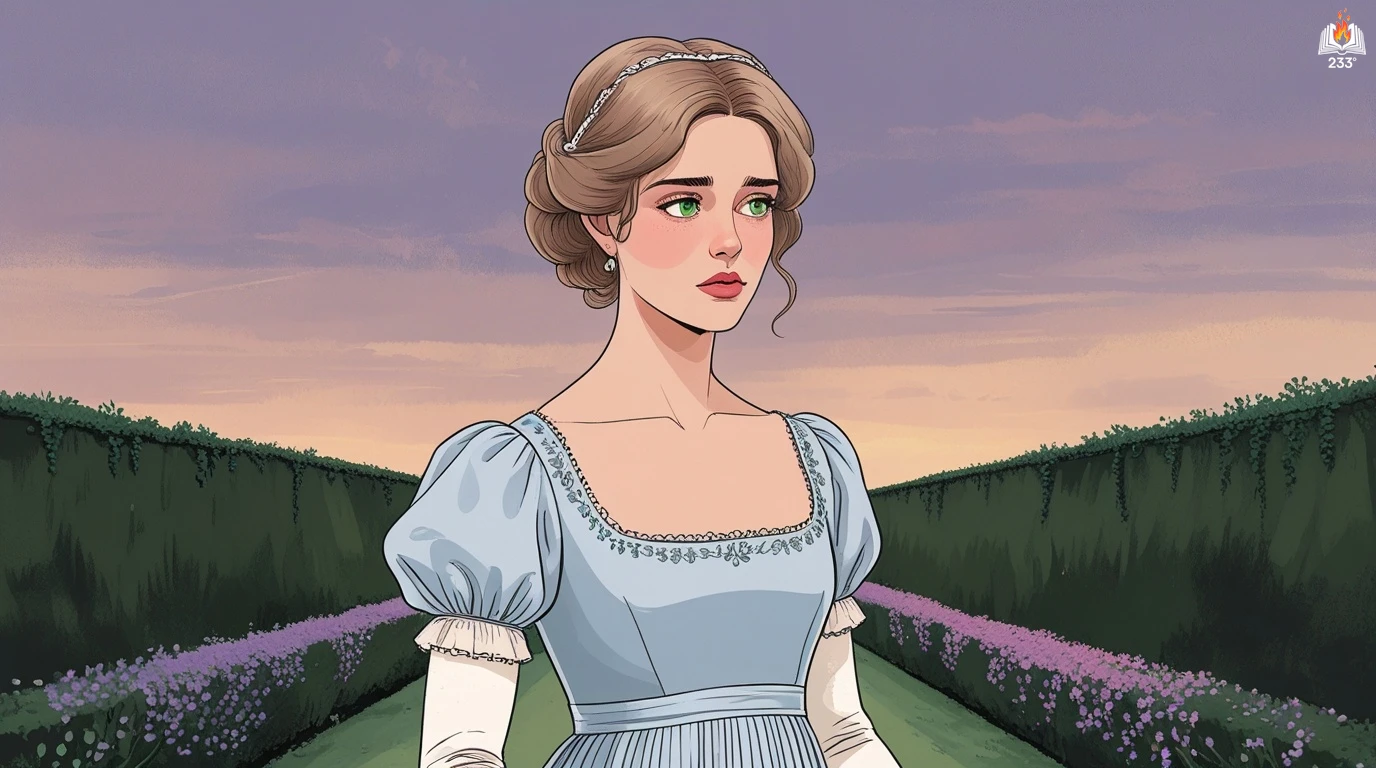
To Sir Phillip, With Love by Julia Quinn was published in 2003 and is the fifth book in the beloved Bridgerton series. Set in the early 19th century, this Regency romance follows Eloise Bridgerton, the witty and outspoken spinster of the Bridgerton family, as she ventures beyond the glittering ballrooms of London to the quiet countryside in search of love. When her long-standing correspondence with the brooding widower Sir Phillip Crane takes a daring turn, Eloise sets out on a journey filled with unexpected emotion, familial defiance, and the tumultuous path to true intimacy.
Plot Summary
On a bright, quiet morning in Gloucestershire, Sir Phillip Crane stared out at the horizon, struggling beneath the weight of solitude. The sun was high, the air brisk, and his heart weary. His wife Marina, long consumed by melancholy, had recently passed, leaving behind two children and a silence that seeped into every corner of Romney Hall. Grief had not come with loud sobs but with a hollow fatigue that dulled his senses and tightened the walls around his world. Yet in his greenhouse, among the pressed petals and failed botanical experiments, something unexpected had begun – a letter, delicate in tone and heavy with curiosity, had arrived from a woman in London: Eloise Bridgerton.
What began as a courteous exchange born of condolences soon blossomed into something neither expected. Eloise, a sharp-tongued, spirited woman of twenty-eight, had grown tired of the idle rounds of society balls and matchmaking. Left behind by the marriage of her closest friend – and the sudden realization that spinsterhood felt far lonelier than she once believed – she clutched onto her secret correspondence with Sir Phillip like a lifeline. In his careful, earnest letters, she found warmth. And in her quick wit and charm, he found something he thought lost forever: a flicker of hope.
One evening, without so much as a farewell, Eloise vanished from her family’s London townhouse during a ball and set off toward a future unwritten. She arrived at Romney Hall unannounced, her valise in hand and nerves disguised behind a torrent of words. Phillip, larger and rougher than she’d imagined from his letters, greeted her with the stunned silence of a man unused to surprise. He had expected someone… different. And Eloise, seeing this disheveled, emotionally closed-off man before her, realized she, too, had conjured someone from the ink of letters who didn’t quite match the reality.
The house was cold, neglected in places, with walls echoing too many years of sadness. Amanda and Oliver, Phillip’s unruly eight-year-old twins, stormed through its halls like miniature tyrants, their laughter often edged with malice. Eloise, caught in a whirlwind of unexpected motherhood, found herself more a governess than a guest. Meals were battles. Lessons dissolved into chaos. Phillip, though aware of his failings, remained emotionally distant, unsure how to bridge the canyon between himself and his children.
Eloise, however, refused to be a quiet spectator. She challenged Phillip at every turn – questioning his parenting, his reticence, and his romantic intentions. He had, after all, invited her with the intent of marriage, though he seemed utterly unprepared to court her. Her sharp tongue clashed with his brooding silences, their arguments as fiery as they were revealing. Phillip expected someone meek, someone willing to mother his children and leave him to his solitude. Instead, he received a hurricane in satin, determined to have not just a marriage but a partnership.
The children, meanwhile, were not blind to the shift. Amanda, perceptive and defiant, watched Eloise with a wary curiosity. Oliver, quieter but no less wounded, kept his distance. Yet despite their mischief – the traps, the defiance, the open hostility – Eloise met their antics with unflinching determination. She understood them in ways Phillip never could. Not through books or discipline, but through instinct and compassion. Bit by bit, the twins tested her less and listened more.
In the greenhouse, Phillip began to see Eloise differently. She was not merely the woman from his letters. She was chaos and clarity. She was the one to remind him that grief need not be a cage. They shared quiet moments amidst the plants, fragments of laughter in the garden, and slowly, without ceremony, something began to root itself between them. But Phillip, haunted by the shadow of Marina’s unhappiness and his own failings as a father, could not bring himself to offer more than affection. He wanted companionship, yes, but feared his own inadequacies might smother anything deeper.
Then came the arrival of Eloise’s brothers. Anthony, Benedict, and Colin descended upon Romney Hall like a royal inquisition, ready to demand answers and challenge Phillip for his supposed dishonor. They had discovered Eloise’s disappearance and tracked her down with the fury only protective siblings could summon. Chaos erupted in the drawing room. Eloise, furious at their interference, defended her decision to leave and stay, making it clear that she was not some fragile maiden in need of rescue.
It was not until a moment of raw honesty – when Phillip admitted he never mentioned his children in the letters out of fear that no woman would want him if she knew the full burden of his life – that the walls began to crumble. He confessed his failings, his guilt, and his desperate hope that someone, someday, might love his children even if she could not love him. It was a confession Eloise had not expected, and it pierced through her doubts.
Her decision to stay became not one of obligation, but of choice. Eloise faced the children again, not as an intruder but as someone who had weathered the storm with them. Amanda and Oliver, once so bent on sabotage, offered the first tentative signs of acceptance. Eloise, through her stubbornness and warmth, had claimed a place not only in the household but in their guarded hearts.
Phillip, at last recognizing that love was not just a thing given, but something cultivated, found the courage to ask again. This time, not as a lonely widower seeking convenience, but as a man finally ready to open himself to joy.
Eloise said yes.
Romney Hall grew warmer. Laughter returned to the halls. In the garden, the meadow cranesbill bloomed again, delicate and certain, just as Phillip had once pressed into an envelope long ago.
Main Characters
Eloise Bridgerton – At 28, Eloise is intelligent, fiercely independent, and known for her love of letter writing. After years of rejecting suitors and enjoying spinsterhood, a sudden shift in her social circle compels her to reevaluate her choices. Eloise is both charmingly impulsive and deeply introspective, and her decision to secretly visit Sir Phillip marks a bold pivot in her life. Her arc is one of personal growth—learning to balance her need for freedom with the vulnerability required to love.
Sir Phillip Crane – A somber and reclusive botanist, Phillip is a widower left emotionally stranded after the death of his melancholic wife, Marina. As a father to unruly twins and a man plagued by guilt and isolation, he seeks companionship and structure through marriage. Phillip is earnest and well-meaning, though emotionally stunted, and his journey involves learning to connect—first with Eloise and later with his children—on a human, empathetic level.
Amanda and Oliver Crane – Phillip’s mischievous eight-year-old twins, who embody chaos and emotional neglect in equal measure. Scarred by their mother’s depression and their father’s detachment, they act out through unruly behavior. As secondary characters, they serve as both comic relief and poignant mirrors of the family’s dysfunction, ultimately playing a key role in Eloise’s integration into their lives.
Theme
Loneliness and Emotional Isolation: Both Eloise and Phillip begin the novel isolated in their own ways—Eloise as a cheerful yet overlooked spinster, and Phillip as a widower emotionally buried beneath grief and duty. Their evolving connection explores how companionship can bridge emotional chasms and offer solace, even when imperfect.
Expectation vs. Reality in Love: The romance between Phillip and Eloise dismantles idealistic notions of love. Their courtship, based on correspondence, crashes into the messy reality of parenting, grief, and miscommunication. The novel explores how love isn’t always instantaneous or effortless—it often requires negotiation, sacrifice, and patience.
Identity and Autonomy: Eloise’s journey challenges societal expectations of women. Her decision to meet Phillip without her family’s consent is an act of rebellion, one that ultimately helps her define who she is—outside of being a Bridgerton. Her character arc examines the tension between individual identity and familial obligation.
Parenting and Responsibility: The strained relationship between Phillip and his children highlights the themes of inherited trauma, emotional neglect, and redemption. Through Eloise’s influence, the novel portrays how love and presence—not just duty—are vital to parenthood.
Writing Style and Tone
Julia Quinn’s writing is delightfully conversational, witty, and rich with emotional texture. She infuses her prose with humor and warmth, balancing the weight of grief and familial tension with sparkling dialogue and subtle irony. The narration shifts fluidly between internal monologue and third-person perspective, giving readers intimate access to the characters’ thoughts, often with self-deprecating charm. The inclusion of letters adds an epistolary layer, highlighting the contrast between the polished facades of written language and the rawness of real-life interaction.
The tone of To Sir Phillip, With Love oscillates between romantic idealism and poignant realism. Quinn doesn’t shy away from depicting the darker corners of her characters’ psyches—Phillip’s guilt and Eloise’s fear of being left behind are explored with sincerity. Yet, the novel remains hopeful and emotionally fulfilling. The humor, while never undermining the emotional stakes, provides buoyancy. Quinn’s tone feels like a warm hand guiding readers through messy truths, reminding them that love, even when imperfect, is worth pursuing.
Quotes
To Sir Phillip, With Love – Julia Quinn (2003) Quotes
“Men. The day they learned to admit to a mistake was the day they became women.”
“He shook his head in wonder. "You are magnificent." "I keep telling everyone that," she said with a nonchalant shrug, "But you seem to be the only one to believe me.”
“If one didn't have love, was it better, then, to be alone?”
“. . . I do not tell you often enough, dear Mother, how very grateful I am that I am yours. It is a rare parent who would offer a child such latitude and understanding. It is an even rarer one who calls a daughter friend. I do love you, dear Mama.”
“I had to do something," she said. "I couldn't just sit and wait for life to happen to me any longer.”
“Miss. My. Wife.”
“Until you've lived through all that," he said, "don't you ever complain about what we have. Because to me... to me..." He choked on the words, but he barely paused before he continued. "This - us - is heaven. I can't bear to hear you say otherwise.”
“Love your siblings. Love them well, for they are your blood, and when you are unsure,or times are difficult, they will be the ones to stand by your side.”
“A lot could happen in a week. Just look at the last one.”
“Be strong. Be diligent. Be conscientious. There is never anything to be gained by taking the easy road.”
“You are a Bridgerton. I don’t care who you marry or what your name becomes when you stand up before a priest and say your vows. You will always be a Bridgerton, and we behave with honor and honesty, not because it is expected of us, but because that is what we are.” Eloise”
“Were you tempted?" "Of course not! Kate would slit my throat." "I'm not talking about what Kate would do to you if you strayed, although I'm of the opinion that she would not start at your throat.”
“I always loved everything about you, of course, but for some reason I always found your impatience especially charming. It was never because you wanted more, it was because you wanted everything.”
“Good,” Colin muttered, taking a bite. “I’m famished.” “How can you think of food?” Gregory said angrily. “I always think of food,” Colin replied, his eyes searching the table until he located the butter. “What else is there?” “Your wife,” Benedict drawled.”
“It was nearly impossible to keep anything a secret, especially from her sisters, the youngest of whom—Hyacinth—could probably have won the war against Napoleon in half the time if His Majesty had only thought to draft her into the espionage service.”
“This was killing her. She had to break the silence. This was not natural. It was too awful. People were meant to talk.”
“Bloody hell," Phillip finally burst out. "If you're going to break my legs, would you just go ahead and do it now?”
“Neither one of you is going to kill, maim, attack, or even hug the other for at least thirty minutes.”
“I never thought I would be left behind." He chuckled. "Eloise Bridgerton, I don't think anyone wouldever make the mistake of leaving you behind.”
“He was hungry, needy, and he kissed her as if he would die without her, as if she were his very food, his air, his body and soul.”
“No, she didn’t need someone perfect. She just needed someone perfect for her.”
“Are you certain you'll be happy?" she asked. Eloise smiled ruefully. "It's a little late to wonder, don't you think?" "It might be too late to do anything about it, but it's never too late to wonder.”
“Don’t settle. Know what you want and reach for it. And if you don’t know what you want, be patient. The answers will come to you in time, and you may find that your heart’s desire has been right under your nose all the while.”
We hope this summary has sparked your interest and would appreciate you following Celsius 233 on social media:
There’s a treasure trove of other fascinating book summaries waiting for you. Check out our collection of stories that inspire, thrill, and provoke thought, just like this one by checking out the Book Shelf or the Library
Remember, while our summaries capture the essence, they can never replace the full experience of reading the book. If this summary intrigued you, consider diving into the complete story – buy the book and immerse yourself in the author’s original work.
If you want to request a book summary, click here.
When Saurabh is not working/watching football/reading books/traveling, you can reach him via Twitter/X, LinkedIn, or Threads
Restart reading!