

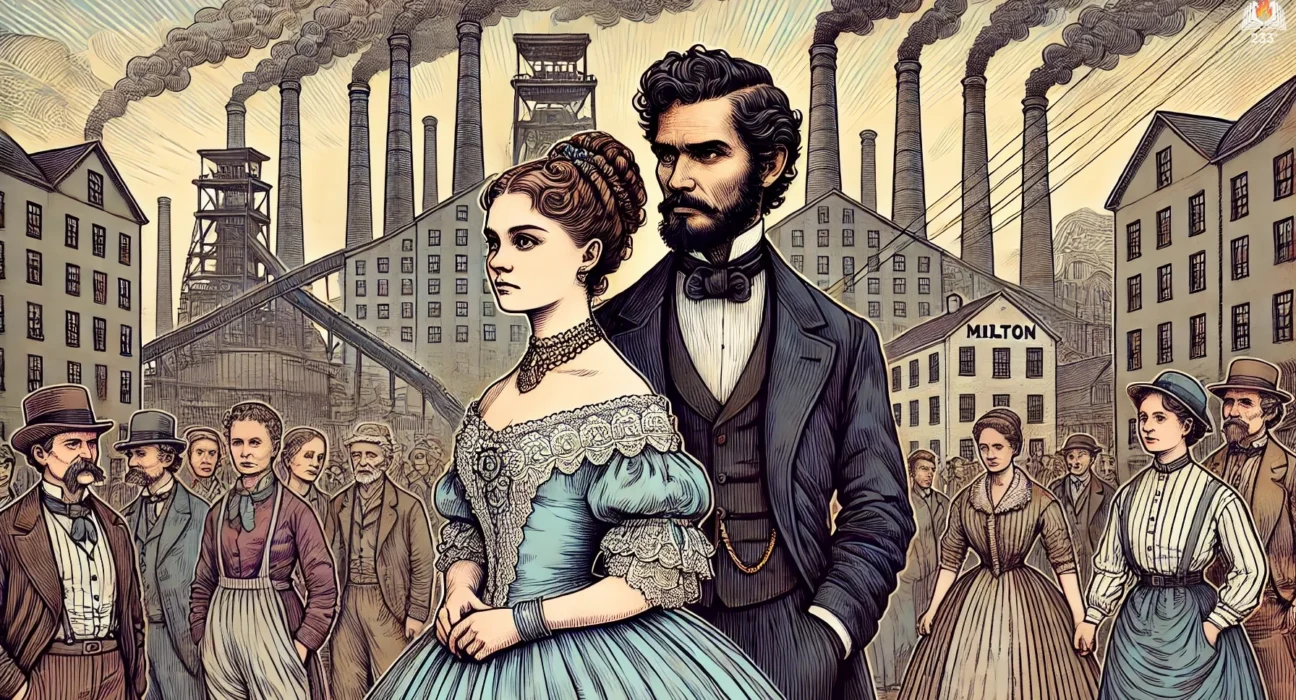
“North and South,” written by Elizabeth Gaskell and published in 1855, is a compelling tale of social conflict, class disparity, and romance set against the backdrop of the industrial revolution in Victorian England. The novel contrasts the industrial North and the agrarian South of England through the experiences of Margaret Hale, a young woman who moves from the tranquil South to the bustling industrial town of Milton in the North.
Plot Summary
Margaret Hale leads a serene life in the quiet village of Helstone, in the South of England. Raised amid the idyllic countryside, she dreams of a future filled with simplicity and peace. Her father, Mr. Hale, a clergyman, provides the family with a stable and tranquil existence. However, this tranquility is shattered when Mr. Hale experiences a crisis of faith. His inability to reconcile his beliefs with the doctrines of the Church of England forces him to resign from his clerical position, an act that sets the Hale family on an unexpected path. Reluctantly, Margaret and her parents move to the industrial town of Milton-Northern, a place that starkly contrasts with the verdant and gentle landscape of the South.
Milton is a world of smoke and machinery, where the relentless hum of cotton mills fills the air. The town pulses with the rhythm of industry, and the people’s lives are tightly woven into the fabric of factory work. Margaret finds herself in a harsh environment where the social divides between the mill owners and their workers are as sharp as the clattering machinery that surrounds them. Her father takes up work as a tutor, and one of his pupils is John Thornton, the powerful and ambitious owner of Marlborough Mills.
Thornton is a man forged by the demands of industrial capitalism. Raised in hardship, he has climbed to his current status through sheer determination and a ruthless work ethic. He is admired and feared by his workers and the community alike. Margaret and Thornton’s first encounters are fraught with tension; she views him as the embodiment of all that is harsh and unfeeling in the industrial North, while he sees her as a haughty and naive outsider who fails to understand the realities of life in Milton.
As Margaret becomes more attuned to the struggles of the working class, her eyes open to the vast gulf between the mill owners and the workers. She befriends Nicholas Higgins, a mill worker who is deeply involved in the labor union, and his daughter Bessy, who is suffering from a terminal illness brought on by the unhealthy conditions in the mills. Through the Higgins family, Margaret learns about the workers’ lives, their grievances, and their desire for fair treatment. She sympathizes with their plight and begins to see Thornton and the other mill owners as oppressors who perpetuate their suffering.
Thornton, on the other hand, is captivated by Margaret’s strength and beauty, despite their ideological differences. He sees in her a fiery spirit that matches his own, and his admiration gradually turns into love. When he proposes to her, however, she rejects him, misinterpreting his proposal as a domineering claim over her rather than a genuine expression of love. This rejection wounds Thornton deeply, and it seems to widen the chasm between them even further.
The conflict in Milton comes to a head when the mill workers, driven by desperation, go on strike. Tensions mount as they demand better wages and working conditions, but Thornton, standing firm in his belief that yielding would threaten the survival of his business, refuses to negotiate. The strike leads to a violent confrontation outside Marlborough Mills, where an angry mob gathers, threatening to break into the premises. In a moment of crisis, Margaret rushes to Thornton’s aid, shielding him from the mob’s wrath. She is struck by a stone and falls, unconscious, but her courageous act leaves a profound impact on Thornton. It forces him to reevaluate his understanding of Margaret, as well as his views on the relationship between mill owners and workers.
Margaret’s actions during the riot create a swirl of rumors and misunderstandings. Her reputation is called into question, and Thornton finds himself torn between his love for her and the suspicion that she has been hiding secrets from him. Meanwhile, Margaret’s brother Frederick, a naval officer living in exile due to his involvement in a mutiny, makes a clandestine visit to see their dying mother. During this visit, Margaret is caught in a compromising situation when she is seen at the train station with Frederick. Thornton, unaware of Frederick’s identity and Margaret’s reasons for secrecy, witnesses this encounter and is left confused and pained by what he perceives as deceit.
The loss of Mrs. Hale and the mounting pressures in Milton drive the Hale family to the brink. Mr. Hale, stricken with grief and feeling the weight of his decisions, passes away, leaving Margaret to fend for herself. She returns to the South, a place that now seems foreign and distant after her experiences in the North. During this time, Thornton faces his own trials. The mills are failing, and he is on the verge of financial ruin. His mother, a stern and proud woman, is his only confidante, but even she cannot help him avert the crisis that looms over Marlborough Mills.
Margaret, now a wealthy heiress after inheriting a fortune from her godfather, finds herself in a position of power and independence. She reflects on her time in Milton and the people she left behind. The North, once so alien and harsh, has become a place of deep personal significance. She realizes that her feelings for Thornton have evolved, shaped by a newfound understanding of the complexities of his character and the struggles he faces.
Fate brings Margaret and Thornton back together in London. They meet, both changed by their experiences, and the barriers that once separated them have fallen away. Thornton, humbled by his failures and losses, is no longer the rigid, unyielding man she once knew. Margaret, softened by her own trials and aware of the courage it takes to stand by one’s convictions, sees him in a new light. In this reunion, they find common ground and a shared vision for the future—a future where their differences are not obstacles but strengths that can be united for a greater good.
Their reconciliation is not just a personal union but also a symbolic bridging of the gap between North and South. It speaks to the possibility of understanding and compromise in a world divided by class and industry. Together, they represent a new way forward, one built on respect, compassion, and a willingness to see beyond one’s own perspective.
Main Characters
- Margaret Hale: A strong-willed and compassionate young woman from the South. Her journey from Helstone to Milton exposes her to the realities of industrial life, challenging her beliefs and shaping her into a more understanding and empathetic individual.
- John Thornton: A successful mill owner in Milton. He is initially seen as stern and unyielding but is later revealed to be a man of principle and integrity. His love for Margaret leads him to question his methods and ultimately strive for better relations with his workers.
- Mr. Hale: Margaret’s father, a former clergyman who resigns due to his crisis of faith. His decision to move to Milton sets the story in motion.
- Mrs. Hale: Margaret’s mother, who struggles to adapt to life in the industrial North and whose health deteriorates rapidly in the harsh environment.
- Nicholas Higgins: A mill worker and union leader. His friendship with Margaret introduces her to the struggles of the working class and adds depth to the novel’s portrayal of industrial strife
Theme
- Class Conflict: The novel explores the divide between the working class and the mill owners, highlighting the lack of understanding and communication between the two groups. Through Margaret’s relationships with Thornton and the Higgins family, Gaskell illustrates the complexities of class dynamics.
- Industrialization: Gaskell provides a vivid depiction of the industrial revolution’s impact on society, including the harsh working conditions in the mills and the changing social landscape of England.
- Prejudice and Understanding: Margaret and Thornton’s initial misunderstandings symbolize the broader cultural divide between the North and the South. Their evolving relationship signifies the possibility of overcoming prejudice through empathy and communication.
- Gender Roles: The novel examines the roles and expectations of women in Victorian society. Margaret defies the traditional passive female role by actively engaging in social issues and challenging Thornton’s views.
Writing Style and Tone
Elizabeth Gaskell’s writing style in “North and South” is rich with detailed descriptions and an acute sense of social realism. She blends romance with social critique, creating a narrative that is both engaging and thought-provoking. Her tone shifts from the serene and idyllic portrayal of the South to the grim and bustling atmosphere of the North. Gaskell’s use of dialogue and character development provides insight into the social and economic issues of the time, while her sympathetic portrayal of both the working class and the mill owners encourages readers to consider multiple perspectives.
Quotes
North and South – Elizabeth Gaskell (1855) Quotes
“I know you despise me; allow me to say, it is because you do not understand me.”
“Margaret was not a ready lover, but where she loved she loved passionately, and with no small degree of jealousy.”
“Oh, Mr. Thornton, I am not good enough!' 'Not good enough! Don't mock my own deep feeling of unworthiness.”
“He shrank from hearing Margaret's very name mentioned; he, while he blamed her – while he was jealous of her – while he renounced her – he loved her sorely, in spite of himself.”
“He shook hands with Margaret. He knew it was the first time their hands had met, though she was perfectly unconscious of the fact.”
“But the future must be met, however stern and iron it be. ”
“A wise parent humors the desire for independent action, so as to become the friend and advisor when his absolute rule shall cease.”
“But the cloud never comes in that quarter of the horizon from which we watch for it.”
“I wanted to see the place where Margaret grew to what she is, even at the worst time of all, when I had no hope of ever calling her mine.”
“Thinking has, many a time, made me sad, darling; but doing never did in all my life... My precept is, "Do something, my sister, do good if you can; but, at any rate, do something".”
“Those who are happy and successful themselves are too apt to make light of the misfortunes of others.”
“I dare not hope. I never was fainthearted before; but I cannot believe such a creature cares for me.”
“Loyalty and obedience to wisdom and justice are fine; but it is still finer to defy arbitrary power, unjustly and cruelly used--not on behalf of ourselves, but on behalf of others more helpless.”
“He knew how she would love. He had not loved her without gaining that instinctive knowledge of what capabilities were in her. Her soul would walk in glorious sunlight if any man was worthy, by his power of loving, to win back her love.”
“He loved her, and would love her; and defy her, and this miserable bodily pain.”
“Take care. If you do not speak – I shall claim you as my own in some strange presumptuous way. Send me away at once, if I must go; – Margaret! –”
“As she realized what might have been, she grew to be thankful for what was.”
“Oh, I can't describe my home. It is home, and I can't put its charm into words”
“Come! Poor little heart! Be cheery and brave. We'll be a great deal to one another, if we are thrown off and left desolate.”
“He is my first olive: let me make a face while I swallow it.”
“No one loves me, - no one cares for me, but you, mother.”
“A girl in love will do a good deal.”
“Oh, my Margaret--my Margaret! no one can tell what you are to me! Dead--cold as you lie there you are the only woman I ever loved! Oh, Margaret--Margaret!”
We hope this summary has sparked your interest and would appreciate you following Celsius 233 on social media:
There’s a treasure trove of other fascinating book summaries waiting for you. Check out our collection of stories that inspire, thrill, and provoke thought, just like this one by checking out the Book Shelf or the Library
Remember, while our summaries capture the essence, they can never replace the full experience of reading the book. If this summary intrigued you, consider diving into the complete story – buy the book and immerse yourself in the author’s original work.
If you want to request a book summary, click here.
When Saurabh is not working/watching football/reading books/traveling, you can reach him via Twitter/X, LinkedIn, or Threads
Restart reading!