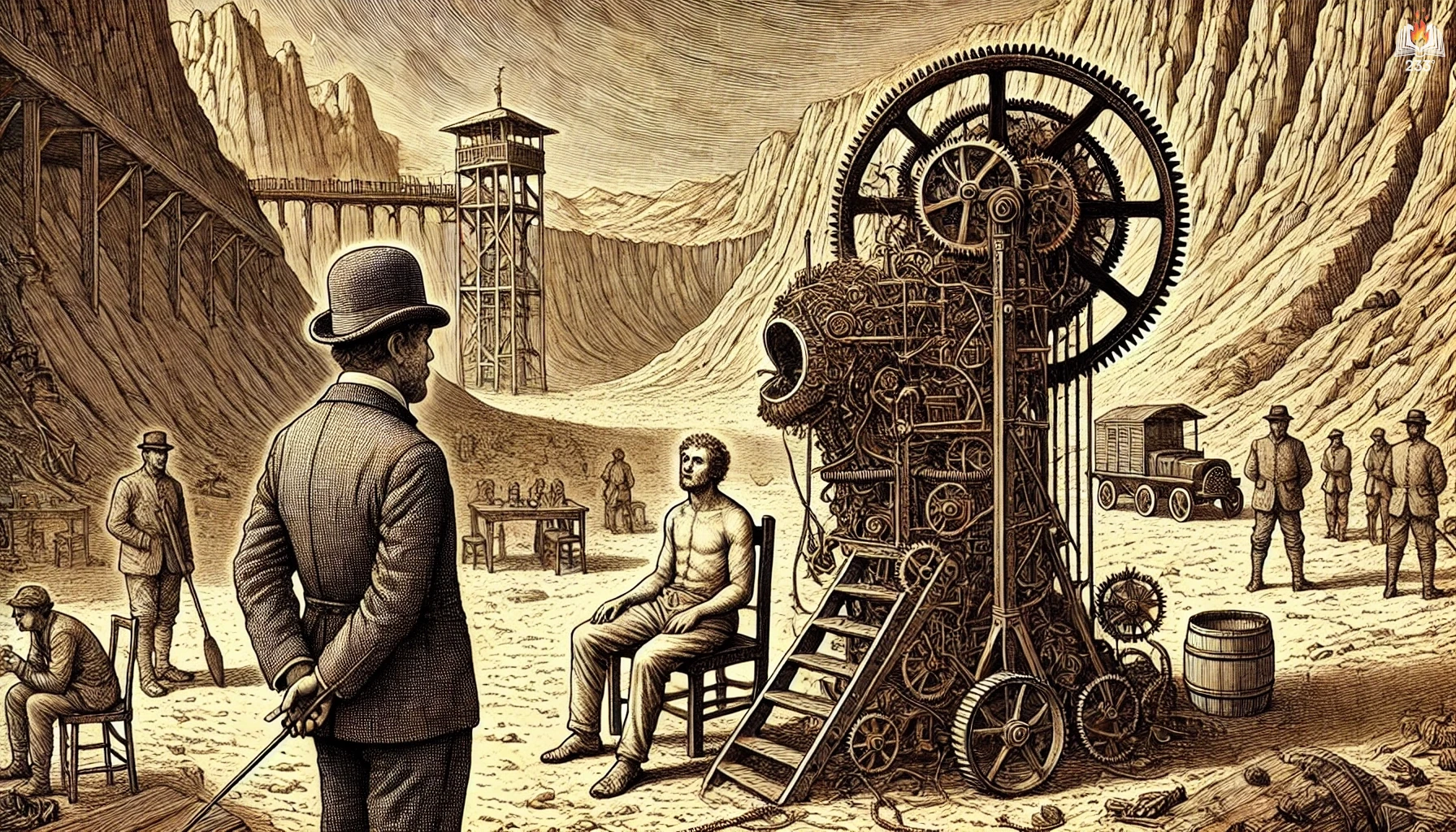
The Metamorphosis by Franz Kafka, first published in 1915, is one of the most iconic works of existentialist and surrealist fiction. It tells the story of Gregor Samsa, a traveling salesman who wakes up one morning to find himself inexplicably transformed into a gigantic insect-like creature. This novella explores themes of alienation, guilt, identity, and the absurdity of human existence, reflecting Kafka’s distinct “kafkaesque” style.
Plot Summary
One morning, as Gregor Samsa awoke from uneasy dreams, he found himself transformed into a monstrous insect. His body, now covered in a hard shell and equipped with numerous legs that fluttered helplessly before his eyes, was unrecognizable. Lying on his back in his small room, Gregor initially believed it was a dream. But as he tried to move and found himself unable to roll over or control his limbs, the terrible reality sank in. His thoughts quickly turned to his job as a traveling salesman. His family depended on his income, and he had planned to leave for work that very morning. Panic set in as he realized he had overslept, and soon, his boss’s assistant would arrive to check on him.
Gregor’s family, unaware of his transformation, began knocking on his door. His mother and sister, Grete, expressed concern when they heard him still in his room so late in the morning. His father, more forcefully, demanded an explanation. Gregor tried to respond, but his voice was now distorted into a high-pitched squeak, alien and unsettling. The family couldn’t understand his words. As he struggled to get out of bed, there was a knock at the door—his boss’s assistant had indeed come to find out why Gregor hadn’t shown up for work.
With great effort, Gregor managed to roll off the bed and open the door using his newly formed insect limbs. The sight of him immediately caused shock and horror. His mother fainted, his father was horrified, and the assistant fled the apartment, too stunned to believe what he had seen. Gregor, in his new form, was unable to explain himself or reassure his family. His father, furious and disgusted, forced him back into his room, driving him with a stick and a newspaper until Gregor, wounded and bleeding, retreated to the confines of his space.
Over the following days, Gregor’s life took a miserable turn. His family, who had once depended on him, now viewed him as a burden. They avoided entering his room unless absolutely necessary, leaving him isolated and unable to communicate. His sister, Grete, took it upon herself to feed him, though she did so with a mixture of pity and revulsion. At first, she brought him milk, his favorite drink, but Gregor found it repulsive in his new state. As time passed, she began bringing him scraps of rotting food, which Gregor devoured with an appetite he barely understood.
Gregor’s family, struggling financially without his income, began making sacrifices. His father, who had previously been too old and weak to work, took up a job as a bank messenger. His mother sewed clothes for neighbors, and Grete, once a carefree girl, began working as a shop assistant. The family grew resentful of Gregor’s presence, and the love they had once shown him faded into a sense of duty and shame. Gregor, unable to communicate or contribute, became acutely aware of how much of a burden he had become. His room, once filled with furniture and personal belongings, was gradually emptied by Grete and their mother, who thought it would give him more space to move around. The process left Gregor feeling increasingly detached from his human past.
One day, as Grete and her mother attempted to move the last piece of furniture out of Gregor’s room, his mother caught sight of him clinging to a picture on the wall in a desperate attempt to preserve something from his former life. Horrified, she fainted. In the ensuing chaos, Gregor’s father returned home and, misunderstanding the situation, assumed Gregor had attacked his mother. In a fit of rage, he hurled apples at Gregor, one of which lodged painfully in his back, leaving a deep wound that never fully healed.
As time passed, Gregor’s family grew increasingly indifferent toward him. His presence in the household became an unspoken shame, and they kept his door closed, interacting with him only when absolutely necessary. Even Grete, who had been the most sympathetic, began to grow tired of caring for him. The family took in boarders to make ends meet, and Gregor was confined to his room even more strictly to avoid disturbing them. One evening, however, as Grete played her violin for the boarders, Gregor, drawn to the music, crawled out of his room. His appearance horrified the boarders, who demanded to leave immediately without paying rent.
This event became the breaking point for the family. Grete, once his closest ally, declared that they could no longer tolerate Gregor’s existence. She insisted that the creature in the room was no longer her brother, and the family would be better off without him. Gregor, hearing this, retreated to his room, overcome with sorrow and guilt. His body, weakened by the lack of food and the infection from the wound in his back, gave out. Alone in the darkness, Gregor took his final breath, succumbing to the physical and emotional toll of his transformation.
The next morning, when the family discovered Gregor’s lifeless body, they felt an overwhelming sense of relief. The father, once so aggressive toward Gregor, gently pushed his body out of the room with a broom. The family, now free from the burden of Gregor’s existence, decided to leave their apartment and start anew. They took a leisurely walk in the countryside, discussing their future plans. Grete, in particular, seemed to blossom in this new chapter of their lives. The parents realized she had grown into a young woman, full of potential, and began making plans for her future. The weight of Gregor’s existence had lifted, and they felt hopeful for the first time in a long while.
Main Characters
Gregor Samsa: The protagonist, a traveling salesman who is suddenly transformed into a monstrous insect. His transformation serves as a physical manifestation of his feelings of alienation and burden to his family. Throughout the story, Gregor struggles with his new form and the implications it has on his family and his humanity.
Grete Samsa: Gregor’s younger sister, initially caring and supportive, but gradually becomes resentful and detached as the family’s situation worsens. Her evolving relationship with Gregor highlights the emotional and psychological toll of his transformation on the family.
Mr. Samsa (Gregor’s Father): A once-failed businessman, now burdened with the responsibility of supporting his family after Gregor’s transformation. His stern, often aggressive behavior toward Gregor reflects his frustration and helplessness in dealing with the situation.
Mrs. Samsa (Gregor’s Mother): A fragile and emotionally sensitive woman who loves Gregor but is horrified by his new form. Her inability to fully cope with Gregor’s transformation symbolizes the emotional disconnect within the family.
Theme
Alienation and Isolation: Gregor’s transformation is a literal representation of the alienation he has always felt. His new form physically isolates him from his family and society, echoing the emotional and psychological alienation experienced by many individuals in the modern world.
Guilt and Responsibility: Gregor feels overwhelming guilt for not being able to provide for his family after his transformation. His previous role as the family’s breadwinner has now become a burden, reflecting the theme of self-sacrifice and societal expectations.
Metamorphosis as a Symbol of Change: The central theme of transformation explores not only Gregor’s physical change but also the shifts in family dynamics and their relationships. The family, especially Grete, undergoes their own transformations in response to Gregor’s plight.
The Absurdity of Existence: The inexplicable nature of Gregor’s transformation reflects Kafka’s exploration of the absurdity of life. The lack of any logical explanation for his condition adds to the surreal and existential quality of the story.
Writing Style and Tone
Kafka’s writing style in The Metamorphosis is direct and matter-of-fact, despite the absurd and grotesque events that unfold. He presents Gregor’s horrifying transformation with stark realism, which enhances the surreal and unsettling atmosphere of the novella. The author’s minimalist prose contrasts sharply with the complex psychological and existential themes, making the reader feel the weight of Gregor’s alienation and despair.
The tone of The Metamorphosis oscillates between bleakness and dark humor. Kafka captures the tragic absurdity of Gregor’s situation, reflecting on the cruelty and indifference of society and even family. Through the increasingly indifferent reactions of Gregor’s family, the tone becomes progressively more somber and hopeless, culminating in an emotionally powerful ending.
Quotes
The Metamorphosis – Franz Kafka (1915) Quotes
“I cannot make you understand. I cannot make anyone understand what is happening inside me. I cannot even explain it to myself.”
“How about if I sleep a little bit longer and forget all this nonsense",”
“As Gregor Samsa awoke one morning from uneasy dreams he found himself transformed in his bed into a gigantic insect.”
“What am I doing here in this endless winter?”
“Was he an animal, that music could move him so? He felt as if the way to the unknown nourishment he longed for were coming to light.”
“He was a tool of the boss, without brains or backbone.”
“Calm —indeed the calmest
“The sister played so beautifully. Her face was tilted to one side and she followed the notes with soulful and probing eyes. Gregor advanced a little, keeping his eyes low so that they might possibly meet hers. Was he a beast if music could move him so?”
“I only fear danger where I want to fear it.”
“What's happened to me,' he thought. It was no dream.”
“the blend of absurd, surreal and mundane which gave rise to the adjective "kafkaesque”
“And so gentlemen, I learned. Oh, if you have to learn, you learn; if you’re desperate for a way out, you learn; you learn pitilessly. You stand over yourself with a whip in your hand; if there’s the least resistance, you lash yourself.”
“One morning, as Gregor Samsa was waking up from anxious dreams, he discovered that in his bed he had been changed into a monstrous bug...”
“Was he an animal if music could captivate him so? It seemed to him that he was being shown the way to the unknown nourishment he had been yearning for.”
“The door could not be heard slamming; they had probably left it open, as is the custom in homes where a great misfortune has occurred.”
“However, Gregor had become much calmer. All right, people did not understand his words any more, although they seemed clear enough to him, clearer than previously, perhaps because had gotten used to them”
“A picture of my existence... would show a useless wooden stake covered in snow... stuck loosely at a slant in the ground in a ploughed field on the edge of a vast open plain on a dark winter night.”
“Then his head sank to the floor of its own accord and from his nostrils came the last faint flicker of his breath.”
“If they were shocked, then Gregor had no further responsibility and could be calm. But if they took everything calmly, he he, too, had no reason to get excited and could, if he hurried, actually be at the station by eight o'clock.”
“His biggest misgiving came from his concern about the loud crash that was bound to occur and would probably create, if not terror, at least anxiety behind all the doors. But that would have to be risked.”
“His growing lack of concern for the others hardly surprised him, whereas previously he had prided himself on being considerate.”
“A man might find for a moment that he was unable to work, but that's exactly the right time to remember his past accomplishments and to consider that later on, when the obstacles has been removed, he's bound to work all the harder and more efficiently.”
We hope this summary has sparked your interest and would appreciate you following Celsius 233 on social media:
There’s a treasure trove of other fascinating book summaries waiting for you. Check out our collection of stories that inspire, thrill, and provoke thought, just like this one by checking out the Book Shelf or the Library
Remember, while our summaries capture the essence, they can never replace the full experience of reading the book. If this summary intrigued you, consider diving into the complete story – buy the book and immerse yourself in the author’s original work.
If you want to request a book summary, click here.
When Saurabh is not working/watching football/reading books/traveling, you can reach him via Twitter/X, LinkedIn, or Threads
Restart reading!