When We Were Orphans by Kazuo Ishiguro, published in 2000, is a haunting and atmospheric novel that blends elements of mystery, memory, and identity. Set against the tumultuous backdrop of early 20th-century Shanghai and London, the novel follows Christopher Banks, an English detective who is haunted by the mysterious disappearance of his parents during his childhood in Shanghai. The story weaves between his adult investigations and fragmented recollections of a colonial past, revealing deep psychological and emotional undercurrents as he seeks to reconcile personal history with historical forces beyond his control.
Plot Summary
In the summer of 1923, a young man named Christopher Banks set his sights on a future in London. Having recently come down from Cambridge, he settled into a modest flat in Kensington, seeking solitude and a sense of purpose. Though his friends speculated on politics or publishing, Christopher quietly held to a different ambition – he meant to become a great detective, a guardian against the rising tide of evil in a world that seemed increasingly chaotic. His earliest days in London were filled with quiet resolve and lingering memories of a boyhood in Shanghai, a city he had left under the shroud of tragedy.
In Shanghai, years earlier, Christopher had lived a privileged colonial life, surrounded by servants, lush gardens, and the illusions of safety. His father worked for a powerful trading company, while his mother, outspoken against the opium trade, walked a thin line between conviction and danger. His days were filled with elaborate games of detection, played in the garden with Akira, his closest friend, a Japanese boy of boundless imagination. But their make-believe world cracked when Christopher’s father vanished without explanation, and not long after, his mother was taken away under mysterious circumstances. In the quiet that followed, no answers came. And so, the boy was sent to England, escorted by the solemn Colonel Chamberlain, carrying only fragments of the life he had known.
Years passed. Christopher made a name for himself in London, gradually becoming a celebrated detective. His successes – such as the Mannering and Roger Parker cases – brought him into the orbit of socialites, scholars, and diplomats. But no case gripped him as fiercely as the one that had shaped his life. His parents were still missing. He never let go of the conviction that one day he would return to Shanghai and find them.
Among the new faces in his life was Sarah Hemmings, a clever and ambitious woman who moved easily through society’s elite circles. Though drawn to her, Christopher remained wary. Sarah was enigmatic, a woman who thrived on proximity to influence and power. Their encounters oscillated between charm and distance, leaving behind a residue of unresolved emotion. Yet even as she flitted through engagements and scandals, she remained a presence – watching, judging, sometimes pursuing.
Christopher’s memories of Shanghai became sharper as time wore on, vivid enough to convince him they were clues rather than dreams. He remembered the mannerisms of men in white suits, the clipped tones of business meetings, the thick silence that settled over conversations about politics and trade. His mother had spoken often about the injustices of the opium trade. His father, once proud and steady, had grown strangely withdrawn. His mother’s warnings had grown more urgent, until she too disappeared, leaving behind a son who had learned far too early that those with conscience rarely triumphed.
Years later, driven by a growing sense of urgency, Christopher finally returned to Shanghai. The city he had imagined in his dreams – familiar, sunlit, still – was no longer there. War had come. The city was choked in violence, confusion, and disrepair. Japanese soldiers marched through broken streets, and refugees crowded doorways. But none of this dampened his belief that somewhere in this wounded city, his parents waited.
He wandered through crumbling districts and tea-houses, navigating a terrain more dreamlike than real. Memory and reality slipped across one another. He tracked rumors, chased shadows, and questioned men who remembered nothing or too much. He encountered an old friend – Akira – but their meeting was surreal, steeped in half-truths and the deterioration of time. Akira, no longer the boy he had known, was consumed by his own ghosts and fought through pain with a fierce, erratic urgency. Whether the encounter was real or a delusion, Christopher could not say.
In the heart of the war zone, Christopher was told his mother was being held captive in a dilapidated house. With reckless courage, he set out into the conflict-ravaged streets, convinced that the moment of truth had arrived. But what he found instead was emptiness – the house was in ruins, the captors long gone, and the woman he rescued bore no resemblance to the mother he remembered. She had been there for decades, a prisoner of the past and of her own mind, and in her silence and confusion, Christopher saw reflected his own longing.
He remained in Shanghai for a time, lingering in the aftermath of failed discoveries. The city, for all its filth and decay, offered no revelations. Yet the journey brought a strange peace. In the absence of answers, Christopher accepted that the story he had been writing since childhood might never resolve. The detective, once so sure of reason and truth, came to see that memory is as fragile as the body, and as prone to invention.
Upon returning to England, Christopher resumed his life with a tempered heart. He continued his work, still sought justice, but no longer clung to the illusions of perfect resolution. Sarah Hemmings, older now and touched by the weight of years, re-entered his life once more. They met not as rivals or romantic possibilities, but as two people who had survived time, with its tender cruelties and quiet devastations. There was no final revelation, no grand reckoning. Just a quiet understanding between them, as if both knew how the world keeps spinning despite all the things it forgets to return.
In the end, the city of his childhood remained distant, unreachable, like a photograph faded by years of sun. His parents, whether dead or dispersed, became part of a fogged tapestry woven from longing and belief. And yet, in the dimming light, Christopher Banks stood not as the boy who had once waited by the gate for his mother to return, but as a man who had searched, and learned, and finally let the silence speak.
Main Characters
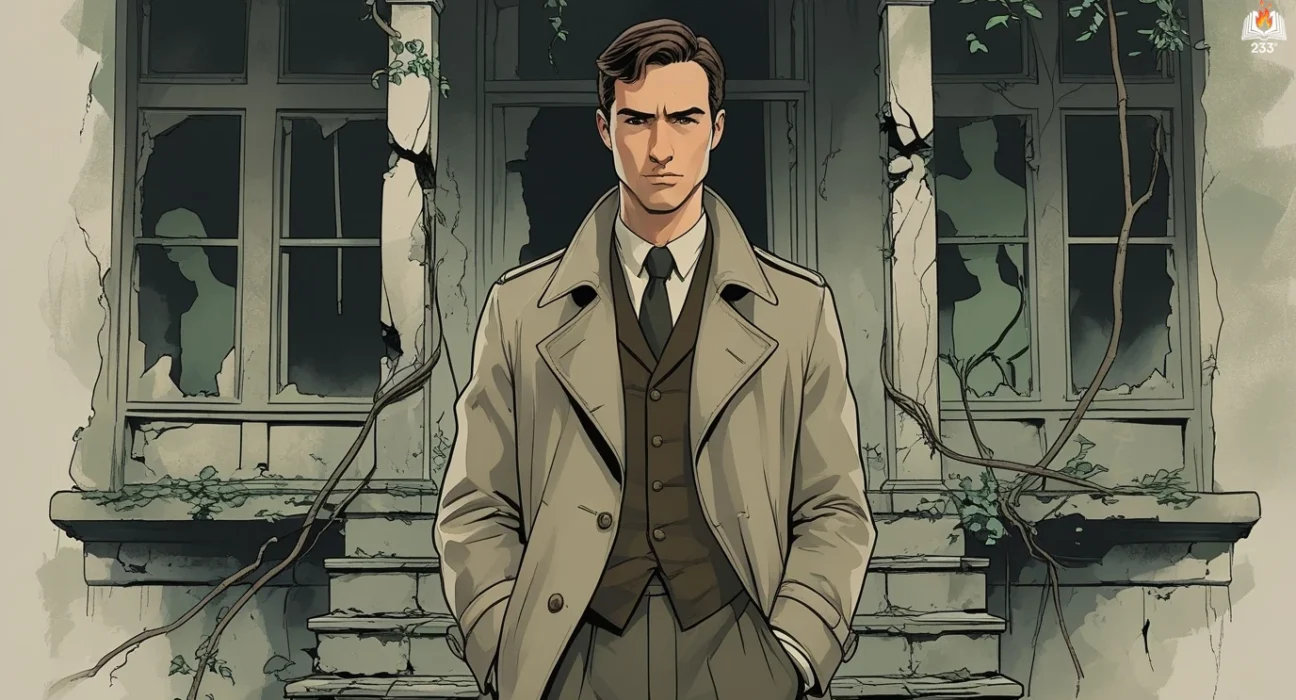
Christopher Banks – The central character and narrator, Christopher is a successful detective in 1930s London who is driven by a desire to solve the mystery of his parents’ disappearance. His character is marked by emotional repression, intense nostalgia, and a persistent belief in the rational order of the world. Throughout the novel, he oscillates between self-assured professionalism and deep personal confusion, embodying the complexities of memory and identity.
Akira Yamada – Christopher’s childhood friend in Shanghai, Akira is a Japanese boy whose shared imaginative play and conspiratorial worldview with Christopher deeply influences the protagonist’s understanding of friendship, loyalty, and perception. Akira’s reappearance later in the narrative challenges Christopher’s notions of memory and truth.
Sarah Hemmings – A socially ambitious and enigmatic woman whom Christopher encounters in London society. Her flirtations and manipulations add emotional tension to Christopher’s otherwise intellectual pursuits. She represents both desire and disillusionment in Christopher’s adult life.
Uncle Philip – A family friend and mysterious figure whose role in the Banks family’s fate is gradually unveiled. He embodies the blurred lines between familial loyalty and colonial power structures.
Colonel Chamberlain – A paternal figure who escorts Christopher to England after the disappearance of his parents. Though kindly on the surface, his patronizing tone and detachment from the trauma Christopher experiences highlight the colonial indifference at the heart of the novel.
Theme
Memory and Unreliable Narration – The novel is built upon the shifting sands of Christopher’s memories. Ishiguro explores how memory is reconstructed, unreliable, and often self-serving. As Christopher’s investigation unfolds, so too does the unreliability of his recollections, suggesting that the past is as elusive as the people he is trying to find.
Colonialism and Moral Ambiguity – Set in Shanghai’s International Settlement during the decline of the British Empire, the novel scrutinizes the colonial power dynamics and their moral contradictions. Characters such as Uncle Philip and Christopher’s father symbolize the complex roles British expatriates played in shaping and ultimately destabilizing Shanghai’s political environment.
Isolation and Identity – Christopher’s identity is fractured—British by nationality, emotionally tied to Shanghai, and isolated both as a child and as an adult. His emotional detachment, cultivated as a coping mechanism in childhood, persists into adulthood and alienates him from genuine relationships.
The Illusion of Control – As a detective, Christopher clings to the belief that the world can be made orderly through logic and investigation. The novel challenges this belief at every turn, revealing a world driven by chaos, coincidence, and forces far beyond individual control.
Writing Style and Tone
Kazuo Ishiguro employs a first-person narrative that is elegant, restrained, and filled with subtle ironies. The tone is introspective and melancholic, with Christopher’s voice marked by a formal, almost mannered detachment that paradoxically reveals deep vulnerability. His narration mirrors the internal logic of someone who has spent a lifetime rationalizing pain and absence.
Ishiguro’s prose is marked by deliberate ambiguity and emotional understatement. Much like in The Remains of the Day, he crafts a narrator who is emotionally reserved and unreliable. This allows the reader to feel the disjunction between what is said and what is truly felt or meant. The author’s quiet, reflective tone imbues even mundane events with a sense of haunting significance, making the ordinary feel uncanny. His subtle shifts in time and memory create a dreamlike quality that blurs reality with perception.
Quotes
When We Were Orphans – Kazuo Ishiguro (2000) Quotes
“It's all right. I'm not upset. After all, they were just things . When you've lost your mother and your father, you can't care so much about things , can you?”
“Perhaps one day, all these conflicts will end, and it won't be because of great statesmen or churches or organisations like this one. It'll be because people have changed. They'll be like you, Puffin. More a mixture. So why not become a mongrel? It's healthy.”
“She wrote of how our childhood becomes like a foreign land once we have grown.” “Well, Colonel, it’s hardly a foreign land to me. In many ways, it’s where I’ve continued to live all my life. It’s only now I’ve started to make my journey from”
“She wrote of how our childhood becomes like a foreign land once we have grown.”
“I was upset. But I'm not any more. You have to look forward in life.”
“But for those like us, our fate is to face the world as orphans, chasing through long years the shadows of vanished parents. There is nothing for it but to try and see through our missions to the end, as best we can, for until we do so, we will be permitted no calm.”
“Those were splendid days. We didn’t know it then, of course, just how splendid they were. Children never do, I suppose.”
“Children can be very taxing.”
“The war, ghastly as it was, represented no more than “an awkward window in Man’s evolution” when for a few years our technical progress had run ahead of our organisational capacities.”
We hope this summary has sparked your interest and would appreciate you following Celsius 233 on social media:
There’s a treasure trove of other fascinating book summaries waiting for you. Check out our collection of stories that inspire, thrill, and provoke thought, just like this one by checking out the Book Shelf or the Library
Remember, while our summaries capture the essence, they can never replace the full experience of reading the book. If this summary intrigued you, consider diving into the complete story – buy the book and immerse yourself in the author’s original work.
If you want to request a book summary, click here.
When Saurabh is not working/watching football/reading books/traveling, you can reach him via Twitter/X, LinkedIn, or Threads
Restart reading!