

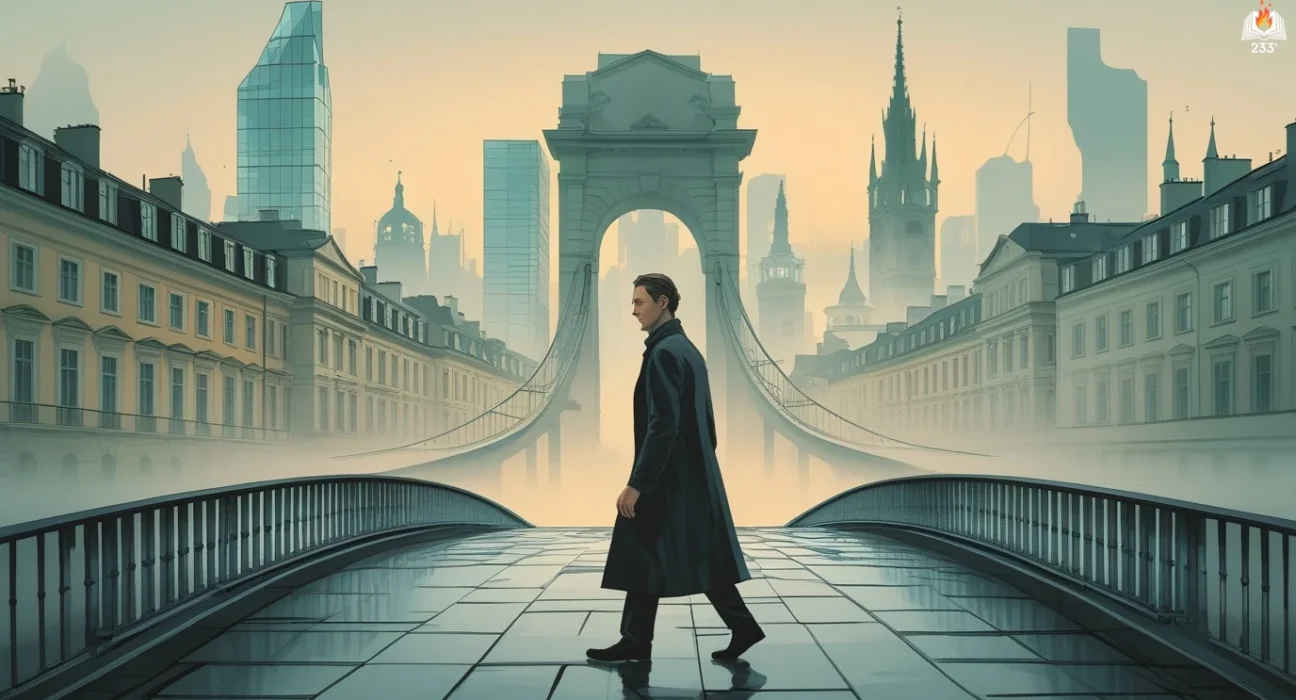
The Unconsoled by Kazuo Ishiguro, published in 1995, is a surreal and dreamlike novel that follows internationally renowned pianist Ryder as he arrives in an unnamed Central European city for a performance that may define his career. Over several disorienting days, Ryder struggles to fulfill a series of ambiguous obligations, navigate a city burdened by psychological tension, and make sense of a reality that continually shifts beneath his feet. This novel, one of Ishiguro’s most ambitious works, marks a departure from conventional narrative structure and instead immerses readers in a haunting and elliptical psychological landscape.
Plot Summary
In a quiet Central European city veiled in faint melancholy and polished civility, the acclaimed pianist Ryder arrives by taxi, his reception subdued and almost accidental. The hotel lobby, with its sagging ceiling and sleepy sunlight, offers no grand welcome, only a distracted clerk and a pianist’s faint rehearsal echoing from behind a closed door. Ryder, burdened with fatigue and uncertainty, is assured by everyone that his presence is a monumental event – one that will culminate in a performance on Thursday night. But Ryder’s mind is scattered. He cannot recall the schedule he is apparently following, nor the many obligations thrust upon him. The city expects him to redeem its cultural soul, yet he himself is adrift, unable to find solid ground in the constantly shifting reality around him.
The elderly porter Gustav, carrying Ryder’s suitcases with theatrical devotion, insists on not setting them down, a ritual born from a lifetime of misunderstood labor and quiet resistance. His dignity, as fragile as his joints, is maintained by his adherence to personal rules formed decades earlier in Lucerne, where porters were once honored like artists. Gustav’s gentle pride and sorrow seep through every word, hinting at a deeper concern – the unhappiness of his daughter Sophie and her young son Boris. The porter’s silent love for his family, long estranged in conversation though not in proximity, reflects a city where emotion is suppressed under layers of politeness and performance.
Ryder’s room reveals more than the plush anonymity of hotel luxury. It is, inexplicably, the very room he once inhabited as a child in his aunt’s home on the border of England and Wales. The wallpaper has changed, the ceiling replastered, yet the sensation of being drawn backward into a time of plastic soldiers and muffled arguments from downstairs is undeniable. Memory, dream, and present blur together as effortlessly as the day transitions into night.
In the hotel lobby, the manager Hoffman introduces himself with grand gestures and offers an unusual request – that Ryder, when convenient, take a look at his wife’s meticulously arranged albums filled with newspaper clippings about the pianist’s life. Ryder agrees politely, his mind still tangled in the fog of his duties and the strange familiarity of his surroundings. Soon after, Stephan, Hoffman’s son, a shy and hopeful amateur pianist, approaches Ryder and requests guidance for his upcoming performance. Stephan’s nervousness is matched only by his reverence, but Ryder, though willing, is unable to promise a definite time.
The city outside the hotel is sun-drenched yet solemn. Gustav recommends the Hungarian Café in the Old Town, urging Ryder to walk there and – more importantly – to speak with Sophie. Something is amiss with her, he explains, and Boris, once carefree, now carries the burden of unspoken anxieties. Ryder agrees to visit. His footsteps take him through streets of glinting glass offices and across a bridge toward cobbled lanes and awnings of color. At the café, Sophie and Boris wait, familiar and unfamiliar all at once. Sophie’s beauty is quiet and worn; Boris, sharp-tongued and sensitive, eyes Ryder with suspicion and pride.
Their conversation, elliptical and brittle, reveals fractured intimacy. Sophie, once emotionally entangled with Ryder, speaks as though they share a personal history – one he struggles to recall with clarity. Boris, fiercely intelligent and prone to disappointment, speaks of spacecraft and disappointment in equal measure. Ryder tries to navigate their delicate lives, offering reassurances he barely believes, tethered more to emotion than to memory. The café becomes a microcosm of the city – filled with warmth, resignation, and a hunger for resolution that always seems just out of reach.
Tasks and appointments arise constantly. Ryder is taken to see Brodsky, a once-great conductor now frail and alcoholic, struggling to prepare the local orchestra for the climactic event. Brodsky, cared for by Miss Collins, a woman he once loved and alienated, practices obsessively in isolation. His presence is tragic and majestic, a man who once shaped sound and now lives in cacophony, both inner and outer. The city has pinned its hopes on his return to glory, just as it has on Ryder, though neither man is fully whole.
Time spirals. Meetings are missed, then remembered too late. People from Ryder’s past and imagination intermingle – former lovers, childhood acquaintances, strangers who seem to know his soul. In long conversations that loop and contradict, Ryder is drawn deeper into the city’s psychological labyrinth. Each promise he makes is a thread he cannot untangle, each request a weight added to his back. He is to attend the Citizens’ Mutual Support Group, deliver speeches, advise the local music critics, guide Stephan, counsel Sophie, and, above all, perform.
But his memories betray him. He forgets where he is, why he came, what he must do. When he speaks, people nod as if enlightened, as if he has delivered wisdom they long awaited. Yet he feels hollow, unsure if any of it is real. In one moment, he comforts Boris with a father’s sincerity; in the next, he walks through streets that rearrange themselves mid-step. Sleep becomes indistinguishable from waking. A child’s voice, a tune played behind closed doors, the sudden appearance of a familiar building from decades ago – all collapse into a fevered haze of longing and confusion.
Thursday approaches, and with it, the burden of fulfillment. Ryder is expected to offer salvation through music, to lift the city’s cultural despair with a single performance. But his hands feel unfamiliar on the keys. He is late, uncertain, perpetually rerouted by others’ crises and his own faltering will. The day passes in a haze of half-kept appointments and well-meaning delays. At the concert hall, faces watch him with expectation, desperation even. Brodsky has attempted to lead the orchestra but falters, collapsing into incoherence. Stephan performs, but his confidence cracks under pressure.
At last, Ryder prepares to play. He is led to the stage, the lights upon him, the silence full of demand. He sits at the piano, fingers poised. But instead of music, memory arrives – pure, unbidden, and overwhelming. A childhood scene. A room filled with toys and unspoken sorrow. A hallway of closed doors. A longing not just to perform, but to be understood.
And then the moment passes. The performance remains unplayed or perhaps it was played and forgotten, like so much else. The city begins to settle back into its quiet, mournful rhythm. Ryder finds himself once more in transit, seated in the back of a taxi, the early morning mist pressing against the glass. The driver speaks of destinations and the future, but Ryder listens only half-heartedly, watching the landscape of the city disappear behind him. Outside, the day is beginning – uncertain, familiar, waiting.
Main Characters
Mr. Ryder – The protagonist and an acclaimed concert pianist. Ryder arrives in a city expecting to give a recital but is immediately pulled into an increasingly surreal web of social expectations, forgotten commitments, and psychological burdens. His fragmented memories and inability to discern reality from hallucination mirror his inner turmoil and isolation.
Gustav – An elderly hotel porter with a deep sense of duty and dignity. He is kind, meticulous, and quietly troubled by his estranged relationship with his daughter Sophie. Gustav represents loyalty and the quiet sadness of emotional repression. His backstory reveals a man shaped by self-imposed ideals and disappointment.
Sophie – Gustav’s daughter and the mother of young Boris. She is portrayed as emotionally vulnerable and weighed down by a vague but persistent depression. Sophie struggles with unresolved issues from her past and her strained relationship with Ryder, which hints at a shared but ambiguous history.
Boris – Sophie’s young son, precociously intelligent yet deeply affected by his mother’s unhappiness and his complex relationship with Ryder. Boris is both endearing and troubled, reflecting the psychological unease that pervades the novel.
Mr. Hoffman – The hotel manager and a representation of nervous civility and superficial order. His obsession with proper decorum and deference to Ryder masks his personal anxieties and the chaotic reality around him.
Stephan Hoffman – Mr. Hoffman’s insecure son, an amateur pianist desperate for validation. He seeks guidance from Ryder, whom he idolizes, yet is constantly undermined by his own lack of confidence and his father’s high expectations.
Miss Hilde Stratmann – A courteous but evasive figure from the Civic Arts Institute who is responsible for managing Ryder’s schedule. Her pleasant demeanor contrasts with her tendency to deflect clarity, adding to the novel’s sense of confusion and entrapment.
Theme
Disorientation and Memory: The novel is structured around a dream logic where time, space, and memory are fluid. Ryder frequently forgets appointments, encounters characters from his past in incongruent contexts, and experiences warped timelines. This theme reflects the instability of personal identity and the unreliability of memory.
Failure and Redemption: Many characters are haunted by past failures – Gustav’s estrangement from Sophie, Stephan’s faltering musical ambitions, Sophie’s depression. They all seek a kind of redemption, often through Ryder, who himself is overwhelmed by unfulfilled expectations and his own inadequacies.
Isolation and Communication Breakdown: Throughout the novel, characters speak at length yet rarely connect meaningfully. Conversations loop, stall, or are misunderstood, underscoring the isolation of the individual and the futility of language in bridging emotional gaps.
Burden of Expectations: Ryder is seen as a savior figure, expected to solve both artistic and civic crises in the city. These escalating expectations mirror societal pressures and the internal struggle between personal desire and public duty.
Parental Relationships: The strained connections between parents and children are central. Gustav and Sophie’s unspoken past, Sophie and Boris’s fragile bond, and Ryder’s unresolved childhood all highlight how emotional wounds are inherited and perpetuated.
Writing Style and Tone
Kazuo Ishiguro employs a hypnotic and recursive prose style in The Unconsoled, marked by long, introspective monologues and meandering conversations that often blur into one another. His language is formal yet intimate, meticulous yet often surreal. There is a deliberate lack of clarity, with characters’ speeches overflowing with interruptions, second-guessing, and shifts in tone that reflect their internal uncertainty. The novel’s structure resists traditional linear progression, creating a labyrinthine effect that mirrors the dreamlike state of the protagonist.
The tone is haunting, melancholic, and frequently claustrophobic. Ishiguro creates an atmosphere of psychological suffocation, where even moments of apparent calm are imbued with latent dread or confusion. Despite its surrealism, the emotional core is grounded in real human anxieties – fear of failure, regret, longing for reconciliation – making the novel both mystifying and deeply affecting. Ishiguro’s signature restraint and subtle emotional layering are present, but in The Unconsoled, they take on an epic and experimental scale, pushing the reader into a sustained confrontation with the unconscious.
Quotes
The Unconsoled – Kazuo Ishiguro (1995) Quotes
“Silence is just as likely to indicate the most profound ideas forming, the deepest energies being summoned.”
“It's nonsense to believe people go on loving each other regardless of what happens.”
“I have this feeling, that all it will take will be one moment, even a tiny moment, provided it’s the correct one. Like a cord suddenly snapping and a thick curtain dropping to the floor to reveal a whole new world, a world full of sunlight and warmth.”
“One should not, in any case, attempt to make a virtue out of one's limitations.”
“Leave us, you were always on the outside of our love.”
“I’m coming to believe it might be to do with me. A sort of illness I have. It might even be part of the ageing process. After all, we get older and parts of us start to die. Perhaps we start to die emotionally too. Do you think that’s possible, Mr Ryder?”
“There’s really no reason to go over the past again. And of course there’s every hope for the future now.”
“If I’d known that was all she would do! A painful thing, Mr Ryder, to push away someone you love. You think I’d have done it? You think I’d have turned myself into this creature if that was all she was going to do?”
“So I knew I was better, better than they said. And for a little while after we came here, she knew it too, I know she did. But then, well, she began to doubt it, who can blame her?”
“All of a sudden I saw clearly something I’d been trying not to see over the years. I mean, that she had always hidden certain parts of herself from me.”
“No, I didn’t know about such things then. I still hoped I would become in time the sort of person she believed me to be. Indeed, sir, I believed I would succeed in becoming such a person precisely because of her presence, because of her influence.”
“I had certain plans then, such as you do when you are young, when you don’t realise how limited time is, when you don’t realise there’s a shell built around you, a hard shell so you can’t – get – out!”
“Of course, I have to say, when I took on these rules for myself, I was much younger and stronger, and I suppose I didn’t really calculate for my growing weaker with age. It’s funny, sir, but you don’t.”
“It was the sort of place one might imagine lorry drivers stopping for a sandwich,”
We hope this summary has sparked your interest and would appreciate you following Celsius 233 on social media:
There’s a treasure trove of other fascinating book summaries waiting for you. Check out our collection of stories that inspire, thrill, and provoke thought, just like this one by checking out the Book Shelf or the Library
Remember, while our summaries capture the essence, they can never replace the full experience of reading the book. If this summary intrigued you, consider diving into the complete story – buy the book and immerse yourself in the author’s original work.
If you want to request a book summary, click here.
When Saurabh is not working/watching football/reading books/traveling, you can reach him via Twitter/X, LinkedIn, or Threads
Restart reading!