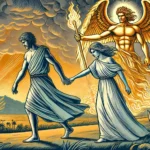
“Paradise Regained,” published in 1667, is John Milton’s sequel to his more famous epic, “Paradise Lost.” This work, although shorter and less grandiose, focuses on the theme of spiritual redemption and the victory of the Son of God over temptation. It captures the biblical story of Jesus’ temptation in the wilderness by Satan, highlighting themes of obedience, faith, and the triumph of good over evil.
Plot Summary
Jesus stands at the edge of the Jordan River, newly baptized by John. A voice from Heaven declares him the Son of God, an announcement that echoes across the heavens and reaches the ears of Satan. The fallen angel, seething with envy and fear, knows that this man threatens his dominion over Earth. He gathers his dark council, the ancient powers of air and earth, plotting to corrupt this new threat. They agree that Satan should confront Jesus in the wilderness, seeking to tempt him into disobedience and thus thwart God’s plan of salvation for mankind.
Jesus is led into the barren wilderness by the Spirit, a desolate expanse of rocks and sand, where he spends forty days and nights in fasting and prayer. He contemplates his mission, his purpose on Earth, and the path that lies before him. He is physically weakened by hunger but spiritually fortified, preparing himself for what he senses is an impending trial. Alone in the vast solitude, he ponders the weight of his task, the salvation of humanity resting on his shoulders.
Satan watches, biding his time, waiting for the perfect moment to strike. He approaches Jesus in the guise of an old man, his demeanor humble and concerned. He speaks to Jesus with feigned kindness, suggesting that he turn the surrounding stones into bread to satisfy his hunger. “You are the Son of God,” he says. “Surely you can use your power to feed yourself.” But Jesus sees through the deception. He responds with unwavering resolve, quoting scripture: “Man shall not live by bread alone, but by every word that proceeds from the mouth of God.” Satan, undeterred, realizes that this battle will require more cunning than he first anticipated.
In his next approach, Satan takes Jesus to the pinnacle of the Temple in Jerusalem. The city sprawls below them, and the temple’s height gives a vertiginous view. The Tempter’s voice is smooth as he dares Jesus to throw himself down, quoting scripture to suggest that angels will save him. “If you are truly the Son of God, prove it,” Satan urges. But Jesus, his eyes piercing through the Tempter’s disguise, replies with calm authority, “It is written, ‘You shall not put the Lord your God to the test.'” He will not be goaded into displaying his power for spectacle or vanity. His mission is one of humility and obedience, not of self-aggrandizement.
Satan retreats momentarily, formulating a new strategy. He cannot provoke Jesus through physical needs or empty displays of power. He must delve deeper, challenge Jesus on a fundamental level, attack the very purpose of his mission. In an instant, he transports Jesus to a high mountain, where the kingdoms of the world stretch out before them, glittering in their splendor and might. Satan gestures to the vast empires, the cities bustling with life, the armies poised for conquest. “All this I will give you,” he offers, “if you will fall down and worship me.” This is the most insidious of temptations, offering Jesus the power to save mankind without the pain, without the suffering. But to accept would mean bowing to evil, compromising the very essence of his divine mission.
Jesus turns his gaze from the dazzling sights, focusing on the Tempter with a look of serene defiance. “Away with you, Satan,” he commands. “For it is written, ‘You shall worship the Lord your God, and Him only shall you serve.'” His voice carries the weight of divine authority, and the words strike Satan like a blow. Jesus’ refusal to bow, to seek power through any means other than obedience to God, signifies a victory not just over the Tempter, but over the very nature of sin itself.
But Satan is relentless. He takes Jesus to another high point, showing him the glories of Rome, the seat of earthly power, where emperors rule with iron fists, and the riches of the world are gathered. He tempts Jesus with visions of ruling this vast empire, of achieving greatness and glory among men. “Think of the good you could do,” Satan whispers. “With this power, you could bring justice, end suffering, establish a kingdom of peace on Earth.” The implication is clear: Jesus could seize the crown without the cross. Yet, Jesus sees the hollowness of this offer. The kingdoms of this world are fleeting, tainted with sin and corruption. His kingdom is not of this world but of a higher, eternal nature. “My kingdom is not of this world,” he replies, turning away from the vision of earthly power.
As a last attempt, Satan offers Jesus the opportunity to demonstrate his divine power, to create a miracle for his own sustenance. He shows him a table laden with the finest foods, an opulent feast that would satisfy the deepest hunger. “You deserve this,” Satan urges. “Prove your divinity by turning these stones into bread.” Yet, Jesus remains unmoved. His mission is not about proving his power for self-gratification but about the spiritual nourishment he brings to mankind. “Man does not live by bread alone,” he repeats, reinforcing the truth that his sustenance comes from obedience to God’s will.
Satan, recognizing his defeat, withdraws. The wilderness falls silent as he vanishes into the shadows, his schemes thwarted. In the wake of this confrontation, angels descend to minister to Jesus, offering him the nourishment and comfort he denied himself. They bring with them the warmth and light of Heaven, a divine acknowledgment of his triumph. Jesus has passed the test, resisted the temptations of power, pride, and physical need. His victory in the wilderness symbolizes the regaining of paradise, not through force or conquest, but through faith, humility, and unwavering obedience to God.
As he stands there, renewed and strengthened, Jesus knows that his path will not be easy. He has chosen the way of suffering and sacrifice, the way that leads to the cross. Yet, it is through this choice, this steadfast refusal to compromise with evil, that he will open the way for humanity to find redemption and eternal life. The battle is won, but the journey has only just begun.
Main Characters
- Jesus: The protagonist of the poem, Jesus embodies the virtues of obedience, humility, and spiritual strength. Through his confrontation with Satan, he demonstrates unwavering faith and the power of divine wisdom over worldly temptations.
- Satan: The antagonist, Satan represents deceit and the lure of worldly power and glory. He is cunning and manipulative, using various tactics to tempt Jesus but ultimately failing to corrupt him.
Theme
- Temptation and Resistance: A central theme is the nature of temptation and the strength required to resist it. Jesus’ steadfastness in the face of Satan’s temptations serves as a model of spiritual resilience.
- Obedience to God: The poem emphasizes the importance of obedience to God’s will over seeking earthly power or glory. Jesus’ victory is portrayed not through might but through his unwavering commitment to God’s command.
- Spiritual versus Worldly Power: “Paradise Regained” contrasts the temporary nature of worldly power with the eternal nature of spiritual authority. It suggests that true power lies in spiritual integrity rather than in material wealth or political dominance.
Writing Style and Tone
Milton’s writing style in “Paradise Regained” is less ornate and more direct compared to “Paradise Lost.” The poem is composed in blank verse, maintaining a solemn and contemplative tone throughout. Milton employs a restrained use of epic conventions, focusing instead on dialogue and internal monologue to convey the moral and spiritual struggles of Jesus. The tone is didactic, aiming to impart lessons on faith, obedience, and the virtues of humility. Milton’s language is elevated but not as dense, making the poem more accessible while still retaining a sense of grandeur and theological depth.
Quotes
Paradise Regained – John Milton (1671) Quotes
“Yet he who reigns within himself, and rules Passions, desires, and fears, is more a king.”
“The childhood shows the man, As morning shows the day.”
“Who reads Incessantly, and to his reading brings not A spirit and judgment equal or superior, (And what he brings what needs he elsewhere seek?) Uncertain and unsettled still remains, Deep versed in books, and shallow in himself.”
“The happy place Imparts to thee no happiness, no joy -- Rather inflames thy torment, representing Lost bliss, to thee no more communicable; So never more in Hell than when in Heaven.”
“Much of the Soul they talk, but all awry; And in themselves seek virtue; and to themselves All glory arrogate, to God give none”
“Most men admire Virtue who follow not her lore.”
“So spake Israel's true king, and to the Fiend Made answer meet, that made void all his wiles. So fares it, when with truth falsehood contends.”
“He who receives Light from above, from the Fountain of Light, No other doctrine needs, though granted true; But these are false, or little else but dreams, Conjectures, fancies, built on nothing firm.”
“Thither he bent his way, determined there to rest at noon; and entered soon the shade high roofed, and walks beneath, and alleys brown, That opened in the midst a woody scene; Nature's own work it seemed, Nature-taught Art”
“Extol not riches, then, the toil of fools, The wise man's cumbrance, if not snare; more apt To slacken virtue and abate her edge Than prompt her to do aught may merit praise.”
“ That who advances his glory, not their own, Them he himself to glory will advance.”
“ His weakness shall o'ercome Satanic strength, And all the world, and mass of sinful flesh; That all the Angels and aethereal Powers
We hope this summary has sparked your interest and would appreciate you following Celsius 233 on social media:
There’s a treasure trove of other fascinating book summaries waiting for you. Check out our collection of stories that inspire, thrill, and provoke thought, just like this one by checking out the Book Shelf or the Library
Remember, while our summaries capture the essence, they can never replace the full experience of reading the book. If this summary intrigued you, consider diving into the complete story – buy the book and immerse yourself in the author’s original work.
If you want to request a book summary, click here.
When Saurabh is not working/watching football/reading books/traveling, you can reach him via Twitter/X, LinkedIn, or Threads
Restart reading!