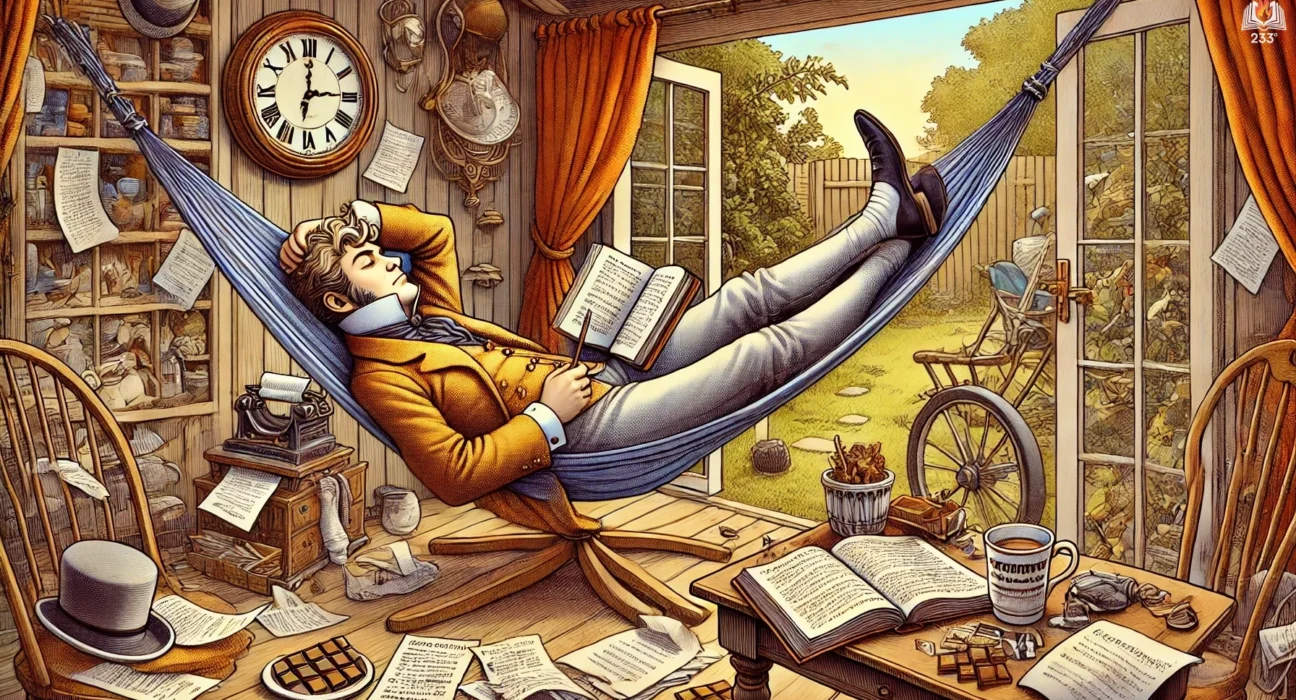
“Idle Thoughts of an Idle Fellow,” written by Jerome K. Jerome and published in 1886, is a charming and humorous collection of essays that reflect on everyday topics with wit and a touch of philosophical insight. Jerome’s lighthearted and often satirical tone offers readers a delightful escape into his musings on various subjects. The essays cover a range of topics from the joy and pain of being idle, the bittersweet nature of love, to the trivialities and vanities of daily life. Jerome’s ability to blend humor with thoughtful observations makes this work an enduring classic.
Plot Summary
Jerome K. Jerome begins with musings on “Being Idle,” a subject he proudly claims expertise in. As a child, his schoolmasters and grandmother lamented his extraordinary ability to do little with great effort. This talent for idleness, he insists, is a gift. Jerome distinguishes genuine idlers from mere lazy individuals and slow-coaches, emphasizing that true idleness requires an abundance of tasks to ignore. He recounts a period of illness during which he was ordered to Buxton for rest. Initially, Jerome relishes the prospect of enforced idleness, envisioning lazy days in a hammock, sipping chocolate, and reading melancholy novels. However, reality soon sours his idyllic vision. The waters of Buxton, which he initially romanticized, turn out to be nauseating. His daily routine of doing nothing becomes torturous. A sense of danger pervades his excursions in a Bath chair, adding to his misery. Eventually, Jerome’s ennui reaches a peak, and he rebelliously escapes Buxton’s lethargy for a long walk, ending his month of idleness with a newfound appreciation for the bustling life of London.
In “Being In Love,” Jerome humorously equates love to the measles, a malady everyone must endure once, and only once. He paints a vivid picture of the symptoms of love: the jealousy, the adoration, and the eventual disillusionment. Young love, he muses, is a fiery, all-consuming passion that eventually cools into the steady warmth of affection. Jerome recalls his youthful experiences of love, from the thrill of a woman’s smile to the agony of her indifference. He reflects on the ephemeral nature of love, which, despite its intensity, inevitably fades. Yet, he finds solace in the enduring affection that follows, a more sustainable and comforting emotion that anchors relationships over time.
In “Being In The Blues,” Jerome explores the inexplicable melancholy that can envelop anyone without warning. He describes the blues as a state of restless irritability, where even the most beloved activities lose their appeal. Jerome recounts a typical episode of the blues, where he vacillates between futile attempts to find solace in books, letters, and social visits. Each endeavor only deepens his sense of ennui. He humorously depicts the absurdity of the blues, where every effort to shake off the melancholy only exacerbates it. Through this exploration, Jerome underscores the universal nature of these bouts of sadness and the irrationality that often accompanies them.
“Being Hard Up” shifts focus to financial struggles and the social stigma of poverty. Jerome draws from personal experience to paint a vivid picture of life on a shoestring budget. He recounts his days as a provincial actor and a journalist, where every penny counted. Jerome humorously describes the ingenious ways he and others navigate their financial constraints, from walking miles to save a penny to living on a great-coat for a fortnight. He critiques societal attitudes toward poverty, highlighting the shame and embarrassment that often accompany financial hardship. Jerome’s reflections reveal the deeper impact of poverty on one’s self-esteem and social interactions, offering a blend of humor and empathy.
In “Vanity And Vanities,” Jerome turns his sharp wit to the subject of human vanity. He observes that vanity is a universal trait, present in everyone from children to adults, and even in animals. Jerome recounts instances of children’s vanity, such as a little girl proudly showing off her new shoes, and a dog’s smug satisfaction while admiring its reflection. He notes that even the most modest people harbor some degree of vanity. Jerome’s humorous anecdotes illustrate the absurdity and universality of this trait, suggesting that vanity, despite its flaws, is an intrinsic part of human nature. Through his reflections, he invites readers to acknowledge and perhaps laugh at their own vanities.
Jerome’s essays weave together humor and philosophy, offering readers a delightful escape into his world of idle thoughts. Each essay is a window into the author’s mind, revealing his wit, his observations on human nature, and his ability to find humor in the mundane. Jerome’s lighthearted approach to serious subjects makes his reflections both entertaining and thought-provoking, inviting readers to reflect on their own lives with a smile.
By blending personal anecdotes with broader reflections, Jerome creates a rich tapestry of thoughts that resonate with readers across generations. His essays are not just idle musings but a celebration of life’s quirks and idiosyncrasies, reminding us that even in our most idle moments, there is much to be learned and enjoyed.
Main Characters
- Jerome K. Jerome: As the narrator and protagonist of these essays, Jerome presents himself as a reflective, witty, and often self-deprecating observer of life. His humorous and philosophical musings provide the central voice throughout the collection.
Theme
Idleness and Work: The essays frequently explore the tension between idleness and productivity. Jerome advocates for the joys of idleness while recognizing the societal value placed on work, presenting a nuanced view of leisure and labor.
Love and Affection: Love, in its various forms, is a recurring theme. Jerome contrasts the intense, fleeting passion of youthful love with the enduring warmth of mature affection, offering insights into the emotional evolution of relationships.
Melancholy and Joy: The collection delves into the dual nature of human emotions, from the inexplicable bouts of the blues to the simple pleasures of daily life. Jerome’s reflections underscore the complexity and unpredictability of emotional experiences.
Vanity and Self-Perception: Jerome humorously examines the vanity inherent in humans and animals, highlighting the absurdity and universality of this trait. His observations suggest that vanity is an intrinsic part of human nature, influencing behavior and self-perception.
Writing Style and Tone
Jerome K. Jerome’s writing style in “Idle Thoughts of an Idle Fellow” is characterized by its wit, humor, and conversational tone. He employs a light, engaging narrative style that makes philosophical reflections accessible and entertaining. Jerome’s use of personal anecdotes and humorous exaggerations adds a relatable and human touch to his essays.
His tone, while often satirical, is also empathetic and reflective, allowing readers to see the deeper truths behind his humorous observations. Jerome’s linguistic choices, such as playful language and clever wordplay, contribute to the overall charm and impact of his writing, making the collection a delightful exploration of everyday life and human nature.
Quotes
Idle Thoughts of an Idle Fellow – Jerome K Jerome (1886) Quotes
“It is so pleasant to come across people more stupid than ourselves. We love them at once for being so.”
“It is in our faults and failings, not in our virtues, that we touch one another and find sympathy. We differ widely enough in our nobler qualities. It is in our follies that we are at one.”
“If there is one person I do despise more than another, it is the man who does not think exactly the same on all topics as I do...”
“Being poor is a mere trifle. It is being known to be poor that is the sting.”
“Idling has always been my strong point.”
“To be misunderstood is the shy man's fate on every occasion; and whatever impression he endeavors to create, he is sure to convey its opposite.”
“Swearing relieves the feelings - that is what swearing does. I explained this to my aunt on one occasion, but it didn't answer with her. She said I had no business to have such feelings.”
“If you are foolish enough to be contented, don't show it, but grumble with the rest; and if you can do with a little, ask for a great deal. Because if you don't you won't get any.”
“Ambition is only vanity ennobled.”
“The truth is, we each of us have an inborn conviction that the whole world with everybody and everything in it, was created as a sort of necessary appendage to ourselves.”
“Speak truth, and right will take care of itself.”
“It must be eight years since I last saw Joseph Taboys. How pleasant it would be to meet his jovial face again, to clasp his strong hand, and to hear his cheery laugh once more! He owes me 14 shillings, too.”
“To tell you the truth - mind, this is strictly between ourselves, please; I shouldn't like your wife to know I said it - the women folk don't understand these things; but between you and me, you know, I think it does a man good to swear.”
“Love is like the measles; we all have to go through it. Also like the measles, we take it only once. One never need be afraid of catching it a second time.”
“I do like cats. They are so unconsciously amusing. There is such a comic dignity about them, such a "How dare you!" "Go away, don't touch me" sort of air.”
“It is only the first baby that takes up the whole of a woman's time.Five or six do not require nearly so much attention as one.”
We hope this summary has sparked your interest and would appreciate you following Celsius 233 on social media:
There’s a treasure trove of other fascinating book summaries waiting for you. Check out our collection of stories that inspire, thrill, and provoke thought, just like this one by checking out the Book Shelf or the Library
Remember, while our summaries capture the essence, they can never replace the full experience of reading the book. If this summary intrigued you, consider diving into the complete story – buy the book and immerse yourself in the author’s original work.
If you want to request a book summary, click here.
When Saurabh is not working/watching football/reading books/traveling, you can reach him via Twitter/X, LinkedIn, or Threads
Restart reading!