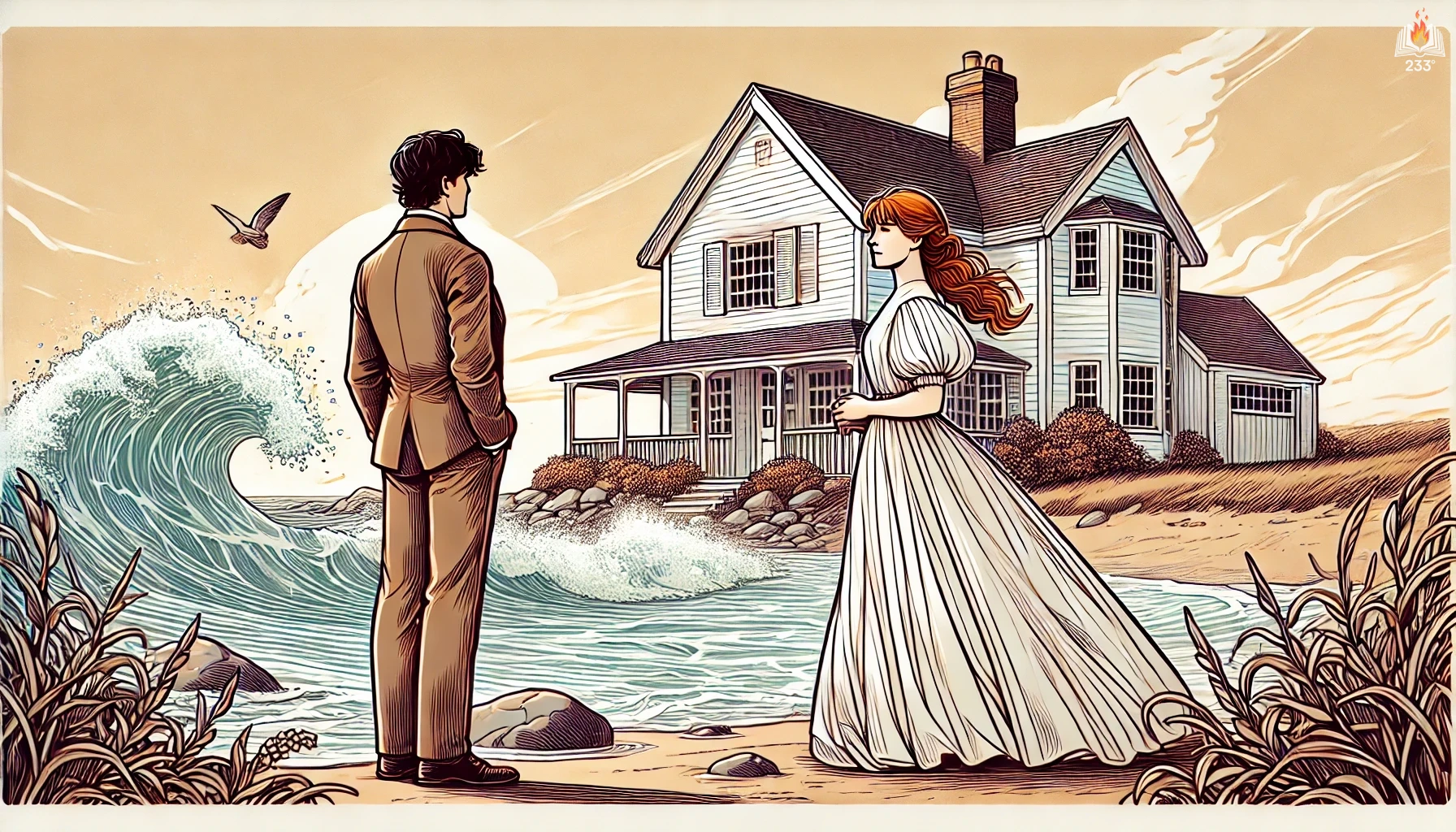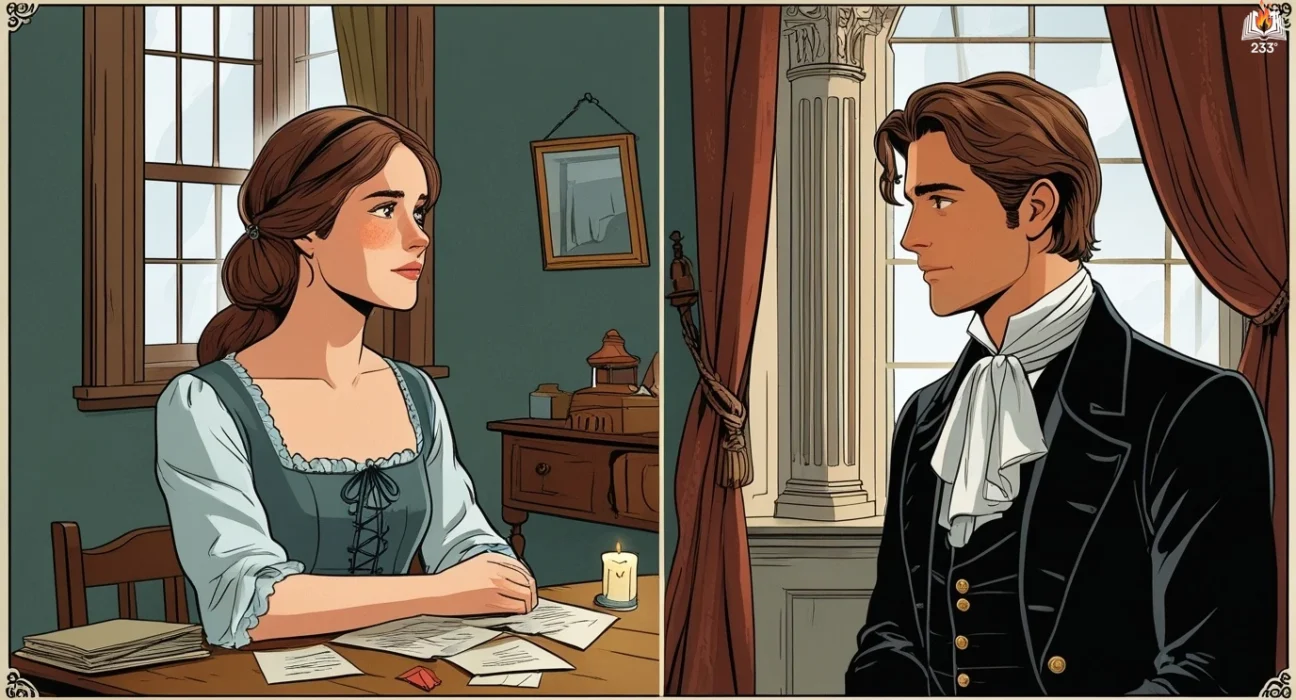
How to Marry a Marquis by Julia Quinn was published in 1999 and is part of the beloved “Agents of the Crown” series, following a blend of Regency romance and witty espionage. This installment centers around Elizabeth Hotchkiss, a genteel but impoverished young woman, and James Sidwell, the Marquis of Riverdale, who is undercover investigating a blackmailer threatening his aunt, the indomitable Lady Danbury. Quinn’s signature charm, humor, and deep character insight are on full display in this lively tale of deception, love, and unlikely alliances.
Plot Summary
In the summer of 1815, Elizabeth Hotchkiss sits at her modest cottage table, despairing over numbers that refuse to add up. She has been head of the family since her father’s death, raising her three younger siblings with determination, pride, and little more than love to sustain them. But with rent due and fuel for winter out of reach, Elizabeth arrives at a desperate conclusion – she must marry, and she must marry well.
Fate, ever mischievous, places in her hands a peculiar book found in the library of her sharp-tongued employer, Lady Danbury. Slim, bound in garish red leather, and titled How to Marry a Marquis, the volume seems absurd at first. But Elizabeth, ever practical, decides that if she must seek a husband for financial salvation, she may as well gather advice, no matter how ridiculous it might seem.
James Sidwell, the Marquis of Riverdale, has troubles of his own. A former agent for the War Office, his covert career ended when a French spy revealed his identity. When his formidable aunt Lady Danbury summons him to her estate with news of a blackmailer threatening to expose her darkest secret – that her daughter was born out of wedlock – James agrees to help. Disguised as a new estate manager under the name James Siddons, he arrives in Surrey determined to investigate quietly and unobtrusively.
But before he even sets foot inside Danbury House, he collides – quite literally – with a whirlwind of blonde hair and panic. Elizabeth, in her rush to flee the scene with her scandalous red book, crashes into him, scattering her belongings and nearly revealing the manual that has quickly become her secret companion. The moment lingers longer than it should, her embarrassment mixing with curiosity, and his trained eyes noting the flush of her cheeks and the quickness of her retreat.
Assigned by Lady Danbury to fetch the new estate manager, Elizabeth is mortified when she realizes the man she nearly bowled over is the very same she must now encounter again. Her attempts to apply the ridiculous advice from the book – edicts about mystery, effortless charm, and never speaking to a man for more than five minutes – leave her tangled in contradictions. Elizabeth is too intelligent to be insipid, too honest to be coy, and too independent to flirt for gain. Yet she is drawn to Mr. Siddons, whose gaze sees too much and whose smile, infuriatingly, lingers in her thoughts.
James, intrigued by the lady who doesn’t know he is a marquis, plays along. He watches as Elizabeth tries and fails to mold herself into the mythical ideal wife the red book prescribes. Instead, what she reveals is something far more captivating – sincerity. Her fire, her fierce loyalty to her siblings, and her complete lack of artifice tug at him in ways he cannot explain. The more time he spends with her, the less he thinks about blackmail and the more he thinks about her laughter, her missteps, and the vulnerability in her eyes when she believes no one is watching.
Meanwhile, Lady Danbury’s household is a flurry of activity as she prepares for a house party, hoping the increased guests might flush out her blackmailer. Elizabeth, who has sworn not to attend, is coaxed into coming when her siblings make a surprise delivery of a borrowed gown. For one night, she is not the impoverished companion or overburdened sister – she is a lady, radiant and startlingly lovely. James, seeing her across the ballroom floor, is undone.
But secrets unravel quickly. A confrontation with the suspicious local squire – the unpleasant and lecherous Squire Nevins – leads James to suspect more than one man might have reason to extort Lady Danbury. At the same time, his feelings for Elizabeth deepen, complicating his mission and his identity. His attempts to warn her about Nevins veer dangerously close to declarations of affection, but Elizabeth, unaware of his true title, remains convinced that marriage to a penniless estate manager is impossible. She has her siblings to think of. She cannot afford dreams.
When the blackmailer strikes again with another letter, James tightens his investigation. He discovers it is not a stranger but a trusted family friend – someone who knew Lady Danbury’s secret from years ago and has now sought to profit from it. With swift precision and quiet cunning, James arranges for the culprit to be exposed and quietly exiled, shielding his aunt and cousin from scandal.
But the real danger lies not in the letters or the gossip, but in the chasm between Elizabeth and James – a chasm built from lies of omission and the walls of social class. When she finally discovers his true identity, her heart breaks. To her, it is a cruel joke, confirmation that love is not for the likes of her. She believes she has been made a fool, that she has opened her heart to a man who could never truly marry her.
James, however, has never been clearer. Title, duty, and propriety fall away in the face of what he feels. He does not want Elizabeth because of her resilience, her virtue, or her beauty – though she has all three – but because with her, he is known. Not the marquis, not the spy, not the wealthy bachelor, but James. Simply James.
He follows her back to her cottage, refusing to be dismissed. There is no great speech, no grand proposal beneath the stars. Just honesty, vulnerability, and a hand held out not as a savior, but as a partner. Elizabeth, with tears in her eyes and laughter threatening to escape, accepts. Not for the money, not for the title, but because she loves him. And for once in her life, she is allowed to choose happiness.
And so, the marquis married not the perfect lady outlined in red leather pages, but a woman who had thrown the book away, laughed at the rules, and captured his heart entirely.
Main Characters
Elizabeth Hotchkiss – The practical, self-sacrificing eldest sibling of an impoverished noble family, Elizabeth is fiercely devoted to her younger siblings. Her sense of duty and pride drive her to consider marriage not for love, but as a means to financial salvation. Intelligent, loyal, and morally grounded, Elizabeth’s journey explores the delicate tension between survival and self-respect, particularly as she struggles with the idea of securing a husband out of necessity.
James Sidwell, Marquis of Riverdale (alias James Siddons) – A former spy for the War Office, James is charming, perceptive, and disarmingly humorous. When summoned by his aunt Lady Danbury to root out a blackmailer, he assumes the identity of a humble estate manager. His growing attraction to Elizabeth challenges his assumptions and status, creating a classic tension between identity and affection. James is a man conflicted between duty and heart.
Lady Agatha Danbury – A fiercely intelligent, sharp-tongued dowager countess, Lady Danbury is both the instigator and the comic backbone of the novel. Her eccentricities are matched only by her perceptiveness and unwavering loyalty to her loved ones. Her secret shame and the threat of blackmail provide the novel’s external conflict and emotional depth.
Susan Hotchkiss – Elizabeth’s younger sister, practical and precocious. Her fascination with the scandalous book How to Marry a Marquis provides humor and inadvertently fuels Elizabeth’s romantic entanglement. She offers lighthearted commentary while embodying the clever wit typical of Quinn’s secondary characters.
Theme
Duty vs. Desire – The novel revolves around the conflict between familial duty and personal happiness. Elizabeth is caught between providing for her siblings and the longing for a love-based union. Similarly, James juggles his obligations as a marquis and nephew against his growing feelings for a woman he cannot marry—at least not without consequences.
Social Class and Identity – The exploration of hidden identities and social roles is central to the plot. James hides his nobility, and Elizabeth hides her desperation. Their masquerade reflects the rigid constraints of Regency-era class expectations and how love can transcend those boundaries.
Pride and Self-Sufficiency – Both protagonists are proud individuals reluctant to ask for help or admit vulnerability. Elizabeth’s refusal to rely on charity and James’s desire to solve problems without leveraging his title create internal tension that drives their character arcs forward.
Deception and Truth – Lies, disguises, and secrets are used for both comedic effect and emotional tension. James’s hidden identity and the forged persona of a practical estate manager form the foundation of his connection with Elizabeth, forcing both characters to reevaluate what honesty in love truly means.
Female Empowerment and Wit – The mock advice book How to Marry a Marquis serves as a humorous yet sharp commentary on the roles women were expected to play. Through Elizabeth and Susan, the novel pokes fun at these societal pressures while also demonstrating the clever ways women could reclaim agency within them.
Writing Style and Tone
Julia Quinn’s writing is marked by sparkling dialogue, clever internal monologues, and a deeply humorous undertone that rarely sacrifices emotional resonance. The tone of How to Marry a Marquis is light and effervescent, yet layered with undercurrents of longing, societal critique, and genuine emotional stakes. Her prose dances between sharp comedic beats and tender reflections, particularly when delving into Elizabeth’s quiet sacrifices or James’s conflicted conscience.
The narrative technique leans heavily on alternating internal viewpoints, allowing readers to experience the romantic tension from both protagonists’ perspectives. Quinn uses comedic exaggeration, especially through characters like Lady Danbury and Susan, to highlight the absurdities of Regency courtship while subtly underscoring its very real consequences for women of limited means. Vivid metaphors, punchy banter, and physical comedy (such as clumsy accidents or mistimed entries) add charm and pace, but beneath it lies a steady emotional core that roots the romance in substance, not just whimsy.
Quotes
How to Marry a Marquis – Julia Quinn (1999) Quotes
“James - "Are you paying attention or just trying to make me look like an idoit?" Elizabeth - "Oh, I'm definately paying attention. If you look like an idiot it has nothing to do with me.”
“He looks like a man.' 'How descriptive,' Susan said in a droll tone. 'Remind me never to advise you to seek work as a novelist.”
“James started to laugh. His chin hurt where she'd smacked him twice, his foot throbbed where she'd stepped on it, and his entire body felt as if he'd swum through a rosebush, which wasn't as far off the truth as it sounded. Yet still he started to laugh.”
“For the love of God, woman, there's only one rule in that bloody book worth following.' 'And that is?' Elizabeth asked disdainfully. 'That you marry your damned marquis!”
“Oh, Elizabeth," he murmured, leaning down to press a gentle kiss on her mouth, "I love you so much. You must believe me." "I believe you," she said softly, "because in your eyes, I see what I feel in my heart.”
“Elizabeth, you resemble nothing so much as a hen trying to hatch a book.”
“If looks could have killed, Susan would have been bleeding profusely from the forehead.”
“Raw toast," Lucas said grimly, shaking his head. "It goes against the very nature of man.”
“All of this presupposes that I have set my sights on a single male.' Susan's eyes bugged out. 'You certainly cannot set your signs on a married man!' 'I meant a particular man,' Elizabeth retorted, swatting her sister on the shoulder.”
“She was swaying slightly from side to side, and he could see her shoulders rise and fall with each shuddering breath. He knew that sort of breath. It was the one you drew when you were trying so hard to keep your feelings inside, but you just weren't strong enough.”
“But you have told me," Elizabeth protested, "time and again, that the hallmark of civilization is routine." Lady D shrugged and made a fussy little chirping sound. "A lady cannot take it upon herself to occasionally change her routine? All routines need periodic readjustment.”
“Am I not allowed to have my pride? Or is that an emotion reserved for the elite?”
“It was just a book. An inanimate object. The only power it held was what she chose to give it. It could only be important in her life if she made it such. Of course, that didn't explain why she half expected it to glow in the dark every time she peered into her satchel.”
“Oh, go ahead and giggle," Lady Danbury sighed. "I've found that the only way to avoid parental frustration is to view him as a source of amusement.”
“We cannot accept this sort of money from a stranger.' 'Maybe it's not a stranger,' Susan said. 'Then that's even worse!' Elizabeth retorted. 'My God, can you imagine? Some horrid person treating us like puppets, pulling our strings, thinking he can control our destiny?”
“And put me down.” James kept walking, his arm a vise under her ribs.”
“I have duties I must carry out as your erstwhile estate manager.”
“We need to be organized. Organization renders any goal reachable.”
“You’re as kind and good a person as they come,” he continued, “but unlike most kind and good people, you don’t preach or cloy, or try to make everyone else kind and good.”
“Not really,” she said in a sad voice. Sometimes I feel so resentful. If I were a better person I’d—”
“Raw toast,” Lucas said grimly, shaking his head. “It goes against the very nature of man.”
We hope this summary has sparked your interest and would appreciate you following Celsius 233 on social media:
There’s a treasure trove of other fascinating book summaries waiting for you. Check out our collection of stories that inspire, thrill, and provoke thought, just like this one by checking out the Book Shelf or the Library
Remember, while our summaries capture the essence, they can never replace the full experience of reading the book. If this summary intrigued you, consider diving into the complete story – buy the book and immerse yourself in the author’s original work.
If you want to request a book summary, click here.
When Saurabh is not working/watching football/reading books/traveling, you can reach him via Twitter/X, LinkedIn, or Threads
Restart reading!