

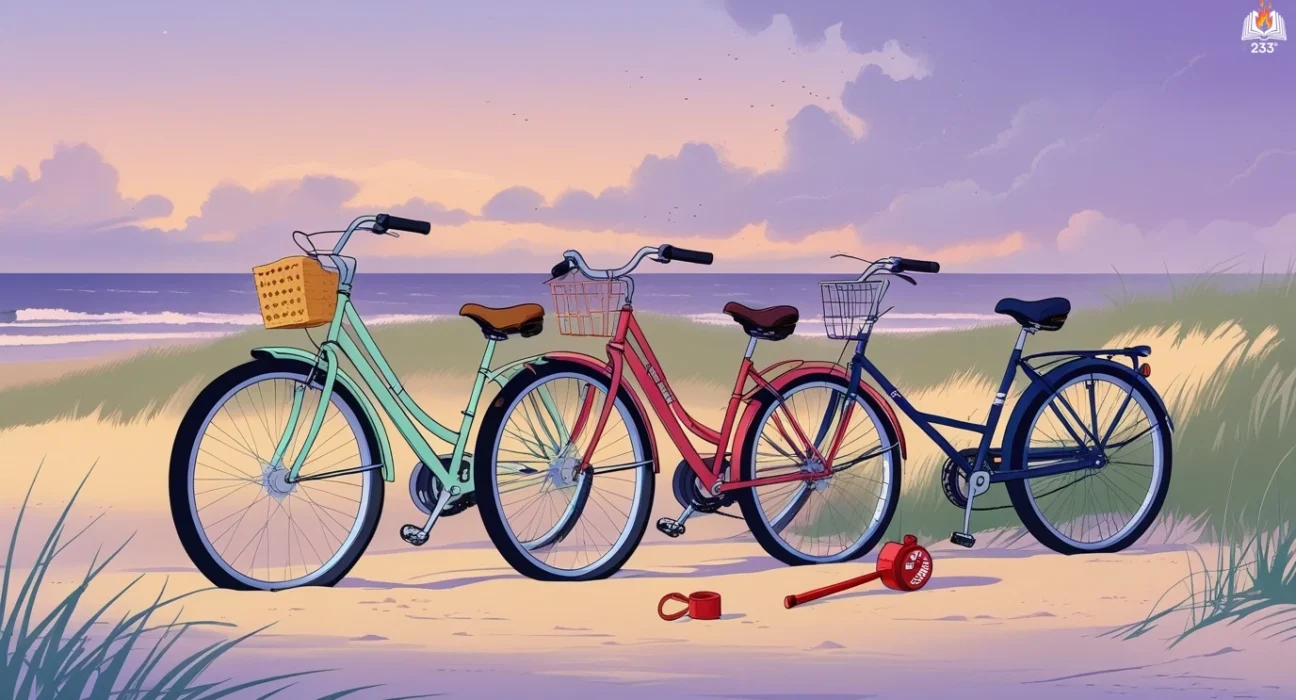
The Last Summer (of You and Me) by Ann Brashares, published in 2007, marks the author’s first foray into adult fiction after her success with The Sisterhood of the Traveling Pants series. Set against the sun-bleached backdrop of Fire Island, New York, the novel unfolds over a single summer that becomes transformative for three childhood friends – two sisters and a boy who has always straddled the line between them. With emotional depth and lyrical precision, Brashares captures the bittersweet turbulence of love, loss, and the irreversible passage into adulthood.
Plot Summary
The ferry carried Paul Martineau back to Fire Island after three long summers away, slipping through the hazy air like a memory returning uninvited. On the dock, Alice Long waited, her pulse thrumming with quiet hope. She told no one she was there for him, but her bare feet and brushed hair told otherwise. Paul had always belonged to both Alice and her older sister, Riley – a boy who grew up next door, one house away, in a bigger home full of emptiness. The three had shared childhood like a sacred trust, bound by sun, surf, and summers that spun long and golden. Now, as adults, they stood at the edge of something more fragile and uncertain.
Alice had loved Paul for as long as she could remember. He was Riley’s best friend, the one who knew her roughness and matched it with stubborn affection. With Alice, Paul had always been distant, teasing and aloof, as though guarding himself against something too real. But on this summer’s arrival, something had shifted. The moment she cut his hair with her old barber scissors, Alice felt the invisible strands between them tighten. As pieces of hair fell into the sink, so too did the years they had missed, the silences that had stretched too long. For a moment, his head rested against her body, a silent surrender that neither dared speak of afterward.
Riley, vibrant and unyielding, still worked as a lifeguard, still climbed into the red chair each day like it was her rightful place. She had not changed, and yet she had. Behind her steady presence lay something buried – an illness she kept hidden, a sickness that curled quietly in the corners of her lungs and shadowed her breath. She said little about it, just as she said little about the shift between Alice and Paul, though her eyes watched closely.
Paul had returned not just to reclaim his past but to untangle its hold. After his father died of an overdose, Paul had been raised in privilege without warmth, surrounded by silence and distance. His inheritance loomed like a tether, held by grandparents who scorned his mother, Lia, and expected loyalty he would not give. The beach, the Longs, Riley and Alice – these had been his real family, his place. But even here, he had always held part of himself back, uncertain of what loving truly demanded.
They spent that summer in the quiet rhythm of old rituals – bike rides over the boardwalk, late-night conversations with the sound of waves scraping the shore, games invented, and memories stirred. Paul and Alice orbited each other carefully. Their closeness grew in subtle gestures – a touch, a glance, a word left unsaid. The fear of losing what had always been made them cautious. Paul knew that choosing Alice might mean losing Riley, or worse, revealing the fragility beneath them all.
But secrets cannot stay buried beneath sand. One night, Riley told Alice the truth. She was sick, terminally so, with a disease that had spread further than she let on. Her body, always lithe and strong, had begun to betray her. Alice reeled under the weight of it, torn between grief and the knowledge that Paul did not yet know. Riley made her promise not to tell him. She wanted the summer to be normal, untouched by sympathy or fear.
When Paul and Alice finally gave in to the current pulling them together, it was inevitable and electric. They spent a night together under the quiet hush of the beach house, and for Alice, it was the fulfillment of years of aching. But morning brought a new kind of silence. Paul, haunted by guilt and confused by love, left again. He did not know about Riley. He only knew that something unspoken lingered between the sisters, and he feared he had trespassed.
Alice broke. She tried to hold herself together, working shifts at the yacht club, biking to the beach, sleeping in the tangled sheets of absence. Riley grew thinner, her lungs betraying her breath by degrees. She still climbed the lifeguard chair, still blew her whistle, still dove into wild waves, but her body no longer obeyed the strength of her will.
Paul returned, summoned by a call he didn’t fully understand until he saw her – Riley, thinner, paler, her skin no longer sunburned but translucent. The truth landed like salt in a wound. He stayed then, not for guilt but for love. He held Riley’s hand when the coughing fits wracked her frame. He sat beside Alice, who no longer pretended she could make things right. The three of them – once invincible in their childhood fortress – sat now in a house by the sea, waiting and watching.
The summer waned. Riley refused treatment. She wanted no hospitals, no machines. She wanted only to stay near the water, to feel sand on her feet and salt on her skin. She died quietly, in her bed, the wind humming through the screens, the sound of the surf just beyond.
Grief wrapped itself around Alice like seaweed, clinging and cold. Paul stayed close, though neither of them spoke of what came next. In time, they left the island. Paul returned to settle his inheritance, to decide what legacy he wanted to build. Alice applied to law school, carrying Riley’s name folded in her notebook.
The next summer, Alice walked down the boardwalk, her feet bare, the wind tangling her hair. She stood at the edge of the ferry dock, remembering the feel of waiting. And then she saw Paul – no longer just her memory, but real, approaching, with the weight of love and time behind him. He reached for her hand, and this time, she didn’t let go.
Main Characters
Alice Long: Gentle, thoughtful, and deeply emotional, Alice is the younger of the two sisters. At twenty-one, she stands at the intersection of youth and adulthood, burdened by longing and uncertainty. Her love for Paul is longstanding and quietly consuming, and much of her journey involves learning how to reconcile desire with dignity. Alice often defers to others but grows throughout the novel in self-awareness and emotional strength.
Riley Long: Twenty-four and physically small but psychologically bold, Riley is the elder sister who exudes a natural confidence, a love for action, and an intolerance for pretense. She is athletic, loyal, and deeply private – especially when it comes to her own vulnerabilities. Her struggle with a life-threatening illness becomes a silent, powerful undercurrent throughout the novel, testing her relationships and personal resilience.
Paul Martineau: A childhood friend of the Long sisters, Paul is complicated, introspective, and emotionally reserved. He returns to Fire Island after a three-year absence, carrying the weight of unresolved grief, family tension, and unspoken love. His relationship with both sisters is intricate: competitive and loyal with Riley, tender and romantic with Alice. Paul’s internal conflict drives much of the story’s emotional tension.
Theme
The Passage of Time and Growing Up: The novel is steeped in nostalgia, examining how time alters relationships, identities, and expectations. The shared past of the trio haunts their present, underscoring the tension between holding on and letting go.
Unspoken Love and Emotional Restraint: At the heart of the story is the quiet, slow-burning romance between Alice and Paul. Their bond is deeply felt but rarely voiced, and the novel explores how silence and yearning shape emotional experience.
Family and Illness: Riley’s undisclosed illness forms an emotional backdrop to the narrative. The theme of familial love is palpable in her relationship with Alice, whose devotion is fierce and aching. The story poignantly portrays how illness tests love without always destroying it.
Memory and Place: Fire Island, with its nostalgic rhythms and customs, functions as more than a setting; it is a memory-space, a repository of the trio’s childhood, and a character in itself. The motifs of summer, sandcastles, ferry boats, and bare feet symbolize the ephemeral nature of youth and the permanence of memory.
Writing Style and Tone
Ann Brashares writes with a lush, lyrical style that is both intimate and emotionally attuned. Her prose is rich with sensory detail, evoking the heat of summer, the hush of memory, and the unspoken weight of longing. The narrative moves fluidly between perspectives – primarily Alice and Paul – offering insight into their inner lives through nuanced, stream-of-consciousness reflections.
The tone is wistful, nostalgic, and tender, tinged with melancholy and romanticism. Brashares treats her characters with empathy, capturing their contradictions and desires with subtlety. The storytelling is gentle yet emotionally powerful, unfolding like a memory that’s being carefully unwrapped. There is a quiet patience in the pacing, allowing the emotional stakes to deepen gradually, and the language often reflects the oceanic themes of ebb, flow, and undercurrent.
Quotes
The Last Summer of You and Me – Ann Brashares (2007) Quotes
“Sometimes you couldn’t face the sadness of being forgotten until you felt the comfort of being remembered again.”
“You'll turn out ordinary if you're not careful.”
“Healing wasn’t always the best thing. Sometimes a hole was better left open. Sometimes it healed too thick and too well and left separate pieces fused and incompetent. And it was harder to reopen after that.”
“She wanted him to see all of her and also none of her. She wanted him to be dazzled by the bits and blinded by the whole. She wanted him to see her whole and not in pieces. She had hopes that were hard to satisfy.”
“You surround yourself with your pain or you avoid it and let it find you when you are trying to do other things”
“It was hard to feel the right emotions at the right times. They didn’t come at all when you set a place for them, and they sacked when you weren’t ready, when you were just innocently flossing your teeth, for example, or eating a bowl of cereal. ”
“There was nothing new in sitting on this dock, on this or that wooden bench, watching for his boat to come. In some ways, she was always waiting for him.”
“She wasn’t sure if he wanted more from her or if he wanted less. Maybe it was both. Maybe it was always both.”
“She was astonished, and at the same time she knew. There were many things in life like that. You couldn’t imagine it, and then it happened and you couldn’t really imagine it hadn’t.”
“There was love expressed in the places you usually forget to look.”
“she never showed girly weaknesses like cellulite or crushes. she never lingered on injustices committed against her.”
“I told him, though, that he better be good to you. When you came along, I said I'd share you, but I told him to remember that you're my sister. I loved you first. (Riley to her sister Alice about Paul)”
“I told him that he better be good to you. When you came along, I said I'd share you, but I told him to remember that you're my sister. I loved you first.”
“There was a moment in between, a moment flung free in the midst of the transition, when he made contact. That was the moment she would dwell on.”
“Everything good requires sacrifices.”
“How is it that a person could be so relieved and so disappointed, both at the same time.”
“Alice suspected Paul couldn’t really picture his father, just like she couldn’t picture Paul when he was away. Maybe that was the case with people you wanted more than was good for you.”
“Let me love you, but don't love me back. Do love me and lt me hate you for a while. Let me feel like I have some control, because I know I never do.”
“Everyone is fragile. Everything beautiful is fragile”
“You could feel things or you could find a way to shut down. But once you were feeling things, you couldn't decide exactly what to feel.”
“Something about giving in without a fight felt wrong.”
“His distress and pleasure mixed and married, giving birth to several anxious children.”
“She didn't deserve it, which was to say she deserved better.”
“Exactly! We run or we lose ourselves in something, somebody, anything to try and ease our pain.”
We hope this summary has sparked your interest and would appreciate you following Celsius 233 on social media:
There’s a treasure trove of other fascinating book summaries waiting for you. Check out our collection of stories that inspire, thrill, and provoke thought, just like this one by checking out the Book Shelf or the Library
Remember, while our summaries capture the essence, they can never replace the full experience of reading the book. If this summary intrigued you, consider diving into the complete story – buy the book and immerse yourself in the author’s original work.
If you want to request a book summary, click here.
When Saurabh is not working/watching football/reading books/traveling, you can reach him via Twitter/X, LinkedIn, or Threads
Restart reading!