

Little Dorrit, authored by Charles Dickens and first published in 1857, is a cornerstone of Victorian literature and a powerful social critique cloaked in personal drama. As one of Dickens’s later novels, it is notable for its dual narrative structure and for its sharp satire of government bureaucracy, financial speculation, and the British class system. The novel was originally serialized in 19 monthly parts and is among Dickens’s most complex works, both structurally and thematically. It is part of the tradition of Dickens’s social novels, standing alongside Bleak House and Hard Times, and marks a profound evolution in his portrayal of institutional failure and personal redemption.
Plot Summary
In the heat-soaked glare of Marseilles, two prisoners languished in a fetid cell. One was John Baptist Cavalletto, a small, wiry Italian smuggler with a good-natured heart. The other, Monsieur Rigaud, was of darker character – a cosmopolitan criminal with polished manners and a sinister smile. It was Rigaud who would soon slip from the jaws of justice, leaving the Marshalsea-like prison behind and stepping back into the world cloaked in mystery.
Far from Marseilles, across the Channel in London, Arthur Clennam returned after many years abroad, heavy with thoughts of his recently deceased father and burdened by a family secret he had never fully understood. He came home to a cold, crumbling house, ruled by his stern and wheelchair-bound mother, Mrs. Clennam, who clung to her Bible and her iron moral code. There was a mystery Arthur sought to unravel – a legacy of guilt and silence that hinted at wrongs done long ago. Among the household servants, a quiet girl named Amy Dorrit caught his eye, a small and gentle creature who carried about her a deep sense of calm and sorrow.
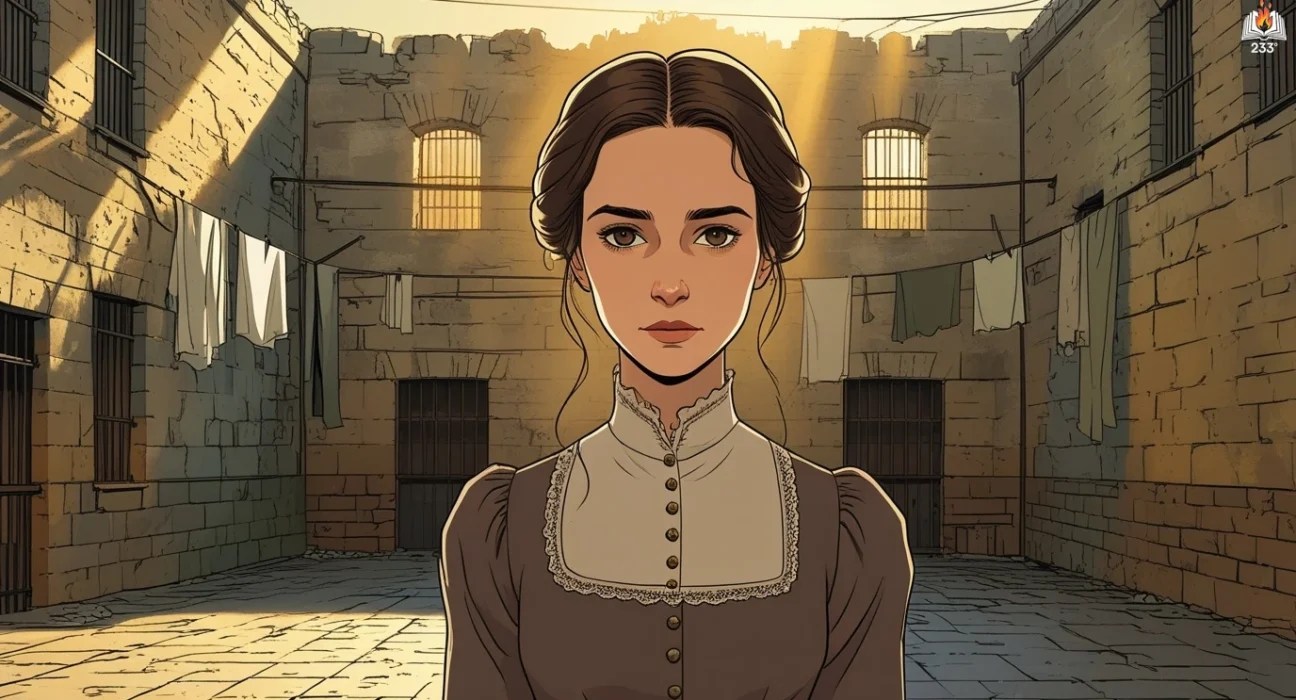
Amy, known affectionately as Little Dorrit, lived two lives. By day, she toiled as a humble seamstress for Mrs. Clennam; by night, she returned to the Marshalsea Prison, where her father, William Dorrit, was a long-term inmate. Amy had been born within its grim walls and had grown up nurturing her father and shielding him from the truth of his captivity. Mr. Dorrit, in his pride, pretended he was a gentleman fallen by cruel fate, and Amy – ever dutiful – never disturbed his illusions.
As Arthur grew closer to Amy and became acquainted with her strange world, he sensed that she carried burdens beyond her years. He resolved to help the Dorrit family and enlisted the aid of Mr. Pancks, a snorting, eccentric rent-collector with a nose for buried truths. Their investigation uncovered a hidden inheritance – a forgotten claim that made Mr. Dorrit suddenly, astonishingly, wealthy.
Wealth transformed the Dorrits. With money came respectability, and with respectability, a desperate grasping at manners and gentility. William Dorrit, once humbled by prison, now strutted through Europe as a man of means. But the past clung to him like a ghost, and despite the gilded rooms and fine company, he remained a prisoner in spirit. His brother Frederick, a frail musician, seemed the only member of the family untouched by pride.
Amy, despite the riches, remained unchanged. Her soul did not bend to fashion or artifice. She moved like a quiet figure through the noise of her newly elevated family, observing with gentle sorrow how the transformation hardened those she loved. She became more isolated, especially as her father sought to distance himself from all reminders of their imprisoned past – including Amy’s friendship with Arthur.
Meanwhile, Arthur’s own fortunes crumbled. Seeking to invest wisely, he placed his trust in the famed financier Mr. Merdle, whose name was whispered in reverence across drawing rooms and parlors. But Merdle’s wealth was an illusion – a monstrous bubble of lies and deceit. When the truth burst, it dragged countless lives into ruin, including Arthur’s. Bankrupted and betrayed, Arthur found himself cast into the Marshalsea, where fate had begun its long, looping circle.
It was there, among the stones where Amy had once walked in silence, that she returned – this time as a visitor, no longer a child of the jail but a woman whose heart still remembered. She came not in pride, but in love. Arthur, once her protector, was now in need, and she did not flinch. Quietly, with tenderness, she ministered to him as she had once done for her father. Their roles reversed, but their hearts aligned.
Rigaud, now known in London as Blandois, emerged again from the shadows. With him came secrets long buried. He insinuated himself into the household of Mrs. Clennam, seeking leverage for his own gain. But the house itself, like the secrets within it, had grown brittle. In a final confrontation, Mrs. Clennam confessed the truth she had long withheld – that Arthur’s supposed mother was not his mother at all, and that a fortune rightfully belonging to Amy had been denied her. The confession brought the house quite literally to ruin, collapsing upon the weight of its guilt and secrecy. Rigaud perished in its fall, crushed beneath the stones of a house built upon lies.
Out of ruin, something pure emerged. Arthur was freed, not just from debt, but from the fog of his life. And Amy, who had always known the quiet language of love, stood beside him. Their bond, born not of passion but of shared suffering and gentle strength, became the truest wealth either had known. From the noise of society and the empty pursuit of status, they turned away.
The Circumlocution Office remained, of course – that maze of government ineptitude where progress went to die. Dickens’s satire spared no ink in painting its endless inefficiencies. Yet even amid such institutions, there were glimmers of humanity – in Pancks’s bulldog tenacity, in Flora’s babbling kindness, and in John Baptist Cavalletto’s unwavering loyalty to the good-hearted Mr. Meagles.
All around them, people continued to live their lives – some in pretense, some in pride, and some, like Amy and Arthur, in quiet truth. They had both been children of imprisonment – she within stone walls, he within silence and guilt. Yet love, steady and enduring, became their freedom. There was no grand triumph, no trumpet blast, only the hush of understanding between two hearts that had endured and waited, and finally found their rest.
Main Characters
Amy Dorrit (Little Dorrit): The gentle and self-sacrificing heroine of the novel, Amy was born in the Marshalsea debtors’ prison and has spent her life caring for her proud but broken father. Her kindness, humility, and resilience form the emotional backbone of the narrative. Despite her meekness, Amy possesses inner strength and moral clarity, often serving as the quiet conscience in a corrupt world.
Arthur Clennam: Returning to England after years abroad, Arthur is a middle-aged man burdened by guilt and unresolved family mysteries. He becomes a friend and benefactor to the Dorrits, and his gradual awakening to love, injustice, and his own purpose makes him one of Dickens’s most introspective and morally steadfast protagonists.
William Dorrit (The Father of the Marshalsea): Amy’s father, long imprisoned for debt, is a proud and delusional man who clings to a sense of gentility despite his fallen circumstances. When he unexpectedly inherits wealth, his transformation into a pompous gentleman exposes the absurdities and dangers of social pretension.
Mr. Merdle: A wealthy financier whose name becomes synonymous with fraudulent investment schemes. Merdle is Dickens’s chilling embodiment of economic speculation and the cult of wealth, whose inevitable downfall devastates many lives.
Flora Finching: A verbose and comically sentimental woman who once had a romantic history with Arthur. Though somewhat absurd, Flora’s warm heart and comical resilience offer a counterpoint to the novel’s darker elements.
Rigaud (also known as Blandois): A sinister French criminal who insinuates himself into multiple plotlines. Rigaud represents unchecked evil, and his movements through the narrative carry an air of menace and mystery.
Mr. Pancks: An eccentric, snorting rent-collector who aids Arthur in investigating Amy’s background. Pancks is a dynamic character who, despite his unconventional behavior, becomes an unexpected agent of truth and justice.
Mrs. Clennam: Arthur’s cold, secretive mother, confined to a wheelchair and ruled by a rigid sense of religious duty and guilt. Her eventual confession reveals long-buried truths that alter the course of many lives.
Tattycoram: A foundling girl raised by the Meagles family, Tattycoram is passionate and emotionally volatile. Her struggle with resentment and identity highlights themes of repression, class, and belonging.
Theme
Imprisonment (Literal and Metaphorical): The Marshalsea Prison, where Amy is born, is the novel’s central symbol of confinement. Yet Dickens extends this to explore societal, emotional, and moral forms of imprisonment – from Arthur’s familial guilt to Mrs. Clennam’s self-imposed penance.
Bureaucracy and the Circumlocution Office: The fictional Circumlocution Office satirizes government inefficiency and red tape. It mocks the paralysis of institutions meant to serve the public, echoing Dickens’s critique of contemporary British governance.
Wealth and Moral Corruption: Through characters like Merdle and the newly rich Dorrits, Dickens critiques the illusion of respectability that often accompanies wealth. The novel portrays how riches can corrupt identity and erode moral sensibility.
The Illusion of Gentility: The novel frequently skewers the Victorian obsession with class and respectability, revealing how status can be both a mask and a trap, particularly in the transformation of the Dorrit family after acquiring wealth.
Redemption and Forgiveness: Both Arthur and Amy’s journeys underscore the redemptive power of love, patience, and humility. Dickens suggests that true nobility lies not in rank or wealth, but in character and compassion.
Writing Style and Tone
Charles Dickens employs a richly descriptive and episodic narrative style in Little Dorrit, weaving multiple plot threads into a densely layered tapestry. His prose shifts deftly between biting satire and deep emotional introspection, and the omniscient narrator often inserts ironic commentary on society’s follies. Dickens’s sharp caricatures – like those in the Circumlocution Office – are balanced by tender portrayals of characters like Amy and Arthur. His language, while at times elaborate, serves to amplify the absurdities and pathos of Victorian life.
The tone of the novel oscillates between somber reflection and comic absurdity. While Little Dorrit is one of Dickens’s darkest works, particularly in its indictment of institutional failure and social inequality, it also bursts with humor, eccentricity, and hope. The juxtaposition of the cold rigidity of characters like Mrs. Clennam with the warmth and humanity of Amy creates a tonal tension that reflects the novel’s moral concerns. The atmosphere is often claustrophobic, mirroring the imprisoning forces in the characters’ lives, yet Dickens leaves space for light – moments of liberation, forgiveness, and love that offer resolution to the prevailing gloom.
Quotes
Little Dorrit – Charles Dickens (1857) Quotes
“[Credit is a system whereby] a person who can't pay, gets another person who can't pay, to guarantee that he can pay.”
“One always begins to forgive a place as soon as it’s left behind.”
“While the flowers, pale and unreal in the moonlight, floated away upon the river; and thus do greater things that once were in our breasts, and near our hearts, flow from us to the eternal sea.”
“You talk very easily of hours, sir! How long do you suppose, sir, that an hour is to a man who is choking for want of air?”
“Every failure teaches a man something, if he will learn; and you are too sensible a man not to learn from this failure.”
“Be guided only by the healer of the sick, the raiser of the dead, the friend of all who were afflicted and forlorn, the patient Master who shed tears of compassion for our infirmities.”
“Mrs General had no opinions. Her way of forming a mind was to prevent it from forming opinions. She had a little circular set of mental grooves or rails on which she started little trains of other people's opinions, which never overtook one another, and never got anywhere.”
“He never thought that she saw in him what no one else could see. He never thought that in the whole world there were no other eyes that looked upon him with the same light and strength as hers.”
“...a sea to intensely blue to be looked at, and a sky of purple, set with one great flaming jewel of fire...”
“We must have humbug, we all like humbug, we couldn't get on without humbug.”
“When they coughed, they coughed like people accustomed to be forgotten on doorsteps and in draughty passages, waiting for answers to letters in faded ink . . .”
“You can't make a head and brains out of a brass knob with nothing in it. You couldn't do it when your uncle George was living much less when he's dead.”
“A commission of haberdashers could alone have reported what the rest of her poor dress was made of, but it had a strong general resemblance to seaweed, with here and there a gigantic tea-leaf. Her shawl looked particularly like a tea-leaf after long infusion.”
“In our course through life we shall meet the people who are coming to meet us, from many strange places and by many strange roads,' was the composed reply; 'and what it is set to us to do to them, and what it is set to them to do to us, will all be done.”
“I am self-contained and self-reliant; your opinion is nothing to me; I have no interest in you, care nothing for you, and see and hear you with indifference.”
“It was an instinctive testimony to Little Dorrit's worth and difference from all the rest, that the poor young fellow honoured and loved her for being simply what she was.”
“He was a dreamer in such wise, because he was a man who had, deep-rooted in his nature, a belief in all the gentle and good things his life had been without.”
“What the mud had been doing with itself, or where it came from, who could say? But it seemed to collect in a moment, as a crowd will, and in five minutes to have splashed all the sons and daughters of Adam.”
“I am unfortunate in using a word which may convey a meaning—and evidently does—quite opposite to my intention.”
“None of us clearly know to whom or to what we are indebted in this wise, until some marked stop in the whirling wheel of life brings the right perception with it.”
We hope this summary has sparked your interest and would appreciate you following Celsius 233 on social media:
There’s a treasure trove of other fascinating book summaries waiting for you. Check out our collection of stories that inspire, thrill, and provoke thought, just like this one by checking out the Book Shelf or the Library
Remember, while our summaries capture the essence, they can never replace the full experience of reading the book. If this summary intrigued you, consider diving into the complete story – buy the book and immerse yourself in the author’s original work.
If you want to request a book summary, click here.
When Saurabh is not working/watching football/reading books/traveling, you can reach him via Twitter/X, LinkedIn, or Threads
Restart reading!


