

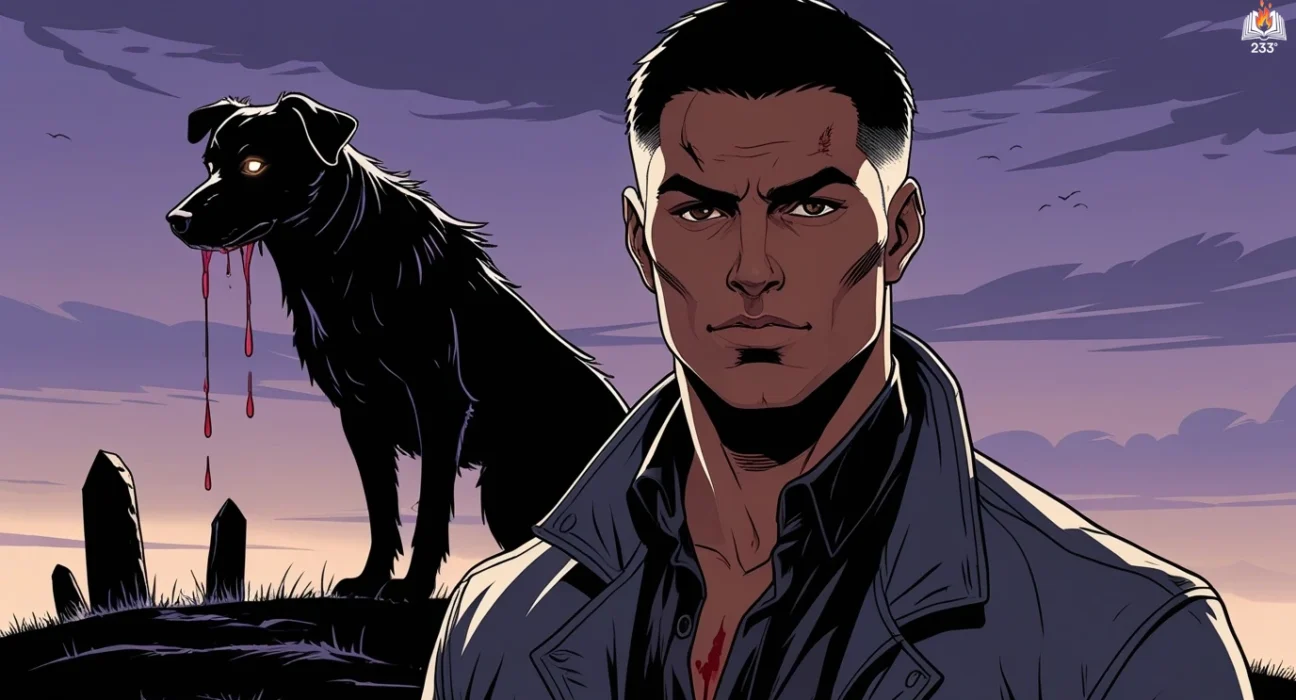
Black Dog by Neil Gaiman, published in 2016, is a haunting novella featuring Shadow Moon, the enigmatic protagonist from Gaiman’s celebrated novel American Gods. This story, set in the moody and mystical English countryside, delves into folklore, psychological trauma, and the supernatural. Drawing upon ancient mythologies and local legends, it stands as a dark meditation on memory, loss, and the predatory nature of depression – represented by the eponymous Black Dog. As part of the American Gods series, Black Dog acts as a coda that deepens Shadow’s character arc and explores new thematic terrain.
Plot Summary
The rain had followed Shadow across the sea, settling with him into the English countryside like an old companion. It drenched the stone paths and curled around the bones of ancient hills, whispering in old tongues. When he stepped into the village pub, the warmth was deceptive. Dogs sprawled on worn rugs. Locals nursed pints and tales. He felt the weight of their eyes, the hidden conversations beneath their words. It wasn’t long before he heard of the Black Dog – a beast of folklore, and perhaps more.
He called himself a tourist, but he was something else, something unstated. Shadow Moon had walked far, carrying a silence inside him, something the English seemed to understand. He met Moira Callanish and Oliver Bierce that night, both locals, both generous, both offering more than just hospitality. They invited him home through the storm, past a gibbet tree and down Shuck’s Lane, where the black dog was said to follow those doomed to die.
Their cottage was warm and old. The kind of place where tea meant comfort and silence was something sacred. But even in its quiet heart, there were shadows. Oliver collapsed in the storm. Narcolepsy, said Moira. But the fear in her eyes betrayed something deeper. He muttered of a dog that had followed him home. Something had begun to stir.
In the days that followed, Shadow stayed. He fetched medicine, shared tea, walked the green hills. The silence grew heavier, not from grief but from something older and unnamed. There was talk of cats buried in walls, drystone circles and doorways into the underworld. A blackened mummified cat stared out from behind glass in the pub, its gaze heavy with anger and warning.
He met Cassie Burglass on one of those hills. She was sketching the landscape, confident and enigmatic, with a green sweater and wind-chapped cheeks. There was warmth in her voice and a sadness behind her smile. She invited him closer, kissed him with cold lips, and asked if he would stay. The place, she warned, clung to you.
Shadow didn’t know then that Cassie had vanished years ago. Moira had loved her once, and Oliver had betrayed her. The pain of it, buried like stone beneath turf, had never healed. Now Cassie walked the hills again, or something wearing her shape did, speaking of old gateways and darker things that moved beneath the land. The local folk didn’t remember her. The pub’s regulars had no memory of the woman who’d shared their beer just nights before.
There were cats too. Not just local strays, but a multitude. Pale-eyed, silent, purposeful. They watched from the hedgerows, slipped through the dusk, and stared with knowing eyes. Once, they surrounded Shadow and Cassie on the hillside, and she fled into the bracken. They weren’t her cats. They were something else’s. Something older, perhaps remembering their long-dead kin mummified and shipped to this soil to feed England’s crops.
Oliver was unraveling. Shadow found him in the bathroom, bloodied and muttering, the old blade from a safety razor clutched in his hand. He spoke of feeding the dog, making friends with it. Not a metaphor. A thing. A presence that demanded tribute.
Moira tried to carry on, brushing away the fear. But the walls of the cottage felt smaller, tighter. The air had the stillness of a held breath. The kind that waits for something to shatter. Shadow was readying to leave when Oliver slipped into the night. Shadow followed him through the fields and up the hill to the place Cassie had drawn – a hollow in the earth, lined with stones, the Gateway to Hell.
Oliver was waiting there. He spoke softly, like he always did. Of sacrifices and forgotten gods. Of old religions that predated stone circles. He said the beast was part of him now. That the hill had claimed Cassie and would now claim Shadow too. She had been sealed into the stones, her body bricked into the wall, her spirit lingering, waiting.
Oliver began to rebuild the wall, stone by stone. The black dog appeared, its eyes glowing like fungus, its body too large to be real. It lunged and tore into Shadow’s arm. Pain like fire, but worse was the fear – unnatural, paralyzing, not his own. He stumbled, wounded, into the niche behind the wall, beside Cassie’s corpse.
The stones rose higher.
Inside that tight space, Cassie’s voice came to him. Another voice followed, musical and wild. Bast. The old Egyptian goddess of cats. She whispered of power, of who Shadow was, and why he could not die here. Not in this place, not like this. He remembered her touch, her claws. The cats were hers. They had come.
Outside, the black dog snarled, a thing born not of flesh but of mind, of guilt and grief, of ancient hunger. Shadow kicked the wall down. The beast leapt again, but this time, he did not flinch. The cats fell upon it – spectral, ancient, furious. Their claws tore into its illusions. Their fangs snapped at its power.
The dog howled and lunged toward Oliver. Its form blurred, then merged. The beast disappeared into the man’s body like water into a cracked cup. Oliver convulsed and collapsed.
The dawn broke across the hill.
Shadow sat among the rubble, bleeding and shaking. He watched the cats vanish into the long grass, shadows returned to shadows. Oliver lay unconscious, the dog quiet for now. There were no gods here that would explain things, no rituals that made sense. Only stones and silence, and a man who had killed and tried to forget.
Back in the kitchen, the mugs still smelled of tea. Moira searched for her garden shears atop the fridge. There would be no more talk of Cassie, not from Oliver. But Moira’s face carried the truth. She had known the pain, the betrayal, the silence.
Shadow would leave soon. No one was waiting for him. He had always been moving. But before he did, he walked once more past the gibbet tree, down the lane where the rain once whispered, and the black dog had first followed them home.
Main Characters
- Shadow Moon – A quiet, brooding American traveler whose inner landscape is as storm-laden as the British countryside he walks through. Shadow is introspective and reserved, burdened by grief and an undefined search for meaning. In this story, he serves as both an outsider and a subtle catalyst in a remote village plagued by invisible threats. His internal strength, compassion, and stoic demeanor allow him to engage with the supernatural without succumbing to it.
- Oliver Bierce – A retired Londoner living with his partner in the countryside. Oliver is eccentric, intelligent, and deeply troubled. Though charming on the surface, he hides a dark history and harbors a terrible secret tied to the hill and the black dog. His descent into psychological horror represents the destructive grip of guilt and repression.
- Moira Callanish – Oliver’s partner, dignified and composed, yet emotionally threadbare. A woman who once loved passionately, now stands as a protector and silent sufferer. Moira’s strength lies in her practical compassion and emotional restraint, but she too is haunted by the past.
- Cassie Burglass – An artist and former lover of Moira, Cassie is a spectral presence who seems both real and unreal. Her tragic story and unresolved fate are central to the novella’s emotional and supernatural undercurrents. She symbolizes unresolved love, betrayal, and the yearning to be seen.
- The Black Dog – Both a literal and metaphorical entity, it is the looming shadow of depression, guilt, and ancient dread. Drawing from British folklore, the beast is less a character and more a manifestation of psychological rot and primordial fear.
Theme
- Depression as a Living Entity – Central to the narrative is the metaphor of the Black Dog, embodying the inescapable weight of mental illness. It follows, attacks, and even possesses – a predator not only of the body but of the soul. Gaiman uses folklore to personify depression in visceral, terrifying ways.
- Folklore and Ancient Belief – The story pulses with mythic resonance – from drystone walls and gibbet trees to the Gateway to Hell. These elements are not merely decorative but serve as conduits to explore how ancient beliefs continue to shape and haunt the modern psyche.
- Memory and Guilt – Characters are trapped not only by their present circumstances but by what they cannot forget. Oliver’s guilt becomes a festering wound, while Shadow’s memories of love and loss color his every action. Memory here is both a curse and a guide.
- The Unseen and the Supernatural – Gaiman blurs the lines between reality and myth. Ghosts, gods, and eldritch creatures inhabit the edges of the narrative, never explained, never entirely visible. They are the manifestations of emotional truths – unseen but always felt.
- Sacrifice and Rebirth – The story navigates cycles of destruction and renewal. Shadow’s literal and symbolic journey through death and rebirth mirrors ancient rites, reinforcing the timelessness of these myths and the transformation they demand.
Writing Style and Tone
Neil Gaiman’s writing in Black Dog is quiet, brooding, and richly textured. His prose is evocative and lean, filled with atmospheric detail that immerses readers in the damp, eldritch English countryside. He interweaves myth with the mundane, rendering the most innocuous conversations – in a pub or around a kitchen table – fraught with tension and significance. The dialogue is naturalistic but often layered with double meanings and quiet foreboding.
Gaiman’s tone throughout is melancholic and suspenseful, with a lingering sense of dread. He employs subtle horror, not through gore or spectacle, but through suggestion and psychological unease. The pacing is slow and deliberate, creating an almost meditative rhythm that mirrors Shadow’s introspection and the creeping inevitability of the story’s climax. The blend of literary fiction and folklore creates a tone that feels both ancient and immediate, a dark fable for the modern age.
Quotes
Black Dog – Neil Gaiman (2016) Quotes
“handwritten piece of paper taped to the wall by the bar telling customers not to order a lager ‘as a punch in the face often offends’.”
We hope this summary has sparked your interest and would appreciate you following Celsius 233 on social media:
There’s a treasure trove of other fascinating book summaries waiting for you. Check out our collection of stories that inspire, thrill, and provoke thought, just like this one by checking out the Book Shelf or the Library
Remember, while our summaries capture the essence, they can never replace the full experience of reading the book. If this summary intrigued you, consider diving into the complete story – buy the book and immerse yourself in the author’s original work.
If you want to request a book summary, click here.
When Saurabh is not working/watching football/reading books/traveling, you can reach him via Twitter/X, LinkedIn, or Threads
Restart reading!


