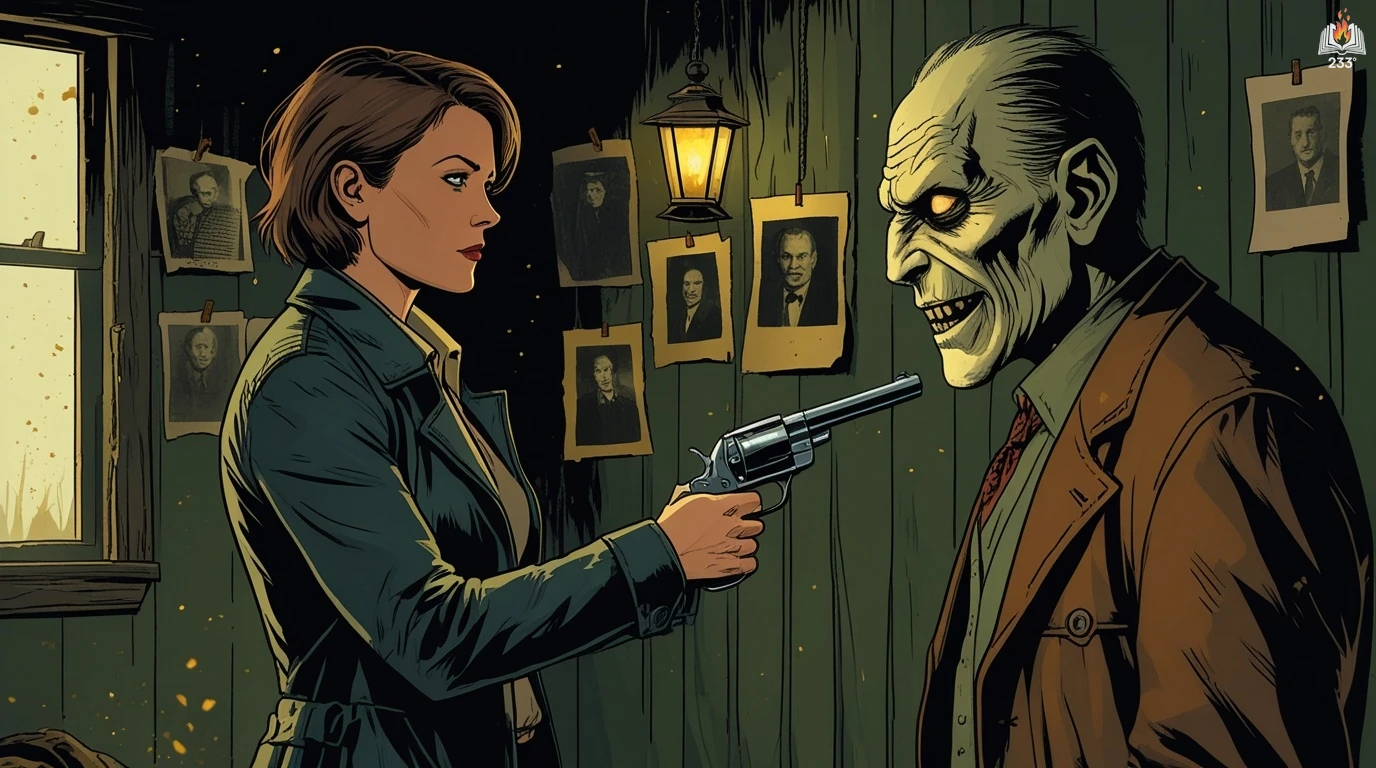
The Narrow Road Between Desires by Patrick Rothfuss, published in 2023, is a beautifully expanded and richly illustrated tale set within the world of The Kingkiller Chronicle, Rothfuss’s acclaimed fantasy series. Originally published as a shorter version under the title The Lightning Tree, this reimagined story delves deeply into the life of Bast, a central yet enigmatic character from the series. Though framed as a standalone narrative, it is deeply woven into the mythos and atmosphere of Rothfuss’s broader world, providing longtime readers with fresh layers of context and emotional resonance.
Plot Summary
In the quiet village of Newarre, beneath the dawn-touched sky, Bast slips through the back door of the Waystone Inn, his movements a ballet of silence and precision. He is not merely sneaking out – he is fleeing tedium, chasing mischief, answering a summons only he can hear. Bast is fae, but not faerie in the way of stories. He is sly, wild, and lovely, and he walks among mortals like a secret given legs. Every day, while his master Kvothe tends the inn, Bast tends to his own rituals – favors traded for secrets, lies spun to shield the truth, and mysteries unspooled like thread from a golden spindle.
He sets his stage at the lightning tree – a splintered trunk etched with the burn of an old storm, half shrine and half stage. Children come to him with requests like prayers. A baker’s daughter wants a lie to hide a kitchen accident. Bast gives her one, fragrant with false memory and salted with fear. Another boy, cheeks raw from a recent punch, asks for revenge. Bast teaches him how to make his brother’s shoes reek with ancient piss – not all at once, but slowly, subtly, until everyone notices but no one understands. Then comes the Alard boy, Kale, with maps and messages. Among his offerings is a name Bast had hoped not to hear – Rike.
Rike is trouble. The sort of trouble that comes quiet and festers, like rot beneath floorboards. The message is simple: Rike wants to meet. Bast sends back a refusal wrapped in silence. But the day turns, and with it, the rhythm of things shifts.
Bast meanders through Newarre’s fields and hollows, following whims and small magics. He plays shepherd’s pipes until a golden-haired boy sheds his shirt beneath a tree. Bast watches with the ache of beauty caught in a trap, a fae creature hiding hunger beneath charm. By the time he returns to the lightning tree, there are no children waiting, and so he casts embrils – tokens carved from bone and clay and horn – drawing signs and secrets from their patterns. He sees a fox and frowns. He sees more and sighs. The magic is restless today, taut as a wire, strange as a tune half-remembered.
Then comes Kostrel.
Sharp-eyed and whip-smart, the boy is Bast’s favorite sparring partner. He brings three things: a gift, a message, and a secret. The gift is a small brass token, bright as sunlight and shaped like a tear. Bast touches it, and the world contracts. Color fades. Breath leaves him. The coin bites deeper than its weight would suggest – it is an old thing, a binding thing. Though it comes from Rike, carried through innocent hands, Bast is caught. The rules are not his to make, and now they close around him like a snare.
Still, the bargain must be honored. The secret Kostrel trades is a good one – the bathing place of Emberlee, one of the town’s prettiest girls. But what the boy truly wants is knowledge. He asks about the Fae. Not in simple questions, but in riddles wearing the shape of inquiries. What are they like? What magics do they wield? Can they lie? Bast answers with reluctance wrapped in poetry, naming glamourie and grammarie – the twin crafts of seeming and being. One makes a thing appear changed, the other makes it so.
Kostrel listens with wide eyes, but his mind is not gentle. It probes, it pries, it presses. Bast offers metaphors, stories, glimpses. A shadow that conceals becomes a cloak. A woman who is merely beautiful becomes the center of all desire. Bast tries to keep the boy in the shallows, but the tide pulls them both deeper.
When Kostrel corners him with a final question – has Bast ever met one of the Fae – Bast answers with the grin of a fox who has stolen the moon. Yes, he has. That counts as the boy’s third question, and the game is over. Kostrel storms off, insulted but not truly wounded. Bast laughs, light but wary. The boy is dangerous, bright as broken glass. Bast cannot hurt him, not in any way that would not hurt himself more. But he knows how quickly fondness can turn fatal when secrets are heavy and truth cuts too deep.
The day grows hotter. Bast rushes to a secluded dell to wash. There, by the water, he scrubs the sweat from his skin and the unease from his bones. Even the washing feels like a rite, a way of shedding the weight of the penance piece he now carries. The token gleams like a curse wrapped in charity. Rike means something by it, though Bast cannot yet see what.
Later, Bast visits the market. He trades riddles with shopkeepers and accepts gossip in exchange for sly smiles. He meets a young girl with a question wrapped in fear. Her mother is dying. She wants to know if Bast can fix it. He cannot. Not without price, not without risk. And yet, he tells her he will try. The weight of that promise hangs in the air like storm-humid silence.
As the sun dips low, Bast returns to the tree, his steps slower now. Children trickle in again. There are more secrets, more trades. A tale about a ghost in the well. A song sung off-key in exchange for a sweet. Then a shadow moves wrong, and Bast senses it before he sees it. Rike is near. Not in body, perhaps, but in reach. The boy has found a way to tether Bast, even if only lightly.
Bast draws a breath and feels the coin’s weight again, not in his hand but in his soul. The road narrows, as it always does. He is not free. He is not caught. He is both. As night draws close, he curls again beneath the lightning tree. The wind hums low in the branches. The secrets of the day lie tucked into the folds of his coat, and the world spins on, quiet and sharp and strange.
Main Characters
Bast – The heart of the story, Bast is a charming, cunning, and complex fae creature living in the mortal world under the watchful eye of his master, Kvothe. Known for his beauty, wit, and mischief, Bast walks the line between predator and protector. He trades secrets and favors with children, weaves magic through lies and truth, and carries the weight of obligations—both magical and moral—that gradually unearth his deeper conflicts. Bast is not just a whimsical trickster; he is a creature of profound duality, yearning for connection while preserving ancient traditions and secrets.
Kostrel – A clever, sharp-tongued village boy and one of Bast’s most formidable young clients. He is both innocent and dangerous, wielding his curiosity like a weapon. Kostrel’s quick mind and genuine charm make him a kindred spirit to Bast, and their exchanges reveal not only lore about the Fae but also Bast’s vulnerabilities. Their dynamic evolves from playful banter to something deeper and more threatening as secrets are traded and truths revealed.
Rike – A shadowy and mostly unseen antagonist, Rike is a child whose presence looms over the story like a distant thunderclap. Through other characters’ mentions and the subtle manipulation he enacts via magical tokens, Rike becomes a figure of danger, hinting at darker motives and an ongoing history with Bast that is both complicated and potentially explosive.
Kvothe (Reshi) – Though largely in the background, Kvothe remains a silent gravitational force in Bast’s world. As Bast’s master and protector, his presence shapes Bast’s decisions and anchors the magical elements in a sense of grounded reality and responsibility.
Theme
Desire and Restraint – True to its title, the story navigates the narrow road between what is desired and what must be denied. Bast, who lives in a constant tension between indulgence and responsibility, becomes the embodiment of this struggle. Whether it’s his hunger for beauty, connection, or truth, every longing is curbed by consequences, and every temptation carries a cost.
Truth, Lies, and the Power of Story – The narrative thrives on the power of storytelling. Bast deals in lies that protect, stories that enchant, and truths that wound. This blurring of fiction and fact isn’t just a theme – it is the language of his world. Through bargains and tales, Rothfuss explores how stories shape identity, belief, and fate.
Obligation and Freedom – Bast’s interactions—particularly his binding by a deceptively innocent gift—underscore the fae concept of obligation, where even the smallest kindness or transaction has weight. The conflict between freedom and duty drives Bast’s choices, revealing how every gift and every favor can become a shackle.
Childhood and Transformation – The children of Newarre aren’t mere background characters. They are catalysts, confessors, and sometimes antagonists. Their guileless questions and secret trades push Bast into revealing parts of himself he’d rather keep hidden. This motif serves as a metaphor for the transformation that occurs when innocence meets the world’s hidden dangers.
Writing Style and Tone
Patrick Rothfuss’s writing in The Narrow Road Between Desires is lush, lyrical, and laden with rhythm and poetry. He writes with an almost musical cadence that brings even mundane village life to shimmering life. His prose often veers into the poetic, using metaphor and sensory detail to conjure a deeply immersive atmosphere. Rothfuss wields language like a spell – softening the boundaries between reality and faerie with words that both charm and chill. Conversations are written with theatrical flair, making every line of dialogue ring with subtext and emotional resonance.
The tone of the book is whimsical yet melancholic, playful yet ominous. Like Bast himself, the story shifts between lighthearted mischief and aching longing. There’s a constant sense of something beautiful and broken lying just beneath the surface. Rothfuss balances the warmth of pastoral life with the cold pull of fae magic, blending comfort and danger in a way that mirrors the central character’s own divided nature. His mastery lies in making the reader feel both enchanted and uneasy – as though any moment of joy could collapse into shadow.
Quotes
The Narrow Road Between Desires – Patrick Rothfuss (2023) Quotes
“Laughter was the true applause you offered to the world for being beautiful.”
“Bast knew true silence was unnatural. To a careful ear, silence sounded like a knife in the dark.”
“A little sweetness is all any of us have sometimes. It’s always worth it. Even if it takes some work.”
“I hope you know this truth down in the middle of your bones: You are amazing. You are fantastic. You are beautiful and brave and full of love. You are as lovely as the moon.”
“He blew across the reeds and cocked his head at their sweet discord. His bright knife flashed, and he tested the reeds again. This time they sounded almost true, which made the discord far more grating. There was a lesson there.”
“Bows and dresses don’t matter much,” he said. “She decided she’s a girl, so she’s a girl.”
“Some have a tender love for nature’s wild. Some are drawn to mortal hearth and home. Some find a secret place and stay, while others cannot help but roam.”
We hope this summary has sparked your interest and would appreciate you following Celsius 233 on social media:
There’s a treasure trove of other fascinating book summaries waiting for you. Check out our collection of stories that inspire, thrill, and provoke thought, just like this one by checking out the Book Shelf or the Library
Remember, while our summaries capture the essence, they can never replace the full experience of reading the book. If this summary intrigued you, consider diving into the complete story – buy the book and immerse yourself in the author’s original work.
If you want to request a book summary, click here.
When Saurabh is not working/watching football/reading books/traveling, you can reach him via Twitter/X, LinkedIn, or Threads
Restart reading!