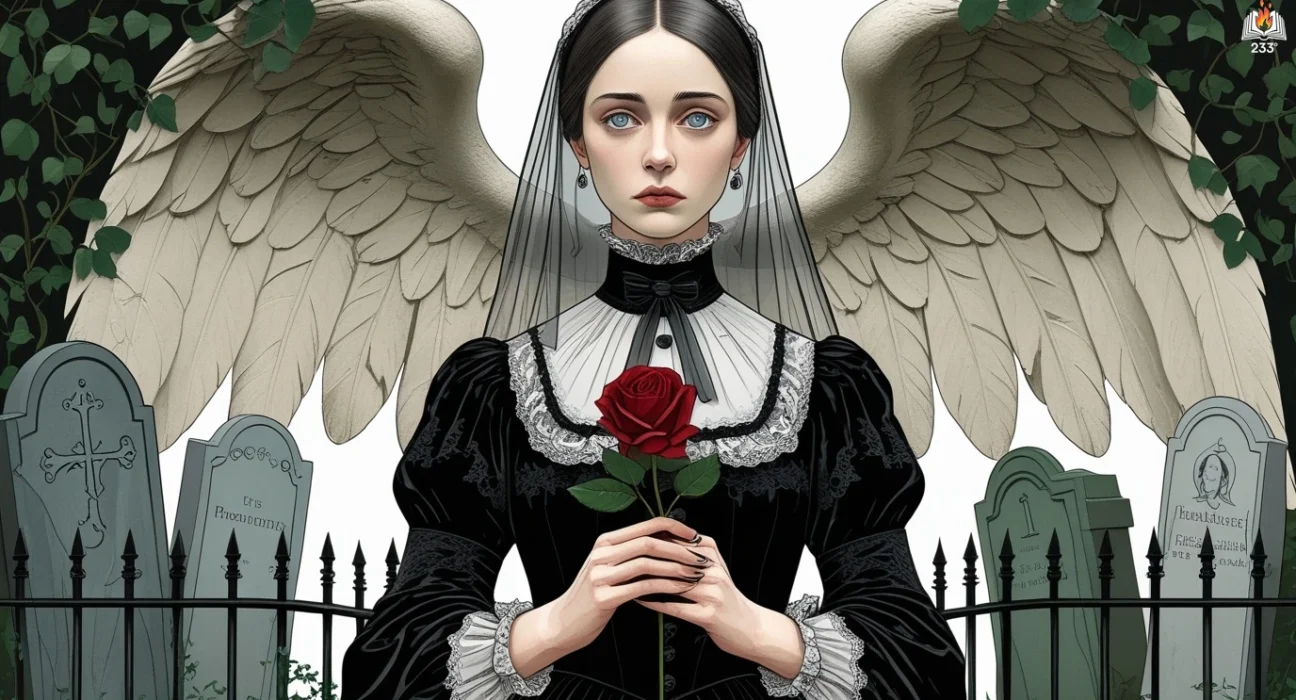
Falling Angels by Tracy Chevalier, published in 2001, is a rich historical novel set in Edwardian London at the turn of the 20th century. Known for her evocative period fiction, Chevalier follows the lives of two neighboring families, the Colemans and the Waterhouses, whose graves lie side by side in a London cemetery. Their young daughters’ blossoming friendship becomes the central thread in a story of class division, societal expectations, grief, rebellion, and change. The backdrop of funerary rituals and suffrage protests serves as a stage for the personal dramas and evolving roles of women in a rapidly modernizing society.
Plot Summary
In January 1901, as Queen Victoria’s death looms and the new century dawns, two London families find themselves side by side – not just in life, but in death. Their graves in Highgate Cemetery sit adjacent, sparking an unlikely connection between the Colemans and the Waterhouses. Kitty Coleman, spirited and restless, sees nothing but constraint in her respectable life. Her husband Richard clings to propriety, and their daughter Maude, intelligent and quietly curious, watches as tension weaves through their home. The Waterhouses – Gertrude, Albert, and their daughters Lavinia and Ivy May – embrace tradition. Gertrude is pious and proper, her sense of morality heavy with Victorian sensibility, while Lavinia, dramatic and eager to perform grief, adores the rituals of mourning.
When Maude and Lavinia meet beside their respective family graves, a fierce bond ignites. Though opposites in temperament, they are drawn to one another, both enchanted by the cemetery and the strange boy who lives among the dead. Simon Field, son of a gravedigger, knows every headstone, every angel, every mound of earth. He scratches skulls and crossbones onto the stone, a quiet rebellion against the solemnity that surrounds him. Dirty and poor, Simon startles the girls, but he also fascinates them. His bluntness, his truth, makes death real. And real things are rare in their world.
As their friendship deepens, Maude and Lavinia make the cemetery their playground. They flit between angels and obelisks, whisper secrets between rows of monuments. Their bond becomes an anchor as their families begin to change. Kitty, disillusioned by her marriage and the stifling decorum of upper-class life, finds herself drawn to the suffragette movement. The rallies, the fire, the voices of women demanding more than domestic servitude spark a forgotten light in her. She joins their ranks quietly at first, but her defiance grows bolder. Her household feels the shift. Richard, baffled by her distance and irreverence, retreats further into his work, into silence. Maude, watching closely, begins to understand that women can live more than one kind of life.
Next door, Gertrude clutches to structure. Mourning clothes, the correct dress lengths, the right words at funerals – these are her tools of order. She disapproves of Kitty’s colors, her independence, her lack of reverence for the Queen. Lavinia mirrors her mother’s obsession with appearances, though hers is more theatrical. She cries at old graves, insists on being called Lavinia instead of Livy, and dreams of dying beautifully, carried away by marble-winged angels.
When the Waterhouses move into the house behind the Colemans, the two families become impossible to avoid. Kitty and Gertrude greet each other with strained civility, while Maude and Lavinia rejoice in their proximity. From bedroom windows and over back fences, their friendship blossoms. Ivy May, Lavinia’s younger sister, tags along, more thoughtful than anyone gives her credit for. Together the girls venture deeper into the cemetery, where Simon continues his work, one grave at a time.
One day, Simon is left behind, accidentally buried alive beneath the green funeral carpets and prepared soil. His quiet endurance in the grave’s cold belly marks him. It becomes a kind of death he survives. When he finally emerges, caked in mud and trembling, the world feels more brittle. He digs with his father still, but something has shifted – in him, and in the way others look at him.
As Kitty becomes more involved in the suffrage movement, she distances herself from domestic duties. She writes for the papers under a pseudonym, attends rallies, and eventually is arrested. Her husband’s shame is immense, and Maude is sent to boarding school. The household begins to unravel under the weight of Kitty’s refusal to remain still. At school, Maude continues to write to Lavinia, but something between them begins to fray. Lavinia, alone and uncertain, becomes more self-absorbed, more desperate for attention, while Maude grows increasingly aware of the divide between them.
When Kitty returns from prison, she is thinner, worn, but luminous in her new purpose. Her estrangement from Richard is complete, and they live like quiet strangers in the same house. Maude returns from school changed. She has seen the outlines of rebellion and independence in her mother and starts to shed the skin of girlhood. Her bond with Simon deepens, though it is tentative and silent, born more of understanding than words.
Lavinia, meanwhile, spirals inward. She becomes sickly, pale with effort, consumed by the rituals of grief and performance. Her obsession with martyrdom – with beauty in death – intensifies. When Ivy May dies suddenly from diphtheria, it is as though Lavinia finally finds the grief she has longed for. She dons mourning as armor, but her sorrow is real, raw. For the first time, her performative veil slips. The loss haunts the Waterhouse home, silent and heavy.
Maude tries to comfort her friend, but they no longer understand each other. Lavinia clings to shadows, to angels and black lace. Maude, restless with the weight of reality, begins to imagine a life beyond the cemetery, beyond London. She sees in Simon not just companionship, but freedom – a boy who digs through the artifice and names what lies beneath. When they kiss for the first time, it is awkward, fleeting, but honest.
Kitty, now fully estranged from her former life, joins a suffragette caravan, leaving Maude and Richard behind. Her farewell is silent. She becomes a name in the papers, a woman on the road, fighting for change. Richard remains, stubborn and bewildered, clinging to the rituals of breakfast and formality. Maude, no longer a child, begins to write, to listen, to walk through the cemetery not as a mourner, but as someone who has lived inside its stories.
Simon continues to dig, his back bent over shovels and earth, but when Maude visits, there is a kind of reverence between them – a shared understanding of loss, of transformation. Lavinia, still fragile, remains in London, forever tied to the angels she once adored. And beneath the ground, beneath urns and cherubs, lie the bones of those who shaped them all, quiet and still beneath the city that never ceases to change.
Main Characters
Maude Coleman: An intelligent and observant girl, Maude is curious, introspective, and less impulsive than her counterpart Lavinia. Her quiet strength lies in her ability to question the norms around her, guided by a mother who herself is beginning to defy expectations. As she matures, Maude increasingly steps into her own identity, embracing complexity and showing compassion for the working-class people often dismissed by others in her social circle.
Lavinia Waterhouse: Lavinia, or Livy, is dramatic, image-conscious, and captivated by Victorian mourning culture. Though imaginative and lively, she is also manipulative and status-driven, often seeking attention through flamboyant displays of grief or emotional performances. Her friendship with Maude reveals a contrast in values that gradually becomes more pronounced as the story progresses.
Kitty Coleman: Maude’s mother, Kitty, is a restless and disillusioned woman trapped in a loveless marriage and mourning the loss of her brother. As a budding suffragette and frustrated intellectual, Kitty longs for a life beyond domesticity. Her transformation over the novel—from a passive participant in social life to an active advocate for women’s rights—is one of the story’s most compelling arcs.
Richard Coleman: Maude’s father, a banker, is conventional and emotionally distant. He is devoted to propriety and appearances but increasingly bewildered by his wife’s emotional detachment and independence. His attempts to maintain order reveal his discomfort with change and inability to comprehend the evolving dynamics within his family.
Gertrude Waterhouse: A pious and proper woman, Gertrude is determined to uphold the values of decorum, grief, and tradition. Though she appears rigid, her character occasionally hints at underlying insecurities about social status and her place in the world, especially when contrasted with the more glamorous Kitty.
Albert Waterhouse: Lavinia’s father, genial and simple, is somewhat henpecked and lives under the shadows of his wife’s ambitions and his daughter’s whims. He is pragmatic and well-meaning, and his awkward interactions with Kitty suggest a deeper frustration with the conventions he follows without questioning.
Simon Field: A gravedigger’s son, Simon provides a link between the worlds of the privileged and the poor. Earthy, candid, and emotionally resilient, Simon becomes a friend to Maude and Lavinia. His vivid descriptions of cemetery work and social realities add texture to the novel, and his experiences offer stark contrast to the sheltered lives of the girls.
Theme
Death and Mourning: The cemetery setting and Victorian funerary customs dominate the novel’s imagery and atmosphere. Characters engage with death in personal and symbolic ways, with some, like Lavinia, romanticizing it, while others, like Simon and Kitty, confront its reality. The juxtaposition of elaborate mourning rituals with raw grief underscores the performative and sometimes oppressive nature of social conventions.
Class and Social Division: Chevalier deftly explores the rigid Edwardian class system through the interactions between the Coleman and Waterhouse families and their engagement with Simon. Differences in wealth, education, and worldview create tensions that play out in both subtle slights and overt judgments, illuminating the persistent boundaries between social classes.
Female Agency and Suffrage: A central theme is the awakening of female consciousness. Kitty’s involvement with the suffragette movement contrasts sharply with Gertrude’s adherence to traditional roles, reflecting the broader societal rift between old-world gender norms and the emerging feminist voice. Maude, observing both women, begins to forge her own understanding of womanhood.
Friendship and Betrayal: The bond between Maude and Lavinia is rich and complex. What begins as innocent camaraderie grows into a nuanced relationship shaped by jealousy, loyalty, and the pressures of family expectations. Their friendship mirrors the larger changes around them – as they grow, so does the distance between who they are and who they are expected to be.
Change and Modernity: Set at the dawn of the 20th century, the novel portrays a world in flux. From the death of Queen Victoria to the rise of women’s rights and the disillusionment with outdated social mores, Falling Angels captures the cultural and emotional shifts that mark the beginning of the modern era.
Writing Style and Tone
Tracy Chevalier employs a polyphonic narrative, using short, alternating first-person chapters to present the perspectives of various characters, including adults, children, and even a gravedigger. This mosaic structure allows readers to inhabit a rich psychological landscape, where misunderstandings, contradictions, and secrets are exposed through each voice. The style is intimate and immediate, drawing the reader into the characters’ internal worlds without resorting to exposition-heavy narration.
Chevalier’s prose is spare yet evocative, balancing lyrical observations with sharp social commentary. Her tone varies with each narrator – Maude’s is thoughtful and precise, Lavinia’s melodramatic and excitable, Simon’s raw and unfiltered. This variation lends authenticity and depth to the story, enhancing its emotional resonance. The overall tone is melancholic but wry, sensitive to the absurdities of rigid traditions while deeply empathetic toward the characters struggling within them.
Quotes
Falling Angels – Tracy Chevalier (2001) Quotes
“Over his shoulder I saw a star fall. It was me.”
“I have spent my life waiting for something to happen,’ she said. ‘And I have come to understand that nothing will. Or it already has, and I blinked during that moment and it's gone. I don't know which is worse
“I'm going to draw on every grave in the cemetery" he continued. "Why do you draw them?" I asked. "Why a skull and crossbones?" "Reminds you what's underneath, don't it? It's all bones down there, whatever you may put on the grave.”
“I stood by the fire, everyone around me so cheerful, and thought what an odd creature I am – even I know that. Too much space and I’m frightened, too little and I’m frightened. There is indeed no comfortable place for me – I am too near the fire or too far away. Behind”
We hope this summary has sparked your interest and would appreciate you following Celsius 233 on social media:
There’s a treasure trove of other fascinating book summaries waiting for you. Check out our collection of stories that inspire, thrill, and provoke thought, just like this one by checking out the Book Shelf or the Library
Remember, while our summaries capture the essence, they can never replace the full experience of reading the book. If this summary intrigued you, consider diving into the complete story – buy the book and immerse yourself in the author’s original work.
If you want to request a book summary, click here.
When Saurabh is not working/watching football/reading books/traveling, you can reach him via Twitter/X, LinkedIn, or Threads
Restart reading!